If your face is shiny by 10 a.m., your makeup slides off by lunch, and you’ve tried “oil-free” everything with no real change — the problem usually isn’t your skin. It’s the routine.
Most oily skin advice falls into one of two traps. Either it tells you to strip everything off your face with harsh cleansers and alcohol-based toners (which backfires almost every time), or it’s so vague — “just drink more water” — that it’s useless.
This is a step-by-step routine built specifically around how oily skin actually behaves, plus honest breakdowns for dry and combination skin, since a lot of people assume they’re oily when they’re actually combination, or vice versa. By the end, you’ll know exactly what to do morning and night, which ingredients are doing the heavy lifting, which habits are quietly making things worse, and how your routine should shift with seasons, age, and even your cycle.
Why Oily Skin Gets Oily (It’s Not Just Genetics)
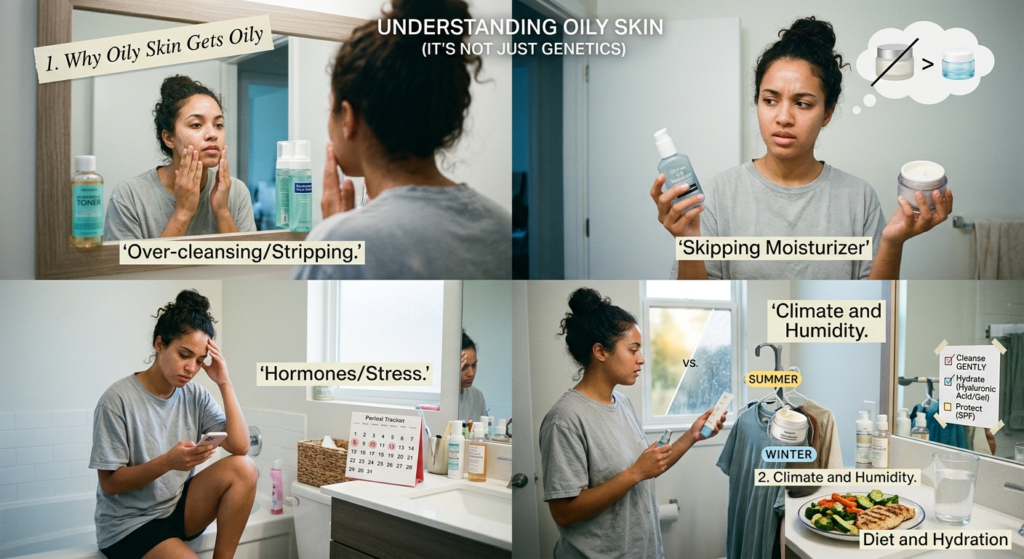
Oil production is controlled by your sebaceous glands, and several things ramp them up beyond genetics alone:
- Over-cleansing or over-exfoliating. Strip your skin’s natural barrier too often, and it panics and produces even more oil to compensate. This is the single most common mistake people with oily skin make.
- Skipping moisturizer. Sounds backwards, but dehydrated skin often overproduces oil to protect itself. Oily doesn’t mean hydrated — those are two different things.
- Hormonal shifts. Cycle-related, stress-related (cortisol increases oil production), or age-related changes all play a role. Many women notice a predictable oil spike in the week before their period, which is a hormonal pattern, not a routine failure.
- Climate and humidity. The same skin can behave differently in July than in January. A routine that works perfectly in summer can leave you flaky in a dry winter climate, and one built for winter can feel heavy and clogging once humidity rises.
- Product mismatch. Heavy, occlusive creams meant for dry skin will sit on oily skin and clog pores, while gel formulas meant for oily skin can leave dry skin feeling tight and irritated.
- Diet and hydration patterns. This one is often overstated, but high-glycemic diets have been loosely linked to increased sebum production in some studies. It’s not a guaranteed fix, but it’s worth noting if nothing topical seems to move the needle.
Understanding this matters because it changes the goal. You’re not trying to eliminate oil — that’s not possible or healthy, and skin without any oil at all becomes irritated and prone to breakdown. You’re trying to regulate it.
Morning Skin Care Routine for Oily Skin
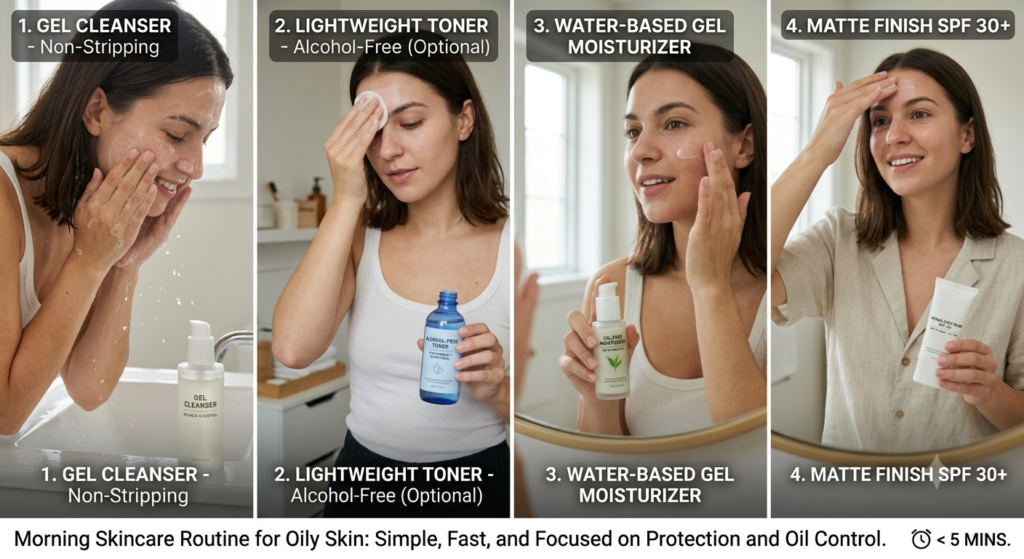
Mornings are about protection and oil control that lasts through the day, not deep treatment. Overloading your morning routine with actives is a common mistake — mornings should be simple, consistent, and fast enough that you’ll actually stick with it.
Step 1: Gel or Foam Cleanser (Not Bar Soap, Not Cream)
Look for a lightweight, non-stripping cleanser. If your face feels tight and squeaky after washing, that’s a sign it’s too harsh — tight skin often overcorrects by producing more oil within hours. A good gel cleanser should leave your skin feeling clean but comfortable, not stripped.
Step 2: Lightweight, Alcohol-Free Toner (Optional)
Skip anything with denatured alcohol high on the ingredient list — it feels satisfying for about 20 minutes, then makes oil production worse. A niacinamide or witch hazel (alcohol-free formulation) toner is a better fit. If your skin already feels balanced without a toner, this step is genuinely optional — it’s not required for a functional routine.
Step 3: Oil-Free, Water-Based Moisturizer
This is the step most people with oily skin skip, and it’s the one that causes the most trouble. A gel-based moisturizer with hyaluronic acid keeps skin balanced without adding shine. If you notice your skin gets oilier an hour after applying moisturizer, you’re likely using one that’s too rich — swap it for a gel texture rather than skipping the step entirely.
Step 4: Broad-Spectrum SPF 30+
Non-negotiable, and this is where product choice really matters for oily skin — a thick, creamy sunscreen will undo everything. Look for “matte finish,” “oil-free,” or gel-based SPF formulas. Mineral sunscreens with zinc oxide can sometimes feel heavier, so if you’ve tried mineral SPF and hated the finish, a lightweight chemical formula might work better for your skin specifically.
Total time: Under 5 minutes. That’s the point — a routine you’ll actually do daily beats a perfect one you abandon after a week.
Night Skin Care Routine for Oily Skin

Nighttime is when you address texture, breakouts, and oil regulation at a deeper level. This is where most of the actual improvement happens, but it’s also where most people overcomplicate things.
Step 1: Double Cleanse (If You Wear Makeup or SPF)
Oil cleanser or micellar water first to break down sunscreen and makeup, then your regular gel cleanser. Skipping this step is a common reason people still see clogged pores despite cleansing every night — one wash often isn’t enough to fully remove SPF, especially the water-resistant formulas.
Step 2: Treatment Step (Alternate, Don’t Stack)
This is where most people overdo it. Pick one active per night, not three:
- Salicylic acid (BHA): Best for blackheads and clogged pores, since it’s oil-soluble and gets into the pore itself. Typically used 2–4 nights a week depending on strength.
- Niacinamide: Regulates oil production over time and calms redness. Gentle enough for nightly use, and one of the few actives that works well alongside almost anything else.
- Retinoid: Improves texture and reduces breakouts long-term, but start at 2–3 nights a week, not daily. Purging (temporary breakouts as skin adjusts) is common in the first 4–6 weeks and isn’t a sign to stop, though it’s worth knowing about in advance so it doesn’t feel like the product is failing.
A realistic weekly pattern: retinoid Monday/Thursday, niacinamide most other nights, salicylic acid spot-treated as needed. Rotating instead of stacking prevents the irritation that leads to more oil production, and it also means you can actually tell which product is responsible when your skin changes — stacking three actives at once makes it impossible to know what’s working.
Step 3: Lightweight Night Moisturizer
Still oil-free, but you can go slightly richer than your morning formula since you’re not layering it under makeup. If your skin feels tight by morning even after moisturizing at night, that’s a sign to size up in richness slightly, not skip the step.
Skin Care Oily Skin Products: What to Actually Look For
Ingredient lists matter more than marketing claims. A product labeled “for oily skin” with coconut oil third on the ingredient list is still going to behave like coconut oil. Here’s a quick reference:
| Look For | Skip or Limit |
|---|---|
| Niacinamide | Coconut oil (high comedogenic rating) |
| Salicylic acid (BHA) | Denatured alcohol as a top-3 ingredient |
| Hyaluronic acid | Heavy petrolatum-based creams |
| Non-comedogenic labels | Fragrance-heavy formulas if you’re breakout-prone |
| Clay (occasional use, 1–2x/week) | Physical scrubs with jagged particles |
| Zinc PCA | Silicone-heavy primers layered daily |
A note on clay masks: they’re genuinely useful for oily skin, but daily use dries out the surface while your glands keep producing oil underneath — you end up dehydrated and shiny. Once or twice a week is the sweet spot. If your clay mask leaves your skin looking shinier a few hours after use, that’s usually a sign it’s being used too often, triggering a rebound oil response.
A note on “oil-free” labeling: it’s not a regulated term, meaning brands can use it loosely. Always check the actual ingredient list rather than trusting the front-of-bottle claim alone.
Common Mistakes People With Oily Skin Make
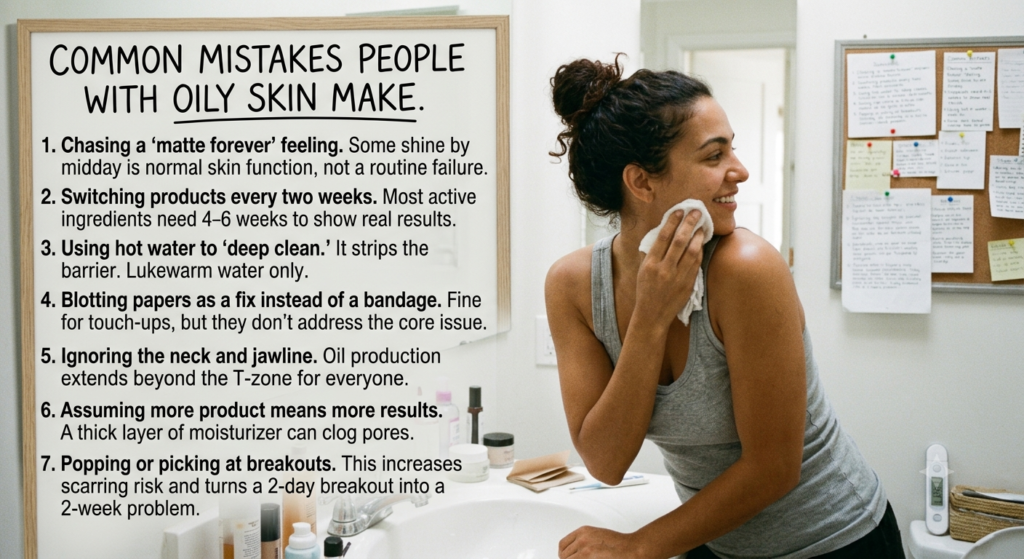
- Chasing a “matte forever” feeling. Some shine by midday is normal skin function, not a routine failure. Expecting zero shine, ever, sets you up to keep switching products that are actually working.
- Switching products every two weeks. Most active ingredients need 4–6 weeks to show real results. Constant switching resets your skin’s adjustment period and makes it impossible to know what’s actually helping.
- Using hot water to “deep clean.” It strips the barrier just like harsh cleansers do. Lukewarm water only, even though hot water can feel more satisfying in the moment.
- Blotting papers as a fix instead of a bandage. Fine for touch-ups, but they don’t address why the oil is there in the first place.
- Ignoring the neck and jawline. Oil production isn’t limited to the T-zone for everyone — extend your routine past the face if that’s where you notice it too.
- Assuming more product means more results. Applying a thick layer of a lightweight moisturizer doesn’t make it work harder; it just sits on the surface and can contribute to clogged pores.
- Popping or picking at breakouts. This is less about oil production and more about scarring risk, but it’s one of the most common ways a two-day breakout turns into a two-week problem.
Skin Care Routine for Dry Skin
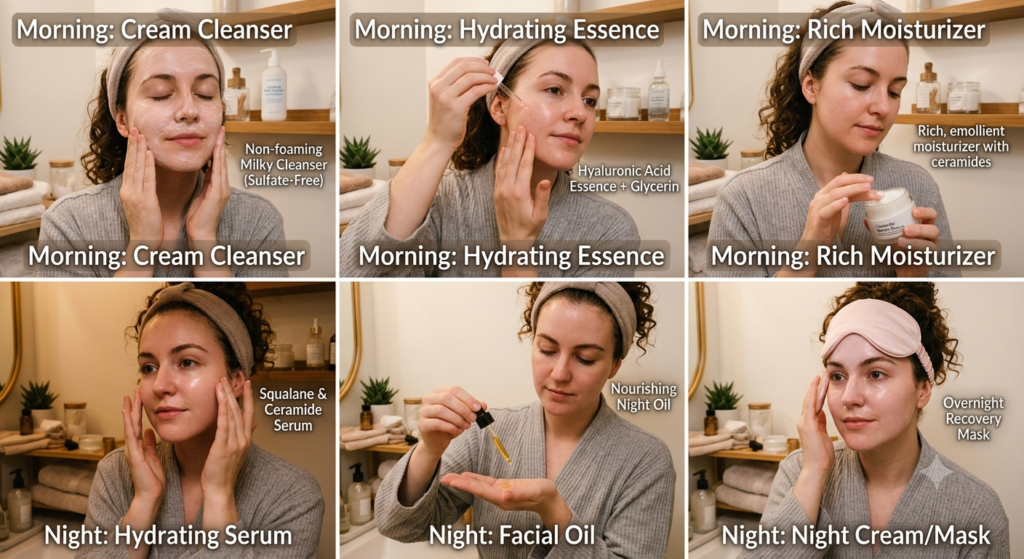
If your skin flakes, feels tight after cleansing, or rarely looks shiny even by evening, you’re likely dealing with dry skin — and the routine looks almost opposite to the oily one above.
Morning:
- Cream or milk cleanser (never foaming — foam formulas often contain sulfates that worsen dryness)
- Hydrating essence or toner with hyaluronic acid or glycerin
- Rich, emollient moisturizer with ceramides
- SPF 30+ (a hydrating, cream-based formula, not matte)
Night:
- Gentle cream cleanser
- Hydrating serum (hyaluronic acid, ceramides, or squalane)
- Facial oil layered under moisturizer, not instead of it
- Thick night cream or sleeping mask
The biggest mistake with dry skin is treating flakiness with harsh exfoliation. Gentle chemical exfoliation (a mild lactic acid, once or twice a week) works better than physical scrubbing, which tends to create micro-tears in already-compromised skin. Dry skin also tends to show irritation more visibly than oily skin does, so introducing new products one at a time — rather than starting a full new routine all at once — makes it much easier to identify what’s causing a reaction if one shows up.
Skin Care Product for Dry Skin: The Non-Negotiables

If you only upgrade three products, make it these:
- A ceramide-based moisturizer — ceramides rebuild the skin barrier itself, not just surface hydration, and are one of the few ingredients proven to help skin retain moisture over time rather than just add it temporarily.
- A humectant serum (hyaluronic acid or glycerin) applied to damp skin — these ingredients pull moisture from the air, so they need water on the skin to work with. Applying hyaluronic acid to completely dry skin in a low-humidity room can actually pull moisture out of the skin instead of into it, which is a detail most people never hear.
- A facial oil for the driest months or driest areas, layered as the final step to lock everything in.
Skin Care Routine for Combination Skin
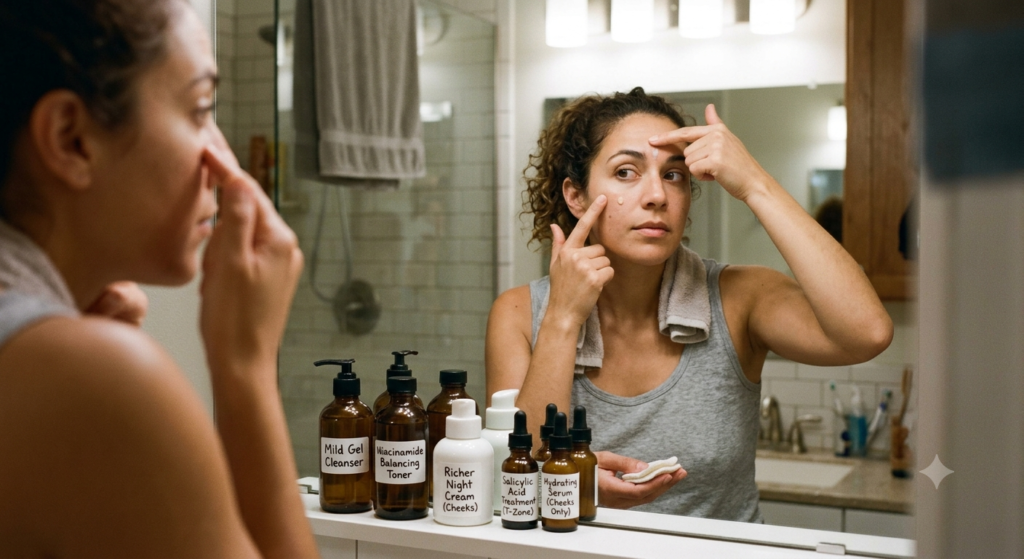
Combination skin — oily T-zone, drier cheeks — trips people up because using one product everywhere either over-dries the cheeks or leaves the T-zone shiny. The fix is zone-specific application, not a single all-purpose product, and it’s the part of skincare advice that gets skipped most often.
Morning:
- Gentle gel cleanser (mild enough for the cheeks, effective enough for the T-zone)
- Balancing toner (niacinamide works well here too)
- Lightweight gel-cream moisturizer all over, with a slightly richer layer added to the cheeks only
- SPF 30+, gel-based
Night:
- Cleanse
- Treatment: salicylic acid on the T-zone only, hydrating serum on the cheeks
- Moisturize with the same zone-specific approach as morning
This “split routine” approach is the biggest thing people with combination skin are missing — most give up trying to find a single miracle product instead of just applying different amounts in different places. It also tends to shift seasonally: many combination skin types become more evenly balanced in humid summer months and more clearly split in dry winter months, so it’s worth reassessing your zones every few months rather than assuming they’re fixed.
Skin Care Products for Combination Skin
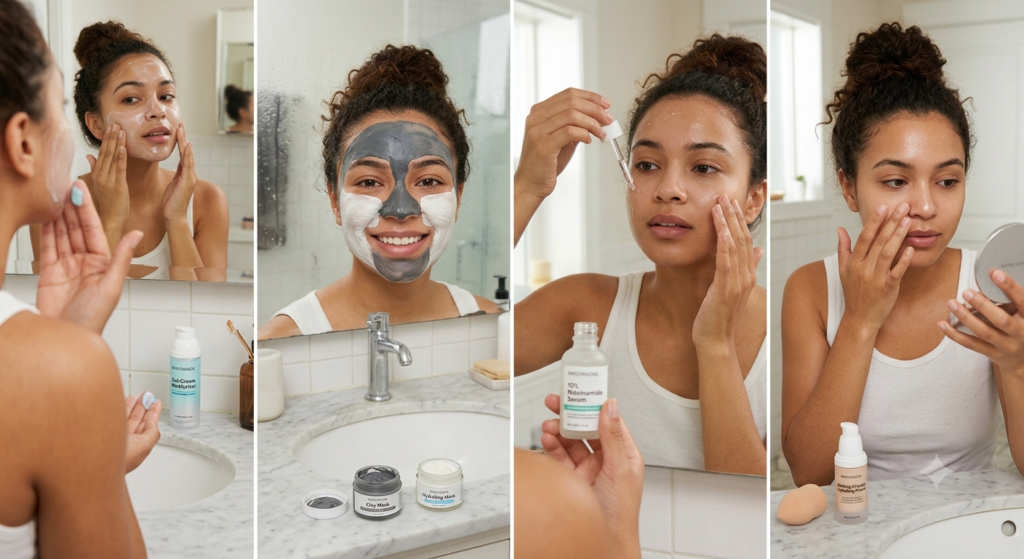
- A gel-cream moisturizer — lighter than a cream, richer than a gel, so it works across both zones with adjusted amounts.
- A multi-masking pair — a clay mask for the T-zone and a hydrating mask for the cheeks, used on the same day, applied to their respective zones at the same time.
- A niacinamide serum — one of the few ingredients that genuinely helps both oil regulation and barrier support, making it useful across the whole face rather than zone by zone.
- A blotting-friendly, hydrating primer — a small detail, but a primer that controls shine in the T-zone while still hydrating the cheeks underneath makeup can solve a problem most combination-skin routines leave unaddressed.
How Your Routine Should Shift With Age and Season
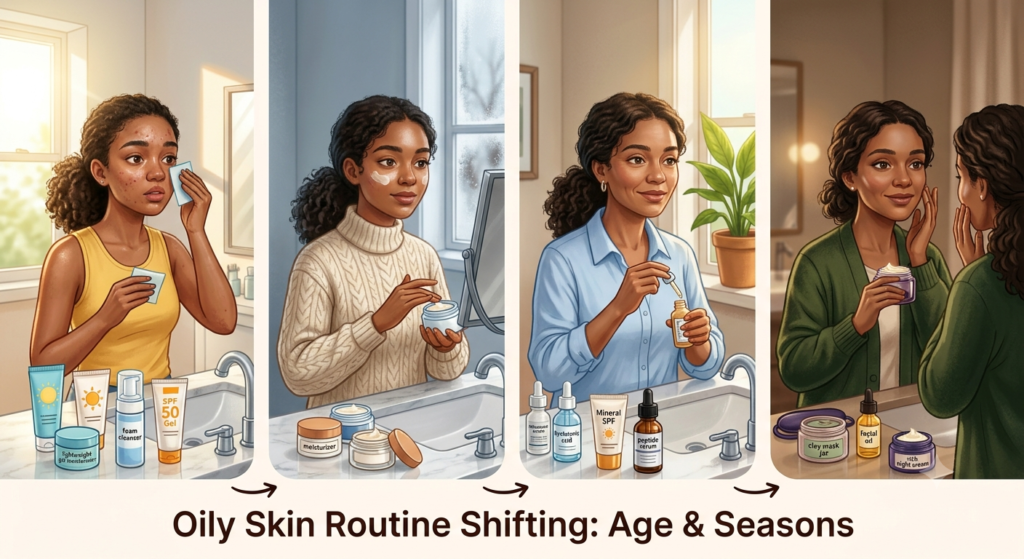
A routine built for oily skin at 22 often needs adjusting by the mid-30s, even if the skin is still technically oily. Oil production naturally decreases with age for most people, which means a routine that felt right for years can start to feel drying without anyone changing a single product. If you notice your usual routine suddenly leaving your skin tight or flaky, it’s worth checking whether your skin type itself has shifted toward combination before assuming a product went bad.
Seasonally, the swap is usually smaller than people expect. Many oily-skin routines only need one change between summer and winter: swapping a gel moisturizer for a slightly richer gel-cream during colder, drier months, then switching back once humidity returns. Overhauling the entire routine each season is rarely necessary and often just introduces new variables to troubleshoot.
Quick Self-Check: Which Skin Type Are You Actually Dealing With?
Wash your face, apply nothing, and wait 60 minutes:
- Shiny all over, especially forehead, nose, and chin: Oily
- Tight, flaky, or dull with no shine anywhere: Dry
- Shiny T-zone, normal-to-tight cheeks: Combination
- Comfortable, no tightness, minimal shine: Normal (lucky you)
This matters because using an oily-skin routine on dry skin (or the reverse) is one of the most common reasons people feel like “nothing works” — the routine wasn’t wrong, it just wasn’t matched to their actual skin. Worth repeating this test every few months, especially around seasonal changes, since skin type can shift more than people expect.
FAQ
Can oily skin become less oily over time with the right routine?
Yes, though it’s regulation more than elimination. Consistent use of niacinamide and proper hydration typically shows visible change in oil levels within 6–8 weeks, not overnight.
Is it normal for oily skin to also be dehydrated?
Very common, actually. Oily and dehydrated are about two different things — oil (sebum) and water content — so you can have plenty of one and not enough of the other. This combination, sometimes called “dehydrated oily skin,” is one of the most commonly misdiagnosed skin conditions, because the shine masks the underlying dryness.
Should oily skin skip moisturizer entirely?
No. Skipping it is one of the most common reasons oil production increases rather than decreases.
How long before a new skincare routine shows results?
Most active ingredients need 4–6 weeks of consistent use. Judging a product after a week isn’t long enough to see its real effect, and switching before that window closes is one of the most common reasons people feel like they’ve “tried everything” without success.
Does oily skin need less sunscreen than other skin types?
No — the amount needed for adequate protection doesn’t change by skin type, only the formula does. Using less because a product feels heavy leaves skin under-protected; switching to a lighter formula is the better fix.
Key Takeaways
Oily skin needs regulation, not stripping — that means lightweight, oil-free hydration every single day, one active ingredient at a time, and SPF that won’t add to the shine. Dry skin needs the opposite: rich, barrier-repairing products and gentle exfoliation. Combination skin does best with a split routine rather than a single product trying to do everything, and most skin types need small seasonal or age-related adjustments rather than a full routine overhaul.
The fastest way to see results isn’t finding a “miracle” product — it’s matching the routine to your actual skin type and staying consistent with it for at least a month before judging whether it’s working. Start with the morning routine above tomorrow, and give it those four weeks before changing anything.