Most “hair growth” advice online is the same five sentences rearranged: drink water, eat protein, use a good shampoo. None of that is wrong, exactly — it’s just too vague to change anything.
Hair doesn’t grow faster because you want it to. It grows faster (and breaks less) when you stop doing the small things that quietly undo your progress: over-washing the scalp, oiling without ever rinsing it out properly, relying on one “miracle” remedy instead of a routine.
This guide covers 15 specific, usable tips — from oiling technique to scalp massage, diet, aloe vera, yogurt masks, and the ingredients worth looking for on a label. No filler, no “just be patient” platitudes. Pin the sections that apply to you and build your own routine from there.
Quick Reference: All 15 Tips
| # | Tip | Best For |
|---|---|---|
| 1 | Oil your hair the right way | Dry scalp, breakage |
| 2 | Massage your scalp daily | Circulation, stress relief |
| 3 | Eat for hair growth, not just “health” | Slow growth, shedding |
| 4 | Use home remedies strategically | Budget-friendly care |
| 5 | Use aloe vera correctly | Itchy or oily scalp |
| 6 | Adjust your routine for thick hair | Thick, coarse, curly hair |
| 7 | Choose natural products wisely | Sensitive scalp |
| 8 | Drink for hair health | Dehydrated, brittle strands |
| 9 | Try a yogurt hair mask | Dull, rough texture |
| 10 | Know your ingredients | Smarter shopping |
| 11 | Get regular trims | Split ends |
| 12 | Reduce heat styling | Heat damage |
| 13 | Switch to silk or satin | Frizz, breakage overnight |
| 14 | Avoid tight hairstyles | Traction hair loss |
| 15 | Manage stress and sleep | Hormonal shedding |
1. Hair Care Oiling: Do It the Right Way, Not Just Any Way
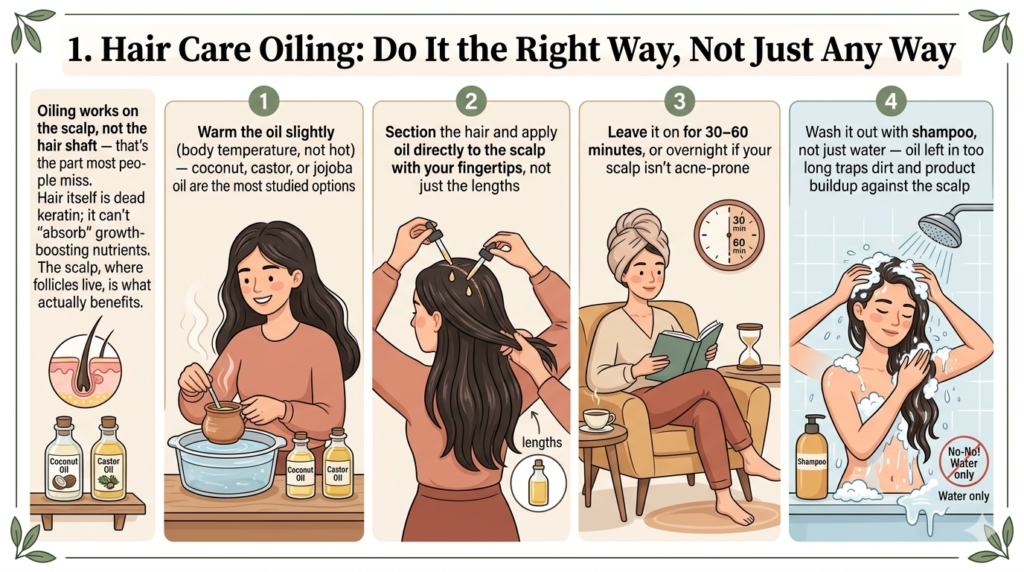
Oiling works on the scalp, not the hair shaft — that’s the part most people miss. Hair itself is dead keratin; it can’t “absorb” growth-boosting nutrients. The scalp, where follicles live, is what actually benefits.
How to do it properly:
- Warm the oil slightly (body temperature, not hot) — coconut, castor, or jojoba oil are the most studied options
- Section the hair and apply oil directly to the scalp with your fingertips, not just the lengths
- Leave it on for 30–60 minutes, or overnight if your scalp isn’t acne-prone
- Wash it out with shampoo, not just water — oil left in too long traps dirt and product buildup against the scalp
Common mistake: Oiling every single day without ever fully washing it out. This suffocates the scalp and can actually worsen shedding. Two to three times a week is plenty for most people.
2. Hair Care Massage: The Step Most People Skip
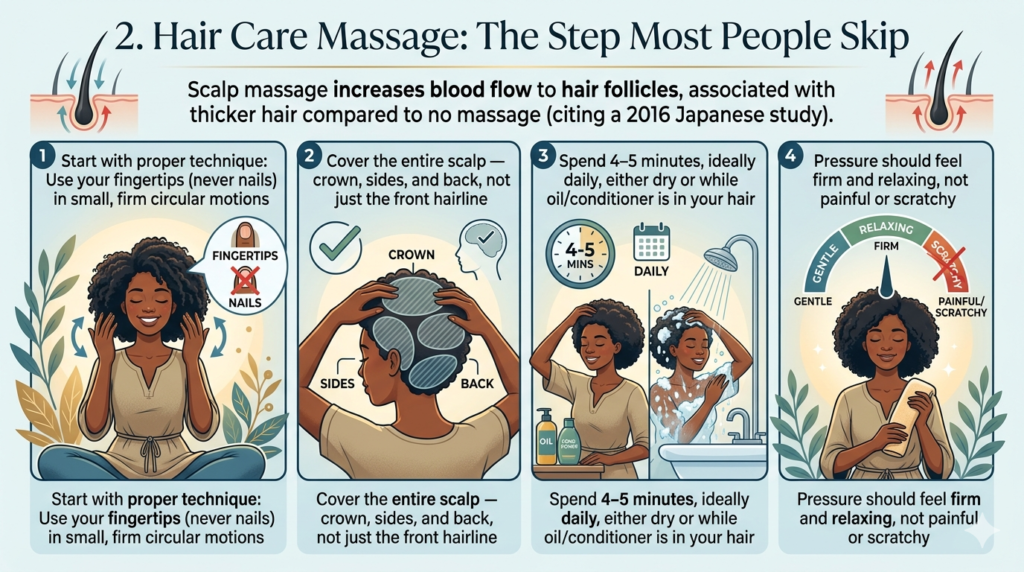
Scalp massage increases blood flow to hair follicles, and a small but frequently cited 2016 Japanese study found that consistent scalp massage over several months was associated with thicker hair compared to no massage at all.
A simple routine:
- Use your fingertips (never nails) in small, firm circular motions
- Cover the entire scalp — crown, sides, and back, not just the front hairline
- Spend 4–5 minutes, ideally daily, either dry or while oil/conditioner is in your hair
- Pressure should feel firm and relaxing, not painful or scratchy
Massage alone won’t reverse genetic hair loss, but as a habit layered onto everything else in this list, it consistently shows up as one of the few “free” tips with real supporting evidence.
3. Hair Care Diet: What Shows Up on Your Plate Shows Up on Your Head
Hair is one of the last places your body sends nutrients — so deficiencies show up there before almost anywhere else. If growth has stalled, diet is worth auditing before any product.
Nutrients that matter most:
- Protein — hair is roughly 90% keratin protein; low intake directly slows growth (eggs, lentils, fish, Greek yogurt)
- Iron — low iron is one of the most common, most overlooked causes of diffuse shedding, especially in women (spinach, red meat, fortified cereals)
- Biotin and zinc — support keratin production (nuts, seeds, whole grains)
- Omega-3 fatty acids — support scalp hydration and reduce inflammation (salmon, walnuts, flaxseed)
A pattern worth knowing: crash diets and sudden, severe calorie restriction often trigger a delayed shedding phase 2–3 months later, called telogen effluvium. If your hair loss started a few months after a major diet change, that timing is a clue worth mentioning to a doctor.
4. Hair Care Home Remedies That Actually Hold Up
Not every remedy on Pinterest is backed by anything beyond tradition — but a few have genuine mechanisms behind them.
| Remedy | What It Actually Does | Worth Trying? |
|---|---|---|
| Onion juice | Sulfur compounds may support follicle activity; one small 2002 study showed improved regrowth in alopecia areata patients | Yes, if you can tolerate the smell |
| Rice water | Contains inositol, which can temporarily strengthen the hair shaft’s surface | Yes, as an occasional rinse |
| Fenugreek seeds | Soaked and blended into a paste; mucilage softens hair and may reduce breakage | Yes, for texture, not proven growth |
| Egg masks | Protein and fat coat the hair shaft temporarily | Mild benefit, mainly cosmetic |
The honest takeaway: home remedies are best treated as supportive habits, not replacements for diet, scalp care, or medical evaluation if shedding is significant.
5. Aloe Vera Hair Care: Where It Actually Helps
Aloe vera doesn’t “grow” hair — its real value is calming an irritated, flaky, or oily scalp, which indirectly creates a better environment for healthy follicles.
How to use it correctly:
- Use fresh gel scraped directly from the leaf when possible; bottled versions often contain added alcohol that can dry the scalp
- Apply directly to the scalp, leave for 20–30 minutes, then rinse
- Combine with a few drops of castor oil if your scalp is dry rather than oily
The myth to drop: Aloe vera is frequently marketed as a stand-alone growth serum. It isn’t. Its strength is calming inflammation and reducing dandruff-related shedding — which matters, but it’s a supporting player, not the main event.
6. Hair Care Tips for Thick Hair: Different Hair, Different Rules
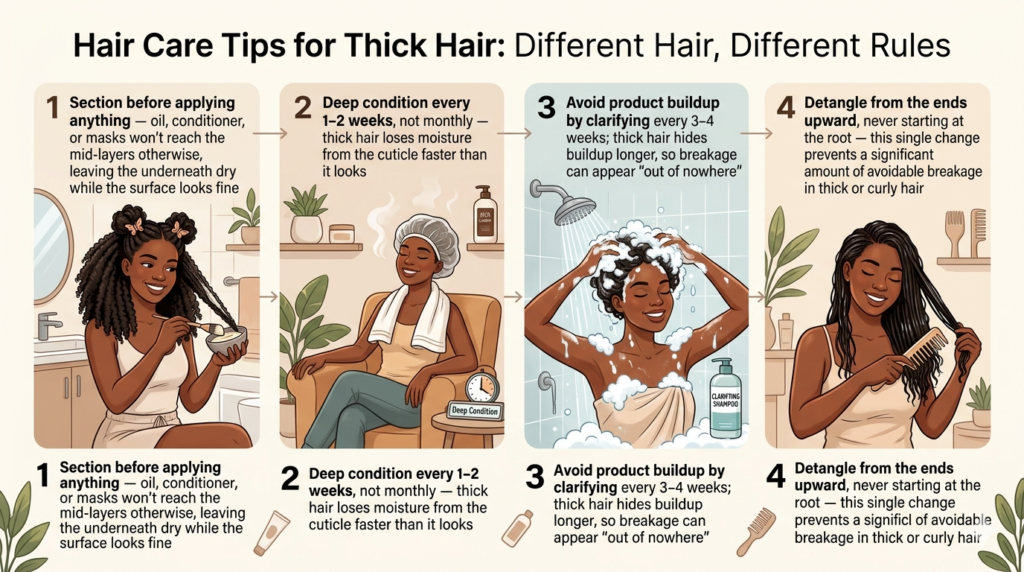
Thick hair has more strands per square inch, which means standard advice (a dime-size amount of product, weekly deep conditioning) often isn’t enough.
- Section before applying anything — oil, conditioner, or masks won’t reach the mid-layers otherwise, leaving the underneath dry while the surface looks fine
- Deep condition every 1–2 weeks, not monthly — thick hair loses moisture from the cuticle faster than it looks
- Avoid product buildup by clarifying every 3–4 weeks; thick hair hides buildup longer, so breakage can appear “out of nowhere”
- Detangle from the ends upward, never starting at the root — this single change prevents a significant amount of avoidable breakage in thick or curly hair
Thick hair often grows at a normal rate but looks like it isn’t, simply because breakage at the ends outpaces visible length gain at the root.
7. Hair Care Natural Products: Choosing Without Wasting Money
“Natural” on a label isn’t regulated the way people assume — it doesn’t guarantee the product is better for growth, or even gentler.
What to actually check:
- A short ingredient list with recognizable plant oils near the top (not buried after a long chemical list)
- No added synthetic fragrance if your scalp is sensitive — “natural fragrance” can still irritate
- Avoid products that lead with marketing claims (“ultimate growth formula”) but list water and filler oils as the first three ingredients
A useful habit: judge a “natural” product by its first five ingredients, not its packaging or claims.
8. Hair Care Drink: Hydration’s Real Role
There’s no single drink that grows hair faster — but chronic dehydration does make hair more brittle and scalp skin less elastic, which shows up as breakage over time.
What’s worth including:
- Plain water, consistently, rather than relying on one “hair tea” to compensate for low daily intake
- Green tea — its catechins have shown mild DHT-blocking activity in lab studies, though human evidence is still limited
- Collagen-based drinks — may support the protein building blocks hair needs, though direct growth claims are overstated in most marketing
Treat hydration as a baseline requirement, not a growth hack. It removes a barrier; it doesn’t add acceleration.
9. Hair Care Yogurt: An Old Remedy With Real Science Behind It
Yogurt masks are a genuinely useful remedy, not just a Pinterest trend. Plain yogurt contains lactic acid, which gently exfoliates the scalp, and protein that temporarily smooths the hair cuticle.
Simple yogurt mask:
- Mix 2–3 tablespoons of plain, unsweetened yogurt with 1 tablespoon of honey
- Apply to scalp and lengths, focusing on dry or flaky areas
- Leave for 20 minutes
- Rinse with cool water and a mild shampoo
Use this once a week. More than that can over-exfoliate sensitive scalps, leading to irritation that looks like “more breakage” but is actually scalp inflammation.
10. Hair Care Ingredients: What to Look For and What to Skip
| Look For | Why | Skip or Limit |
|---|---|---|
| Caffeine | Shown in studies to extend the hair growth phase slightly | Sulfates (in daily-use shampoo) — strip natural oils with repeated use |
| Rosemary oil | A 2015 study found it performed comparably to 2% minoxidil over 6 months | Heavy silicones (long-term, no rinse-out days) — cause buildup that blocks moisture |
| Peptides | Support keratin structure | Denatured alcohol (high on the list) — drying for already-dry scalps |
| Niacinamide | Supports scalp barrier health | Synthetic fragrance (if scalp is reactive) |
The biggest shopping mistake: choosing a product based on one “hero ingredient” on the front label while ignoring everything else in the formula.
11. Get Regular Trims — Even If You’re Growing It Out
This feels counterintuitive, but split ends travel up the hair shaft if left untreated, eventually requiring a bigger cut later. A trim every 8–12 weeks (just removing the split portion, not length) prevents that domino effect and makes hair look like it’s growing faster simply because less is breaking off.
12. Reduce Heat Styling and Use Real Heat Protection
Heat above 300°F breaks down the hair’s protein bonds permanently — no product reverses this, only prevents it. If heat tools are non-negotiable, a leave-in with silicone or dimethicone before styling, plus keeping tools under 350°F, meaningfully reduces damage.
13. Switch to a Silk or Satin Pillowcase
Cotton pulls moisture out of hair and creates friction overnight, which shows up as frizz and breakage at the hairline. Silk or satin reduces that friction significantly — a small change with a noticeably outsized result for very little effort.
14. Avoid Tight Hairstyles and Constant Tension
Tight ponytails, buns, and braids worn daily can cause traction alopecia — gradual hair loss along the hairline and part from sustained pulling. The damage is often reversible early on but can become permanent with years of repeated tension. Alternating styles and loosening hairlines, especially while sleeping, prevents this.
15. Manage Stress and Prioritize Sleep
Chronic stress raises cortisol, which can push more follicles into the shedding phase prematurely. This is a major, underdiscussed cause of sudden hair thinning that has nothing to do with products at all. Sleep is when the body repairs tissue, including the scalp — consistently poor sleep is one of the few factors that can undo an otherwise solid hair care routine.
Mistakes That Quietly Stall Hair Growth
A few habits work against all 15 tips above, even when everything else is done right:
- Washing scalp daily with hot water — strips natural oils faster than they can regenerate
- Brushing wet hair starting at the root — wet hair is at its weakest; always start detangling at the ends
- Switching products every few weeks — most hair care needs 6–8 weeks of consistent use before results show; constant switching resets that clock
- Rubber hair ties without fabric coating — cause more breakage at the point of tension than most people realize
FAQ
How long before I see results from a new hair care routine? Most visible change takes 8–12 weeks, since hair grows roughly half an inch per month and shedding patterns take time to shift. Anything claiming results in days is overselling.
Can I oil my hair every day? Daily oiling without proper washing tends to cause buildup and can worsen scalp issues. Two to three times weekly, fully rinsed out, works better for most hair types.
Is rice water or yogurt better for hair? They do different jobs — rice water mainly strengthens the hair shaft’s surface, while yogurt exfoliates the scalp and smooths texture. Many people benefit from rotating both rather than picking one.
Do I need a doctor if my hair is shedding a lot? If shedding is sudden, significant, or comes with scalp pain, redness, or patchy bald spots, that’s worth a dermatologist visit rather than home remedies alone — it can signal an underlying issue like thyroid imbalance or iron deficiency.
Conclusion
Healthy hair growth isn’t usually about finding one powerful remedy — it’s about removing the small habits that cause breakage while supporting the scalp consistently over time. Oiling, massage, diet, and ingredient awareness all work toward the same outcome from different angles, and most people see meaningful change once a few of these become routine rather than occasional.
Start with two or three tips that match your current hair concern — scalp massage and a better diet if growth feels slow, silk pillowcases and looser styles if breakage is the issue — rather than trying to overhaul everything at once. Save this guide so you can come back to it as you build your routine.