Most people don’t have a styling products problem. They have a styling order problem.
Walk into any curly-hair Facebook group and you’ll see the same photo posted a hundred times: a bathroom counter lined with six or seven bottles — leave-in, cream, gel, mousse, oil, serum — and a caption that says “which of these do I actually need?”
The honest answer is that you probably need three, maybe four, and the reason your hair still doesn’t look like the tutorial isn’t the product. It’s the layering, the amount, or the timing.
This guide breaks styling products down the way a stylist would explain it to you in the chair — not by brand, but by function, so you can build a routine that actually matches your hair instead of guessing. By the end, you’ll know not just what to buy, but why your current routine might be working against you, and how to fix it without starting from scratch.
What Styling Products Actually Do (And Why Order Matters More Than Brand)
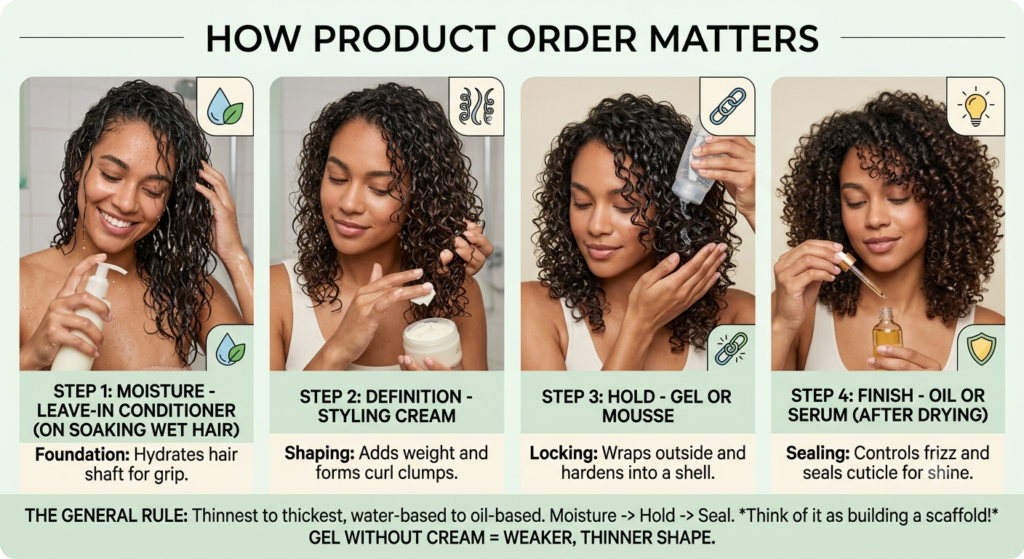
Every styling product falls into one of four jobs:
- Moisture — leave-in conditioners, creams, and milks that hydrate the hair shaft
- Hold — gels, mousses, and creams with polymers that lock a shape in place
- Definition — products (often cream-gel hybrids) that separate strands into clumps
- Finish — oils and serums that seal the cuticle and control frizz after everything else has dried
The mistake most people make is applying products in the wrong order for what each one is designed to do. Gel applied before a leave-in has nothing to “grip” onto, so it flakes and sits on top of the hair instead of coating it. Oil applied before gel creates a barrier that stops the gel from sealing properly, which is why so many people say gel “never really dries hard” for them — it’s not the gel, it’s the oil underneath it.
The general rule: thinnest to thickest, water-based to oil-based, moisture to hold to seal.
A basic order looks like this:
- Leave-in conditioner (on soaking wet hair)
- Styling cream (for definition and extra moisture)
- Gel or mousse (for hold)
- Oil or serum (only after hair is 80–100% dry, if at all)
It helps to think of each layer as building a scaffold for the next one. The leave-in gives the hair strand something to hold onto. The cream adds weight and shape around that moisture. The gel wraps the outside of the clump and hardens into a shell. Skip a layer, or apply them out of order, and the whole scaffold collapses — usually by early afternoon.
One thing worth noting: more product is not the same as more hold. A common misread is assuming that flat, lifeless curls by midday mean you need a stronger-hold gel. Often what’s actually missing is the cream step underneath it. Gel without cream can hold a shape, but it’s a thinner, weaker shape with less volume to begin with. The cream is doing the shaping; the gel is just locking it in place.
How to Choose Styling Products by Hair Porosity (Not Just Curl Type)
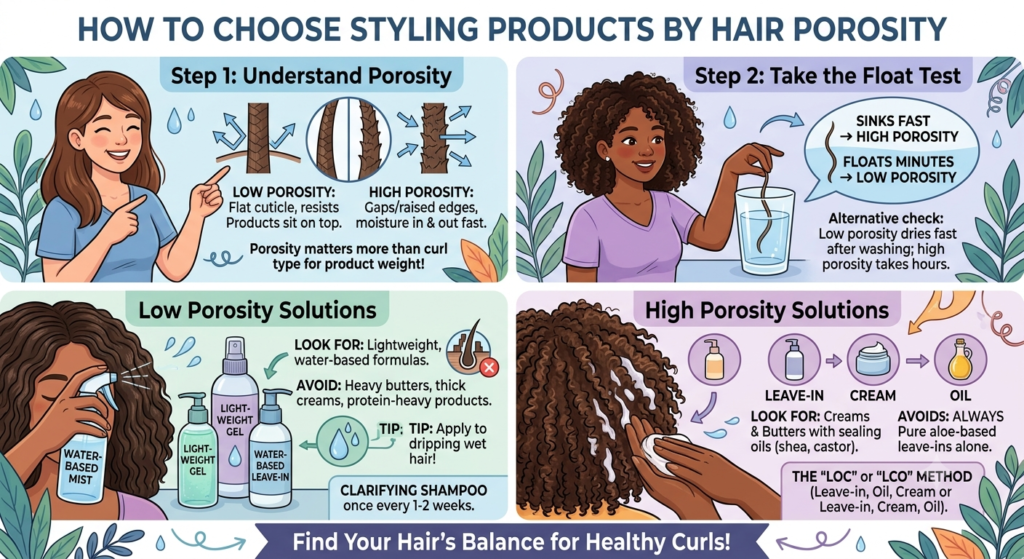
This is the part most articles skip, and it’s the actual reason two people with the same curl pattern can use the same product with completely different results.
Porosity is how easily your hair absorbs and holds moisture, and it matters more than curl type when picking product weight.
Low Porosity Hair
The cuticle lies flat and resists moisture absorption, so product tends to sit on top of the hair and build up.
- Look for: lightweight, water-based leave-ins and gels
- Avoid: heavy butters, thick creams, and protein-heavy products, which will sit on the surface and cause buildup within a week
- Application tip: apply products to hair that’s dripping wet — the extra water helps lift the cuticle slightly so product can actually get in
Low porosity hair is also the type most likely to react badly to dry shampoo and heavy leave-ins used together, since neither absorbs well and both just accumulate on the strand. If you notice your curls looking duller or feeling coated no matter what you use, a clarifying shampoo once every one to two weeks usually resets things faster than switching products again.
High Porosity Hair
The cuticle has gaps or raised edges, so moisture gets in fast but escapes just as fast.
- Look for: creams and butters with sealing oils (shea, castor) already blended in
- Avoid: pure aloe-based leave-ins alone — they hydrate but evaporate quickly without something to seal them in
- Application tip: always finish with an oil, even a small amount, or the moisture you just applied will be gone in a few hours
High porosity hair also tends to respond well to the “LOC” or “LCO” method (leave-in, oil, cream or leave-in, cream, oil) rather than the standard leave-in/cream/gel order, because it needs an extra sealing step that lower-porosity hair doesn’t. If your curls always look great right after washing but dry out and frizz within a couple of hours, this is usually the fix.
Medium Porosity Hair
Generally the easiest to work with — most products marketed as “universal” are formulated for this range.
- Look for: cream-gel combinations
- Watch for: over-applying just because products “work easily” — this hair type still gets weighed down with too much product
Don’t know your porosity? Drop a clean strand of hair in a glass of water. If it sinks fast, you’re high porosity. If it floats for several minutes, you’re low porosity. Somewhere in between is medium. A second, faster check: if your hair dries quickly after a wash, you’re likely lower porosity; if it takes hours to air dry, you’re likely higher porosity.
The Cast: What It Is and Why You Shouldn’t Skip It
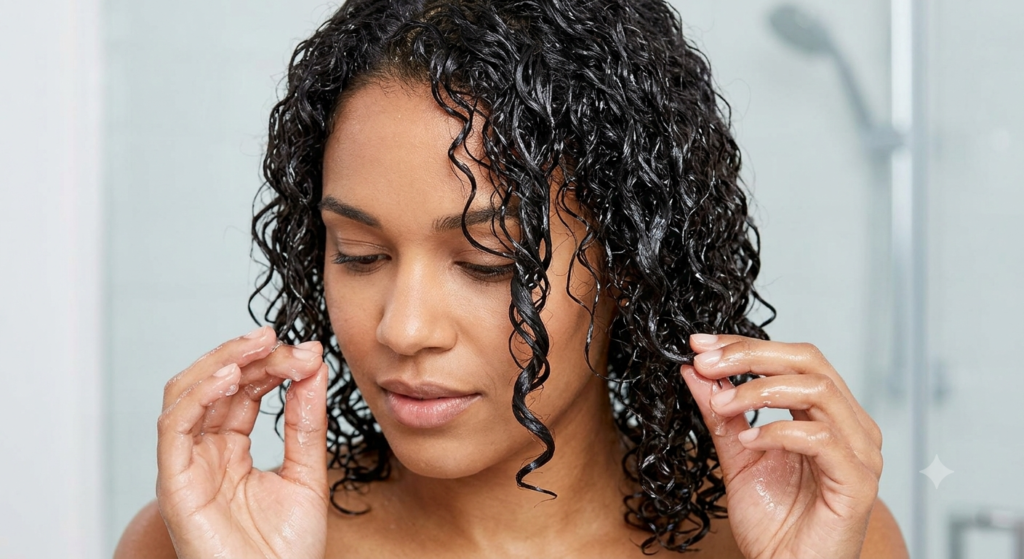
If you’ve heard curly-hair people mention “scrunching out the cast” and had no idea what that meant, here’s the explanation nobody gives you clearly.
When gel dries, it forms a hard, crunchy shell around each curl called a cast. This isn’t a styling failure — it’s the gel doing exactly what it’s supposed to do. The cast holds your curl pattern in place while your hair finishes drying underneath it.
The mistake is touching your hair while the cast is still forming (usually the first 1–2 hours), which breaks the shell prematurely and causes frizz. The second mistake is never breaking the cast at all, which leaves hair feeling stiff and crunchy all day.
The correct process:
- Let hair air-dry or diffuse until it’s 100% dry and the cast feels hard to the touch
- Cup your hands and gently scrunch upward from the ends — this cracks the cast into soft, separated pieces instead of frizzed-out fluff
- Optionally, rub a small amount of oil between your palms and scrunch again for shine
If your curls consistently deflate the moment you scrunch out the cast, the gel didn’t have enough hold for your hair type or wasn’t applied heavily enough — not that “gel doesn’t work” for your hair.
It’s also worth knowing that diffusing speeds up cast formation significantly compared to air-drying, which is why diffused curls often hold up better throughout the day. If you consistently air-dry and find your curls collapse by evening, testing a few sessions with a diffuser on low heat before giving up on a product entirely is worth the extra ten minutes.
Common Styling Product Mistakes (And What They’re Actually Doing to Your Hair)
| Mistake | What’s Actually Happening | Fix |
|---|---|---|
| Applying gel on dry hair | Gel needs water to activate and distribute; on dry hair it sits unevenly and flakes | Apply on soaking wet hair only |
| Using too much leave-in | Excess protein/glycerin can leave hair gummy or “crunchy soft” (tacky, not hard) | Start with a quarter-sized amount, add more only if hair feels dry after |
| Skipping the “praying hands” or raking method | Product isn’t distributed evenly, so some sections get frizzy and others get overly coated | Rake through sections, then use praying hands to encourage clumping |
| Touching hair while it dries | Breaks forming curl clumps and adds frizz before the cast sets | Hands off until hair is fully dry |
| Applying oil before gel | Oil blocks gel from sealing the hair shaft properly | Oil only goes on after hair is completely dry, if used at all |
| Using the same routine in every season | Humidity and heater-dry winter air change how much moisture/hold hair needs | Increase gel in humid months, increase cream/leave-in in dry winter air |
| Buying a new product every time hair looks off | Product-hopping rarely fixes technique-based problems and adds unnecessary buildup | Troubleshoot application and porosity fit before replacing a product |
That last mistake deserves its own mention, because it’s the most common one in curly-hair communities. A bad hair day is usually caused by application, weather, or a buildup issue — not a bad product. Switching brands repeatedly without changing technique just resets the guesswork without solving anything.
Styling Products by Hair Goal: A Quick Reference

Sometimes the fastest way to choose is by what result you actually want, not by hair type at all.
Want maximum definition and separated ringlets? Prioritize a strong-hold gel applied generously, plus the praying-hands method during application. Tighter curl patterns (type 3B–4A) usually need more product per section than looser patterns, simply because there’s more surface area folding in on itself.
Want a soft, undone wavy look? Use mousse instead of gel — it gives light hold without the hard cast, which suits looser wave patterns (type 2A–2C) that don’t need heavy hold to keep their shape. Applying mousse to slightly damp, not soaking, hair also helps avoid weighing waves down flat.
Hair falls flat by midday? The issue is usually too much cream and not enough gel. Cream alone rarely has enough hold to survive a full day; it needs a gel layer on top to lock it in. If you’re already using both, check whether you’re applying enough gel at the roots specifically, since that’s usually where volume loss starts first.
Hair feels crunchy and you hate it? You don’t have too much gel — you’re skipping the scrunch-out-the-cast step, or scrunching too early before hair is fully dry.
Frizzy halo but defined curls underneath? This is almost always a root or edge issue, not a product issue. Try clipping roots up while drying (“root clipping”) to reduce frizz at the scalp specifically, where hair tends to dry faster and puff up before the rest catches up.
Second-day hair always looks worse than day one? This usually isn’t a product problem either — it’s a refresh technique problem. Spraying water directly onto dry curls without any product reactivates the old gel unevenly, leaving some sections crunchy and others limp. A light mix of water and a small amount of fresh gel or leave-in, applied section by section, refreshes more evenly.
Frequently Asked Questions
Do I need a leave-in conditioner if I already use a styling cream? Usually yes, if you’re low to medium porosity or have finer hair. Leave-in adds the moisture layer that cream alone often can’t provide on its own, especially for hair that dries out quickly.
Can I mix gel and mousse together? You can, but it’s rarely necessary and can dilute the hold of both. If you want moisture and hold in one step, look for a “curl cream” or “curling custard” formulated to do both instead of combining two separate products.
How much product is too much? A rough guide for shoulder-length hair: a quarter-sized amount of leave-in, a quarter-sized amount of cream, and a golf-ball-sized amount of gel. Fine or thin hair should cut all of these roughly in half.
Why does my hair look great on day one but frizzy by day two or three? This is normal and expected with most water-based gels, since they don’t hold up to pillow friction. A silk pillowcase, pineapple method (loose high ponytail while sleeping), and a light refresh spray with a bit of extra gel at the roots will extend it by a day or two.
Do I really need different products for summer and winter? Not entirely different products, but different amounts. Humid air adds moisture to hair throughout the day, which can loosen a cast and cause frizz, so heavier gel application helps in summer. Dry winter air pulls moisture out of hair, so leaning more on cream and leave-in, with a lighter gel layer, tends to work better in colder months.
Is it normal for my curls to look different from wash to wash even using the same products? Yes — this is usually caused by small differences in how wet your hair was during application, how much product you used, or ambient humidity that day, not a flaw in your routine. Curly hair is more weather- and technique-sensitive than straight styling, which is part of why consistency in application matters more than finding a “perfect” product.
Conclusion
Styling products aren’t the mystery most tutorials make them out to be — the real skill is understanding what job each product does and applying them in the right order for your specific hair. Get your porosity right, respect the drying process instead of rushing it, and resist the urge to add a fifth product when the first three just weren’t applied correctly.
Start with a simple three-step routine — leave-in, cream, gel — and only add extras once you’ve actually diagnosed what your hair is missing. You’ll get further with three well-applied products, applied with attention to your porosity and technique, than with seven random ones layered on hoping something sticks.