Most curly hair advice fails for a simple reason: it treats “curly hair” as one category, when it’s really a combination of several independent variables — curl pattern, porosity, density, and current condition. A wash-and-go method that transforms one person’s 3B curls into definition can leave a 4C coily texture dry and a wavy 2A texture weighed down and limp. That’s not a product problem. It’s a mismatch problem.
This guide breaks curly hair care down the way a stylist would: by what your hair is actually doing, not just what it looks like. You’ll find dedicated routines for porosity type, curl pattern, common structural issues like frizz and damage, and length-specific challenges — plus a shopping checklist so you know exactly what to look for the next time you’re restocking your shower shelf.
How to Actually Read Your Hair Before You Buy Anything
Two people can both have “curly hair” and need opposite routines. Before diving into any specific section below, it helps to know where you land on three scales.
Curl pattern (the shape your hair forms when wet and undisturbed):
- 2A–2C: Wavy, S-shaped bends, ranges from barely-there waves to defined S-curves
- 3A–3C: Curly, from loose loops to tight corkscrews
- 4A–4C: Coily, from springy coils to a tight zigzag pattern with little visible curl definition
Porosity (how easily your hair absorbs and retains moisture) — drop a clean strand of hair into a glass of room-temperature water. If it sinks within a minute or two, you likely have high porosity. If it floats for several minutes, you’re likely low porosity. Hair that sinks slowly and gradually is typically “normal” porosity.
Density vs. thickness — these get confused constantly. Density is how many strands you have per square inch of scalp. Thickness (or width) is the diameter of each individual strand. You can have fine, low-density hair that still feels “thick” in volume because of how the curl pattern coils, or coarse, high-density hair that looks thin because the curls are tightly packed. Product weight needs to match thickness, while the amount of product needs to match density — using a lot of product on fine, low-density hair is one of the most common reasons curls end up greasy and flat by day two.
The Four Non-Negotiables of Any Curly Routine
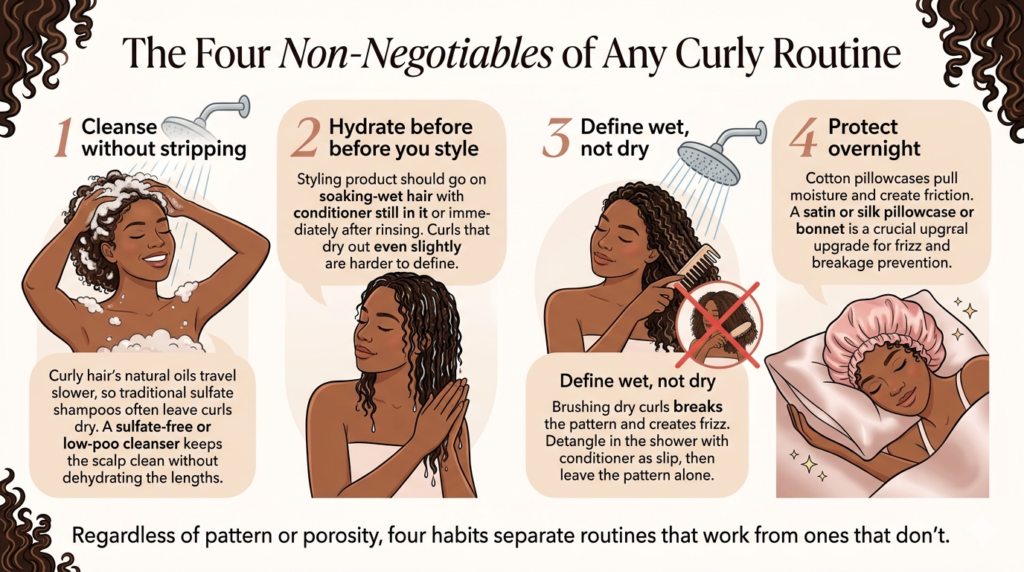
Regardless of pattern or porosity, four habits separate routines that work from ones that don’t:
- Cleanse without stripping. Curly hair’s natural oils travel slower down a bent strand than a straight one, so traditional sulfate shampoos that are formulated for oilier, straighter hair often leave curls dry. A sulfate-free or low-poo cleanser keeps the scalp clean without dehydrating the lengths.
- Hydrate before you style. Styling product should go on soaking-wet hair with conditioner still in it (for the “praying hands” or finger-coiling method) or immediately after rinsing. Curls that dry out even slightly before product application are much harder to define.
- Define wet, not dry. Brushing or combing dry curls breaks the curl pattern and creates frizz. Detangle in the shower with conditioner as slip, then leave the pattern alone once it starts drying.
- Protect overnight. Cotton pillowcases pull moisture out of hair and create friction that causes frizz and breakage. A satin or silk pillowcase or bonnet is one of the cheapest upgrades with the most noticeable payoff.
Common mistakes that undo good products:
- Touching or “scrunching out the crunch” too early, before hair is fully dry
- Over-washing fine, low-density curls (which strips needed natural oil) or under-washing coily hair (which causes buildup)
- Applying conditioner to the scalp instead of focusing it mid-shaft to ends
- Using a regular bath towel instead of a microfiber towel or cotton t-shirt, which roughs up the cuticle and causes frizz
High Porosity Hair Care
High porosity hair has a raised, often damaged cuticle layer, so it absorbs moisture quickly but loses it just as fast. It’s common after color treatments, bleaching, frequent heat styling, or simply years of sun exposure. If your hair feels rough, tangles easily, and dries fast but seems dry again within a day, you’re likely dealing with high porosity.
Routine adjustments:
- Alternate protein treatments with moisture treatments — too much protein on already-fragile high porosity hair makes it brittle and prone to snapping, so balance is more important than frequency
- Seal in moisture with a butter or oil layered over a water-based leave-in (the LOC method: liquid, oil, cream)
- Rinse conditioner with cool water to help smooth the cuticle down before styling
- Be cautious with heavy glycerin-based products in very humid weather, since high porosity hair can over-absorb moisture from the air and end up frizzy and limp rather than defined
Low Porosity Hair Care
Low porosity hair has a tightly bound cuticle that resists letting moisture in — which means products often sit on top of the strand instead of absorbing, leading to buildup, dullness, and hair that feels coated rather than moisturized. This type usually takes a long time to get fully wet in the shower and dries slowly.
Routine adjustments:
- Apply deep conditioner with heat — a warm towel wrap, hooded dryer, or steamer helps lift the cuticle enough for product to actually penetrate, rather than just sitting on the surface
- Favor lightweight, water-based leave-ins and humectant-rich products over heavy butters and oils, which tend to create buildup on low porosity strands specifically
- Clarify every two to four weeks to prevent product buildup, since low porosity hair holds onto residue more stubbornly than other porosity types
- Apply products to soaking-wet hair, never towel-dried hair — the extra water helps push product past the resistant cuticle
| Porosity Type | Quick Test Result | Main Risk | Product Priority |
|---|---|---|---|
| High Porosity | Strand sinks fast | Moisture escapes quickly | Sealing oils/butters + protein balance |
| Low Porosity | Strand floats | Product buildup | Lightweight, heat-assisted hydration |
| Normal Porosity | Strand sinks slowly | Few extremes, easiest to manage | Balanced moisture-protein routine |
4C Hair Care Routine
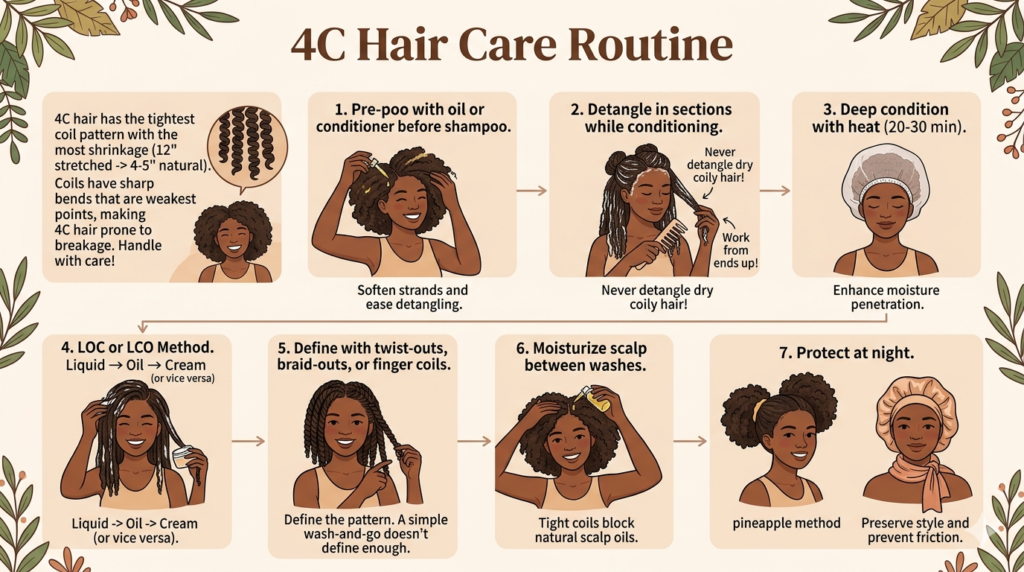
4C hair has the tightest coil pattern with the most shrinkage — hair that measures 12 inches stretched can appear as short as 4–5 inches in its natural state. The sharp bends in each coil are also the weakest structural points, making 4C hair more prone to breakage if handled roughly.
A reliable wash-day routine:
- Pre-poo with an oil or conditioner before shampooing to soften strands and ease detangling
- Detangle in sections with a wide-tooth comb or fingers while conditioner is still in the hair — never detangle dry coily hair
- Deep condition with heat for at least 20–30 minutes
- Apply the LOC or LCO method (liquid, cream, oil — order depends on your hair’s preference) on soaking-wet, sectioned hair
- Style using twist-outs, braid-outs, or finger coils for definition, since wash-and-go alone often doesn’t fully define the tightest coil patterns
- Moisturize the scalp directly between washes, since 4C hair’s coil pattern makes it harder for natural scalp oils to travel down the strand
At night, gather hair loosely (pineapple method) or wrap in a satin bonnet or scarf to preserve the style and prevent friction.
Wavy Hair Care Routine
Wavy hair (2A–2C) sits in a frustrating middle ground — too much product weighs it into limpness, too little leaves it frizzy with no real definition. Waves also respond poorly to products formulated for tighter curl patterns, which often contain heavier oils and butters than wavy hair needs.
Routine adjustments:
- Use lightweight gels or mousses rather than rich curl creams or butters, which are usually too heavy for the wave pattern
- Scrunch product in upward into the ends rather than raking it through, which can stretch out the wave pattern
- Apply product at the mid-lengths and ends first, adding minimally at the roots to avoid greasy-looking volume loss
- Diffuse on a low, cool setting, cupping sections in the diffuser bowl rather than moving it through the hair, which disrupts wave formation
Hair Care for Frizzy Hair
Frizz happens when the hair’s outer cuticle layer is raised, allowing moisture from the air to enter the strand unevenly and swell it — which is why frizz gets dramatically worse in humid weather regardless of curl pattern or porosity. It’s a cuticle and moisture-balance issue, not a “bad hair” issue.
What actually reduces frizz:
- Use an anti-humectant styler (look for products with film-forming ingredients rather than pure glycerin) on humid days, since heavy humectants can pull in excess moisture and cause swelling
- Dry with a microfiber towel or cotton t-shirt using a gentle plunging motion, never rubbing
- Apply a strong-hold gel to create a “cast” over the curls as they dry, then scrunch out the crunch (SOTC) once fully dry — skipping this step is one of the most common reasons curls look frizzy by midday
- Avoid touching, restyling, or running fingers through curls while they’re still drying
Hair Care for Straight Hair
Many readers managing curly hair in their household are also caring for straight-haired family members, so it’s worth covering the very different approach straight hair needs. Because there’s no bend in the strand, natural scalp oil travels down the hair shaft much faster, often leaving roots oily while ends stay comparatively dry.
Routine adjustments:
- Focus shampoo at the scalp, where oil actually accumulates, and let the lather rinse through the lengths rather than re-applying conditioner there
- Apply conditioner from mid-shaft to ends only, skipping the roots to avoid weighing hair down
- Choose lightweight, volumizing formulas over rich, curl-specific creams, which can make straight hair look greasy fast
- Use dry shampoo at the roots between washes rather than washing daily, which can overstimulate oil production over time
Hair Care for Dry, Damaged Hair
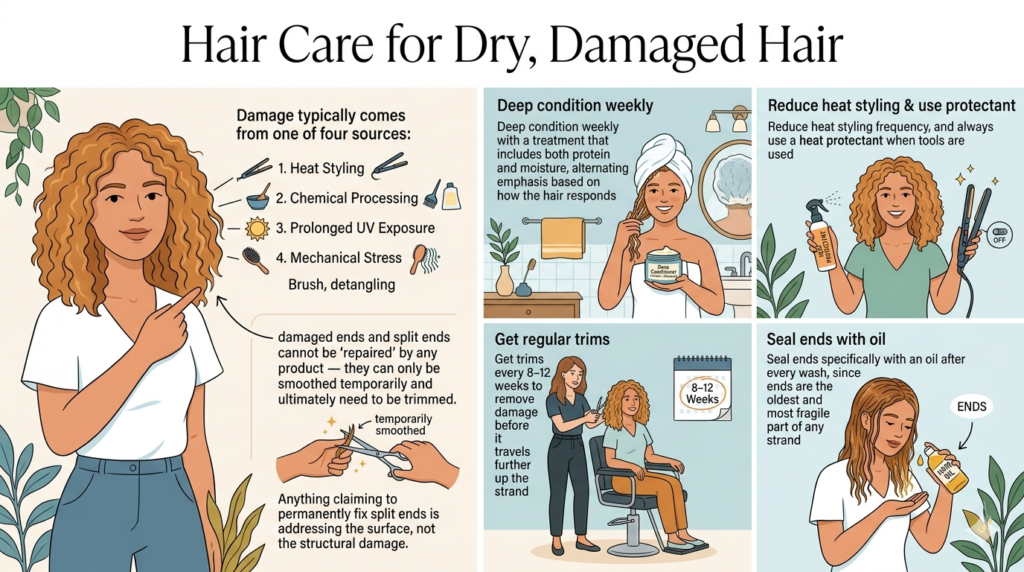
Damage typically comes from one of four sources: heat styling, chemical processing (color, bleach, relaxers), prolonged UV exposure, or mechanical stress from rough detangling and friction. It’s worth being clear about one thing: damaged ends and split ends cannot be “repaired” by any product — they can only be smoothed temporarily and ultimately need to be trimmed. Anything claiming to permanently fix split ends is addressing the surface, not the structural damage.
Routine adjustments:
- Deep condition weekly with a treatment that includes both protein and moisture, alternating emphasis based on how the hair responds
- Reduce heat styling frequency, and always use a heat protectant when tools are used
- Get trims every 8–12 weeks to remove damage before it travels further up the strand
- Seal ends specifically with an oil after every wash, since ends are the oldest and most fragile part of any strand
Hair Care for Dandruff
Dandruff is often confused with simple dry scalp, but they have different causes and need different treatments. Dry scalp is genuinely dehydrated skin, often resolved with gentler cleansers and scalp oils. Dandruff is typically linked to a yeast called Malassezia and excess oil production, causing flaking, itching, and sometimes redness. Persistent, severe, or red and inflamed scalp symptoms are worth seeing a dermatologist about, since they can indicate seborrheic dermatitis, which needs medicated treatment beyond over-the-counter products.
Routine adjustments for curly or coily hair specifically:
- This is the trickiest territory for curly hair, since infrequent washing (common in coily routines to preserve moisture) allows buildup that worsens dandruff. Balance this by co-washing more often while doing a dedicated medicated shampoo wash on the scalp every one to two weeks
- Look for active ingredients like zinc pyrithione, ketoconazole, or salicylic acid, and apply directly to the scalp rather than throughout the lengths
- Gently exfoliate the scalp periodically (a soft scalp brush works well) to lift flakes and product buildup without irritating skin
- Avoid heavy butters and oils directly on the scalp if you’re prone to dandruff, since they can feed the yeast that causes it — save heavier products for the lengths only
Short Hair Care
Curl shrinkage hits short styles the hardest — a curly bob or TWA (teeny weeny afro) can shrink up dramatically more than the same length would on someone with looser waves, which is worth knowing before getting a cut so the result isn’t a surprise.
Routine adjustments:
- Use less product than you think you need — short hair has far less surface area, and over-applying creates a greasy, weighed-down look fast
- Refresh between washes with a water-and-leave-in spray bottle, scrunching curls back to life rather than re-washing daily
- Pay extra attention to the hairline and edges, which see more friction from glasses, masks, and hats on shorter cuts
- Get regular trims (every 6–8 weeks for very short cuts) to maintain shape, since curl shrinkage makes uneven growth more visible sooner than it would on longer hair
Hair Care for Long Hair
Long curly hair faces a different set of problems: the ends are the oldest part of the hair (sometimes years old) and the most fragile, the nape tends to tangle more from rubbing against clothing and bedding, and the sheer weight of longer length can gradually loosen and stretch out the curl pattern over time.
Routine adjustments:
- Detangle in small sections, always starting at the ends and working upward, rather than pulling a comb from root to tip
- Use protective styles (braids, twists, buns) on high-friction days like workouts or travel to reduce manipulation
- Concentrate moisture and protein treatments on the lower two-thirds of the hair, since the upper portion near the scalp typically needs less intensive care
- Sleep with hair fully contained in a satin bonnet or on a satin pillowcase, since long hair has more surface area exposed to friction overnight
- Trim every 10–12 weeks even when growing length out — this feels counterintuitive, but removing a small amount of damaged ends regularly results in healthier-looking length over time than skipping trims altogether
What to Look for in Curly Hair Products
Rather than chasing specific brands, shop by category and ingredient function — this works across porosity types and curl patterns, and you can adjust formulation weight (lightweight vs. rich) based on your own hair’s needs.
| Product Category | What to Look For | Skip If |
|---|---|---|
| Cleanser | Sulfate-free, gentle surfactants | You have very low porosity hair prone to buildup — clarify periodically instead |
| Leave-In Conditioner | Water as the first ingredient, lightweight humectants | Hair is fine and low-density (can weigh hair down) |
| Curl Cream / Gel | Strong hold for definition, flexible (not stiff) once dry | Formula leaves white residue or flakes when scrunched out |
| Deep Conditioner / Mask | Alternating protein and moisture formulas | You already feel straw-like or stiff (sign of protein overload) |
| Microfiber Towel or Cotton T-Shirt | Smooth fabric, no terrycloth loops | — |
| Satin or Silk Bonnet / Pillowcase | Tight-knit satin or silk (not cheap synthetic that slips off) | — |
| Diffuser Attachment | Wide bowl shape that cups sections | — |
Frequently Asked Questions
How often should curly hair actually be washed? There’s no universal number — it depends on porosity and scalp condition, not curl pattern alone. Low porosity and oily scalps often do better washing every 4–5 days, while very dry, high porosity or coily hair may only need full washing every 7–10 days with co-washing in between.
Can you change or “train” your curl pattern? You can’t change your genetic curl pattern, but damage, product buildup, and protein-moisture imbalance can all make existing curls look looser, frizzier, or less defined than they naturally are. Restoring hair health often reveals a curl pattern that looks notably different from what heat damage or buildup had been masking.
Do curl creams cause buildup, or is that always a clarifying issue? Both can be true. Heavy creams used on low porosity hair build up because the product can’t absorb into the strand. The fix isn’t necessarily switching products — it’s often applying to soaking-wet hair, using less product, and clarifying every few weeks regardless of porosity type.
Is the “no-poo” method right for every curl type? Not universally. It tends to work well for high porosity and very dry, coily hair that’s prone to over-stripping. It works poorly for fine, low-density hair or anyone managing dandruff, both of which usually need the deeper cleanse a proper shampoo provides.
Conclusion
The biggest shift in curly hair care isn’t a new product — it’s matching your routine to your hair’s actual porosity, pattern, and condition instead of following generic “curly girl” advice that assumes one-size-fits-all. High porosity hair needs sealing and protein balance; low porosity needs heat-assisted, lightweight hydration. 4C coils need gentle, section-by-section handling; wavy hair needs less product, not more. Frizz, dandruff, and damage each have distinct causes that call for distinct fixes, not just “more moisture.”
The most useful next step is the simplest one: do the porosity float test and an honest pattern check today, then compare your current shower shelf against the category checklist above. You’ll likely find at least one product working against your hair type rather than for it — and swapping that single piece often makes more difference than overhauling the entire routine at once.