Somewhere between the 10-step routine hype and the “just wash your face” minimalism, most people lost the plot on what Korean skincare actually is. It’s not a rulebook. It’s a layering philosophy — thin to thick, water-based to oil-based — and the 5-step version is where almost every Korean skincare regimen actually starts, whether you’re 16 in Seoul or 34 in Ohio.
This guide breaks down the real 5-step routine step by step, explains why the order matters more than the product names on the bottles, and shows you how to scale it up or down depending on your skin, your budget, and how much time you actually want to spend in front of a mirror. You’ll also get a 7-day challenge to test it out before committing to a full product lineup, along with guidance on adjusting the routine by skin type and season — the part most guides skip entirely.
What the 5-Step Korean Skincare Routine Actually Is
The 5-step routine is the practical core of K-beauty. It strips away the extras (essences, ampoules, sheet masks) and keeps only the steps that do the heaviest lifting for skin health:
- Cleanser
- Toner
- Serum or treatment
- Moisturizer
- Sunscreen (AM) or sleeping pack (PM)
The logic behind the order isn’t arbitrary. Korean skincare follows a texture rule: apply products from thinnest to thickest consistency so each one can actually absorb instead of getting blocked by a heavier layer underneath it. Put a thick cream on before a watery toner, and the toner just sits on top, doing nothing.
This is the single most overlooked detail in Western adaptations of K-beauty — people buy the right products but layer them in the wrong order, then wonder why their skin isn’t improving. It’s also why two people can use the exact same five products and get different results: one is applying a serum onto damp, still-absorbing toner, and the other is applying it onto a moisturizer that’s already sealed the skin shut.
The 5 Steps Explained (With Real Product Logic)
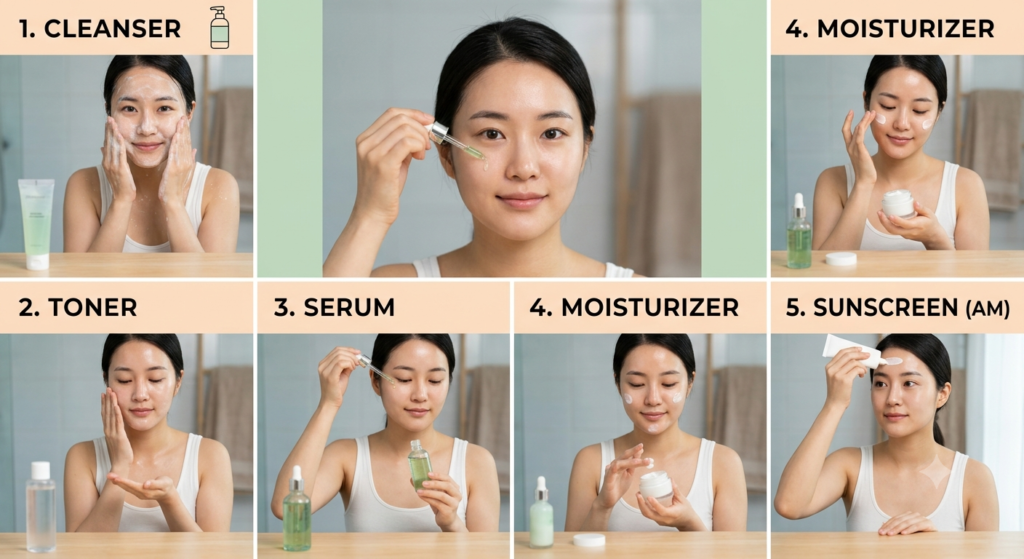
Step 1: Cleanser
Korean routines almost always start with a double cleanse at night — an oil-based cleanser first to dissolve sunscreen, makeup, and sebum, followed by a water-based cleanser to remove sweat, dirt, and residue. In the morning, a single gentle cleanser is usually enough since you’re only washing off overnight product buildup, not a full day of grime and SPF.
Common mistake: Using a foaming, high-pH cleanser twice a day. This strips the skin barrier and is one of the top causes of “my skin got worse after starting Korean skincare” complaints. Look for a cleanser with a pH between 5 and 6, and if your skin feels tight or squeaky right after washing, that’s a sign the cleanser is too harsh, not a sign it’s “working.”
Step 2: Toner
Korean toners aren’t the astringent, alcohol-heavy toners common in Western drugstores. They’re closer to a lightweight hydrating layer that rebalances skin pH after cleansing and preps it to absorb everything that follows. Think of this step as “priming,” not “stripping.”
A practical detail most people miss: pat toner in with your palms rather than swiping with a cotton pad. Swiping can drag on skin and waste product; pressing helps it absorb and lets you gauge how much your skin is actually soaking up.
Step 3: Serum or Treatment
This is where you address specific concerns — hyperpigmentation, acne, fine lines, dullness. Common actives include niacinamide (brightening, barrier support), vitamin C (antioxidant, tone), and hyaluronic acid (hydration). Use one active-focused serum at a time when you’re starting out; layering three new actives at once makes it impossible to tell what’s helping or irritating your skin.
Situational example: someone dealing with post-acne marks might reach for a vitamin C serum in the morning and a gentle exfoliating acid at night, three times a week — not both every day, since that combination is a common cause of new sensitivity rather than faster fading.
Step 4: Moisturizer
Korean moisturizers tend to be lighter than Western equivalents but layered more generously. The goal is to seal in everything applied before it, not to add a heavy occlusive barrier on its own. Gel-creams work well for oily and combination skin; richer creams suit dry or mature skin. If your moisturizer pills or balls up on your skin, it usually means you applied it before the previous layer finished absorbing — wait an extra thirty seconds between steps.
Step 5: Sunscreen (Day) / Sleeping Pack (Night)
This is the step people skip, and it’s the one that determines whether the previous four steps were worth anything. Korean sunscreens are famous for a reason: they’re cosmetically elegant, layer well under makeup, and don’t leave a white cast. At night, a sleeping pack (a lightweight overnight mask) locks in hydration while you sleep — optional, but genuinely effective for dry or stressed skin.
A quick reality check: no amount of brightening serum will out-perform sun damage. If you’re only going to be consistent with one step, make it this one.
3-Step Skincare Routine: The Minimalist Option
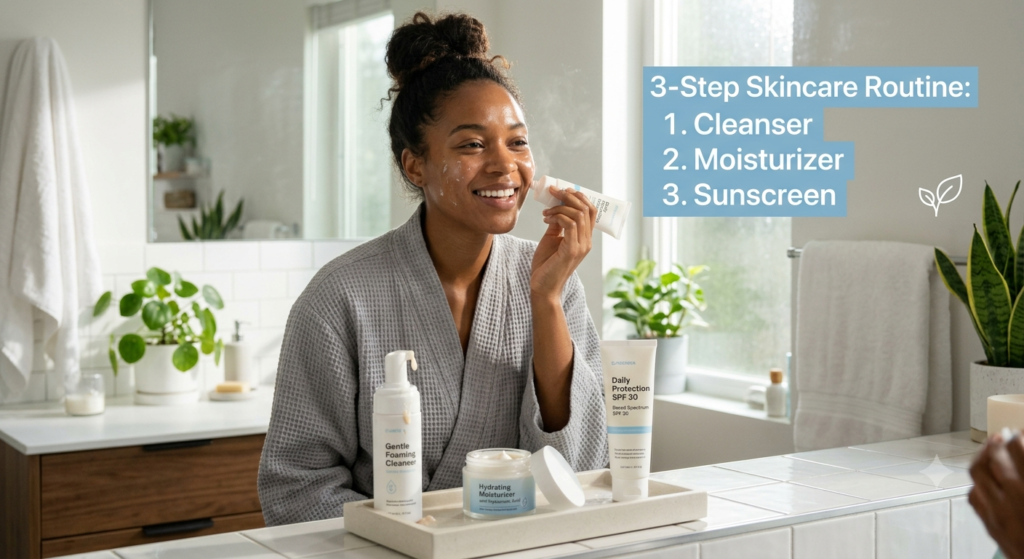
Not everyone wants five products every morning. If you’re new to skincare, traveling, or just tired, a 3-step skincare routine is a legitimate starting point:
- Cleanser
- Moisturizer with built-in hydrating ingredients (like hyaluronic acid)
- Sunscreen
This is essentially a “skincare routine 3 products” setup — no toner, no dedicated serum. It’s not a lesser version of Korean skincare; it’s the same philosophy stripped to its non-negotiables. Dermatologists frequently recommend exactly this combination for people recovering from over-exfoliated or irritated skin, because it removes variables while the barrier heals.
When 3 steps isn’t enough: if you have a specific concern (acne scarring, melasma, visible fine lines) that a plain moisturizer won’t address, you’ll plateau quickly without a treatment step. Three steps is a floor to stand on, not a ceiling to stay under indefinitely.
5 Steps Skin Care vs. Everything Else: A Quick Comparison
| Routine | Steps | Best For | Time (AM) |
|---|---|---|---|
| 3-step | Cleanse, Moisturize, SPF | Beginners, sensitive/recovering skin | 3–5 min |
| 5-step | + Toner, + Serum | Most people, most skin types | 6–8 min |
| 6-step | + Eye cream | Anyone targeting under-eye concerns | 8–10 min |
| 7-step | + Essence | People wanting deeper hydration layering | 10–12 min |
| 8-step | + Ampoule/treatment mask | Targeted, intensive skin concerns | 12–15 min |
| 9-step | + Sheet mask rotation | Special occasions, skin resets | 15–20 min |
The 5-step routine sits at the sweet spot: enough steps to actually treat and protect skin, not so many that most people abandon it within a week. Every step beyond five should be answering a specific question — “what problem is this solving?” — rather than being added because a routine “should” have more steps.
6-Step Skin Care Routine: When to Add Eye Cream
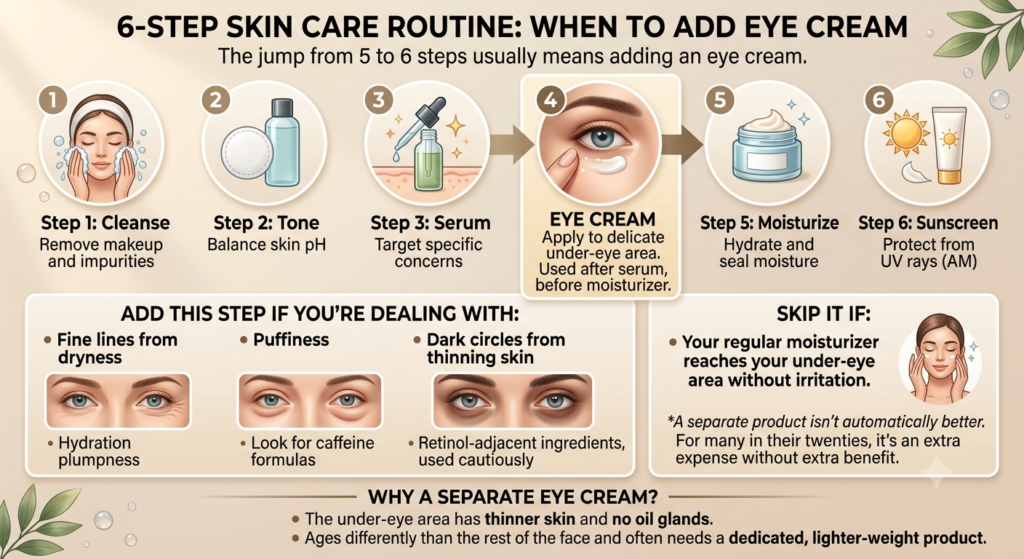
The jump from 5 to 6 steps almost always means adding an eye cream, applied after serum and before moisturizer. The under-eye area has thinner skin and no oil glands, so it ages differently than the rest of the face and often needs a dedicated, lighter-weight product rather than your regular moisturizer.
Add this step if you’re specifically dealing with:
- Fine lines from dryness (not genetics — eye cream won’t fix structural lines)
- Puffiness (look for caffeine-based formulas)
- Dark circles from thinning skin (retinol-adjacent ingredients, used cautiously)
Skip it if your regular moisturizer already reaches your under-eye area without irritation — a separate product isn’t automatically better, and for many people in their twenties, it’s simply an extra expense without an extra benefit.
The Traditional Korean 7-Step Routine
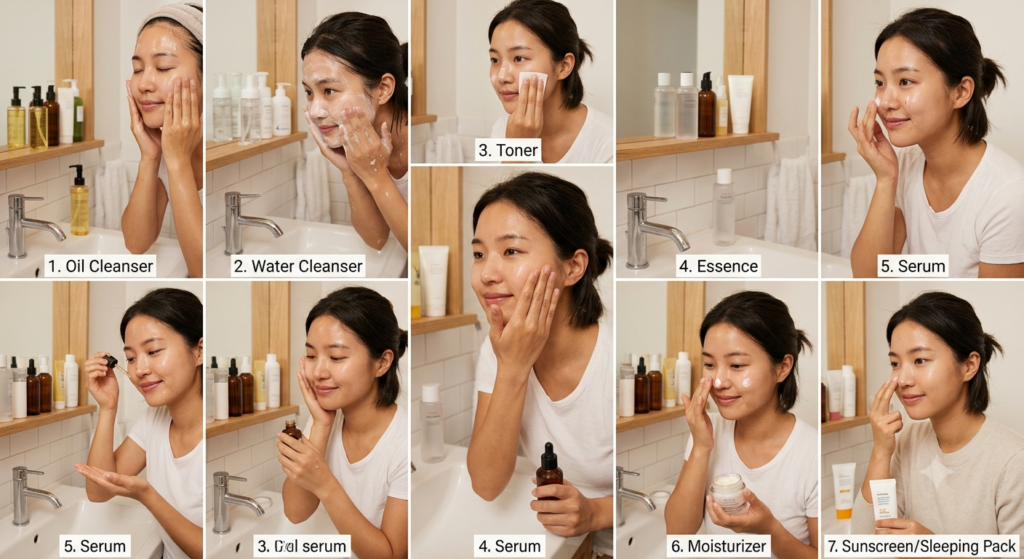
The korean 7 step skin care routine adds an essence between toner and serum. Essences are often confused with toners, but they’re formulated to be more concentrated and are designed to be pressed into skin (not swiped with a cotton pad) to deliver deeper hydration and support cell turnover.
Full sequence:
- Oil cleanser
- Water cleanser
- Toner
- Essence
- Serum
- Moisturizer
- Sunscreen/sleeping pack
This is the routine most people picture when they hear “Korean skincare,” and it’s genuinely effective — but it also assumes you have both the time and the product budget to sustain it daily. If either is limited, the 5-step version delivers most of the same results with far less friction. Think of the essence as the step you add once your skin has adjusted to five steps and you’re specifically chasing plumper, more hydrated texture rather than solving an active concern.
8-Step and 9-Step Routines: Where K-Beauty Gets Serious
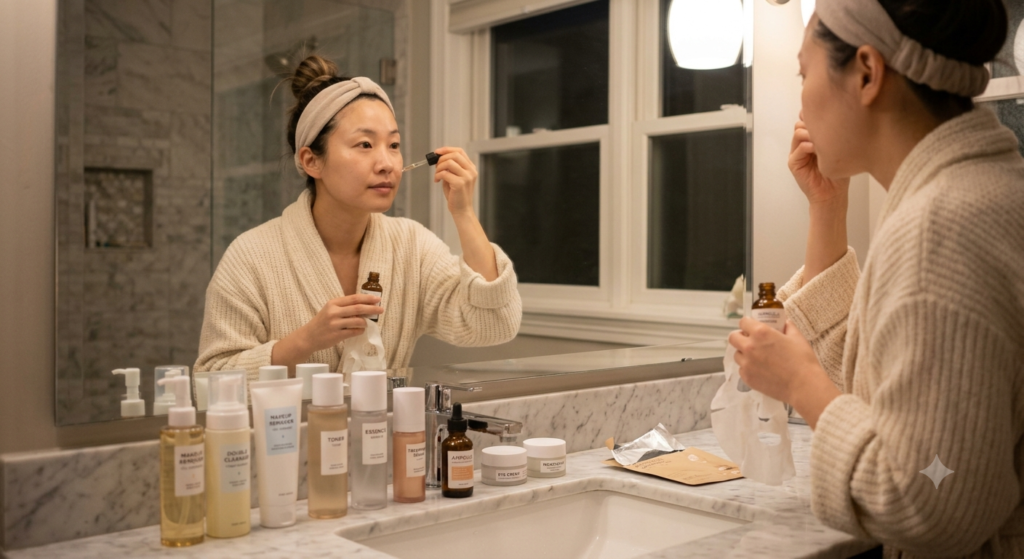
The 8 step skin care routine typically adds an ampoule — a highly concentrated treatment used for a short, intensive period (think two to four weeks) rather than as a permanent daily step. Ampoules are the “prescription-strength” version of a serum, often used to treat a flare-up of dullness, breakouts, or dehydration.
The 9 step skin care routine adds sheet masks into rotation, usually two to three times a week rather than daily. Sheet masks deliver a concentrated dose of one ingredient (hydration, brightening, calming) in a single sitting and work well as a weekly reset rather than a daily habit.
Reality check: Very few people — including many Koreans — actually do 8 or 9 steps every single day. These extended routines are typically weekly or occasion-based additions layered onto a consistent 5-step foundation, not a daily replacement for it. A useful way to think about it: 5 steps is your daily maintenance, 7 steps is your “I have a bit more time” version, and 8–9 steps is your once-a-week reset before an event or during a specific flare-up.
Adjusting the Routine by Skin Type
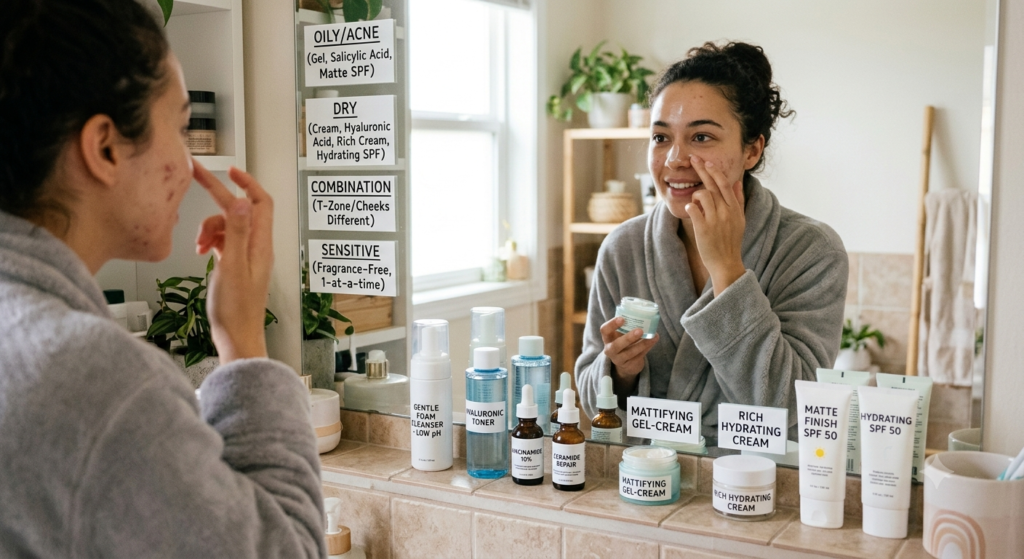
The 5-step framework stays the same, but what goes into each step should change based on your skin type. Applying the exact same product line regardless of skin type is one of the quieter reasons a “correct” routine still underperforms.
Oily and acne-prone skin: Use a gel or foam cleanser with a low pH, a lightweight toner, a niacinamide or salicylic acid serum, a gel-cream moisturizer, and a matte or gel-finish sunscreen. Skip heavy, oil-based moisturizers even at night — oily skin still needs hydration, just not heaviness.
Dry and dehydrated skin: Use a cream or oil cleanser, a hydrating toner with hyaluronic acid or glycerin, a ceramide or hyaluronic acid serum, a richer cream moisturizer, and a hydrating (not matte) sunscreen. Layer toner in two to three thin coats rather than one thick one for a noticeable difference in plumpness.
Combination skin: Treat the T-zone and cheeks slightly differently if needed — a lighter moisturizer on the forehead and nose, a richer one on the cheeks — rather than forcing one product to do both jobs evenly.
Sensitive or reactive skin: Start with the 3-step version, introduce one product at a time with several days between each, and prioritize fragrance-free, alcohol-free formulas across every step, especially toner and sunscreen.
Seasonal Adjustments Worth Knowing
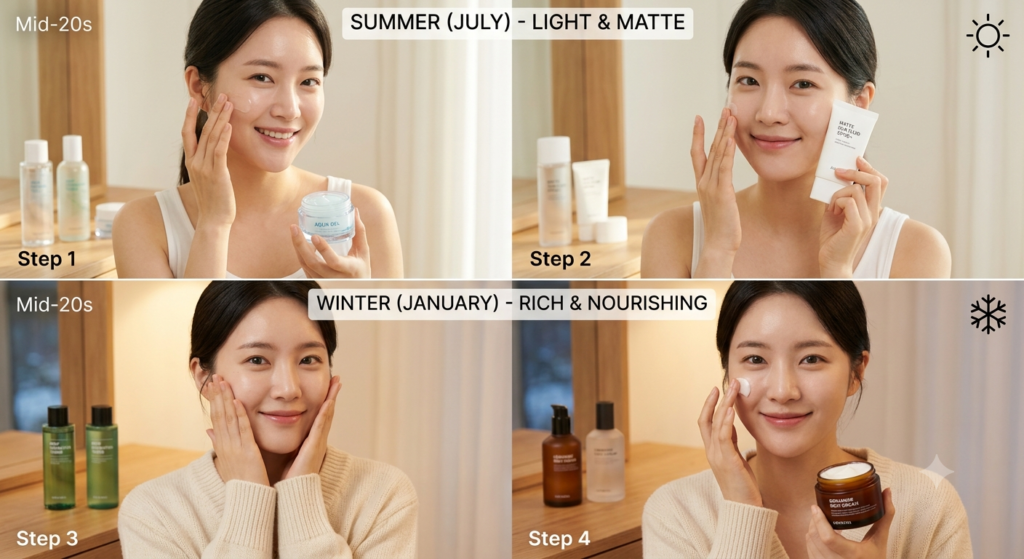
Korean skincare culture treats routines as seasonal, not fixed year-round — a detail that rarely makes it into Western guides. In summer, many people swap to a lighter gel moisturizer and a more matte sunscreen, and may drop a heavier night cream in favor of just a sleeping pack. In winter, the same person often swaps in a richer cream, adds an extra thin layer of toner for hydration, and may reduce active ingredients like exfoliating acids since dry, cold air makes skin more reactive. If your skin behaves differently in July than in January, changing your product weight seasonally — not your number of steps — is usually the fix.
Skin Care 7 Days Challenge: Build the Habit First
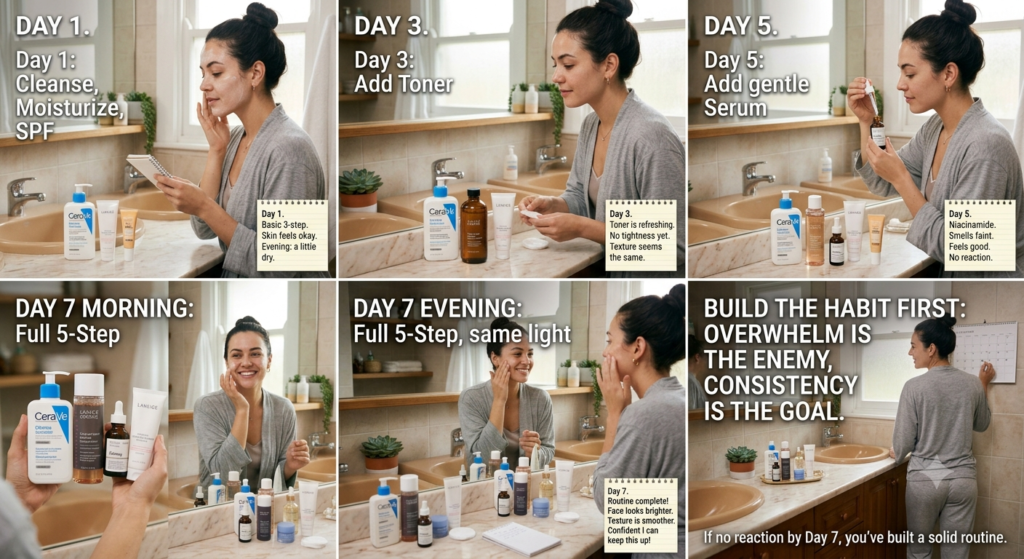
Before buying a full product lineup, try this 7-day skincare challenge using only what you likely already own, to see how your skin responds to consistent, correctly-ordered care:
- Day 1–2: Cleanse, moisturize, SPF only (3-step). Note how skin feels by evening.
- Day 3–4: Add a toner after cleansing. Watch for any change in texture or tightness.
- Day 5–6: Add one targeted serum (start with something gentle, like niacinamide, not an acid or retinoid).
- Day 7: Full 5-step routine, morning and night. Take a photo in the same lighting as Day 1.
This challenge exists because the biggest reason people quit skincare routines isn’t the products — it’s overwhelm. Introducing one step every couple of days makes it easy to spot what’s actually helping (or irritating) your skin, and it builds a routine you’ll still be doing in month three, not just week one. If any step causes redness or breakouts, that’s your answer about which product doesn’t belong in your routine — no guesswork required.
Common Mistakes That Undo a Good Routine
- Layering thick to thin. Reverses the entire absorption logic of the routine.
- Introducing three new actives at once. Makes it impossible to identify the cause of any reaction.
- Skipping sunscreen because “it’s cloudy.” UV exposure isn’t dependent on visible sunlight.
- Over-exfoliating because K-beauty = glowing skin. Glow comes from hydration and barrier health, not from scrubbing harder.
- Copying a 9-step routine as a beginner. Skin needs time to tolerate actives; more steps on day one usually means more irritation, not more results.
- Ignoring product expiry and storage. Vitamin C and certain actives degrade quickly once opened, especially in a bathroom exposed to heat and light — a serum that’s turned brown or lost its scent has likely lost its potency too.
- Judging results after three days. Cell turnover takes weeks; most people give up right before a routine would have started showing visible change.
FAQ
Do I need all 5 steps every single day?
The core 4 — cleanser, serum, moisturizer, sunscreen — are worth doing daily. Toner is beneficial but the one step you can skip occasionally without much downside.
Is toner necessary, or can I go straight from cleanser to serum?
It’s not strictly necessary if your serum is well-formulated and your skin isn’t dehydrated, but toner helps rebalance pH and preps skin for better serum absorption — most people notice a difference within a couple of weeks of adding it back in.
How long before I see results from a 5-step routine?
Hydration and texture improvements are often visible within 1–2 weeks. Tone and pigmentation changes typically take 6–8 weeks of consistent use, since that aligns with the skin’s natural cell turnover cycle.
Can I mix Korean products with my existing Western skincare?
Yes — the routine is a framework for order and layering, not a brand requirement. What matters is following thin-to-thick application and not stacking multiple strong actives (like retinol and vitamin C) without spacing them out.
Should my morning and night routines be identical?
Not quite. Mornings should prioritize protection (antioxidant serum, sunscreen); nights should prioritize repair (treatment actives, richer moisturizer or sleeping pack). Using the exact same lineup twice a day often means missing out on either protection or repair.
Conclusion
The 5-step Korean skincare routine works because it keeps the four things that actually matter — cleansing, treating, hydrating, protecting — while cutting the steps that add time without adding results. Whether you scale down to 3 steps while your skin heals, or scale up to 7, 8, or 9 steps for a targeted reset, the underlying order and logic stays the same, and the right number of steps depends on your skin type, the season, and how much of a specific concern you’re actually trying to solve.
Start with the 7-day challenge above before buying anything new. You’ll know within a week whether your skin wants more steps or fewer — and that’s a far better foundation for a routine than following someone else’s 10-product shelf.