Most skin care confusion has nothing to do with which products you own — it comes down to order. You can buy the right cleanser, the right serum, and the right moisturizer, and still get lackluster results if you’re layering them wrong or skipping the steps that make everything else work better.
This guide walks through the full skin care routine steps in the correct order, explains why that order matters (not just what it is), and covers the products worth owning versus the ones you can skip. It also breaks things down by skin type and season, since a routine that works in July often needs adjusting by January. By the end, you’ll have a routine you can actually follow — not a 12-step regimen borrowed from someone with completely different skin than yours.
Skin Care Basics: What a Routine Is Actually Doing
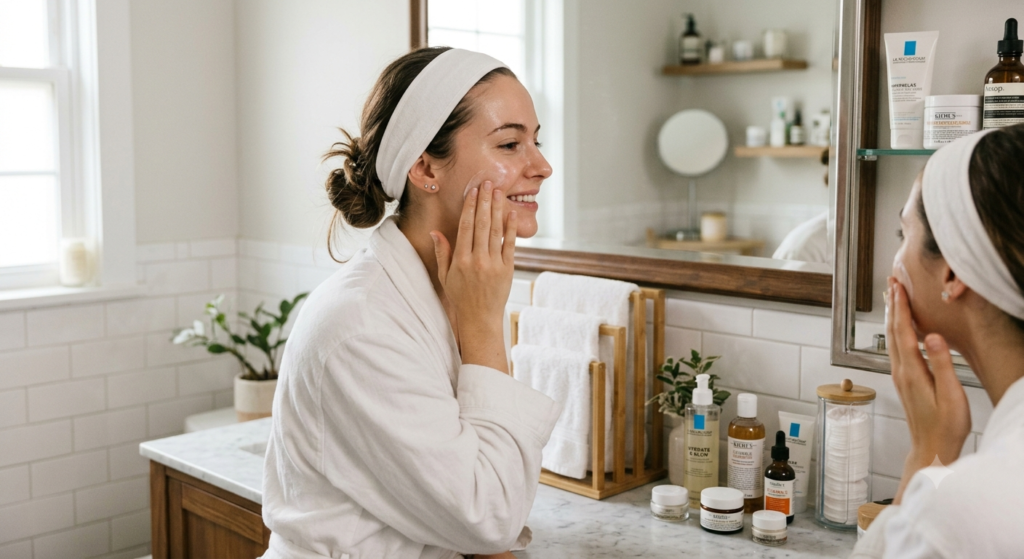
Before getting into steps, it helps to understand the three jobs every routine is doing, whether you realize it or not:
- Removing what shouldn’t be there (dirt, oil, sunscreen, dead skin cells)
- Treating specific concerns (dark spots, breakouts, fine lines, dullness)
- Protecting the skin barrier so it can do its job (retaining moisture, blocking irritants, healing itself)
Every product you apply falls into one of those three categories. A common beginner mistake is loading up on “treating” products (serums, acids, actives) while skipping the “protecting” step — this is why so many people end up with irritated, reactive skin even though they’re using “good” products. The treatment only works if the barrier underneath it is intact.
It also helps to know that skin care results aren’t linear. Skin has a renewal cycle of roughly 28 days in younger adults, stretching to 45–60 days as we age. That’s why a routine can feel like it’s “doing nothing” for the first few weeks and then show a visible shift all at once — the change was happening underneath the surface the whole time.
The Skin Care Routine Steps, In Order
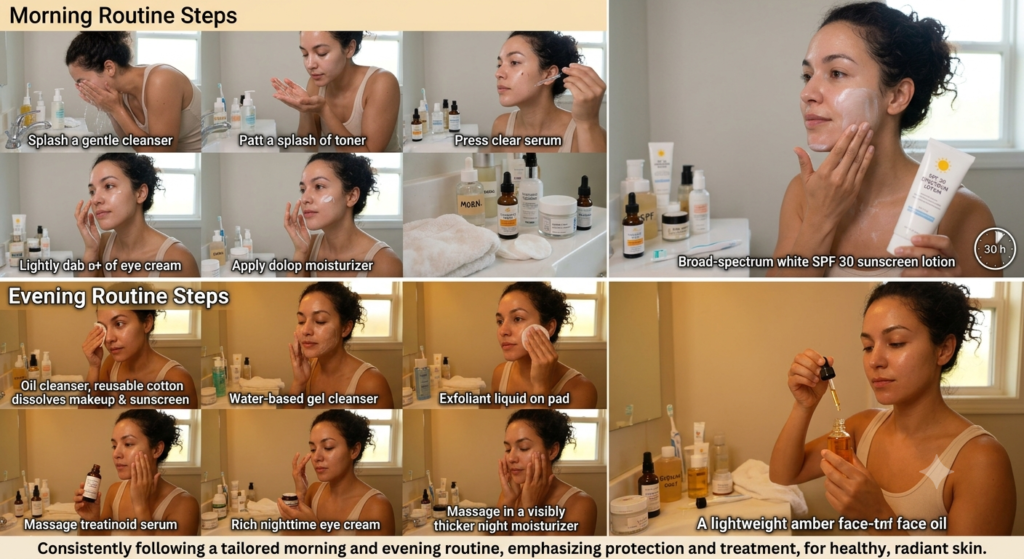
Here’s the actual sequence, broken into morning and evening — because they serve different purposes and don’t need to mirror each other.
Morning Routine Steps
- Cleanser (a gentle, low-foam formula — skin doesn’t need deep cleaning after sleep, just a light rinse)
- Toner or essence (optional, but useful for hydration or gentle exfoliation)
- Serum (typically antioxidant-focused — vitamin C is the most common morning choice)
- Eye cream (if used)
- Moisturizer
- Sunscreen (SPF 30 or higher — this is the step people skip most, and it’s the one doing the most protective work)
Evening Routine Steps
- Oil cleanser or micellar water (first cleanse, to break down sunscreen and makeup)
- Water-based cleanser (second cleanse — this “double cleansing” method matters more if you wear sunscreen or makeup daily; skip it on low-makeup days)
- Exfoliant (chemical exfoliants like AHA/BHA, used 2–4x per week, not nightly)
- Treatment serum (retinoid, niacinamide, hydrating serum — whatever addresses your specific concern)
- Eye cream (if used)
- Moisturizer (often a slightly richer formula than your AM one)
- Face oil (optional, sealed on top as the very last step if used)
Notice sunscreen doesn’t appear at night, and exfoliants don’t appear in the morning routine above — both are common places beginners over-apply products they don’t need twice a day.
Skin Care Order of Application: Why Sequence Actually Matters
The general rule is thinnest to thickest consistency. Lighter, more water-based products go first so they can absorb into the skin; heavier, oil-based products go last so they can seal everything in. Apply it backward, and a thick moisturizer applied first will block a serum from ever penetrating — you’ve essentially wasted the serum.
| Order | Product Type | Texture | Purpose |
|---|---|---|---|
| 1 | Cleanser | Liquid/foam | Removes debris |
| 2 | Toner/Essence | Watery | Preps and hydrates |
| 3 | Serum | Liquid/gel | Delivers active ingredients |
| 4 | Eye cream | Light cream | Targets thin skin area |
| 5 | Moisturizer | Cream/lotion | Locks in hydration |
| 6 | Face oil | Oil | Seals moisture (PM only, typically) |
| 7 | Sunscreen | Lotion | Protects (AM only, always last) |
One exception worth knowing: sunscreen is always the last step in the morning, even though it isn’t the thickest product. This is because sunscreen needs to sit on top of skin to form a protective film — if you apply moisturizer over it, you dilute and disrupt that film, reducing how well it actually protects you.
Another exception people run into: spot treatments. A benzoyl peroxide or sulfur spot treatment for an active breakout typically goes after moisturizer, applied directly to the blemish only, so it isn’t diluted or spread across skin that doesn’t need it.
Skin Care Layering: How Long to Wait Between Products
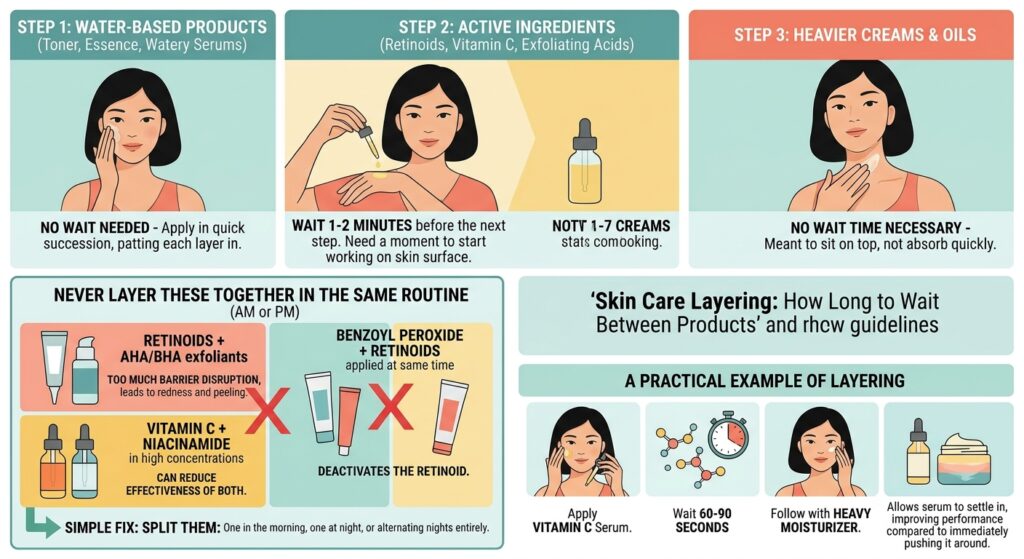
This is the part most guides skip, and it’s where a lot of people either waste time or undermine their products.
- Water-based products (toner, essence, watery serums): No wait needed — apply in quick succession, patting each layer in.
- Active ingredients (retinoids, vitamin C, exfoliating acids): Wait 1–2 minutes before the next step. These need a moment to start working on the skin surface before another product sits on top and dilutes them.
- Heavier creams and oils: No wait time necessary — they’re meant to sit on top, not absorb quickly.
A practical example: if you apply vitamin C serum and immediately follow it with a heavy moisturizer, you can physically push the serum around on the skin’s surface rather than let it settle in. Giving it even 60–90 seconds makes a measurable difference in how well it performs.
Never layer these together in the same routine, morning or night:
- Retinoids + AHA/BHA exfoliants (too much barrier disruption, leads to redness and peeling)
- Vitamin C + niacinamide in high concentrations (can reduce effectiveness of both — though low-percentage formulas are usually fine)
- Benzoyl peroxide + retinoids applied at the same time (deactivates the retinoid; use one AM, one PM instead)
If you want to use two conflicting actives, the simplest fix is splitting them: one in the morning, one at night, or alternating nights entirely (retinoid Monday/Wednesday/Friday, exfoliant Tuesday/Thursday, for example).
Skin Care Essentials Products: What You Actually Need
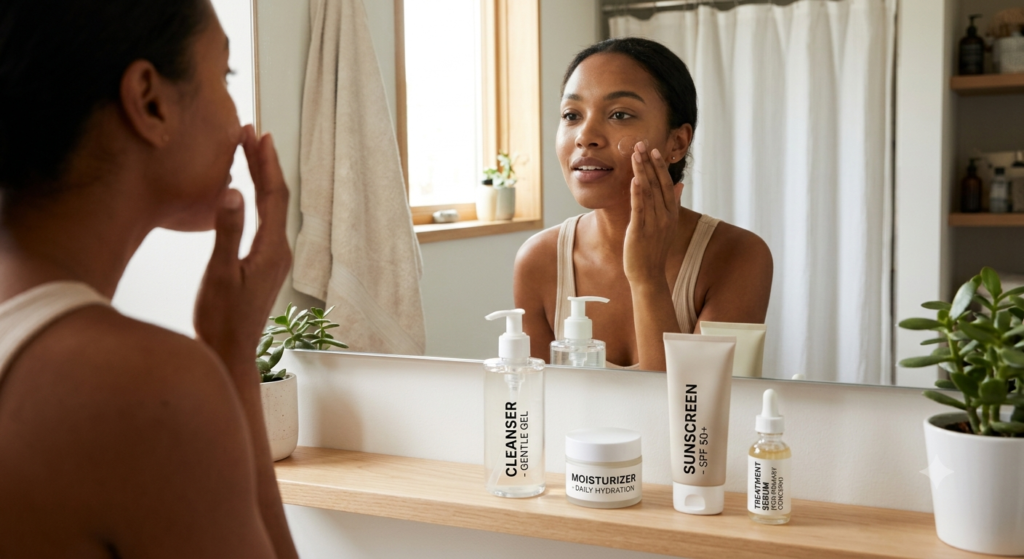
Not everything sold as “essential” actually is. Here’s an honest breakdown.
The Skin Care You Need (Non-Negotiable)
- Cleanser — matched to your skin type (gel for oily, cream for dry, gentle foam for combination)
- Moisturizer — even oily skin needs this; skipping it often increases oil production as skin overcompensates
- Sunscreen — the single highest-impact anti-aging product that exists, full stop
- One treatment serum — chosen based on your primary concern, not a stack of five
Skin Care Items That Are Optional (But Genuinely Helpful)
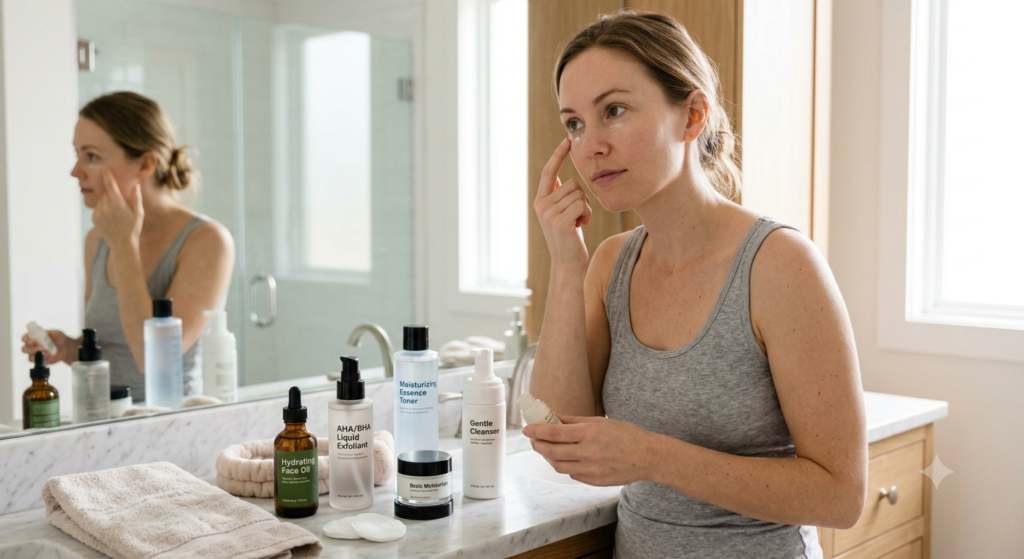
- Exfoliant — speeds up cell turnover, helps with texture and dullness
- Eye cream — mostly about hydration in the thinner under-eye skin; not “essential” but noticeably helpful for dryness or fine lines
- Toner/essence — useful for hydration layering, not required for basic skin health
- Face oil — best for very dry or mature skin; can feel heavy or cause breakouts on oily/acne-prone skin
What You Can Usually Skip
- Multiple serums stacked for different concerns (pick one priority at a time — layering five actives is more likely to irritate skin than transform it)
- Separate “day” and “night” versions of the same product type, unless your skin genuinely behaves differently at different times
- Trend products with no ingredient backing (skin care fads move fast; core routines don’t need to chase them)
The Skin Care You Need at Different Life Stages
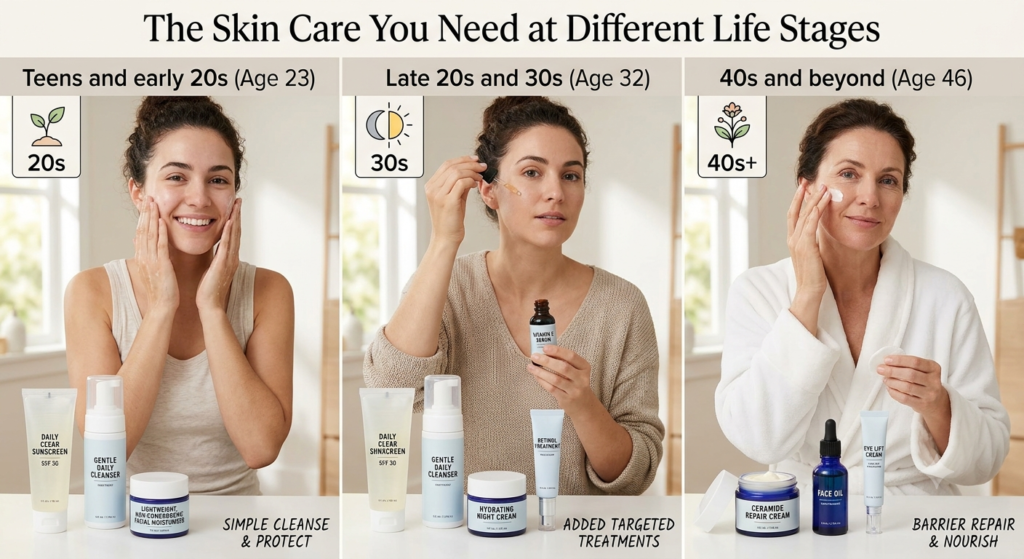
The essentials list above holds steady for most people, but how much of each step you need tends to shift with age — and knowing this ahead of time saves money on products you don’t need yet, or products you should have started sooner.
Teens and early 20s: A simple routine is usually enough — gentle cleanser, lightweight moisturizer, sunscreen. Sunscreen started now is the single biggest long-term investment, even though the payoff won’t be visible for years. Heavy anti-aging serums aren’t necessary yet and can sometimes irritate skin that doesn’t need that level of intervention.
Late 20s and 30s: This is typically when people add their first real treatment serum — retinoids for texture and fine lines, or vitamin C for brightness and early sun damage. Skin also starts losing moisture more easily, so a slightly richer moisturizer than what worked at 20 is common.
40s and beyond: Barrier support becomes more of a priority, since skin naturally produces less oil and repairs itself more slowly. This often means richer creams, added ceramides, and sometimes a face oil at night. Retinoid use is frequently increased in frequency (with proper barrier support alongside it), and eye cream shifts from “nice to have” to genuinely useful as under-eye skin thins further.
None of this means you need to overhaul your entire routine the moment you hit a new decade — it’s simply a signal that the proportions of your existing routine (how rich, how often, how much treatment) are worth revisiting every few years rather than staying static indefinitely.
Adjusting Your Routine by Skin Type
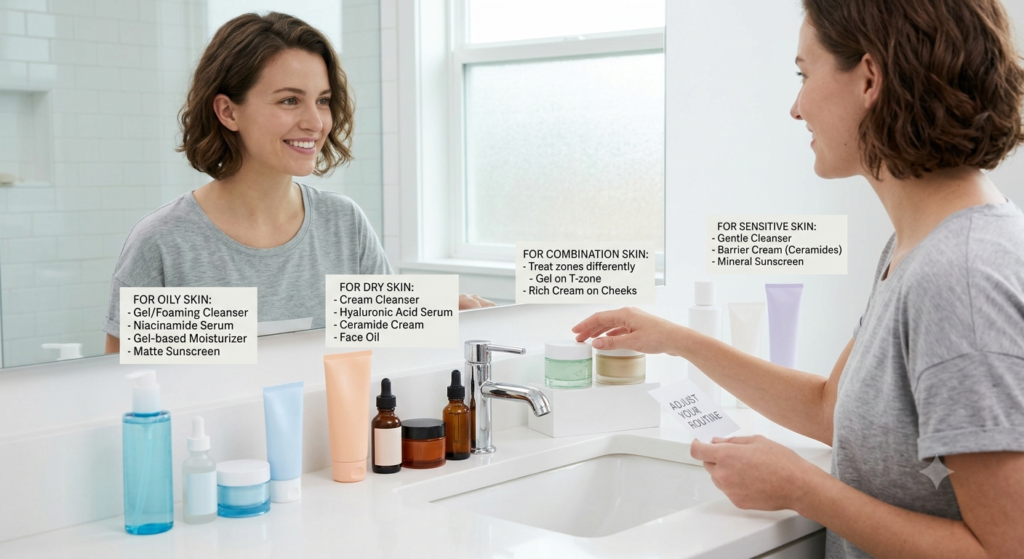
The steps above stay the same, but the products filling each step should shift depending on your skin type.
Oily or acne-prone skin: Use a gel or foaming cleanser rather than a cream cleanser, which can feel heavy. Choose oil-free, gel-based moisturizers, and lean on niacinamide or salicylic acid as your primary treatment serum. Skip heavy face oils, and pick a sunscreen labeled “matte” or “oil-free” so it doesn’t sit greasy under makeup.
Dry skin: Cream or balm cleansers work better than foaming ones, which can strip already-limited natural oils. Look for moisturizers with ceramides or hyaluronic acid, and consider a face oil as your final PM step. Exfoliate less frequently — once or twice a week is often enough.
Combination skin: This usually means treating zones differently rather than picking one product for the whole face. A lighter gel moisturizer on the T-zone and a richer cream on the cheeks is a common, effective approach, even though it means slightly more product handling.
Sensitive or reactive skin: Fewer steps, not more, tends to help. A short routine of cleanser, a barrier-supporting moisturizer (look for ceramides, centella asiatica, or panthenol), and mineral sunscreen (zinc oxide or titanium dioxide) is often more effective than a longer one packed with actives.
Adjusting Your Routine by Season
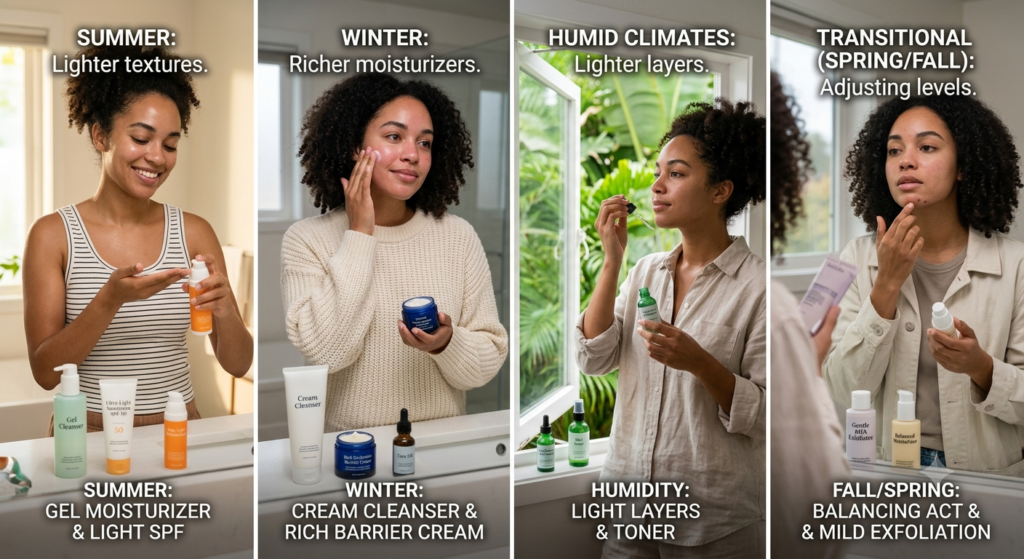
Skin needs change with the weather, and a routine that felt perfect in summer can suddenly feel wrong once the air turns dry.
- Summer: Lighter textures across the board. Gel moisturizers, lighter sunscreens, and more frequent reapplication if you’re sweating or swimming.
- Winter: Richer moisturizers, reduced exfoliation frequency (dry indoor heat already stresses the barrier), and sometimes swapping a foaming cleanser for a cream one to avoid over-stripping.
- Humid climates: Lighter layers overall — heavy creams can feel suffocating and contribute to clogged pores when humidity is already keeping skin hydrated.
- Transitional seasons (spring/fall): This is often when people notice breakouts or sensitivity for no obvious reason — it’s frequently just the routine not yet adjusted to the new humidity and temperature levels.
Skin Care Habits That Actually Stick
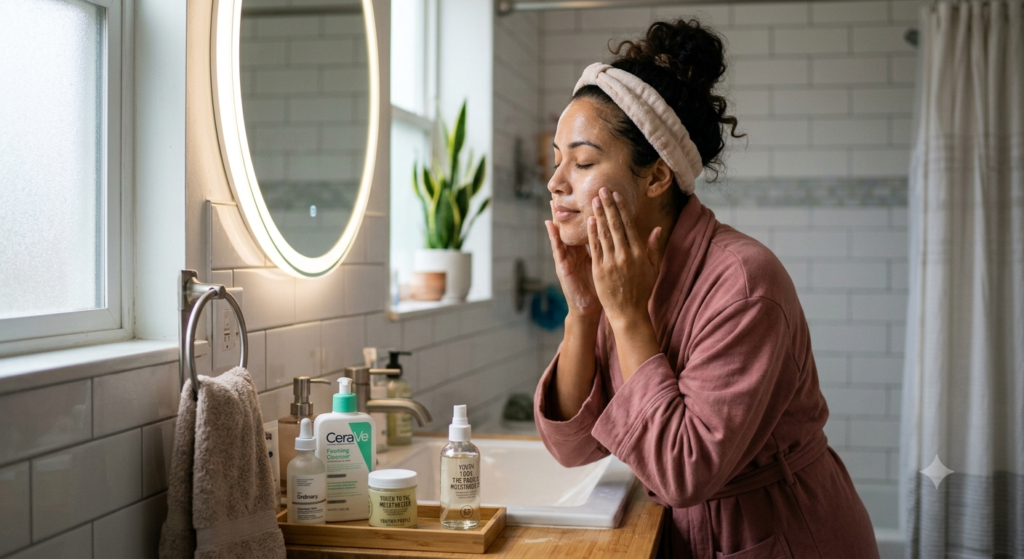
A routine only works if you actually do it. A few habits separate people who see results from people who quietly give up after two weeks:
- Introduce one new product at a time, waiting 1–2 weeks before adding another. This is the only reliable way to know what’s actually causing a reaction if your skin gets irritated.
- Apply sunscreen even on cloudy days and indoors near windows. UVA rays (the aging kind) pass through clouds and glass; this is the most commonly skipped step and the one with the most long-term impact on skin aging.
- Reapply sunscreen if you’re outdoors for extended periods — one morning application doesn’t last all day under direct sun.
- Keep your pillowcase and phone screen clean. Skin care habits aren’t limited to products; these two surfaces touch your face constantly and are frequently overlooked sources of breakouts.
- Give new products 4–6 weeks before judging results. Skin cell turnover takes about a month — expecting visible change in a week sets you up for disappointment and unnecessary product-switching.
- Track what you’re using, especially early on. A simple note on your phone with product names and start dates makes it much easier to identify what’s working (or what’s not) instead of relying on memory weeks later.
Skin Care List: Quick-Reference Checklist

Use this as a simple gut-check for your current routine:
- [ ] Cleanser matched to skin type
- [ ] Moisturizer used daily (both AM and PM)
- [ ] SPF 30+ applied every single morning
- [ ] No more than one active treatment serum introduced at a time
- [ ] Exfoliants used 2–4x weekly, not daily
- [ ] Products applied thinnest to thickest
- [ ] 60–90 second wait after active serums before next step
- [ ] Sunscreen applied last, not under moisturizer
- [ ] New products introduced one at a time, spaced 1–2 weeks apart
- [ ] Routine adjusted seasonally, not left identical year-round
Common Skin Care Routine Mistakes
- Applying sunscreen under moisturizer instead of on top. This is one of the most common ordering errors and it meaningfully reduces sun protection.
- Exfoliating daily. Over-exfoliation is one of the top causes of a compromised skin barrier, showing up as redness, sensitivity, and ironically, more breakouts.
- Using hot water to cleanse. It feels good but strips natural oils and can worsen dryness and sensitivity over time — lukewarm is the better default.
- Skipping moisturizer on oily skin. This often backfires, since skin can increase oil production to compensate for the dryness caused by skipping it.
- Changing the entire routine at once. When something breaks skin out, a routine of six new products makes the cause almost impossible to identify.
- Ignoring the neck and chest. These areas age at the same rate as the face but are frequently left out of both moisturizer and sunscreen application.
- Expecting overnight results from slow-acting ingredients. Retinoids, in particular, often cause an initial adjustment period of mild dryness or flaking before skin improves — mistaking this for “it’s not working” leads a lot of people to quit right before results would have shown up.
FAQ
Do I need to follow all these steps every single day? No. Cleanser, moisturizer, and sunscreen are the daily non-negotiables. Everything else (exfoliant, treatment serums, oils) can rotate based on your skin’s needs that week.
What if I only have five minutes? Cleanse, moisturize, sunscreen (AM) or cleanse, moisturize (PM). That’s a complete, effective minimum — skipping steps like toner or essence won’t undo your skin’s progress.
Is it bad to use the same moisturizer morning and night? Not at all, as long as it doesn’t contain SPF-disrupting ingredients or feel too heavy for daytime wear under makeup or sunscreen.
How do I know if my routine is too complicated for my skin? If skin is regularly red, stinging, flaking, or breaking out in new areas after a routine change, that’s a sign to strip back to the basics (cleanser, moisturizer, sunscreen) for a week or two and reintroduce products slowly from there.
Can I switch up my routine based on how my skin looks that day? To an extent, yes — many people keep a “flare-up” version of their routine (gentler cleanser, no actives, extra moisturizer) for days when skin looks irritated, and their regular version for normal days.
Conclusion
The order you apply skin care products in matters just as much as which products you choose. Cleanse, treat, moisturize, and — in the morning — protect with sunscreen as the final step, always applying thinnest formulas first and thickest last. Skip the urge to stack every trending product into one routine; a few well-chosen essentials, applied consistently and in the right order, will outperform a crowded shelf every time.
If you’re just getting started, don’t try to build the full routine overnight. Start with cleanser, moisturizer, and SPF for two weeks, then layer in one treatment product at a time — your skin, and your patience, will thank you.