Somewhere around 50, a lot of women hit the same wall: the moisturizer that worked for a decade suddenly isn’t enough, foundation sits differently, and the “just cleanse, tone, moisturize” routine from their 30s stops doing its job.
That’s not bad luck. It’s biology. Estrogen decline during perimenopause and menopause changes collagen production, oil output, and how quickly skin repairs itself — often within a fairly narrow window of a few years. A routine that isn’t built around that shift will always feel one step behind, no matter how expensive the products are.
This guide walks through the exact skin care routine steps for women over 50, in the right order, with the reasoning behind each one — not just a list of products to buy. It also breaks down how skin needs shift at 25, in your 30s, at 35, at 40, and again after 60, because knowing what changed before 50 makes it much easier to understand what’s happening at 50. By the end, you should be able to look at your own bathroom shelf and know exactly what to keep, what to replace, and what order to use it in.
Why Skin Care After 50 Needs a Different Approach
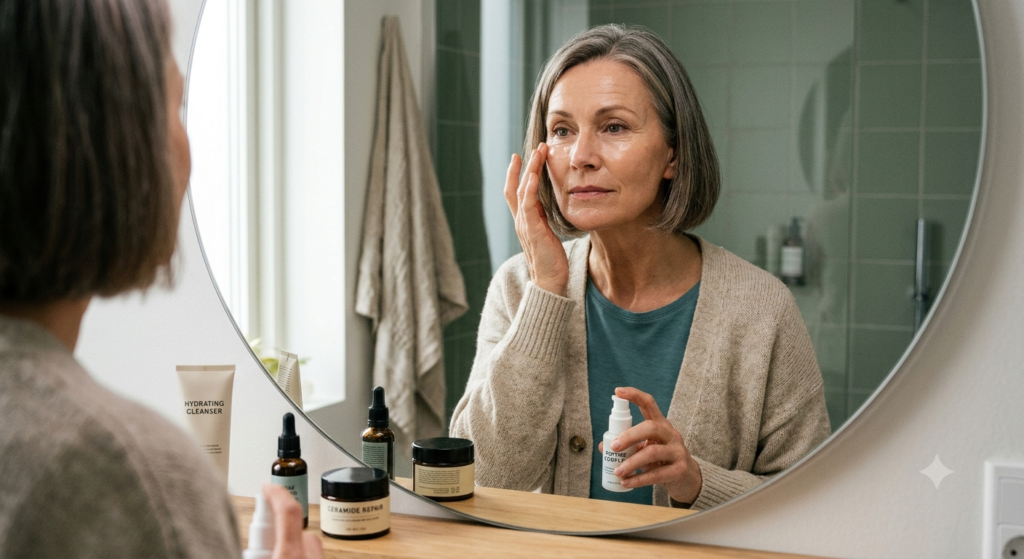
By the time most women reach their early 50s, they’re one to five years into menopause or perimenopause. During this stretch, skin can lose a significant portion of its collagen — some research points to roughly 30% within the first five years after menopause, with a slower decline after that.
Practically, this shows up as:
- Skin that feels thinner and bruises more easily
- Increased dryness, even in people who never had dry skin before
- Slower cell turnover, so dullness and rough texture build up
- Reduced barrier function, meaning products that used to feel fine can suddenly sting
- Volume loss in the cheeks and temples, which changes how existing fine lines look
- Slower wound healing, so blemishes and irritation take longer to resolve than they used to
The mistake most women make isn’t using the wrong products — it’s keeping the same routine structure from their 30s and 40s and just swapping in “anti-aging” versions of the same steps. A richer moisturizer alone doesn’t compensate for a barrier that’s actively breaking down, and a stronger retinol doesn’t help if the skin underneath can’t tolerate it yet. The structure itself needs to change, not just the labels on the bottles.
There’s also a timing issue that rarely gets addressed: many women make their biggest skincare changes reactively, after they notice a problem, rather than proactively as hormone levels shift. By the time dryness or sensitivity becomes obvious, the barrier has often already been compromised for months. Building the routine below before symptoms show up — even at 47 or 48 — tends to produce far better results than waiting.
The Complete Skin Care Routine Steps for Women Over 50
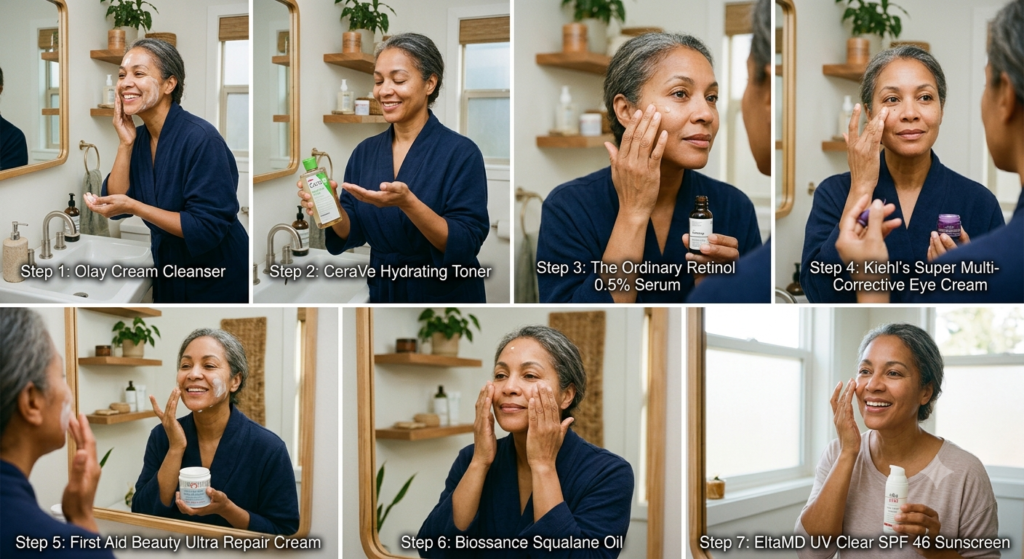
Here is the order that dermatologists generally recommend, along with what each step is actually doing and where women commonly go wrong.
Step 1: Cream or Oil-Based Cleanser (Morning and Night)
Foaming cleansers that were fine at 30 often strip mature skin, which already produces less oil. Switch to a cream, milk, or gel-to-oil cleanser that removes makeup and buildup without leaving skin tight afterward.
A quick way to test whether your current cleanser is too harsh: wash your face, wait ten minutes without applying anything else, and see how your skin feels. If it’s tight, squeaky, or slightly itchy, the cleanser is stripping more than it should.
Common mistake: Double cleansing every single night out of habit. If skin is dry and you didn’t wear heavy makeup or SPF that day, one gentle cleanse is enough. Over-cleansing accelerates barrier damage, and mature skin doesn’t rebuild its lipid layer as quickly as it used to.
Step 2: Hydrating Toner or Essence (Optional but Useful)
This step isn’t about “tightening pores” — that’s outdated marketing left over from the astringent-toner era of the 1990s. A hydrating toner or essence with humectants (glycerin, hyaluronic acid, panthenol) preps skin to absorb the next layers more effectively, which matters more as skin’s natural absorption slows down.
If your routine already feels long, this is the easiest step to skip without losing much benefit — unlike the moisturizer or SPF steps, which aren’t optional.
Step 3: Targeted Treatment (Serum)
This is where most of the “active” ingredients go, and it’s the step women over 50 tend to under-invest in, often because it’s the most confusing aisle at the drugstore. Here’s a simple way to match the concern to the ingredient:
- Fine lines, texture, dullness: a retinoid — either over-the-counter retinol or prescription tretinoin — used at night only
- Loss of firmness, dullness: vitamin C, used in the morning under sunscreen for added antioxidant protection
- Dehydration, lack of plumpness: hyaluronic acid, which can be used both morning and night
- Uneven tone, dark spots: niacinamide, gentle enough for twice-daily use for most people
- Redness, sensitivity: centella asiatica or azelaic acid, either time of day
Nuance most articles skip: After 50, skin often can’t tolerate the same retinoid strength or frequency it could handle at 40. If you’re seeing flaking, redness, or increased sensitivity, that’s not “purging” — it’s irritation, and it means you should scale back to two to three nights a week rather than pushing through. A surprising number of women stop retinoids entirely because of this reaction, when the real fix is simply less frequency, not zero.
Step 4: Eye Cream
The skin around the eyes has fewer oil glands to begin with, and that gap widens with age. A dedicated eye cream with peptides or a gentle retinoid-adjacent ingredient (like bakuchiol, for those sensitive to retinol) addresses this area without irritating it the way a full-strength facial retinoid would.
One detail that’s easy to miss: apply eye cream with your ring finger, using the lightest possible pressure, and pat it in rather than rubbing. The skin here is thin enough that repeated tugging motions, done daily over years, can contribute to the very fine lines you’re trying to treat.
Step 5: Moisturizer Built for Barrier Repair
This is the step that needs the biggest upgrade after 50. Look for moisturizers built around ceramides, cholesterol, and fatty acids — the same lipids skin naturally loses. Lightweight gel moisturizers that worked fine at 35 usually aren’t rich enough now, even if the skin doesn’t look visibly dry.
Situational example: If your skin feels fine in summer but tight and flaky by winter, you likely need two moisturizers in rotation, not one “good enough” year-round product. This is one of the most overlooked adjustments in routines for women over 50 — most women buy one moisturizer and stick with it regardless of season, which means it’s either too heavy for six months or too light for the other six.
Step 6: Facial Oil (Optional, Nighttime)
For very dry skin, a facial oil layered over moisturizer at night can seal in hydration more effectively than moisturizer alone. This isn’t necessary for everyone — if your skin still produces adequate oil, adding more can lead to clogged pores or a heavy feel without added benefit. A reasonable test: use it three nights in a row and see whether skin looks calmer or looks congested by morning.
Step 7: Sunscreen (Non-Negotiable, Every Morning)
Sun damage doesn’t stop mattering after 50 — if anything, it compounds existing collagen loss. A broad-spectrum SPF 30 or higher, applied as the last step every morning regardless of makeup plans, is the single highest-impact step in this entire routine. No serum or moisturizer, however advanced, can undo what daily unprotected sun exposure does over a decade.
A Sample Morning and Evening Routine
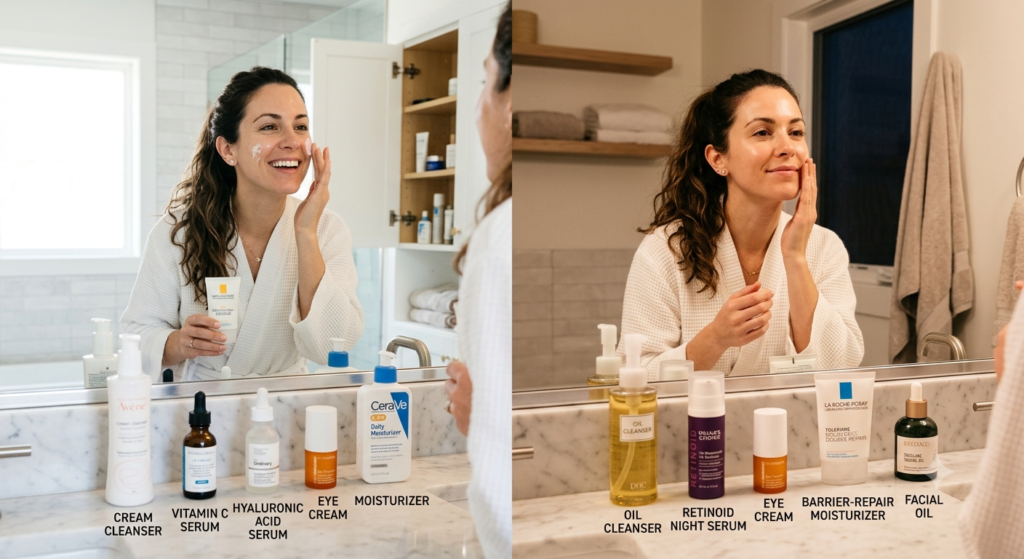
Morning:
- Cream cleanser (or just water if skin is very dry)
- Vitamin C serum
- Hyaluronic acid serum
- Eye cream
- Moisturizer
- SPF 30+
Evening:
- Cream or oil cleanser
- Retinoid (2–4 nights per week) or hydrating treatment on off nights
- Eye cream
- Barrier-repair moisturizer
- Facial oil, if needed
If this looks like a lot of steps, it’s worth remembering that not every step needs a separate product purchase — several brands now combine hyaluronic acid with vitamin C, or ceramides with a facial oil, in a single formula. The order matters more than the number of bottles.
Skin Care in Your 20s: What a 25-Year-Old Actually Needs
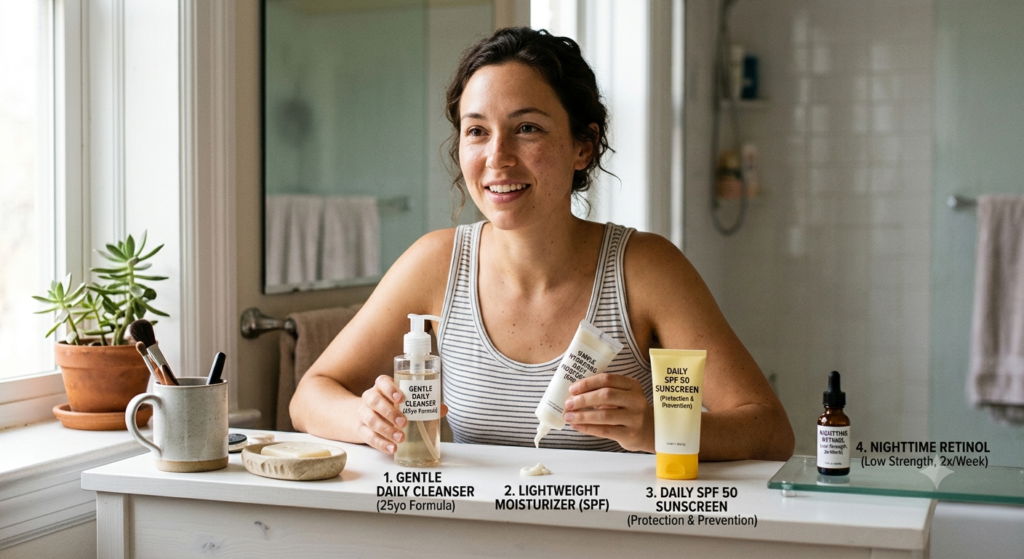
At 25, skin is still producing collagen efficiently, so the goal isn’t correction — it’s protection and prevention. A routine this age only really needs:
- Gentle cleanser
- Lightweight moisturizer
- Daily SPF (the habit that pays off most 20 years later)
- Optional: a low-strength retinol at night, 2–3 times a week, to build tolerance early
Common mistake at this age: Layering five or six actives because of trends seen online. Skin at 25 rarely needs that much intervention, and overuse can create sensitivity that shows up later — often as a compromised barrier in the 30s that takes months to repair. The irony is that the women most likely to over-treat at 25 are often the ones who end up with more sensitivity issues by 40.
30s Skincare Routine: The Shift Toward Prevention
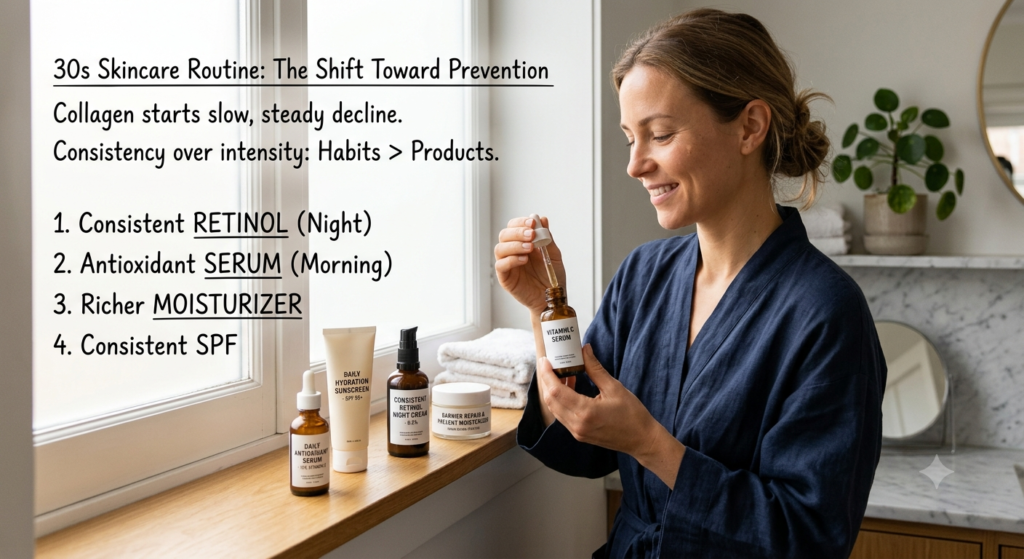
Collagen production starts its gradual decline in the early 30s — slow, but steady, roughly 1% per year. This is the decade to introduce:
- A consistent retinol (not just occasional use)
- Antioxidant serum (vitamin C) in the morning
- Slightly richer moisturizer than in your 20s
- Continued, consistent SPF use
This is also the decade where habits matter more than products. A retinol used inconsistently — a few nights on, weeks off, restarted after a break — does far less than a lower-strength retinol used steadily three nights a week for years. Consistency at 30 sets up everything that follows.
Skin Care for a 35-Year-Old: The In-Between Decade
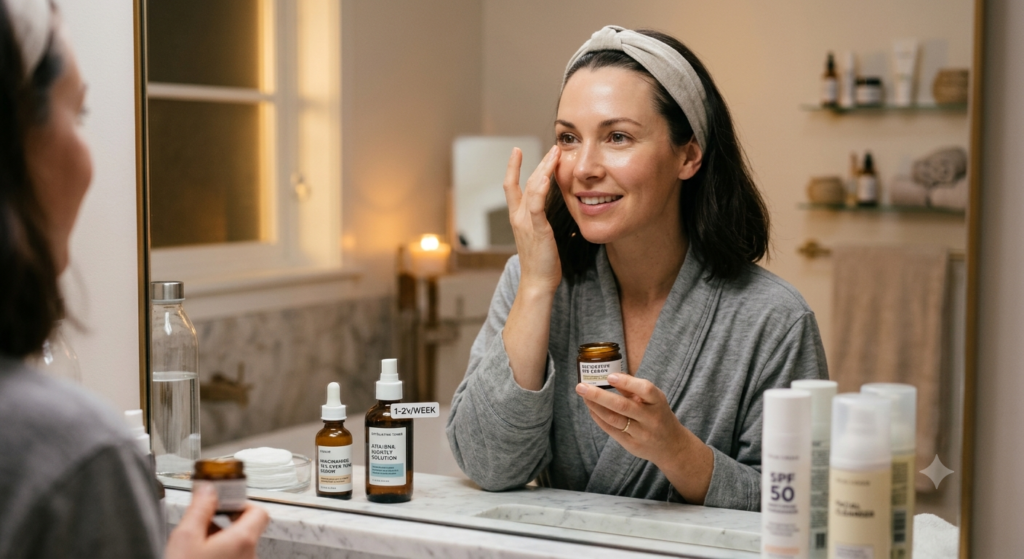
35 sits at an interesting point — early signs of slower cell turnover appear, but skin is usually still resilient. This is the ideal age to add:
- Niacinamide for tone evenness
- An exfoliating acid (AHA/BHA) once or twice a week
- A hydrating eye cream, if fine lines are starting to show
The biggest advantage at 35 is that skin still responds quickly to consistency — results from a new routine often show within 6–8 weeks, faster than they will a decade later. This is a good age to fix any long-standing bad habits, like skipping SPF reapplication or sleeping in makeup occasionally, before they compound further.
Skin Care for a 40-Year-Old Woman: Anti-Aging Becomes Structural
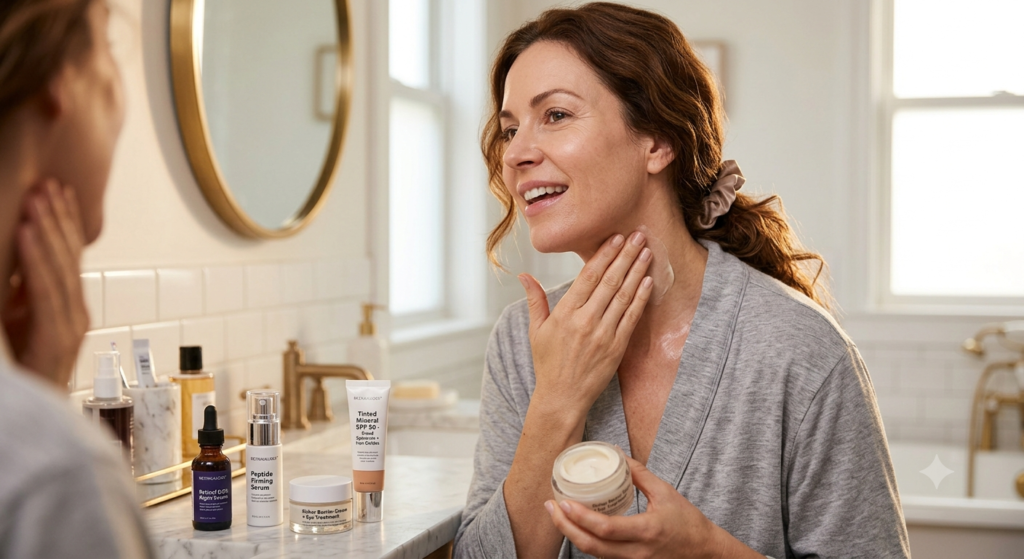
At 40, many women notice their skin looks different not just in texture but in shape — early volume loss in the midface, more visible nasolabial folds, and skin that photographs differently than it used to, particularly in certain lighting.
Routine priorities shift to:
- Stronger, more consistent retinoid use
- Peptide-based serums to support collagen signaling
- Richer moisturizer, especially around the eyes and neck
- SPF that also addresses existing pigmentation (tinted mineral sunscreens work well here, since the iron oxides in tinted formulas also help block visible light, which contributes to pigmentation in ways UV-only sunscreens don’t)
Overlooked detail: The neck and chest are frequently skipped in routines at this age, yet they show sun damage and thinning just as early as the face. Extending every step — cleanser through SPF — down to the neck and décolletage makes a visible difference over a year. Most women can point to their face and describe their routine in detail but have never applied a single product to their neck.
Skincare Routine for Women Over 60: Building on the Over-50 Foundation
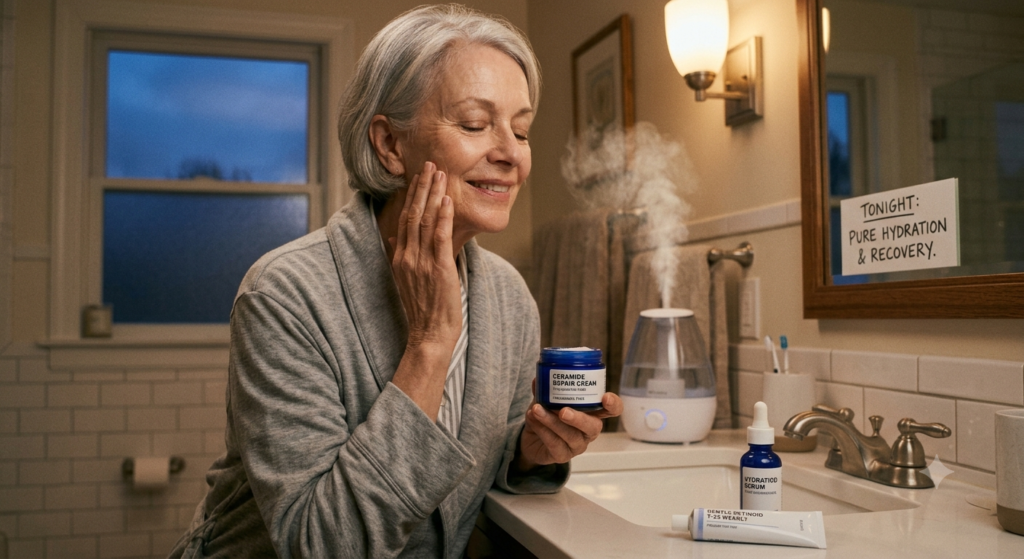
The core structure from the over-50 routine still applies after 60, but skin typically becomes even more barrier-compromised, so a few adjustments help:
- Simplify actives. Skin over 60 often tolerates fewer strong ingredients at once. Alternating retinoid nights with pure hydration nights (no actives at all) prevents cumulative irritation, and gives the barrier recovery time it may not have needed a decade earlier.
- Prioritize ceramide-rich, fragrance-free formulas. Fragrance and essential oils, even “natural” ones, are a common trigger for irritation at this stage, even in products that never caused a reaction in earlier decades.
- Add a humidifier to the nighttime routine, especially in dry climates or heated homes — skin over 60 loses moisture to the air faster than it can replace it topically, and this one change often does more for overall comfort than an extra product.
- Don’t skip retinoids entirely out of fear of irritation. Many women stop all actives after 60, but a gentle prescription retinoid used once or twice weekly, paired with strong moisturizer, still supports collagen and is generally well tolerated when introduced slowly and built up over months rather than weeks.
Skincare Products for Women Over 60: What to Actually Look For
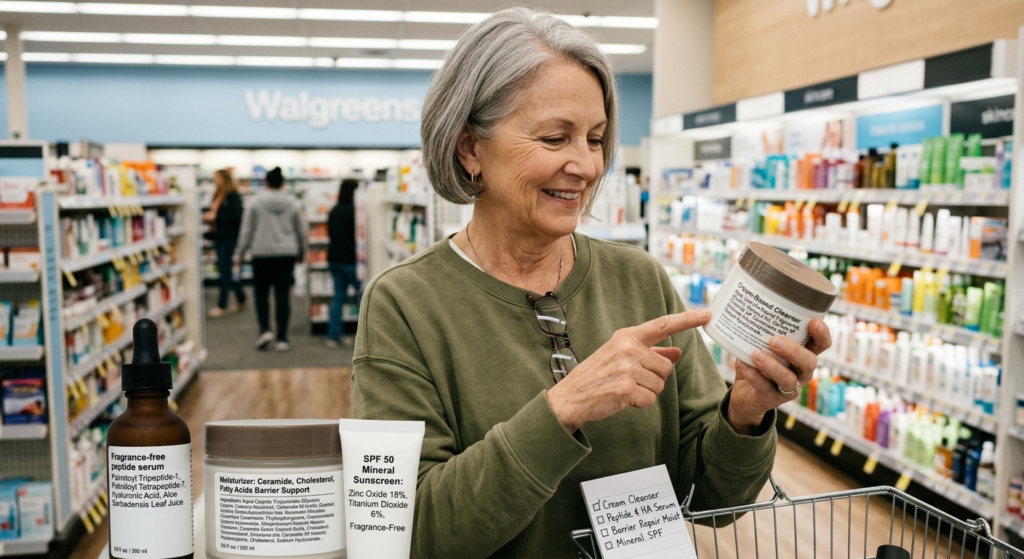
Rather than chasing specific brand names, look at ingredient lists for these markers of quality:
- Cleanser: cream or milk formula, no sulfates, ceramides listed in the first half of the ingredient list
- Serum: peptides plus hyaluronic acid, fragrance-free
- Moisturizer: ceramides, cholesterol, fatty acids together (this trio mimics skin’s natural barrier more effectively than any single ingredient, and the combination matters more than any one of them alone)
- SPF: mineral-based (zinc oxide or titanium dioxide) tends to cause less irritation on thinner, more reactive skin than chemical filters, and doesn’t sting as easily around the eye area
It’s also worth reading past the front-of-package claims. “Anti-aging” and “firming” aren’t regulated terms, so two products with that exact language on the label can have completely different formulations. The ingredient list, not the marketing copy, is the reliable source of information.
Common Mistakes at Every Age
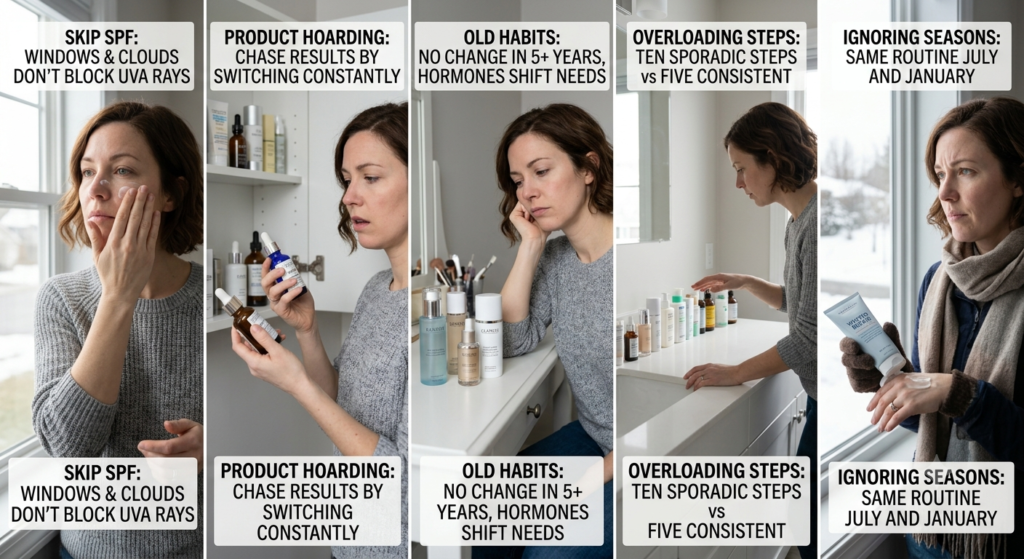
- Skipping SPF on cloudy days or “indoor” days — UVA rays penetrate windows and clouds, and cumulative exposure adds up even without a visible sunburn
- Switching products too frequently to chase results, which never allows skin enough time (usually 6–12 weeks) to show whether something is working
- Using the same routine for five-plus years without reassessing, even as hormonal changes shift skin’s needs in ways that aren’t always visible right away
- Assuming more steps equals better results — a five-step routine used consistently outperforms a ten-step routine used sporadically
- Ignoring how climate and season affect the routine, and expecting one moisturizer or one SPF formula to perform identically in July and January
FAQ
Can I start retinol for the first time after 50? Yes. Start with a low concentration two nights a week, always followed by moisturizer, and increase frequency slowly over several months. There’s no benefit to rushing this — slower introduction generally means fewer setbacks and better long-term tolerance.
Do I need different products for morning and night? Not entirely different lines, but yes — mornings should prioritize antioxidants and SPF, while nights are the time for retinoids and richer repair-focused products, since skin does most of its repair work while you sleep.
How long before I see results from a new routine over 50? Generally 8–12 weeks for texture and tone changes, and 4–6 months for firmness-related improvements, since collagen remodeling is a slow process that doesn’t show up overnight, regardless of what before-and-after photos online might suggest.
Is it too late to start a real skincare routine at 55 or 60 if I’ve never had one? No. Skin continues to respond to consistent care at any age. The starting point may be different, but ceramide-based moisturizers, daily SPF, and a gradually introduced retinoid still produce meaningful improvements in texture and comfort within a few months.
Conclusion
The skin care routine steps for women over 50 aren’t complicated, but they do need to be intentional: gentle cleansing, targeted treatment, real barrier repair, and daily SPF, in that order, every day. What changes most isn’t the number of steps — it’s the reasoning behind each one, shaped by what’s actually happening hormonally at this stage.
If you’re building or rebuilding a routine right now, start with one change: swap your current moisturizer for a ceramide-based barrier cream and add SPF as a non-negotiable final step. Layer in a retinoid gradually from there. Small, consistent adjustments made in the right order will outperform a complete overhaul every time — and unlike a routine built around trends, one built around what your skin actually needs at this stage tends to keep working for years, not months.