Most “skin care hacks” articles say the same five things: drink water, sleep more, wear sunscreen, don’t touch your face, use a gentle cleanser. All true. None of it explains why your skin still looks dull after doing all of that for two weeks straight.
The truth is that skin responds to consistency, sequencing, and a handful of details most people skip — not to more products. Somewhere between “just use sunscreen” and a 12-step Korean routine, most people give up because nobody tells them what to expect on which day, or why the plan seems to stop working around week three. That gap is exactly what this guide fills.
This is a longer, more detailed version of a topic that usually gets skimmed over: what actually happens to your skin in 2 days versus 7 days versus 30, the mistakes that quietly cancel out good habits, how to set goals you won’t abandon by Thursday, and a realistic breakdown of what a full month of consistent care looks like on someone’s face — including the parts that don’t fully resolve, because pretending everything clears up in 30 days is how people end up disappointed and quitting. If you only have time for one section, read the mistakes list first. It’s the part most guides skip entirely, and it’s usually the reason “good” routines stop producing results.
What Actually Makes Skin Care Hacks Work (vs. Just Sounding Good)
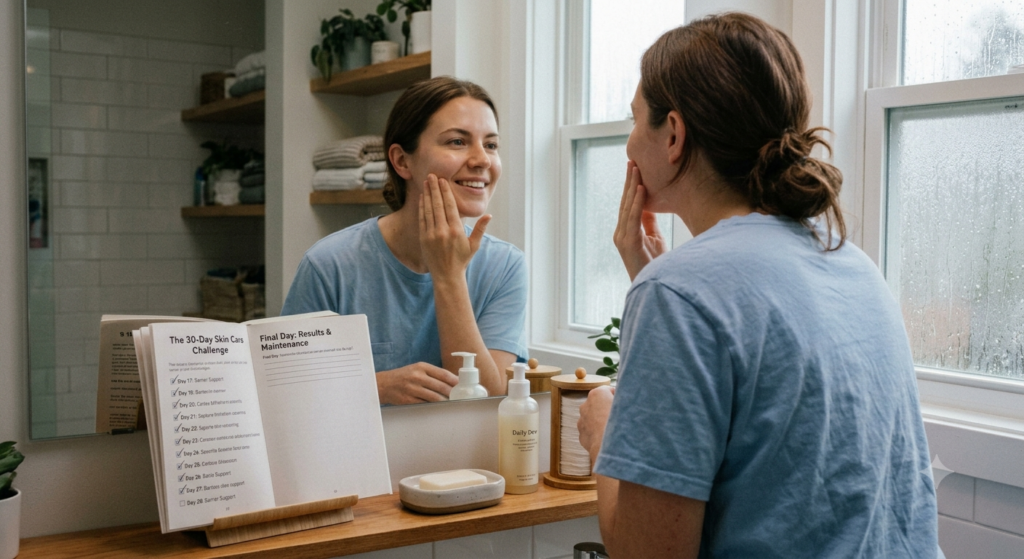
A “hack” only earns a place in your routine if it does one of three things: reduces irritation, supports your skin barrier, or speeds up cell turnover without stripping the skin in the process. Anything that doesn’t fit into one of those three buckets is probably a trend, not a mechanism — and trends are fine as long as you know that’s what they are.
Here’s why this distinction matters in practice. Ice rolling is popular because it feels effective — it reduces puffiness for about 20–30 minutes by constricting blood vessels near the surface. That’s a real, measurable effect. But it doesn’t change acne, texture, or tone long-term, because it doesn’t touch cell turnover or barrier function at all. That’s not a criticism of ice rolling — it’s a reminder to sort hacks by what they can and can’t do before building a routine around them, so you’re not disappointed when a de-puffing trick doesn’t clear a breakout.
The same logic applies to jade rollers, gua sha, LED masks, and DIY masks made from pantry ingredients. Some of these have legitimate, if modest, effects (LED red light has some evidence for mild collagen support; gua sha genuinely reduces lymphatic puffiness). Others — like toothpaste on pimples or lemon juice for brightening — actively damage the skin barrier while offering no real benefit. The filter below helps you sort quickly.
Quick filter to use before trying any skin hack you see online:
- Does it address barrier repair, sun protection, or cell turnover? Keep it in rotation.
- Is the result purely visual and temporary, like de-puffing or a glossy, filter-like sheen? Fine to use occasionally, but don’t build your whole routine around it.
- Does it involve scrubbing, high-frequency exfoliation, or DIY acids (lemon juice, baking soda, straight cinnamon, raw garlic)? Skip it entirely — these damage the barrier faster than they improve anything, and the damage often shows up days or weeks later as unexplained sensitivity.
- Is it a product claiming results in under 48 hours for acne scarring, deep pigmentation, or wrinkles? Treat the claim with skepticism — nothing legitimate works that fast on those specific concerns.
5 Skin Care Mistakes That Quietly Undo Your Progress
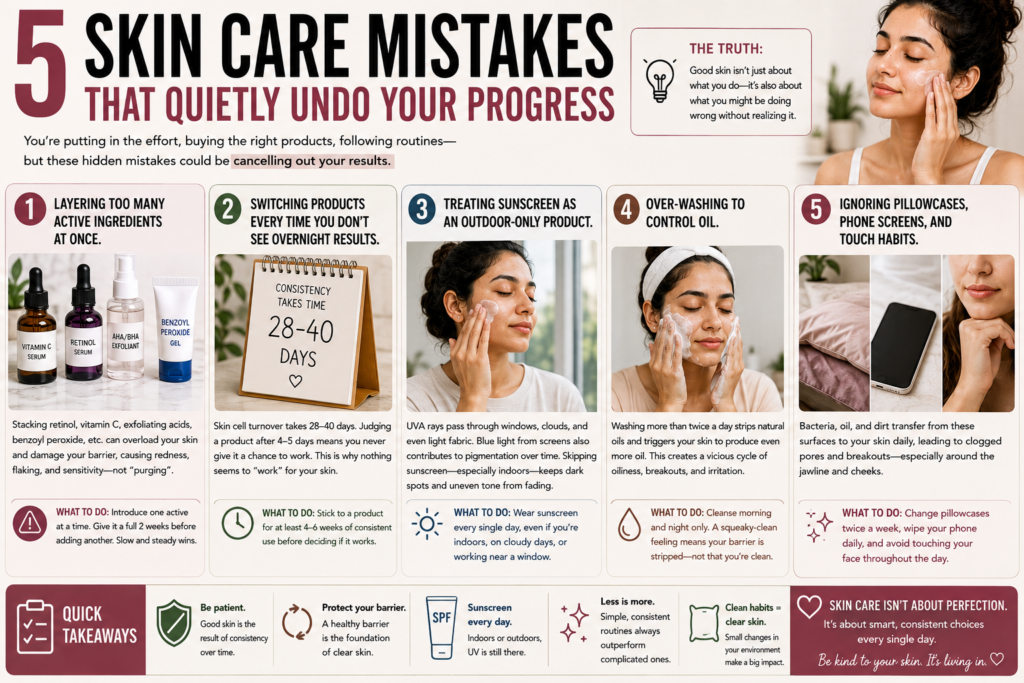
These aren’t the obvious mistakes you’ve already heard a hundred times (forgetting sunscreen, sleeping in makeup). These are the ones that sabotage people who are genuinely trying, which is what makes them so frustrating — the effort is real, but the results still don’t show up.
1. Layering too many active ingredients at once.
Retinol, vitamin C, exfoliating acids, and benzoyl peroxide all work individually — but stacking three or more of them into one routine usually causes irritation that looks like “bad skin,” when it’s actually barrier damage from overload. This is especially common with people who follow multiple skin care influencers at once and combine everyone’s “must-have” product into a single nightly stack. Pick one active ingredient to introduce at a time, and give it a full two weeks before adding another. If your skin gets red, flaky, or stingy, that’s not “purging” — that’s your barrier telling you to slow down.
2. Switching products every time you don’t see overnight results.
Skin cell turnover takes roughly 28–40 days depending on age (it slows as you get older, which is part of why routines that worked in your teens can stop working in your late 20s without any other change). Judging a new product after 4–5 days and swapping it out means you never actually see what any single product does. This is the single biggest reason people feel like “nothing works” for their skin — they never let anything finish its full cycle before moving on to the next thing.
3. Treating sunscreen as an outdoor-only product.
UVA rays pass through windows, clouds, and even light fabric. Indoor screen exposure (blue light from phones, laptops, and monitors) also contributes to pigmentation over time, particularly in people with more melanin in their skin. Skipping sunscreen on “indoor days” — work-from-home days, rainy days, days spent near a window — is one of the most common reasons dark spots and uneven tone don’t fade even when someone is doing everything else right.
4. Over-washing to control oil.
Washing your face more than twice a day strips natural oils, which triggers the skin to overproduce oil to compensate. This creates a frustrating cycle where oily skin gets oilier the more it’s washed — the exact opposite of the intended effect. This mistake is especially common with people using foaming or gel cleansers with sulfates multiple times a day, thinking a “squeaky clean” feeling means the skin is actually clean. That tight, squeaky feeling is usually a sign the barrier has been stripped, not that the skin is healthy.
5. Ignoring pillowcases, phone screens, and touch habits.
Bacteria and oil buildup on pillowcases and phone screens transfer directly to skin nightly and throughout the day. This is a completely free fix that most routines never account for — changing a pillowcase twice a week, wiping down your phone screen daily, and being conscious of resting your chin or cheek on your hand during the day (a habit most people don’t even notice they have). Combined, these small contact points can be responsible for a surprising amount of jawline and cheek breakouts that no product seems to fix, simply because the product isn’t the problem.
Skin Care Tips That Actually Move the Needle
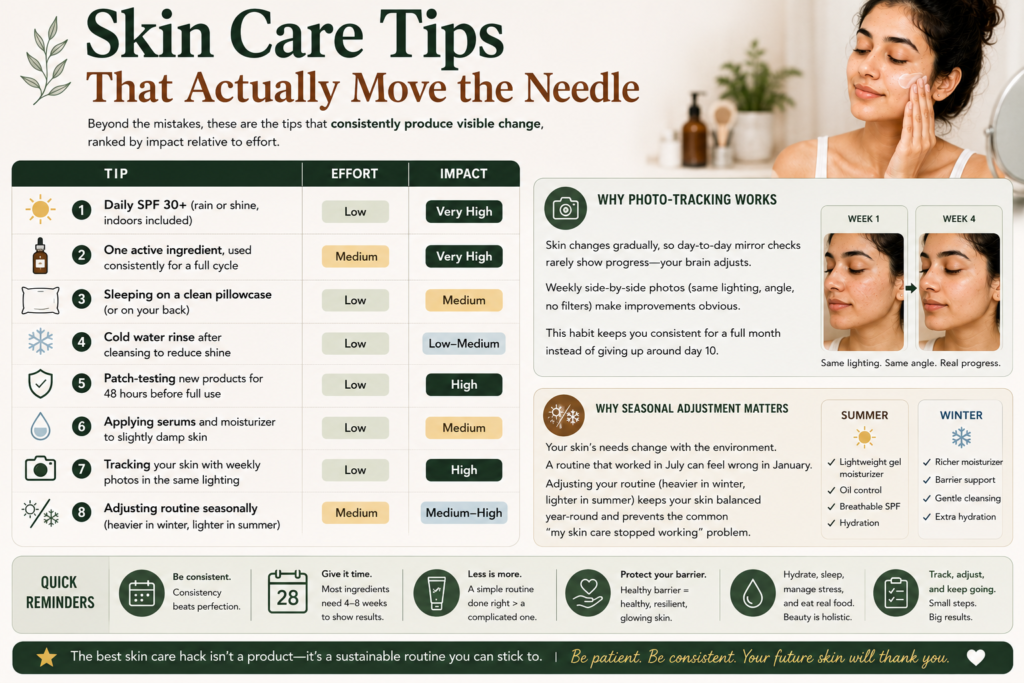
Beyond the mistakes above, here are the tips that consistently produce visible change, ranked by impact relative to effort.
| Tip | Effort | Impact |
|---|---|---|
| Daily SPF 30+ (rain or shine, indoors included) | Low | Very High |
| One active ingredient, used consistently for a full cycle | Medium | Very High |
| Sleeping on a clean pillowcase (or on your back) | Low | Medium |
| Cold water rinse after cleansing to reduce shine | Low | Low-Medium |
| Patch-testing new products for 48 hours before full use | Low | High (prevents setbacks) |
| Applying serums and moisturizer to slightly damp skin | Low | Medium |
| Tracking your skin with weekly photos in the same lighting | Low | High (accountability) |
| Adjusting routine seasonally (heavier in winter, lighter in summer) | Medium | Medium-High |
The photo-tracking tip is consistently underrated, and it deserves more explanation than a single line in a table. Skin changes gradually enough that you often can’t tell it’s improving day-to-day, because you’re looking at your own face in the mirror multiple times a day and your brain adjusts to gradual change. A side-by-side comparison from week one versus week four, taken in the same lighting and angle, usually makes the progress obvious in a way that daily mirror-checking never does. This single habit is often the difference between someone sticking with a routine for a full month versus giving up around day 10 because “nothing seems different.”
Seasonal adjustment is the other tip people skip, and it explains a lot of “my skin care stopped working” complaints. A moisturizer that felt perfect in July can feel too light in January, leading people to assume their skin got worse when really their environment changed and their routine didn’t follow.
The 7-Day Skin Care Challenge
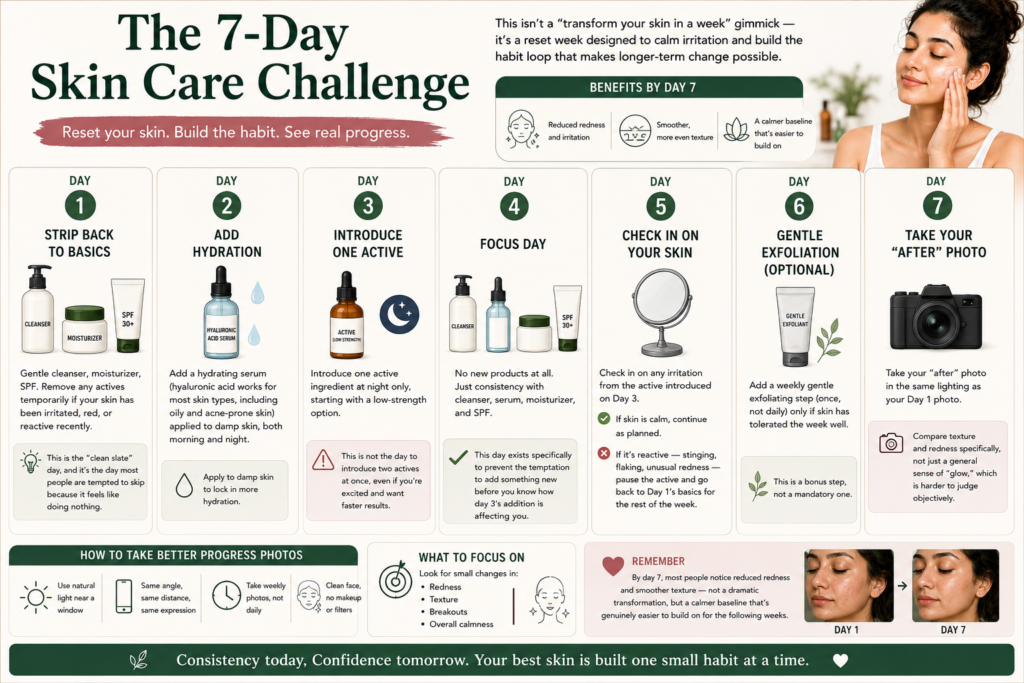
This isn’t a “transform your skin in a week” gimmick — it’s a reset week designed to calm irritation and build the habit loop that makes longer-term change possible. Trying to overhaul your entire routine and see dramatic change in seven days sets you up to feel like it failed, when in reality seven days is enough time to stabilize, not transform.
Day 1: Strip back to basics — gentle cleanser, moisturizer, SPF. Remove any actives temporarily if your skin has been irritated, red, or reactive recently. This is the “clean slate” day, and it’s the day most people are tempted to skip because it feels like doing nothing.
Day 2: Add a hydrating serum (hyaluronic acid works for most skin types, including oily and acne-prone skin, contrary to popular belief) applied to damp skin, both morning and night.
Day 3: Introduce one active ingredient at night only, starting with a low-strength option. This is not the day to introduce two actives at once, even if you’re excited and want faster results.
Day 4: Focus day — no new products at all. Just consistency with cleanser, serum, moisturizer, and SPF. This day exists specifically to prevent the temptation to add something new before you know how day 3’s addition is affecting you.
Day 5: Check in on any irritation from the active introduced on Day 3. If skin is calm, continue as planned. If it’s reactive — stinging, flaking, unusual redness — pause the active and go back to Day 1’s basics for the rest of the week.
Day 6: Add a weekly gentle exfoliating step (once, not daily) only if skin has tolerated the week well. This is a bonus step, not a mandatory one.
Day 7: Take your “after” photo in the same lighting as your Day 1 photo. Compare texture and redness specifically, not just a general sense of “glow,” which is harder to judge objectively.
By day 7, most people notice reduced redness and smoother texture — not a dramatic transformation, but a calmer baseline that’s genuinely easier to build on for the following weeks.
The 1-Week Glow Up Challenge for Skin
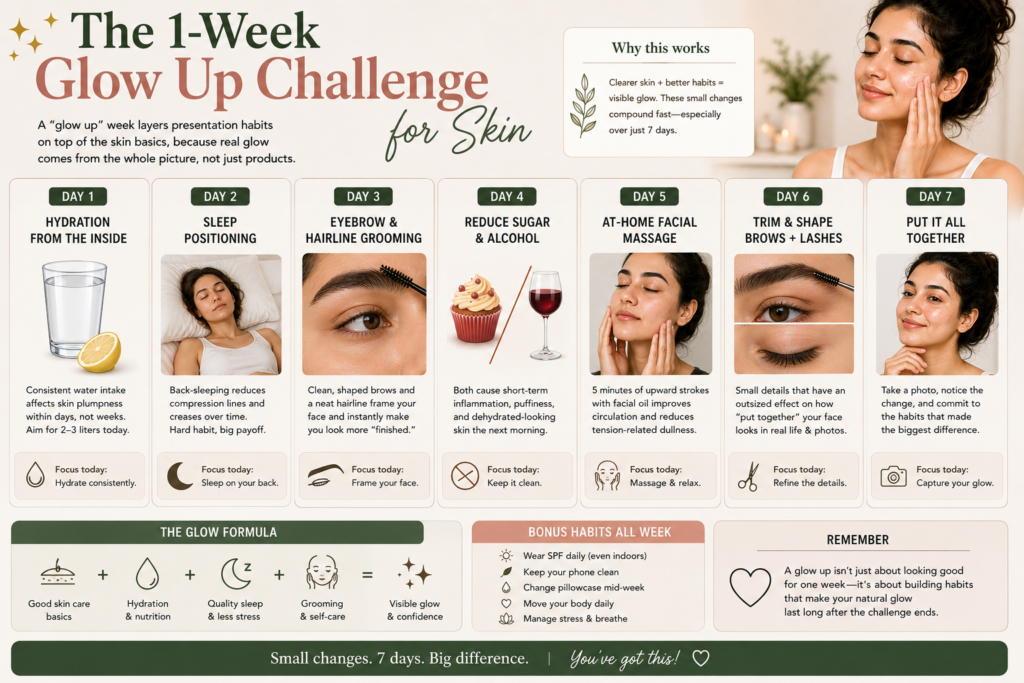
A “glow up” week layers presentation habits on top of the skin basics above, because a large part of visible glow comes from things adjacent to skin care itself, not from skin care products alone.
- Hydration from the inside — consistent water intake affects skin plumpness within days, not weeks, and is one of the fastest visible changes available.
- Sleep positioning — side-sleeping creates compression lines and creases over time from repeated pressure against a pillow; back-sleeping reduces this, though it’s genuinely one of the hardest habits to change.
- Eyebrow and hairline grooming — framing the face cleanly makes skin look more “finished” even without makeup, and it’s a change people notice in others before they can articulate why someone looks different.
- Reducing sugar and alcohol for the week — both are linked to short-term inflammation, puffiness, and dehydrated-looking skin the following morning.
- One at-home facial massage session — around 5 minutes of upward strokes with a facial oil can reduce tension-related dullness, particularly around the jaw and forehead where people hold stress without realizing it.
- Trimming or shaping brows and lashes — a small, often-skipped detail that has an outsized effect on how “put together” a face looks in photos.
The combination of clearer skin and better framing — brows, hair, hydration, sleep — is usually what people actually mean when they say someone had a “glow up.” It’s rarely skin care alone, which is why someone can have a technically great routine and still not look like they’ve changed much, if the surrounding habits haven’t shifted too.
Skin Care Goals: How to Set Ones You’ll Actually Hit
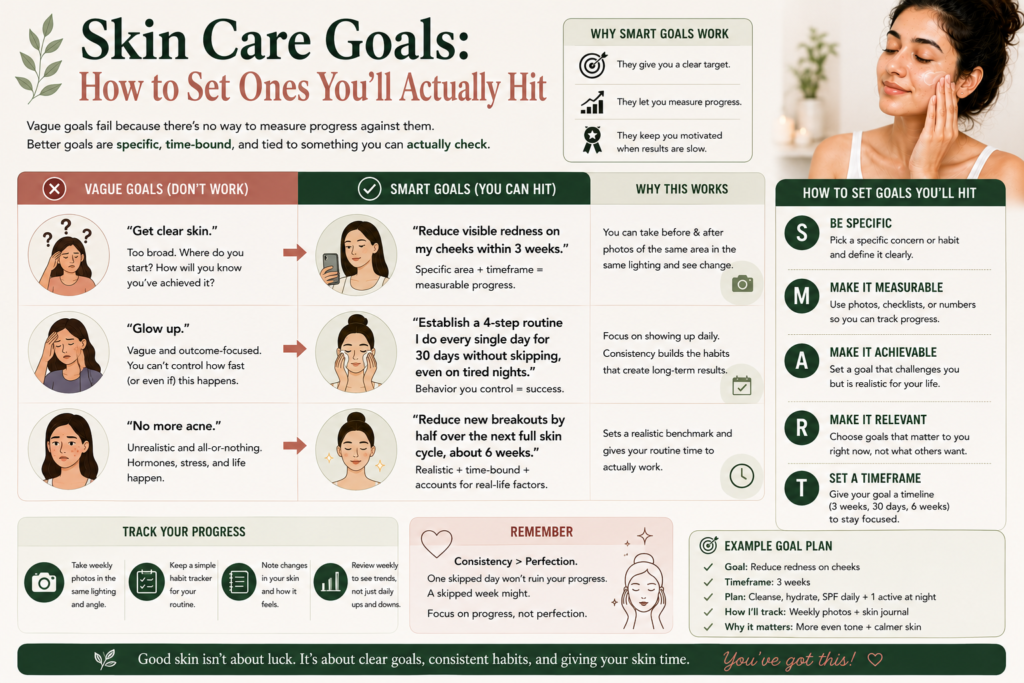
Vague goals — “get clear skin,” “look better,” “fix my skin” — fail because there’s no way to measure progress against them, and that lack of measurement is what kills motivation somewhere around week two. Better goals are specific, time-bound, and tied to something you can actually check.
Instead of “clear skin,” try: “Reduce visible redness on my cheeks within 3 weeks.” This gives you a specific area to photograph and compare.
Instead of “glow up,” try: “Establish a 4-step routine I do every single day for 30 days without skipping, even on tired nights.” This makes the goal about behavior, which is entirely within your control, rather than about an outcome that depends on many variables.
Instead of “no more acne,” try: “Reduce new breakouts by half over the next full skin cycle, about 6 weeks.” This accounts for the fact that some breakouts are hormonal or stress-related and won’t disappear completely regardless of routine quality.
The reason this reframing works: skin care goals framed around consistency — routine adherence — rather than outcome — clear skin by Friday — are far more achievable. Ironically, they also tend to produce the outcome-based results faster, because they don’t get abandoned during a single slow or discouraging week the way outcome-only goals do.
What You Can Realistically Achieve in 2 Days
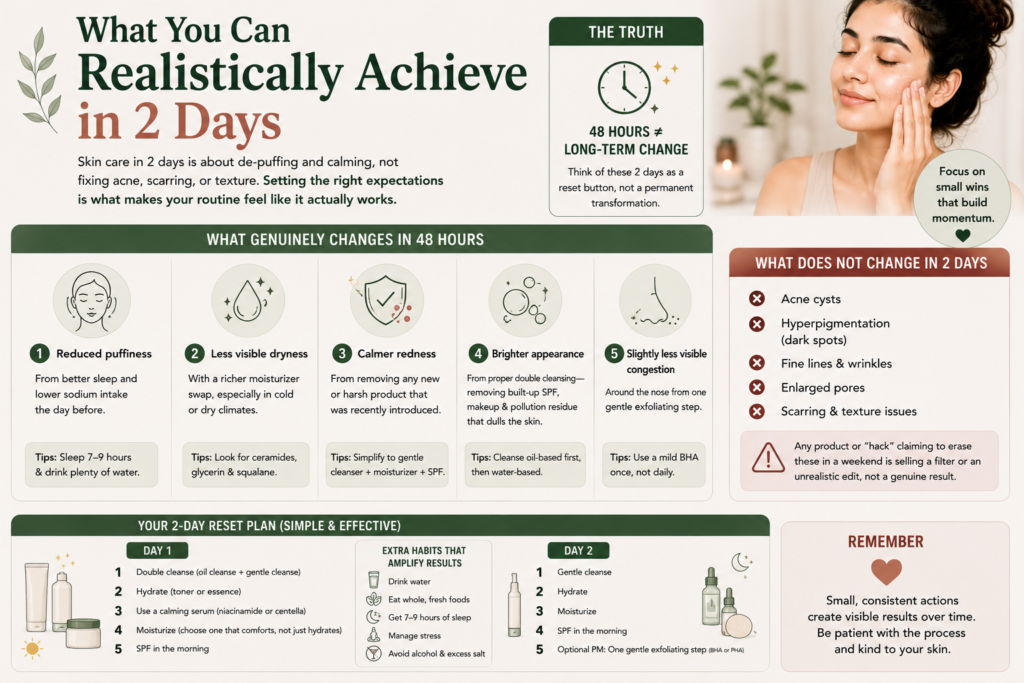
It’s worth being honest here, because a lot of content oversells this timeframe: skin care in 2 days is about de-puffing and calming, not fixing acne, scarring, or texture. Setting the wrong expectation for a 48-hour window is exactly what makes people feel like skin care “doesn’t work” — they’re judging a 6-week process on a 2-day timeline.
What genuinely changes in 48 hours:
- Reduced puffiness from better sleep and lower sodium intake the day before.
- Less visible dryness with a richer moisturizer swap, especially in cold or dry climates.
- Calmer redness from removing any new or harsh product that was recently introduced.
- A brighter appearance from proper double cleansing — removing built-up SPF, makeup, and pollution residue that dulls the surface of the skin.
- Slightly less visible congestion around the nose from one gentle exfoliating step, though this is cosmetic and temporary, not a fix for underlying clogged pores.
What does not change in 2 days: acne cysts, hyperpigmentation, fine lines, enlarged pores, or scarring. Any product or “hack” claiming otherwise, especially anything promising to erase dark spots or scars in a weekend, is selling a filter or an unrealistic edit, not a genuine result.
The 30-Day Skin Care Challenge
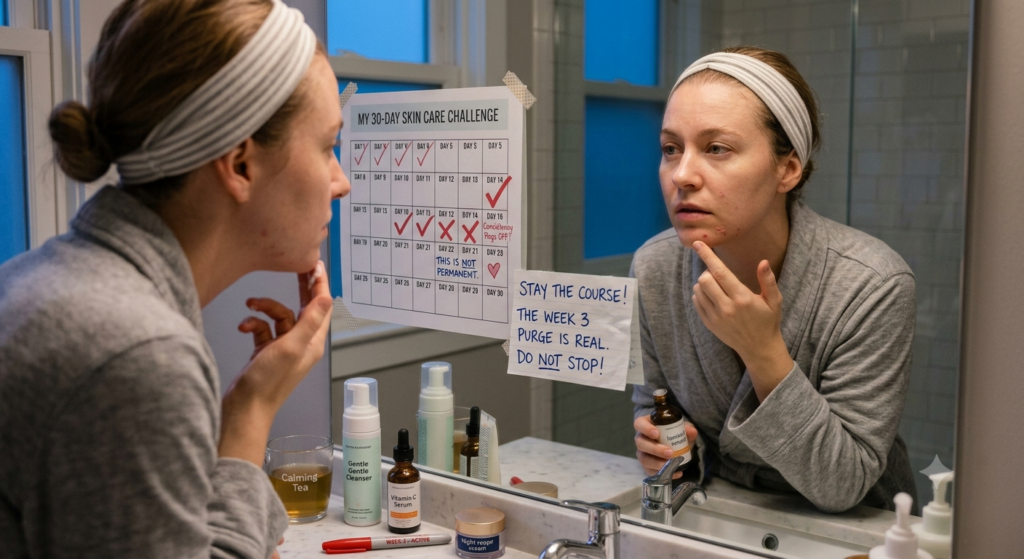
Thirty days lines up almost exactly with one full skin cell turnover cycle, which is why it’s the most realistic timeframe for visible structural change — not just surface-level glow, but actual improvement in texture, tone, and breakout frequency.
Week 1: Reset and stabilize, following the 7-day plan above as your foundation.
Week 2: Introduce your one core active ingredient consistently, and monitor closely for irritation, since this is often when mild purging or adjustment starts.
Week 3: This is typically the “purge” or adjustment week for actives like retinoids or higher-strength acids — texture may temporarily look worse before it improves, especially if you’re dealing with clogged pores that are being pushed to the surface faster than usual. This is also, statistically, the most commonly abandoned week of any skin care plan, because it’s the point where effort and visible results seem to move in opposite directions.
Week 4: Add a second supporting step, like a weekly mask or a second active spaced out from the first, only if week 3 was tolerated reasonably well. Take your final comparison photo at the end of this week, using the same lighting and angle as your day-1 photo.
Common mistake during the 30-day challenge: people restart from zero every time they see a single breakout, treating it as proof the entire routine failed. One breakout is data, not a verdict — hormonal cycles, stress, poor sleep, and diet all cause isolated flare-ups independent of whether your routine is actually working. The people who see through the full 30 days are usually the ones who’ve decided in advance that one bad skin day mid-month doesn’t mean starting over.
Real Example: A Guy’s Face After 1 Month of Skin Care
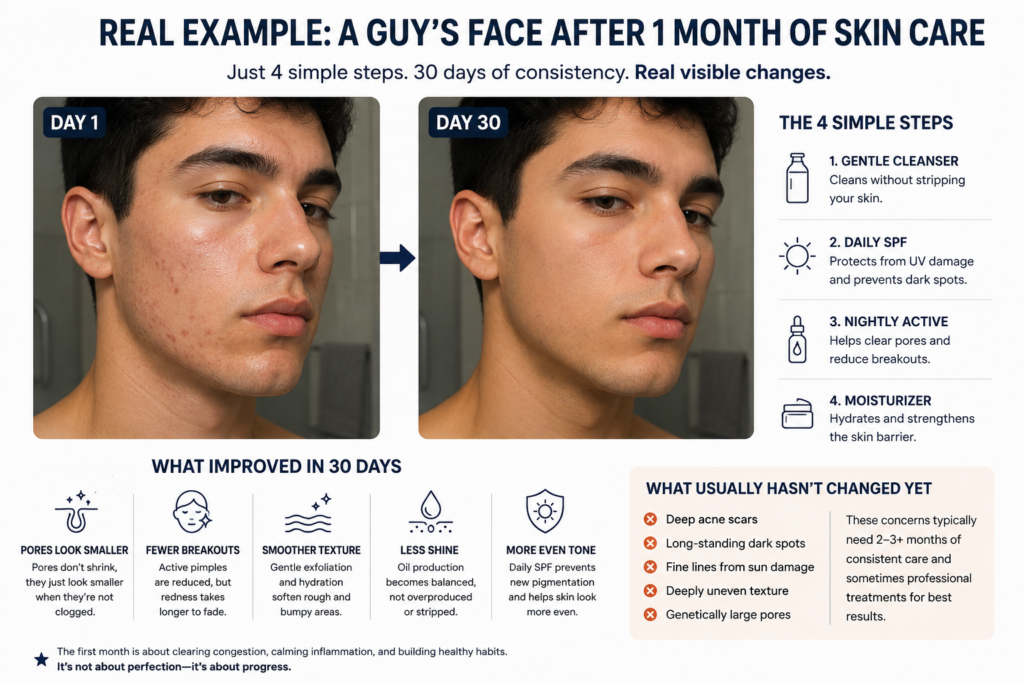
A common before-and-after scenario looks like this: a guy in his early 20s starts with clogged pores across the nose and forehead, mild acne along the jawline from shaving irritation, and dull, slightly rough texture from never having moisturized consistently in his life.
After 30 days of just four consistent steps — a gentle cleanser, daily SPF, one nightly active (typically a low-strength salicylic acid or adapalene), and a basic fragrance-free moisturizer — the most common changes are:
- Noticeably smaller-looking pores. It’s worth being precise here: pores don’t physically shrink or grow. They appear smaller when they’re not clogged with oil and dead skin, which is why “shrinking pores” is really a congestion fix, not a structural one.
- Fewer active breakouts, though some post-acne redness typically remains and takes longer than 30 days to fully fade, sometimes another 4–8 weeks depending on skin tone and how the breakouts were treated (or picked at) beforehand.
- Smoother texture, especially across the forehead, from consistent gentle exfoliation and better hydration.
- Less shine by midday, from more balanced — not stripped — oil production, once the over-washing cycle from Mistake #4 above is broken.
- A slightly more even tone overall, mostly attributable to consistent SPF use preventing new pigmentation rather than any single “brightening” product.
What typically hasn’t resolved by day 30: deeper acne scarring, established dark spots, and texture issues from years of no moisturizer use. Those require 2–3+ months minimum, sometimes longer for textured scarring that may need professional treatment like microneedling or chemical peels to fully resolve. The realistic takeaway from any “1 month glow up” example is that month one fixes surface-level congestion and active inflammation — it doesn’t erase years of skin history, and expecting it to is a setup for disappointment rather than motivation.
Skin Care Glow Up: What It Really Takes
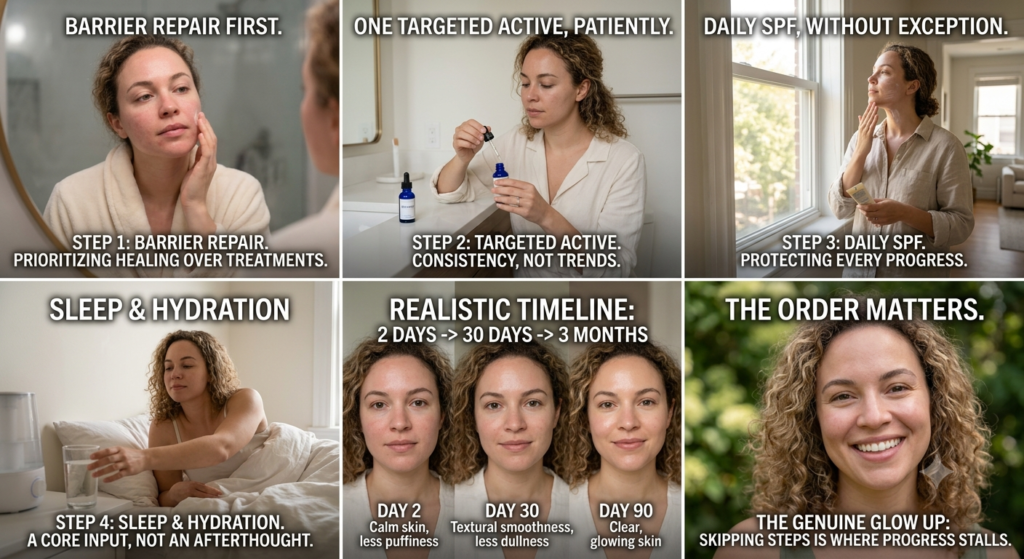
A genuine glow up is layered, not a single product, hack, or purchase — and skipping the order below is the most common reason glow up attempts stall halfway through.
- Barrier repair first. Nothing looks glowy on irritated, compromised skin, no matter how good the product layered on top is. If your skin currently feels tight, stingy, or reactive, this step comes before anything else, including the active ingredient you’re excited about.
- One targeted active, used correctly and patiently. Chosen based on your actual concern — acids for texture and mild acne, retinoids for texture and fine lines, azelaic acid for redness and tone — not based on whatever’s trending that week.
- Daily SPF, without exceptions, including indoor days, cloudy days, and days you’re “just running errands.” This single habit protects every other change you make.
- Sleep and hydration, which affect the visible quality of skin faster than most topical products, and which most routines treat as an afterthought rather than a core input.
- Realistic timeline expectations — 2 days for de-puffing, 7 days for calming and stabilizing, 30 days for the first real structural change, and 2–3 months for anything involving scarring or deep pigmentation.
Skipping straight to steps 2 or 3 without step 1 is why so many glow up attempts stall — people add treatments to skin that’s still inflamed or barrier-damaged from over-washing, over-exfoliating, or stacking too many actives, which is exactly the mistake covered earlier in this guide. The order matters as much as the ingredients themselves.
Skin Care Questions (Quick FAQ)
How long until I see real results from a new skin care routine?
Expect subtle changes — less redness, better hydration, a calmer overall look — within a week. Structural changes, like fewer breakouts and improved texture, tend to show up around the 4–6 week mark, which lines up with a full skin cell turnover cycle.
Can I do the 7-day challenge and the 30-day challenge back to back?
Yes — the 7-day plan is designed to function as week one of the 30-day plan. Think of it as the on-ramp rather than a separate, unrelated program.
Why did my skin get worse in week 2 or 3 before getting better?
This is common with active ingredients like retinoids and is often referred to as “purging” — it’s the skin adjusting to increased cell turnover, sometimes pushing existing congestion to the surface faster than before. It should improve, not continue worsening, by week 4; if it keeps getting worse past that point, scale back frequency rather than pushing through.
Do I need expensive products for any of this to work?
No. Consistency and correct sequencing — cleanse, treat, moisturize, protect — matter far more than price point. A well-formulated $12 SPF used every single day will outperform a $60 serum used sporadically, simply because sporadic use never gives an ingredient the time it needs to work.
Is it normal for one side of my face to improve faster than the other?
Yes, and it’s one of the more overlooked realities of skin care. Sleep position, sun exposure while driving, and even which hand you use to rest your face during the day can cause one side to show visible change before the other. This isn’t a sign anything is wrong — it’s just asymmetry in habits, not in the routine itself.
Should I stop everything if I have a breakout mid-routine?
No — this is the exact mistake covered in the 30-day section above. A single breakout mid-routine is far more likely to be hormonal, stress-related, or diet-related than a sign your products have failed. Restarting from scratch every time this happens is what prevents most people from ever making it through a full skin cycle.
Conclusion
Skin care hacks that actually work aren’t secrets — they’re sequencing, patience, and avoiding the five mistakes that quietly cancel out otherwise good habits. Two days can calm and de-puff. Seven days can reset and stabilize. Thirty days is where real, structural change shows up, provided you don’t quit during the adjustment period around week three, and provided you’re setting goals around consistency rather than an overnight outcome.
If you’re starting today, don’t try to do everything in this guide at once. Pick the 7-day challenge, fix the one mistake from the list above that sounds most like you, and take a photo before you begin. That single photo will end up being the most convincing piece of evidence that consistency — not a miracle product — is what actually changes skin.