Somewhere between ages 12 and 14, most teenagers wake up to a skin that behaves nothing like it used to. Suddenly there’s oil by lunchtime, a breakout the night before picture day, and a bathroom cabinet full of products that promised clear skin and delivered redness instead.
Here’s the part nobody tells teenagers: most of what’s marketed to them is either too aggressive, too expensive, or solving a problem their skin doesn’t actually have. A 15-year-old with occasional hormonal breakouts does not need the same routine as a 30-year-old dealing with wrinkles, and using adult anti-aging products on teenage skin is one of the most common (and avoidable) skin care mistakes.
This guide breaks down what’s actually happening to teenage skin, how to build a routine that matches your specific skin type, what to do about acne without overdoing it, and how the needs of a 14-year-old differ from those of an 18-year-old. No filler, no 10-step routines you’ll abandon in a week — just what works.
Why Teenage Skin Behaves Differently Than Adult Skin
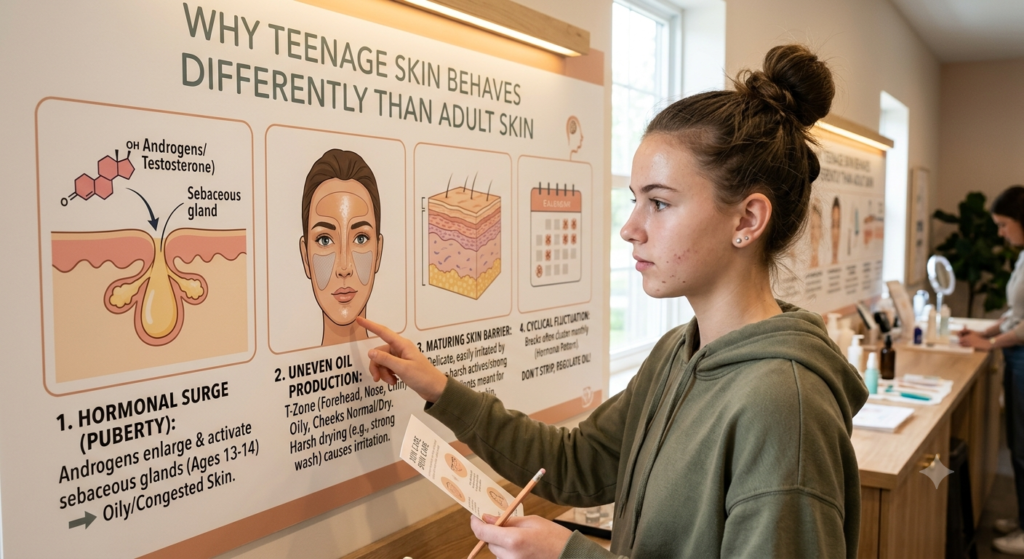
Puberty triggers a surge in androgens (hormones like testosterone), and one of their jobs is to enlarge and activate the sebaceous (oil) glands. This is why skin that was completely normal at age 10 can turn oily, congested, or acne-prone by age 13 or 14 — nothing went “wrong,” the skin is just responding to a hormonal shift that will eventually stabilize.
A few things make teenage skin genuinely different to care for:
- Oil production is often uneven. The T-zone (forehead, nose, chin) tends to overproduce oil while the cheeks stay normal or even dry — which is why “just use a drying acne wash everywhere” backfires and creates dry, irritated patches next to oily, broken-out ones.
- The skin barrier is still maturing. Teenage skin can look resilient but actually gets irritated easily by harsh actives, which is why so many teens react badly to strong exfoliants or high-percentage acne treatments meant for adult skin.
- Hormonal fluctuation is cyclical, not constant. For teenage girls especially, breakouts often cluster around the same time each month — which means a routine that seems to “stop working” may just be reacting to a hormonal pattern, not a product failure.
Understanding this changes how you approach acne: the goal isn’t to strip oil away completely, it’s to regulate it.
The 4 Skin Types Teenagers Typically Have
Before picking products, it helps to actually identify what you’re working with. Most teens fall into one of these categories:
| Skin Type | How to Tell | What It Needs |
|---|---|---|
| Oily | Shiny by midday, especially forehead/nose/chin; larger pores | Lightweight, oil-balancing products — not stripping ones |
| Combination | Oily T-zone, normal-to-dry cheeks | Different products for different zones, or a balanced formula |
| Dry/Sensitive | Tightness, occasional flaking, easily irritated by new products | Gentle, fragrance-free, barrier-supporting formulas |
| Acne-Prone | Regular breakouts (can occur with any of the above types) | Non-comedogenic products + targeted acne treatment |
A common mistake: assuming “acne-prone” is its own separate skin type. It’s not — you can have dry, acne-prone skin or oily, acne-prone skin, and the treatment approach is different for each.
The Teen Skin Care Routine That Actually Works (Morning & Night)
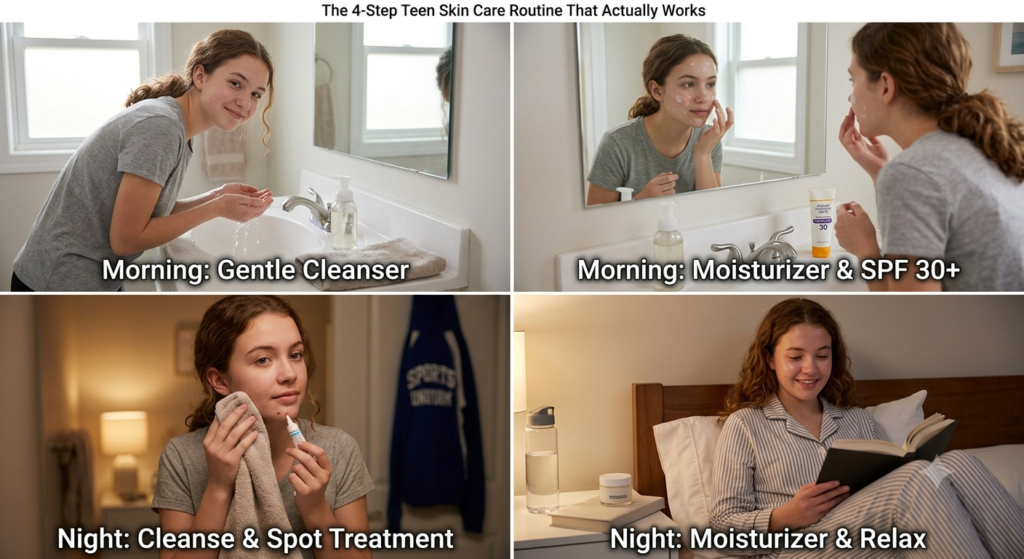
This is intentionally simple. A shorter routine that’s followed consistently outperforms a long one that gets abandoned after two weeks.
Morning Routine
- Gentle cleanser — rinse away overnight oil buildup (30 seconds, lukewarm water)
- Lightweight moisturizer — even oily skin needs this; skipping it often makes oil production worse, not better
- SPF 30+ sunscreen — the single most skipped step by teenagers, and the one with the longest-term payoff for skin texture and tone
Night Routine
- Cleanse — especially important after sports, sweat, or wearing makeup
- Treatment product (if needed) — a spot treatment or acne treatment applied only where needed, not all over the face
- Moisturizer — supports the skin barrier overnight
That’s it. Five products total, used correctly, will outperform a fifteen-product routine assembled from social media hauls.
What NOT to Include (Common Teen Mistakes)
- Multiple exfoliants at once. Combining a scrub, a chemical exfoliant, and an acne treatment in the same week is one of the most common causes of teen skin becoming red, raw, and more broken out.
- Anti-aging serums. Retinol, peptides, and firming creams are formulated for concerns (fine lines, collagen loss) that teenage skin doesn’t have yet. At best they’re wasted money; at worst they irritate the skin barrier.
- Popping pimples. It feels productive in the moment but is the leading cause of acne scarring in teenagers — far more than the acne itself.
- Switching products every few days. Most active ingredients (like salicylic acid or benzoyl peroxide) take 4–6 weeks of consistent use to show results. Switching every week means never actually testing anything.
Skin Care for 14–15 Year Olds: What’s Different at This Age
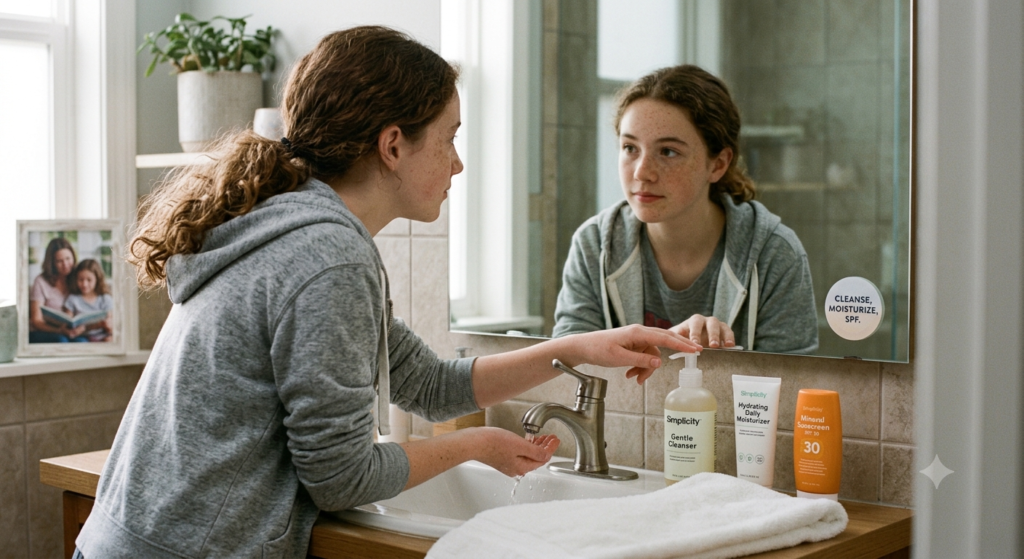
Skin care advice aimed at teens often lumps a 13-year-old in with an 18-year-old, but 14 and 15 is genuinely a distinct stage — puberty-driven oil production is often just beginning, and the skin barrier is more reactive than it will be a few years later.
Here’s what tends to work best specifically for this age group:
- Start simpler than you think you need to. A cleanser, moisturizer, and SPF is enough for most 14-15 year olds. There’s rarely a need for acne treatments unless breakouts are frequent, since occasional hormonal breakouts at this age are extremely common and often resolve as the skin adjusts.
- Avoid strong active ingredients as a first step. If breakouts do start, begin with a low-strength salicylic acid (0.5–2%) or benzoyl peroxide (2.5%) product rather than jumping to the highest percentage available — teenage skin at this age tends to react more strongly to actives than it will at 17 or 18.
- This is the age parental guidance matters most. Many 14-15 year olds are shopping for skin care for the first time, often influenced by social media trends that recommend adult-strength products. A parent or trusted adult helping read ingredient labels at this stage can prevent months of irritated, over-treated skin.
- Focus on habits over products. Teaching consistent cleansing (especially after sports or sweating), sunscreen use, and not touching/picking at the face matters more at this age than any specific product — these habits set the foundation for how skin behaves through the rest of the teen years.
How to Actually Treat Teen Acne (Without Overdoing It)
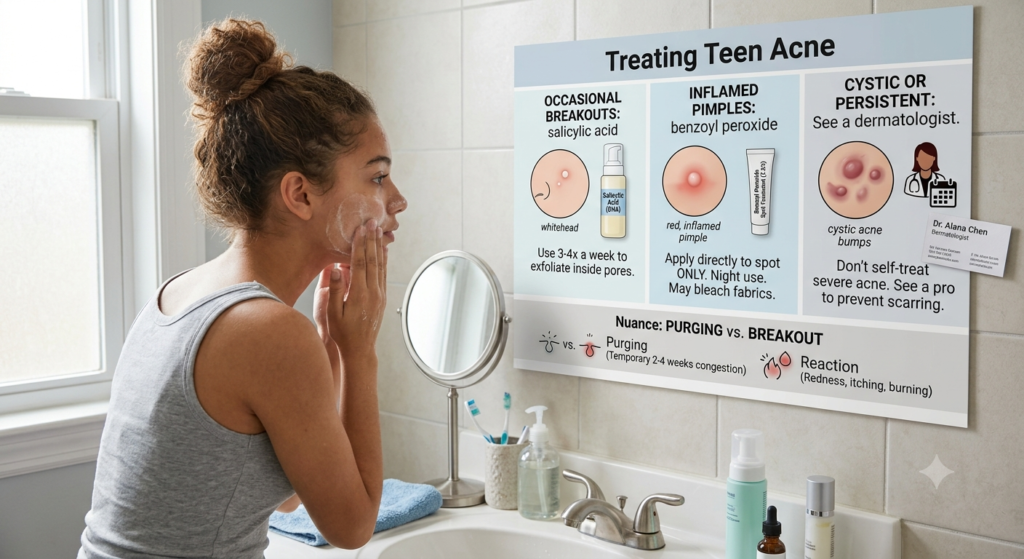
Not all acne needs the same approach. Here’s how to match the treatment to what you’re actually seeing:
Occasional whiteheads/blackheads: Salicylic acid (BHA) in a cleanser or leave-on treatment, used 3–4 times a week to start. This ingredient exfoliates inside the pore, which is where blackheads and whiteheads actually form.
Inflamed, red pimples: Benzoyl peroxide (2.5%–5%) applied directly to the spot, not the whole face. It kills acne-causing bacteria but can bleach fabric and hair, so it’s applied carefully and usually at night.
Widespread or cystic acne: This is the point to see a dermatologist rather than continuing to self-treat. Persistent, painful, or cystic acne often needs prescription-strength treatment, and a dermatologist can also address it before it causes scarring — something over-the-counter products can’t reliably prevent once acne reaches that severity.
A nuance most articles skip: purging vs. breaking out. When starting a new active ingredient (like salicylic acid or retinoids), skin can temporarily look worse for 2–4 weeks as it brings existing congestion to the surface faster. This is different from a product simply not working or causing a genuine reaction (which usually shows up as redness, itching, or burning rather than typical-looking pimples). Knowing the difference prevents quitting on a product right before it starts working.
Lifestyle Factors That Affect Teen Skin More Than Most Products Do

Products get most of the attention, but a handful of daily habits influence teenage skin just as much — sometimes more.
Sleep. Skin repairs itself overnight, and chronically short sleep (common during exam periods) shows up as duller skin, slower healing of existing breakouts, and puffier under-eyes. This isn’t about needing a “beauty sleep” product — it’s about the actual hours.
Sweat and sports. Sweat itself doesn’t cause acne, but sweat mixed with oil, dirt, and pressure from equipment (helmets, chin straps, sports bras) does. Teens in sports or marching band, for example, often develop breakouts specifically along the jawline or forehead where equipment sits — the fix is washing the face as soon as possible after practice, not switching skin care products.
Diet. The link between diet and acne isn’t as simple as “chocolate causes pimples,” but there’s reasonable evidence that high-glycemic foods (sugary drinks, white bread, heavily processed snacks) and dairy can worsen acne in some people. This varies a lot person to person — a more useful approach than cutting out entire food groups is noticing if breakouts reliably follow certain foods, and adjusting from there rather than assuming diet is or isn’t the cause.
Stress. Cortisol (the stress hormone) increases oil production, which is why breakouts often cluster around exams, tryouts, or big social events. This is a physiological response, not a coincidence — and it’s also why stress-related breakouts often clear up on their own once the stressful period passes, without any change in routine.
Hands and phones. Constantly touching the face, resting a chin on a hand during class, or holding a phone against the cheek during calls all transfer oil and bacteria to specific spots — which is a common reason breakouts appear in the same location repeatedly (one cheek, or along the jaw) rather than randomly across the face.
Body Acne: The Part of Teen Skin Care Most Guides Skip
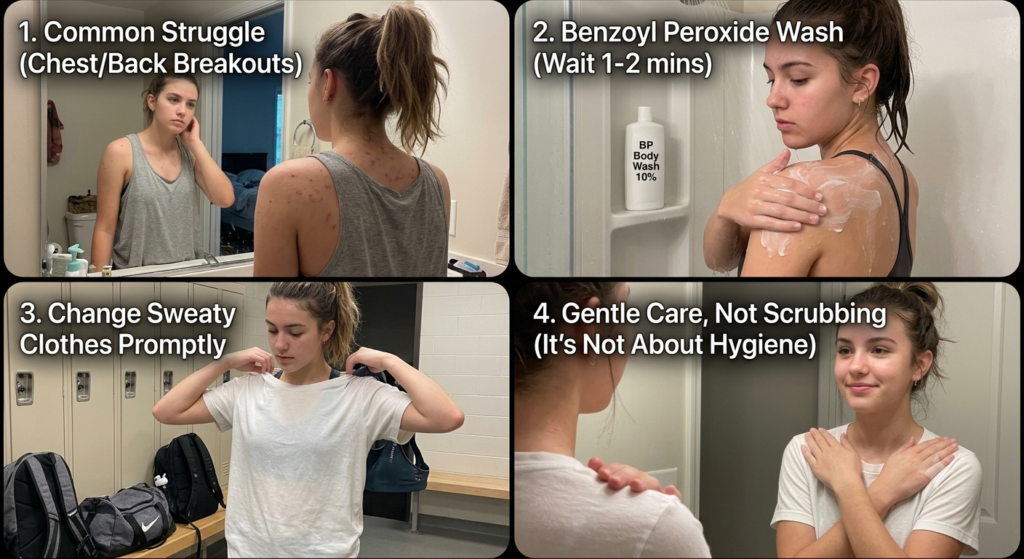
Chest, back, and shoulder breakouts are extremely common in teenagers, especially those in sports, and they need a different approach than facial acne.
- Body acne responds well to benzoyl peroxide body washes. Because the skin on the back and chest is thicker than facial skin, it can tolerate a stronger benzoyl peroxide wash (often 5–10%) left on for a minute or two before rinsing — something that would be too harsh for the face.
- Tight or non-breathable fabric makes it worse. Sports bras, tight athletic shirts, and backpack straps trap sweat and oil against the skin. Changing out of sweaty clothes promptly, rather than staying in them after practice, meaningfully reduces body breakouts.
- Body acne is often mistaken for a hygiene issue. It’s not about being “dirty” — it’s about oil gland activity in an area with more friction and less airflow than the face. This distinction matters because over-scrubbing the back (thinking more washing will fix it) usually just causes irritation without clearing the breakouts.
Budget-Friendly Product Categories (Not Specific Brand Hype)
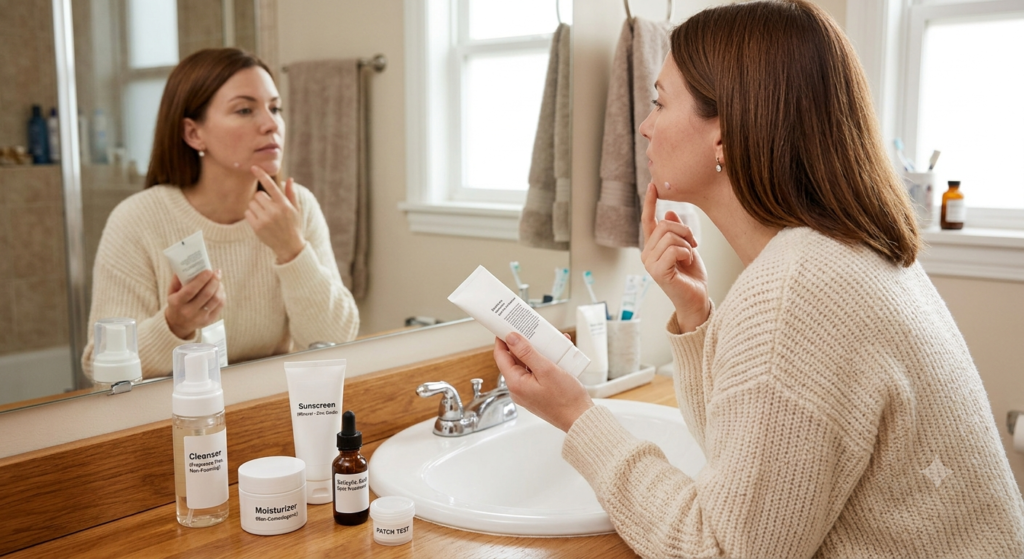
Rather than chasing whatever’s trending, here’s what to actually look for on a label:
- Cleanser: fragrance-free, non-foaming (foaming cleansers tend to be more stripping) for dry/sensitive skin; gel-based for oily/acne-prone skin
- Moisturizer: “non-comedogenic” on the label — this means it won’t clog pores, which matters even for oily skin
- Sunscreen: mineral (zinc oxide/titanium dioxide) options tend to be gentler for sensitive, acne-prone skin than chemical sunscreens, though either works if reapplied
- Spot treatment: benzoyl peroxide or salicylic acid, ideally in a small tube meant for targeted use rather than a full-face product
A genuinely useful habit: patch-test any new product on the jaw or behind the ear for 2–3 days before applying it to the whole face. It costs nothing and prevents a full-face reaction to a new ingredient.
A Simple Checklist to Keep Skin Care Sustainable
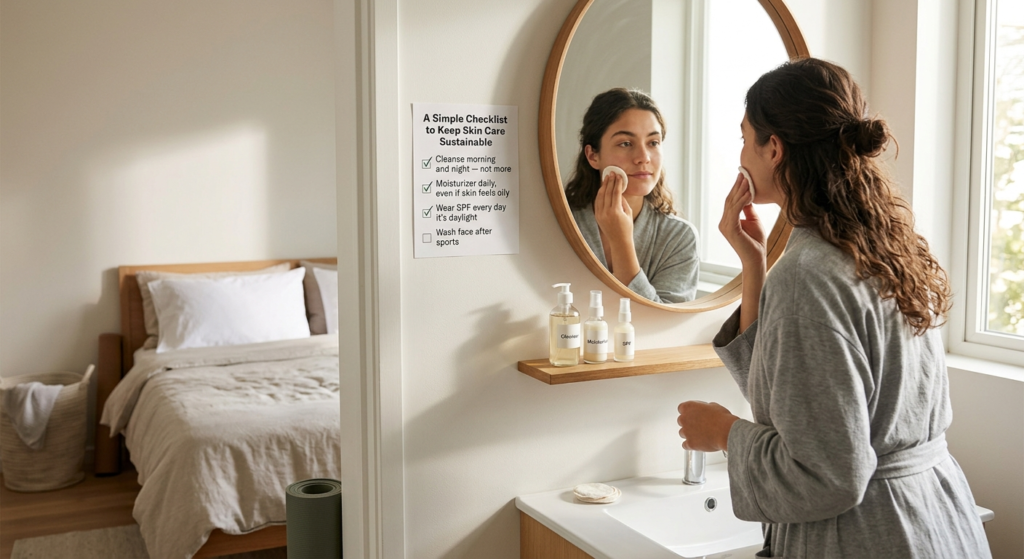
- [ ] Cleanse morning and night — not more (over-washing strips the skin and can increase oil production as skin overcompensates)
- [ ] Moisturize daily, even if skin feels oily
- [ ] Wear SPF every day it’s daylight, not just on sunny days
- [ ] Change pillowcases weekly
- [ ] Wash face after sports or heavy sweating
- [ ] Introduce one new product at a time, and give it 4–6 weeks before judging results
- [ ] Avoid touching or picking at the face throughout the day
Frequently Asked Questions
Does drinking more water clear up acne? Hydration supports overall skin health, but acne is primarily driven by hormones, oil production, and clogged pores — not dehydration. Water alone won’t resolve hormonal breakouts, though it’s still a healthy habit.
Is it normal for acne to come back after clearing up? Yes, especially around monthly hormonal cycles for teenage girls, or during high-stress periods (exams, sports seasons) for any teen. This is a normal pattern, not a sign the routine has failed.
Should makeup be avoided during breakouts? Not necessarily — non-comedogenic makeup applied to clean skin and removed thoroughly at night is generally fine. The bigger issue is usually leaving makeup on overnight or using expired products.
When should a teenager see a dermatologist instead of using drugstore products? If acne is painful, cystic, leaving dark marks or scars, or hasn’t responded to 2–3 months of consistent over-the-counter treatment, it’s worth a dermatologist visit rather than continuing to experiment.
Why does acne leave dark marks even after the pimple is gone? Those marks (post-inflammatory hyperpigmentation) are the skin’s healing response to inflammation, not scarring in the permanent sense. They typically fade over several months on their own, and picking or popping the original pimple makes them darker and slower to fade — another reason to leave breakouts alone rather than intervene manually.
Can boys and girls use the same skin care products? Yes — skin type, not gender, determines what a product should do. Marketing sometimes splits “men’s” and “women’s” skin care by scent or packaging, but an oily-skin cleanser works the same way regardless of who’s using it.
Is it too early to start skin care at 13? No — a simple cleanser, moisturizer, and sunscreen routine is appropriate as soon as puberty starts affecting the skin, which for many is around 12–13. What’s “too early” is reaching for acne treatments or actives before there’s an actual issue to treat.
Conclusion
Teenage skin doesn’t need a complicated routine — it needs the right routine, matched to what’s actually happening hormonally at this stage of life. A simple cleanse-moisturize-SPF routine, an honest assessment of skin type, and patience with any acne treatment (giving it the 4–6 weeks it actually needs) will outperform almost any trending 10-step routine.
For 14-15 year olds specifically, starting simple and gentle — rather than reaching for the strongest product on the shelf — sets up healthier skin habits for the years ahead. If breakouts are more than occasional or start affecting confidence day-to-day, that’s the signal to loop in a dermatologist rather than keep experimenting alone.
The next step: pick one change from this guide — adding daily SPF, simplifying to one active ingredient, or finally ditching the adult anti-aging serum — and give it a full month before adding anything else.