Nobody warns you that acne might follow you into your 30s and bring fine lines to the party.
If you’re dealing with a jawline breakout and your first crow’s feet in the same week, you’re not imagining things, and you’re not doing something wrong. Adult acne affects a significant share of women in their late 20s and 30s, and it rarely shows up alone — it tends to overlap with early signs of aging, post-inflammatory dark spots, and skin that’s suddenly more reactive to products that used to work fine.
The problem is that most acne advice was written for teenagers with oily, resilient skin, and most anti-aging advice assumes you’re not also managing active breakouts. Follow acne advice alone and you can accelerate fine lines with harsh, stripping products. Follow anti-aging advice alone and you can clog your pores with heavy, rich formulas never meant for blemish-prone skin.
This guide is built for the in-between: a real skin care for acne routine that also treats hyperpigmentation and wrinkles, because for most women in this age range, those three things need to be solved together, not separately. We’ll walk through why adult acne behaves differently, how to build a routine that treats all three concerns without conflict, what to actually check on a product label before buying, and how the habits you build now shape your skin decades from now.
Why Acne Doesn’t Just “Age Out” in Your 30s
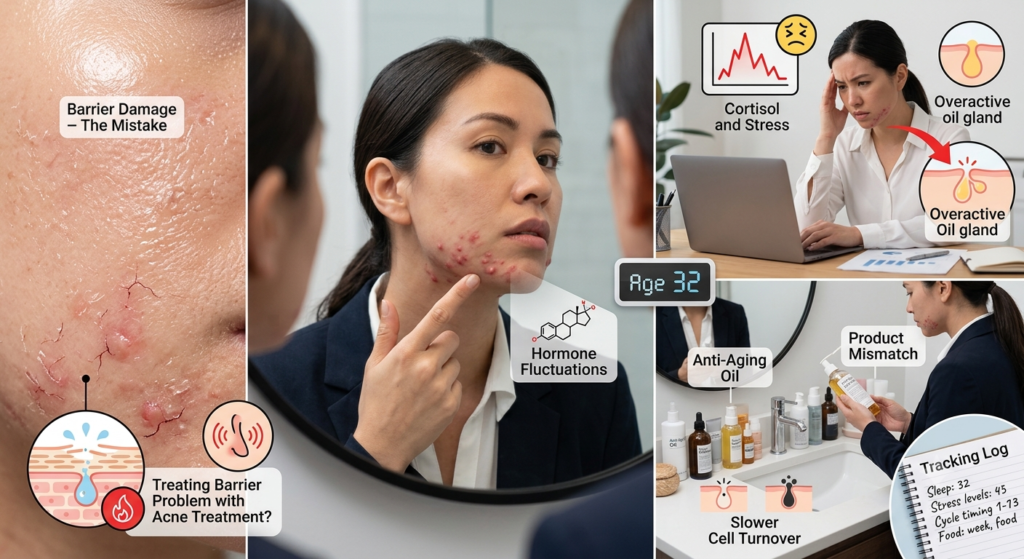
Teenage acne and adult acne are driven by different mechanisms, which is why products that worked at 17 often stop working at 30.
Adult acne in women is frequently linked to:
- Hormonal fluctuations — breakouts that cluster around the jawline, chin, and lower cheeks, worsening around your cycle
- Cortisol and stress — chronic stress raises cortisol, which increases oil production
- Slower cell turnover — skin sheds dead cells more slowly with age, so pores clog more easily even without excess oil
- Product mismatch — switching to “anti-aging” moisturizers and oils that are too heavy for acne-prone skin
- Barrier damage — years of using acne treatments (or over-exfoliating) can wear down the skin barrier, which paradoxically triggers more breakouts
Here’s the detail most articles skip: barrier damage is often the actual root cause of “stubborn” adult acne, not excess oil. If your skin feels tight, stings when you apply products, or looks shiny but flaky at the same time, you may be treating a barrier problem with more acne treatment — which makes it worse. This is one of the most common mistakes in adult acne care, and it’s worth ruling out before you add another active ingredient to your routine.
There’s also a diet and lifestyle layer that’s easy to dismiss but worth taking seriously. High-glycemic foods and dairy have both been associated with increased breakouts in some studies, though the effect varies a lot from person to person. Rather than eliminating entire food groups on a hunch, a more useful approach is tracking breakouts against sleep, stress levels, cycle timing, and diet for a few weeks. Adult acne is rarely caused by one single factor, and treating it as purely a topical skin care problem, while ignoring these inputs, is one reason results can stall even with a solid routine.
Building a Skin Care for Acne Routine That Doesn’t Age You
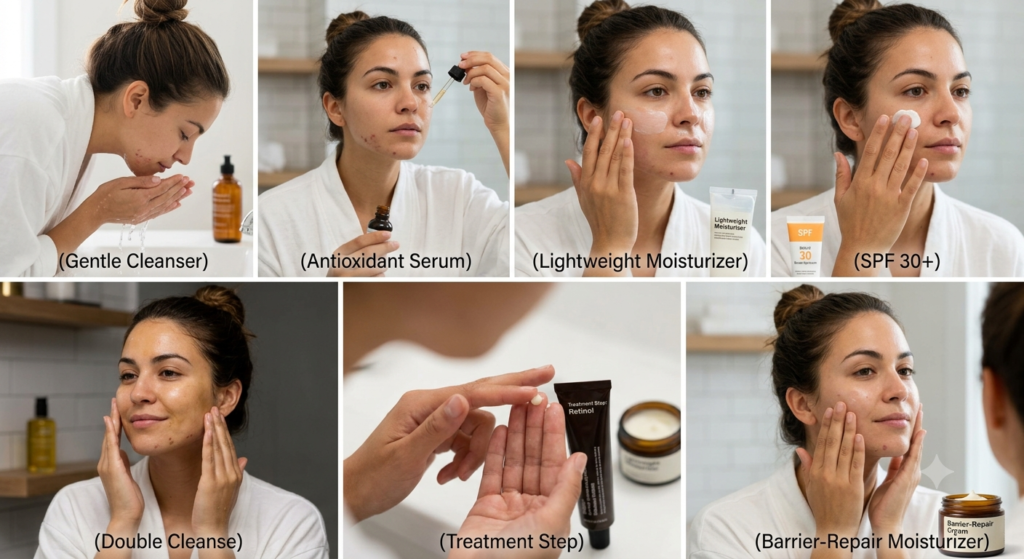
A routine that manages breakouts without accelerating fine lines needs to do three things at once: control oil and bacteria, support the skin barrier, and protect collagen. Here’s a routine structured around that balance.
Morning Routine
- Gentle, non-foaming cleanser — Look for a cream or gel cleanser without sulfates. If your cleanser leaves skin feeling tight, it’s stripping your barrier, which will worsen both acne and fine lines over time.
- Antioxidant serum (vitamin C) — Protects against UV-driven collagen breakdown and helps fade post-acne dark marks. Start at a lower concentration (10–15%) if your skin is acne-prone, since higher strengths can irritate compromised skin.
- Lightweight, non-comedogenic moisturizer — Skipping moisturizer because you have oily or acne-prone skin is a common mistake; dehydrated skin often overproduces oil to compensate, which can worsen breakouts.
- Broad-spectrum SPF 30+ — Non-negotiable. UV exposure is the single biggest driver of wrinkles and the reason acne dark spots take months instead of weeks to fade. Choose a matte or gel-based sunscreen formulated for acne-prone skin so it doesn’t clog pores.
Evening Routine
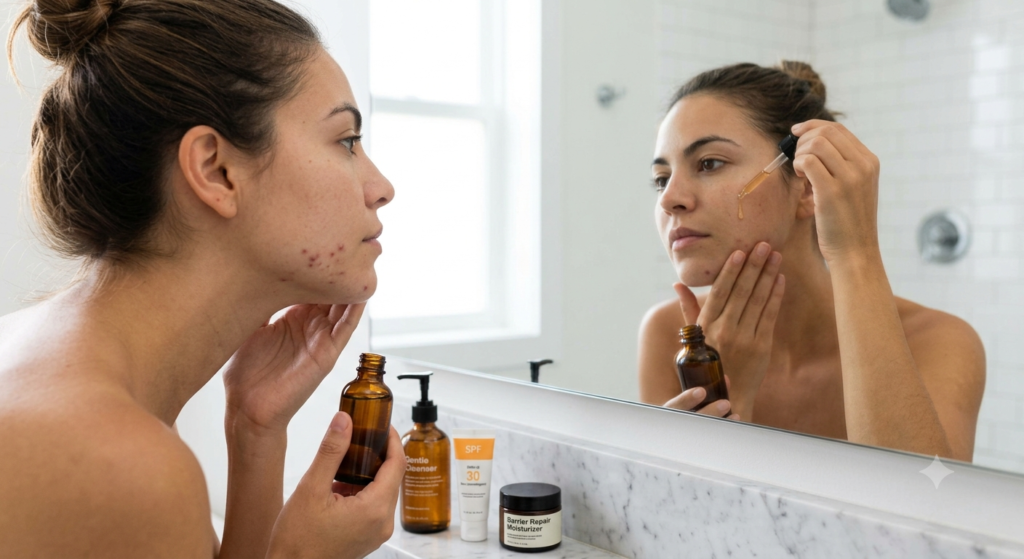
- Double cleanse if wearing sunscreen/makeup — An oil cleanser followed by your gentle cleanser removes SPF and buildup without over-scrubbing.
- Treatment step (alternate nights) — This is where most people go wrong by layering too much at once. Use one active per night, not several:
- Salicylic acid (BHA) — best for blackheads, clogged pores, and oily texture
- Benzoyl peroxide — best for inflamed, red, active breakouts
- Retinoid (retinol or prescription tretinoin) — best for texture, fine lines, and long-term acne prevention, but introduce it slowly (2–3 nights per week to start)
- Barrier-repair moisturizer — A slightly richer formula at night than your daytime one, ideally containing ceramides, to offset the drying effect of your treatment step.
A note on combining actives: Retinoids and benzoyl peroxide can be used together, but many people find it too drying when starting out. Retinoids and vitamin C don’t need to be avoided together as often as skincare content claims — the bigger issue is usually pH stability in the same application, not safety. If irritation shows up, simplify to one active at a time rather than troubleshooting five variables at once.
A Note on Product Order and Patch Testing
Product order matters more than most routines explain. The general rule is thinnest to thickest texture: cleanser, toner or essence if you use one, water-based serums, treatment actives, then moisturizer, with sunscreen always applied last in the morning. Applying a heavy moisturizer before a serum will block the active ingredient from penetrating at all, which is a quiet reason some products seem to “not work” when the issue is actually application order.
Before introducing any new active — especially a retinoid or a new acid — patch test on a small area, like behind the ear or along the jaw, for three to four nights. Full-face reactions to a new product are far more disruptive and harder to calm down than a contained patch reaction, and this single habit prevents a lot of the “my skin broke out from a new product” situations that derail routines entirely.
Skin Care for Hyperpigmentation From Acne
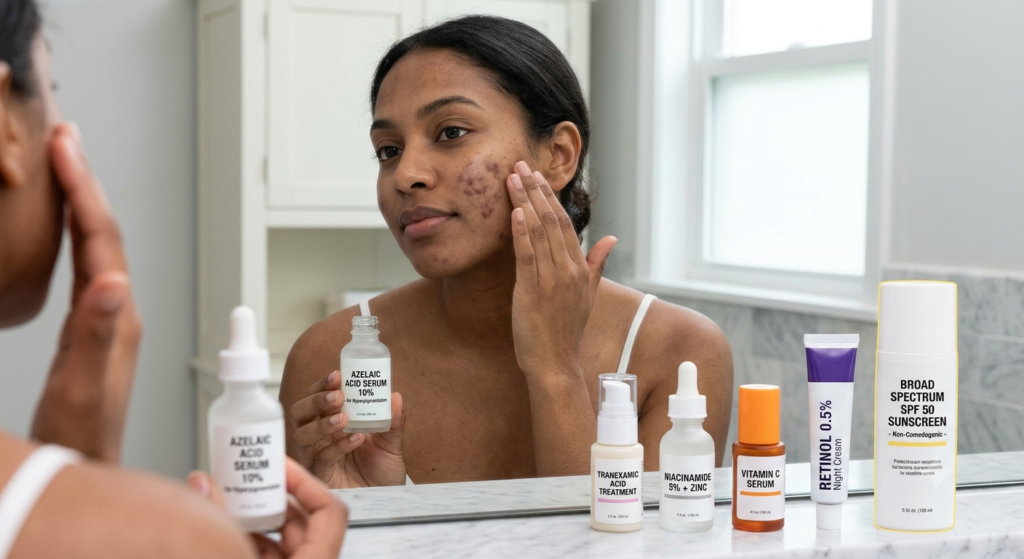
Post-acne dark spots (technically called post-inflammatory hyperpigmentation, or PIH) are often more frustrating to treat than the acne itself, because they can take three to twelve months to fade even after the breakout is gone.
It’s worth distinguishing PIH from true acne scarring, since the treatment approach is different for each. PIH is flat discoloration — brown, red, or purple marks left behind after a pimple heals — and it responds to the ingredients below. Textural scarring (indented or raised marks) doesn’t respond to brightening ingredients at all and typically needs in-office treatments like microneedling, lasers, or chemical peels performed by a professional. Applying vitamin C or niacinamide to a textural scar for months, expecting it to smooth out, is a common and understandable mistake — but it targets pigment, not texture.
What actually works for acne-related hyperpigmentation:
| Ingredient | Best For | Timeline | Notes |
|---|---|---|---|
| Azelaic acid | Sensitive or acne-prone skin | 8–12 weeks | Treats acne and pigmentation simultaneously; gentle enough for daily use |
| Tranexamic acid | Stubborn, hormone-related discoloration | 8–12 weeks | Often layered with niacinamide |
| Niacinamide | General dullness and mild discoloration | 4–8 weeks | Also helps regulate oil, making it useful for acne-prone skin specifically |
| Vitamin C | Prevention and brightening | 8–12 weeks | More effective at preventing new spots than fading deep ones |
| Retinoids | Deeper, longer-standing marks | 12+ weeks | Speeds cell turnover; can initially worsen redness before improving |
The mistake most people make here is switching products every few weeks because they don’t see results fast enough. Hyperpigmentation ingredients need consistent use for at least two full skin cycles (roughly 8 weeks) before you can fairly judge whether they’re working. Constantly switching resets that clock and irritates the skin barrier in the process, which can actually trigger more pigmentation.
If a dark spot is raised, changing shape, or has irregular borders, that’s a signal to see a dermatologist rather than treat it at home — not all discoloration is post-acne marking.
One overlooked detail: sunscreen isn’t optional support for hyperpigmentation treatment, it’s arguably the most important step. UV exposure darkens existing PIH and can undo months of progress from an active ingredient in a single unprotected summer. If you’re treating dark spots but skipping daily SPF, you’re working against yourself.
Skin Care for Wrinkles Without Triggering Breakouts
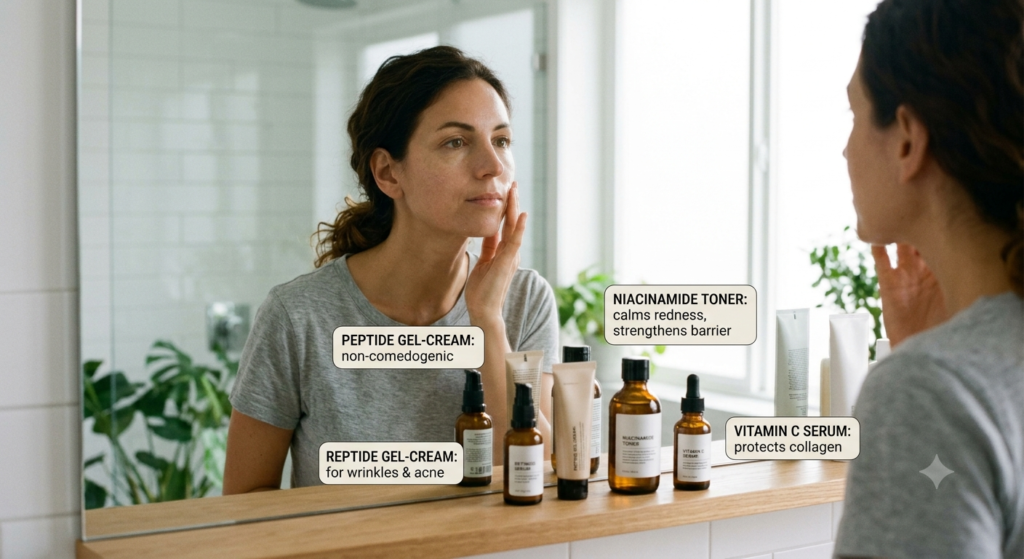
This is where most anti-aging advice fails acne-prone skin. Rich creams, facial oils, and heavy occlusives are marketed as “anti-aging,” but many are comedogenic and will worsen breakouts on oily or combination skin.
Anti-aging ingredients that are also acne-safe:
- Retinoids — the single most evidence-backed ingredient for both wrinkles and acne. This is the one product where “anti-aging” and “acne treatment” overlap almost perfectly.
- Peptides — support collagen production without pore-clogging risk; a good layering option under sunscreen.
- Niacinamide — strengthens the skin barrier (which slows visible aging) while also calming acne-related redness.
- Vitamin C — protects existing collagen from UV breakdown.
- Hyaluronic acid — plumps fine lines without the heaviness of oil-based moisturizers.
Anti-aging ingredients to use cautiously on acne-prone skin:
- Heavy facial oils (coconut oil in particular is highly comedogenic)
- Rich, ceramide-and-oil-based night creams marketed for “mature skin”
- Some silicone-heavy primers and makeup sold as “anti-aging”
The underlying principle: texture and formulation matter as much as the active ingredient itself. A serum with the same percentage of retinol can behave completely differently depending on whether it’s suspended in a lightweight gel or a heavy cream base. If you have acne-prone skin, prioritize gel and lotion textures over creams and balms, even within “anti-aging” product lines.
Seasonal adjustments matter here too. Many women need a slightly richer moisturizer in winter and a lighter one in summer, even within an otherwise consistent acne-safe routine. Treat this as a texture swap rather than a full routine overhaul — same active ingredients, adjusted base formula for humidity and heating.
Best Anti-Aging Skin Care for Acne-Prone Skin: What to Actually Look For
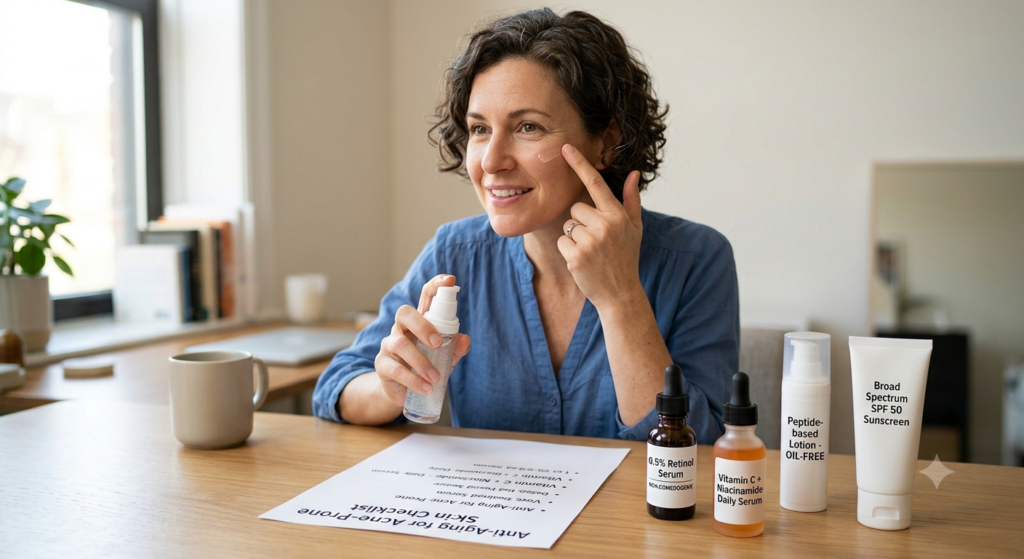
When shopping for anti-aging products that won’t trigger breakouts, skip the marketing language and check the formulation itself. Use this checklist:
- Labeled “non-comedogenic” or “oil-free”
- Contains retinoids, peptides, niacinamide, or vitamin C as the primary actives
- Lightweight gel, serum, or lotion texture — not a thick balm
- Fragrance-free (fragrance is a common trigger for both irritation and breakouts)
- Avoid products where mineral oil, coconut oil, or isopropyl myristate appear high in the ingredient list
- Avoid “anti-aging” bundles built around heavy night creams as the main step
A simple way to build this out: pick one retinoid product, one vitamin C or niacinamide serum, one peptide-based moisturizer, and one broad-spectrum sunscreen. That four-product core covers acne prevention, pigmentation, and wrinkle prevention without the layering conflicts that come from an eight-step routine.
If budget allows for one splurge item, make it the retinoid — formulation quality and delivery system vary widely at that price point, and it’s the ingredient doing the most overlapping work across acne, pigmentation, and wrinkles. Cleansers and sunscreens, by contrast, tend to perform similarly across a wide price range once you’ve found a texture and formula your skin tolerates well.
Best Anti-Aging Skin Care for Your 50s — Habits Worth Starting Now
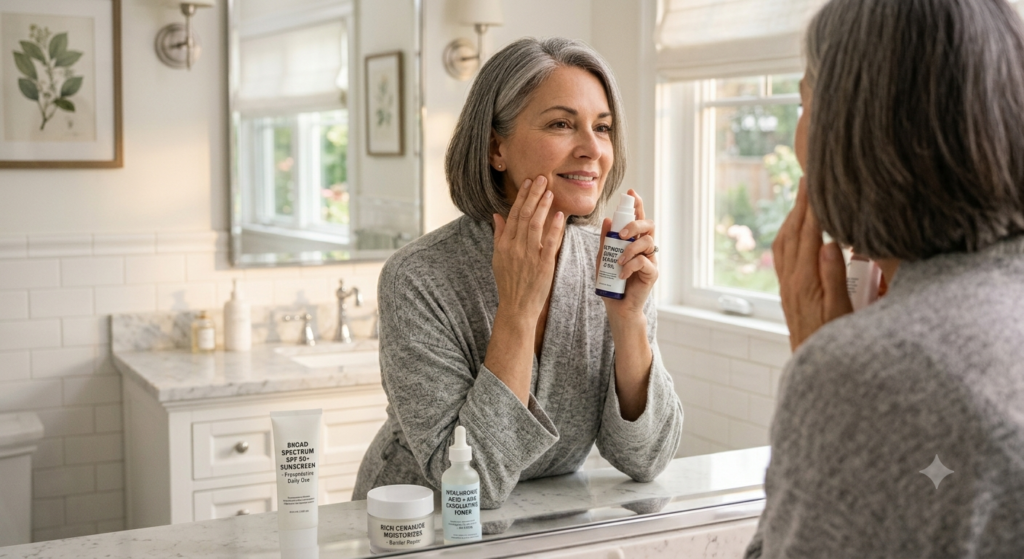
You may be in your late 20s or 30s reading this, but the skin care for acne habits you build now directly shape what your skin looks like by your 50s — particularly around collagen preservation and pigmentation.
By your 50s, the skin concerns most women manage shift in a few predictable ways:
- Slower cell turnover means exfoliating actives (retinoids, AHAs) become even more important, not less
- Thinner skin barrier means richer moisturizers become appropriate again, even if they weren’t during your acne-prone years
- Existing sun damage becomes visible as deeper pigmentation and texture changes, which is why sunscreen consistency in your 30s has an outsized effect decades later
- Acne can still occur, often hormonally linked around perimenopause, so “anti-aging” and “acne-safe” still need to coexist for many women well past 40
If you’re building a routine now, the two habits with the highest long-term payoff are daily SPF and a consistent retinoid. Both are more effective as prevention than as correction — which is the opposite of how most people discover them, usually after damage is already visible.
It’s also worth knowing that retinoid tolerance generally improves with consistent long-term use. Many women who found retinol too irritating in their 20s can use it nightly without issue by their late 30s, simply because the skin barrier has adapted. If you tried a retinoid once, reacted badly, and wrote it off, it may be worth a second, slower attempt years later rather than avoiding the ingredient category permanently.
Common Mistakes That Slow Down Results
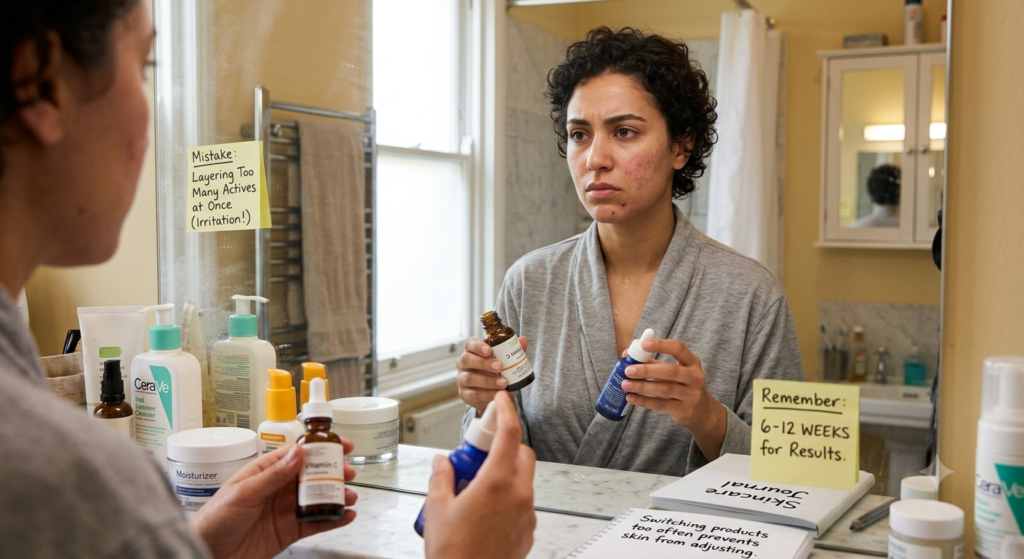
- Layering too many actives at once. Three treatment steps in one night usually means irritation, not faster results.
- Judging a product within two weeks. Most active ingredients need 6–12 weeks to show visible change.
- Skipping moisturizer or sunscreen because skin is oily. Both dehydration and UV exposure worsen acne and aging simultaneously.
- Popping or picking at breakouts. This is the single biggest cause of long-lasting dark spots and, eventually, scarring.
- Chasing “anti-aging” marketing over formulation. A product’s claims matter less than its actual ingredient list and texture.
- Switching products too often. Constant switching prevents your skin from ever fully adjusting to an active ingredient.
- Applying products in the wrong order. A heavy moisturizer applied before a treatment serum can block it from working at all.
- Treating textural scarring with brightening products. Pigment and texture are different problems that need different treatments.
FAQ
Can I use retinol and acne treatments like benzoyl peroxide at the same time? Yes, but not necessarily on the same night when starting out. Many people alternate them (retinol one night, benzoyl peroxide the next) until their skin builds tolerance, then combine as needed.
Why is my acne worse now than it was as a teenager? Adult acne is often hormonally driven and clusters around the jawline and chin, unlike the T-zone pattern common in teenage acne. It typically responds better to consistent, gentle treatment than to harsh, drying products.
Do I need separate products for acne and anti-aging, or can one routine handle both? One routine can handle both for most people. Retinoids, niacinamide, and vitamin C are effective for acne, pigmentation, and wrinkles simultaneously, which is why they form the core of a combined routine rather than layering separate acne and anti-aging product lines.
How long until I see results from a new acne and anti-aging routine? Expect initial improvement in texture and oiliness within 3–4 weeks, meaningful reduction in active breakouts by 8 weeks, and visible fading of dark spots or fine lines closer to 12 weeks. Consistency matters more than product intensity.
Should I see a dermatologist instead of managing this with over-the-counter products? If breakouts are cystic, painful, or leaving noticeable textural scarring, a dermatologist can prescribe stronger options like oral medication or prescription-strength retinoids that work faster and more reliably than over-the-counter routines. Over-the-counter skin care is well-suited to mild-to-moderate acne and maintenance; it’s not always sufficient on its own for severe or cystic acne.
Key Takeaways
Adult acne, hyperpigmentation, and early fine lines aren’t separate problems requiring separate routines — they respond to many of the same core ingredients: retinoids, niacinamide, vitamin C, and consistent sun protection. The biggest shift most women need to make isn’t adding more products, but choosing fewer, better-formulated ones and giving each one enough time to actually work.
Start simple: one cleanser, one treatment active, one barrier-supporting moisturizer, and daily SPF. Apply them in the right order, patch test anything new, and resist the urge to judge a product before it’s had a full skin cycle to work. Build from there only if your skin tells you it needs more — not because a new product launched. Your skin at 50 will reflect the consistency you build today far more than any single product you buy this year.