Open any skincare aisle and you’ll find yourself standing in front of double-cleansers, essences, ampoules, and six kinds of serum, wondering how anyone affords — or has time for — all of it.
Here’s the truth most skincare content won’t tell you: you do not need fifteen products to have healthy, functioning skin. You need the right skin care essentials products for your actual skin, applied consistently, in the correct order. That’s it.
This guide breaks down exactly what belongs in a skincare routine, why each item earns its spot, which tools and accessories are worth owning, how to layer everything correctly, and how to build your own combo or collection — whether your budget is under 500 or well beyond it. You’ll also find the difference between a routine that looks impressive on a shelf and one that actually does something for your skin.
Skin Care You Need vs. Skin Care You Don’t
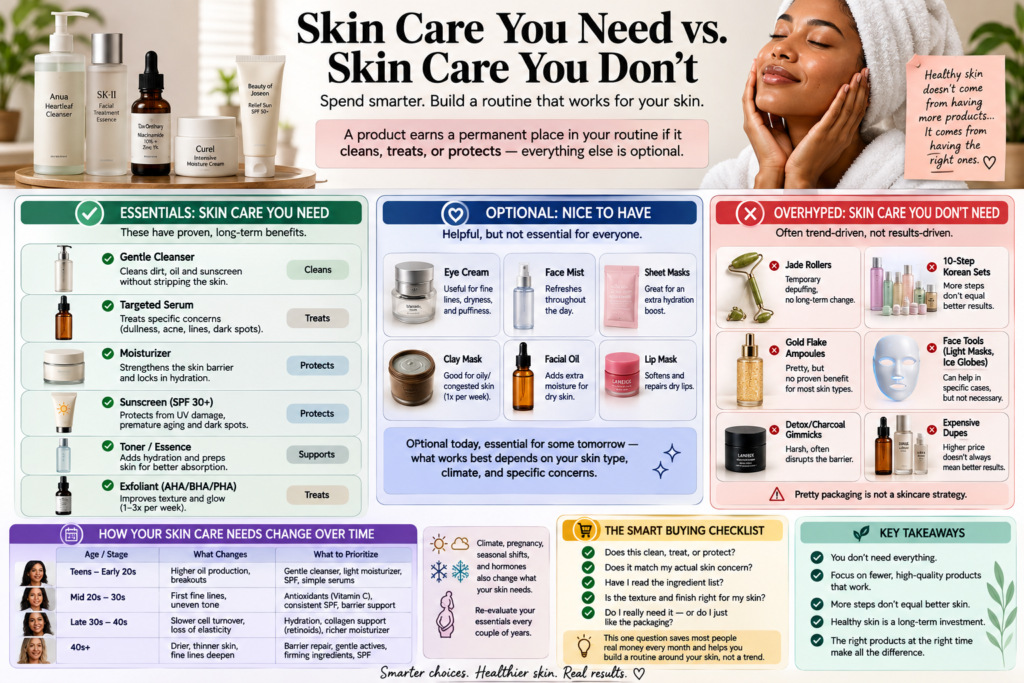
Before buying anything, it helps to separate what your skin genuinely needs from what’s simply been marketed well. A product earns a permanent place in your routine only if it does one of three things:
- Cleans the skin without stripping it
- Treats a specific concern (dullness, breakouts, texture, aging)
- Protects the skin barrier or from UV damage
Everything else — jade rollers, 10-step Korean sets, ampoules with gold flakes in them — is optional. Nice, sometimes genuinely helpful, but optional.
A quick gut-check before buying anything new: “Does this clean, treat, or protect — or am I buying it because the packaging is pretty?” This one question saves most people real money every month, and it’s the difference between a routine built around your skin and a routine built around a trend.
The skin care you actually need also shifts with age, climate, and hormonal changes. A routine that worked at 22 often stops working at 30, not because the products got worse, but because oil production, cell turnover, and barrier strength change over time. Pregnancy, seasonal shifts, and even switching climates for a new job or move are all valid reasons to re-audit what you’re using. Re-evaluate your essentials every couple of years rather than assuming your teenage routine still fits your skin today.
Skin Care Items Every Routine Should Include
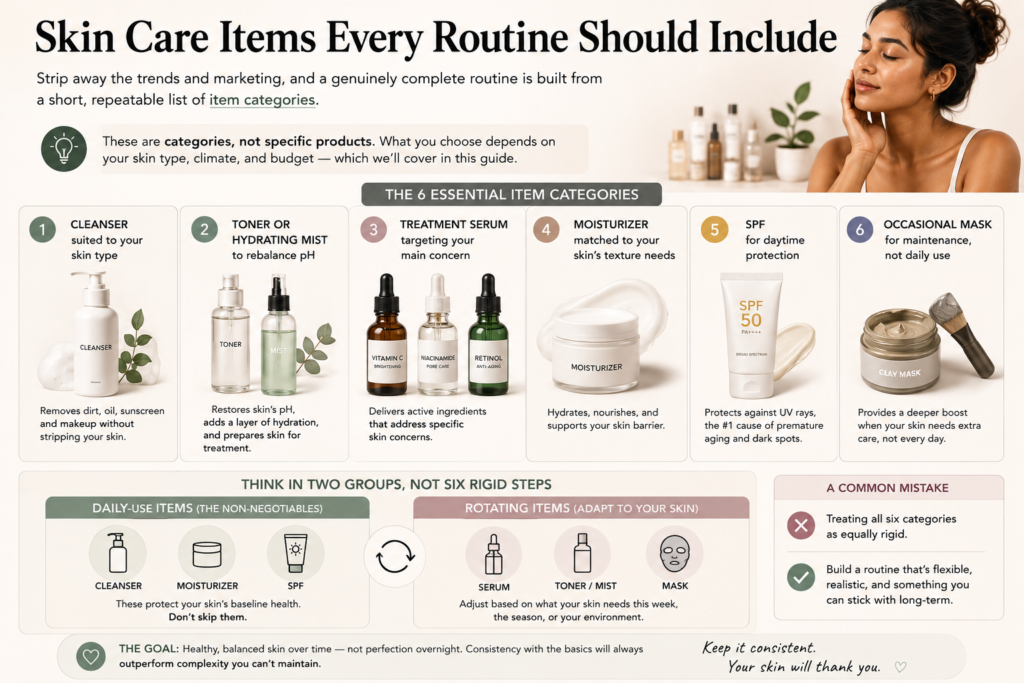
Strip away the trends and marketing, and a genuinely complete routine is built from a short, repeatable list of item categories:
- A cleanser suited to your skin type
- A toner or hydrating mist to rebalance pH
- A treatment serum targeting your main concern
- A moisturizer matched to your skin’s texture needs
- SPF for daytime protection
- An occasional mask for maintenance, not daily use
That’s the full list of item categories — not specific products. Within each category, what you choose depends entirely on your skin type, climate, and budget, which is what the rest of this guide walks through.
A useful way to think about these items is in two groups: daily-use items (cleanser, moisturizer, SPF) that should never be skipped, and rotating items (serum, toner, mask) that can shift based on what your skin needs that week. Treating all six categories as equally rigid is a common reason people burn out on their routine within a month.
The Skin Care List: How Many Products You Actually Need
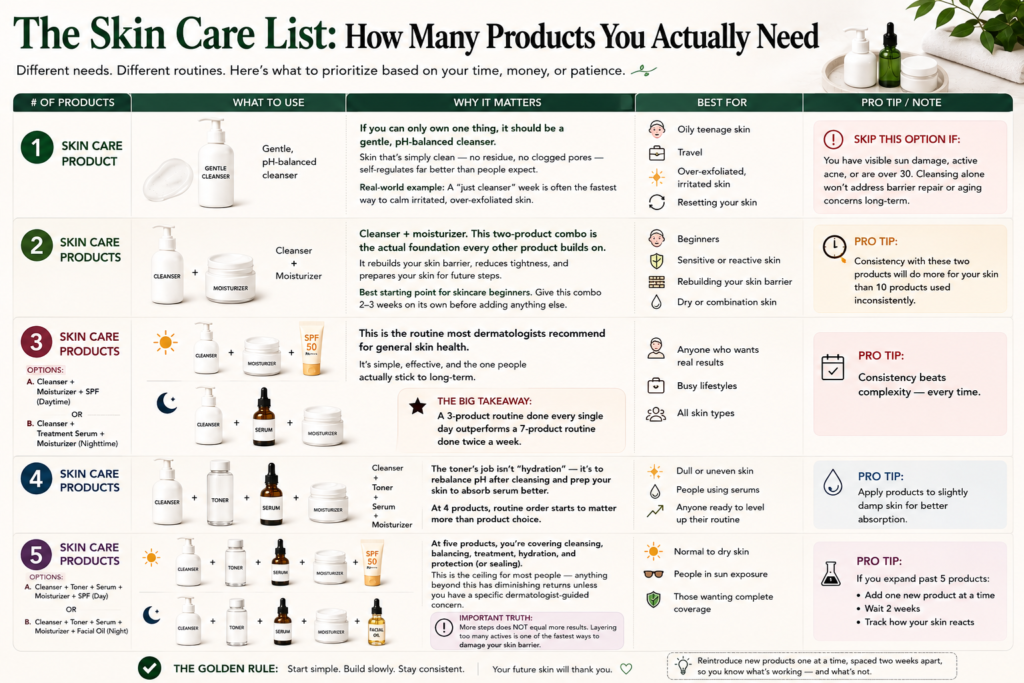
This is the part people search for most, so let’s be direct. Here’s what to prioritize depending on how much time, money, or patience you have.
1 Skin Care Product
If you can only own one thing, it should be a gentle, pH-balanced cleanser. Skin that’s simply clean — no residue, no clogged pores — self-regulates far better than people expect. This is the right call for oily teenage skin, for travel, or for anyone recovering from over-exfoliated, irritated skin who needs to strip their routine back to zero.
Real-world example: if you’ve ever gone through a period of harsh acids and retinol that left your skin red and flaking, a “just cleanser” week is often the fastest way to calm it back down before reintroducing anything else. Dermatologists sometimes call this a “skin fast,” and it’s a legitimate reset strategy, not a shortcut.
Skip this option if you already have visible sun damage, active acne, or are over 30 — cleansing alone won’t address barrier repair or aging concerns long-term.
2 Skin Care Products (The Skin Care Combo That Covers the Basics)
Cleanser + moisturizer. This two-product skin care combo is the actual foundation every other product builds on top of. If your skin feels tight, flaky, or reactive, this is where to rebuild from — not by adding more, but by nailing these two first.
This is also the right starting combo for anyone new to skincare altogether. Adding a serum or acid before your skin has adjusted to a consistent cleanse-and-moisturize habit tends to backfire with irritation you can’t easily trace back to a cause. Give this combo two to three weeks on its own before adding anything else — it’s tempting to rush, but that patience is what makes every product you add afterward actually work better.
3 Skin Care Products
Cleanser + moisturizer + SPF (daytime) or cleanser + treatment serum + moisturizer (nighttime). This is genuinely the routine most dermatologists recommend for general skin health, and it’s the one people actually stick to long-term — which matters more than any 10-step routine you’ll abandon by week three.
If you only remember one takeaway from this whole guide, make it this: a 3-product routine done every single day outperforms a 7-product routine done twice a week.
4 Skin Care Products
Cleanser + toner + serum + moisturizer. The toner’s job here isn’t “hydration” (a common myth) — it’s to rebalance the skin’s pH after cleansing and prep it to absorb the serum better. Skipping this step doesn’t ruin your routine, but adding it noticeably improves how well your serum performs.
This is also the point where routine order starts to matter more than product choice. A serum applied to skin that’s still slightly acidic from tap water absorbs differently than one applied after a pH-balancing toner, which is why this step earns its place at four products rather than staying optional forever.
5 Skin Care Products
Cleanser + toner + serum + moisturizer + SPF (day) or facial oil (night). At five products, you’re covering cleansing, balancing, targeted treatment, hydration, and protection or sealing. This is the ceiling for most people — anything beyond this point has diminishing returns unless you have a specific dermatologist-guided concern, like active cystic acne or diagnosed rosacea.
A note most articles skip: more steps does not equal more results. Layering five actives on top of each other is one of the fastest ways to trigger a compromised skin barrier — the exact problem most of these products claim to fix. If you’re going to expand past five products, add one new item at a time, spaced two weeks apart, so you can actually tell what’s working.
Skin Care Essentials by Product Type
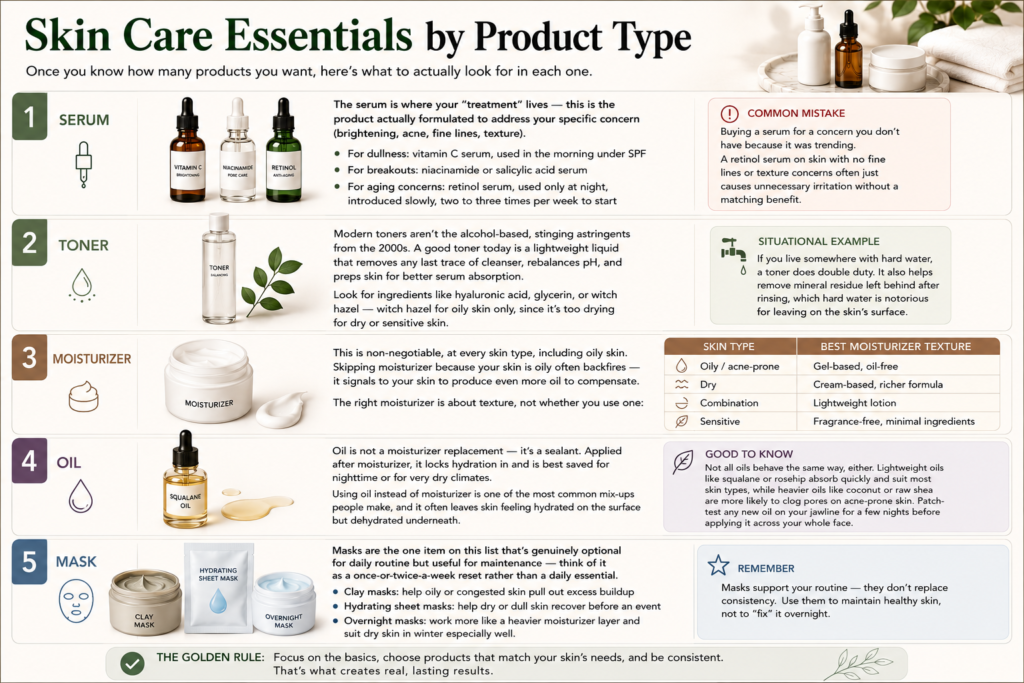
Once you know how many products you want, here’s what to actually look for in each one.
Skin Care Serum
The serum is where your “treatment” lives — this is the product actually formulated to address your specific concern (brightening, acne, fine lines, texture).
- For dullness: vitamin C serum, used in the morning under SPF
- For breakouts: niacinamide or salicylic acid serum
- For aging concerns: retinol serum, used only at night, introduced slowly, two to three times per week to start
Common mistake: buying a serum for a concern you don’t have because it was trending. A retinol serum on skin with no fine lines or texture concerns often just causes unnecessary irritation without a matching benefit.
Skin Care Toner
Modern toners aren’t the alcohol-based, stinging astringents from the 2000s. A good toner today is a lightweight liquid that removes any last trace of cleanser, rebalances pH, and preps skin for better serum absorption. Look for ingredients like hyaluronic acid, glycerin, or witch hazel — witch hazel for oily skin only, since it’s too drying for dry or sensitive skin.
Situational example: if you live somewhere with hard water, a toner does double duty. It also helps remove mineral residue left behind after rinsing, which hard water is notorious for leaving on the skin’s surface.
Skin Care Moisturizer
This is non-negotiable, at every skin type, including oily skin. Skipping moisturizer because your skin is oily often backfires — it signals to your skin to produce even more oil to compensate. The right moisturizer is about texture, not whether you use one:
| Skin Type | Best Moisturizer Texture |
|---|---|
| Oily/acne-prone | Gel-based, oil-free |
| Dry | Cream-based, richer formula |
| Combination | Lightweight lotion |
| Sensitive | Fragrance-free, minimal ingredients |
Skin Care Oil
Oil is not a moisturizer replacement — it’s a sealant. Applied after moisturizer, it locks hydration in and is best saved for nighttime or for very dry climates. Using oil instead of moisturizer is one of the most common mix-ups people make, and it often leaves skin feeling hydrated on the surface but dehydrated underneath.
Not all oils behave the same way, either. Lightweight oils like squalane or rosehip absorb quickly and suit most skin types, while heavier oils like coconut or raw shea are more likely to clog pores on acne-prone skin. Patch-test any new oil on your jawline for a few nights before applying it across your whole face.
Skin Care Mask
Masks are the one item on this list that’s genuinely optional for daily routine but useful for maintenance — think of it as a once-or-twice-a-week reset rather than a daily essential. Clay masks help oily or congested skin pull out excess buildup; hydrating sheet masks help dry or dull skin recover before an event. Overnight masks, a third category worth knowing, work more like a heavier moisturizer layer and suit dry skin in winter especially well.
How to Layer Your Skin Care Products Correctly
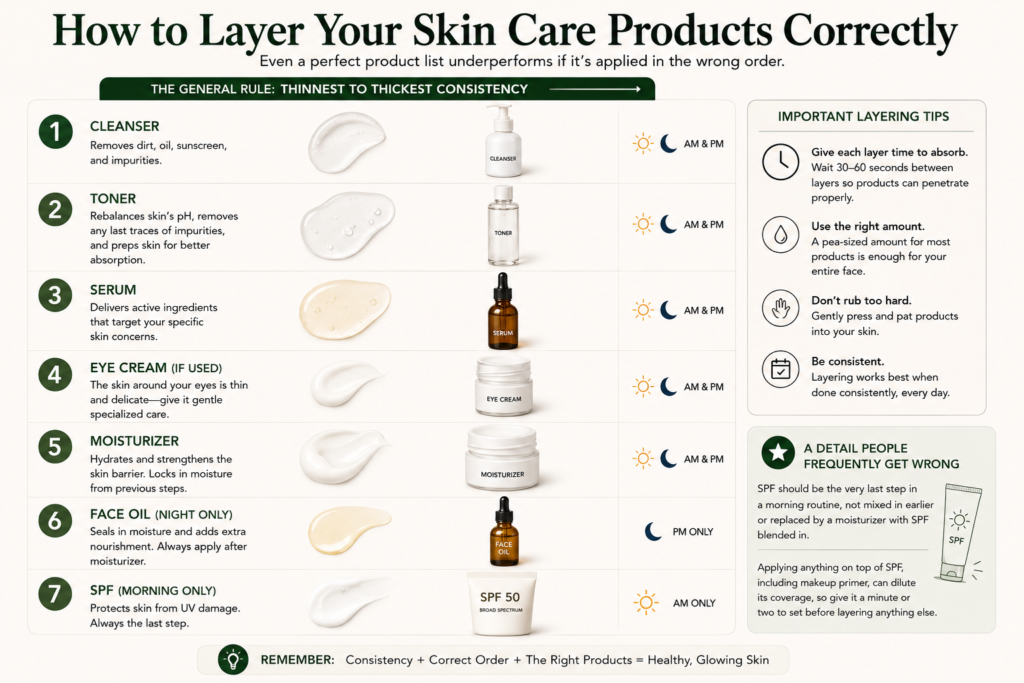
Even a perfect product list underperforms if it’s applied in the wrong order. The general rule is thinnest to thickest consistency:
- Cleanser
- Toner
- Serum
- Eye cream, if used
- Moisturizer
- Face oil, at night only
- SPF, in the morning, always last
A detail people frequently get wrong: SPF should be the very last step in a morning routine, not mixed in earlier or replaced by a moisturizer with SPF blended in. Applying anything on top of SPF, including makeup primer, can dilute its coverage, so give it a minute or two to set before layering anything else.
Skin Care by Skin Type
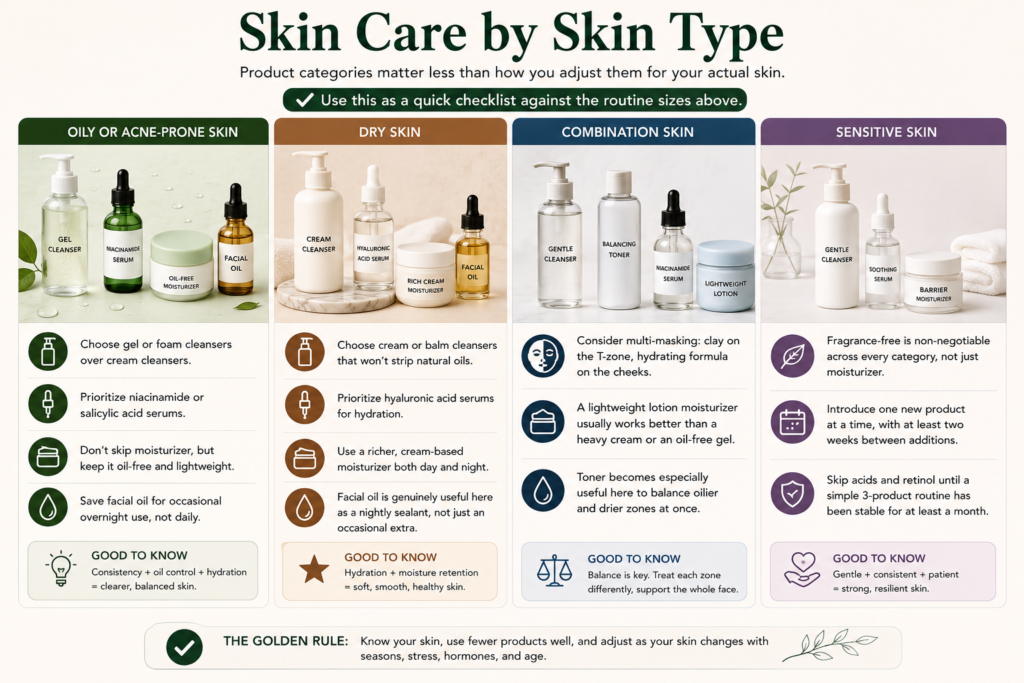
Product categories matter less than how you adjust them for your actual skin. Use this as a quick checklist against the routine sizes above.
Oily or acne-prone skin
- Choose gel or foam cleansers over cream cleansers
- Prioritize niacinamide or salicylic acid serums
- Don’t skip moisturizer, but keep it oil-free and lightweight
- Save facial oil for occasional overnight use, not daily
Dry skin
- Choose cream or balm cleansers that won’t strip natural oils
- Prioritize hyaluronic acid serums for hydration
- Use a richer, cream-based moisturizer both day and night
- Facial oil is genuinely useful here as a nightly sealant, not just an occasional extra
Combination skin
- Consider multi-masking: clay on the T-zone, hydrating formula on the cheeks
- A lightweight lotion moisturizer usually works better than a heavy cream or an oil-free gel
- Toner becomes especially useful here to balance oilier and drier zones at once
Sensitive skin
- Fragrance-free is non-negotiable across every category, not just moisturizer
- Introduce one new product at a time, with at least two weeks between additions
- Skip acids and retinol until a simple 3-product routine has been stable for at least a month
Skin Care Tools Worth Actually Owning
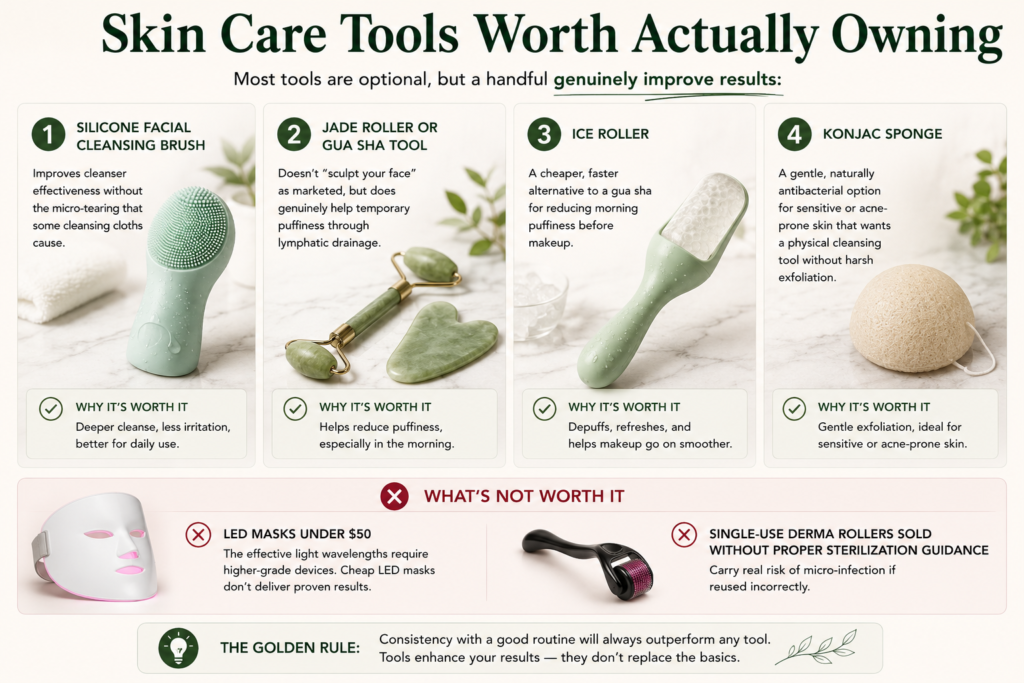
Most tools are optional, but a handful genuinely improve results:
- Silicone facial cleansing brush — improves cleanser effectiveness without the micro-tearing that some cleansing cloths cause
- Jade roller or gua sha tool — doesn’t “sculpt your face” as marketed, but does genuinely help temporary puffiness through lymphatic drainage
- Ice roller — a cheaper, faster alternative to a gua sha for reducing morning puffiness before makeup
- Konjac sponge — a gentle, naturally antibacterial option for sensitive or acne-prone skin that wants a physical cleansing tool without harsh exfoliation
What’s not worth it: LED masks under $50, since the effective light wavelengths require higher-grade devices, and single-use derma rollers sold without proper sterilization guidance, which carry real risk of micro-infection if reused incorrectly.
Skin Care Headband
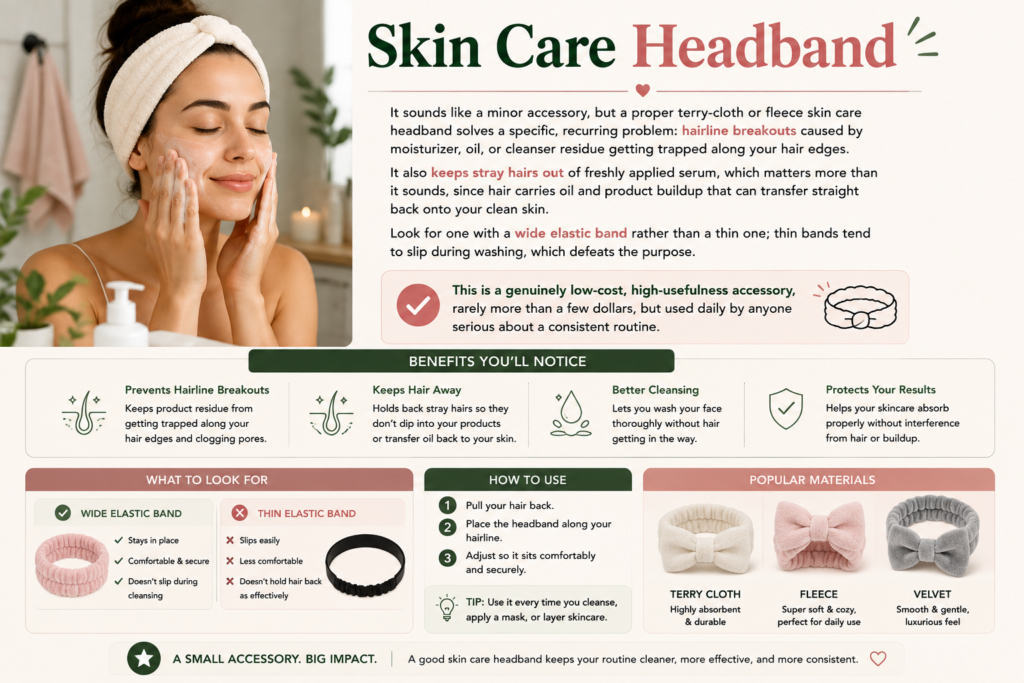
It sounds like a minor accessory, but a proper terry-cloth or fleece skin care headband solves a specific, recurring problem: hairline breakouts caused by moisturizer, oil, or cleanser residue getting trapped along your hair edges. It also keeps stray hairs out of freshly applied serum, which matters more than it sounds, since hair carries oil and product buildup that can transfer straight back onto your clean skin.
Look for one with a wide elastic band rather than a thin one; thin bands tend to slip during washing, which defeats the purpose. This is a genuinely low-cost, high-usefulness accessory, rarely more than a few dollars, but used daily by anyone serious about a consistent routine.
Skin Care Jar and Storage
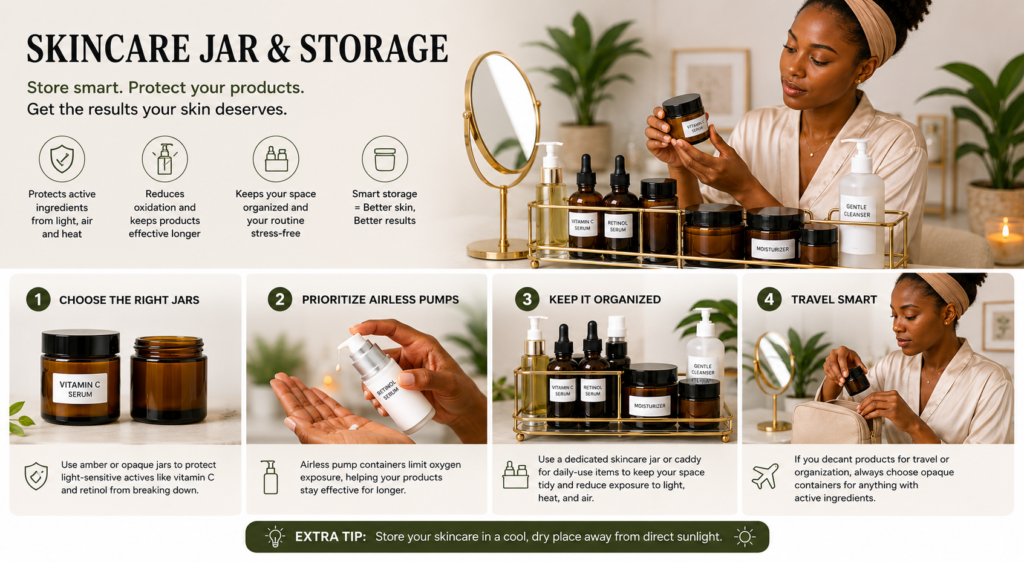
How you store your products affects how well they work. Open jars, especially anything with vitamin C, retinol, or plant oils, degrade faster once exposed to air, light, and heat.
- Amber or opaque jars protect light-sensitive actives like retinol and vitamin C from breaking down
- Airless pump containers limit oxygen exposure compared to open-jar packaging, worth prioritizing when choosing between two similar products
- A dedicated skin care jar or caddy for daily-use items keeps your counter organized and reduces the temptation to leave bottles open near a sunny window, which is a bigger problem than most people realize
If you decant products into your own jars for travel or organization, always choose opaque containers over clear glass for anything with active ingredients.
Skin Care Accessories Beyond the Basics
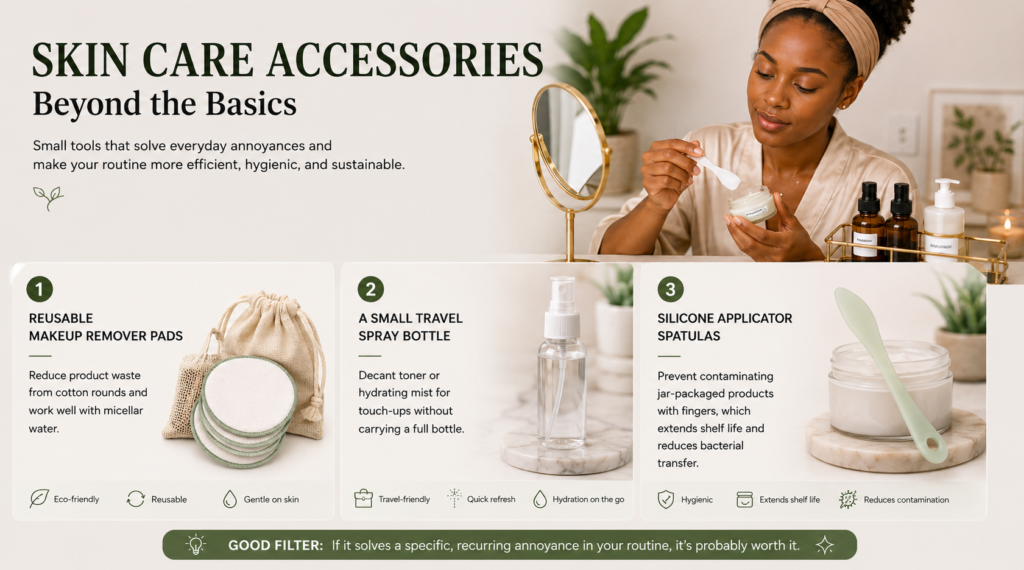
Beyond headbands and storage, a few smaller accessories round out a functional setup:
- Reusable makeup remover pads — reduce product waste from cotton rounds and work well with micellar water
- A small travel spray bottle — decant toner or hydrating mist for touch-ups without checking a full bottle
- Silicone applicator spatulas — prevent contaminating jar-packaged products with fingers, which extends shelf life and reduces bacterial transfer
None of these are essential in the way a cleanser or moisturizer is essential, but each solves a specific, recurring annoyance, which is a good filter for deciding whether any accessory is worth buying.
Skin Care Fridge: Do You Actually Need One?
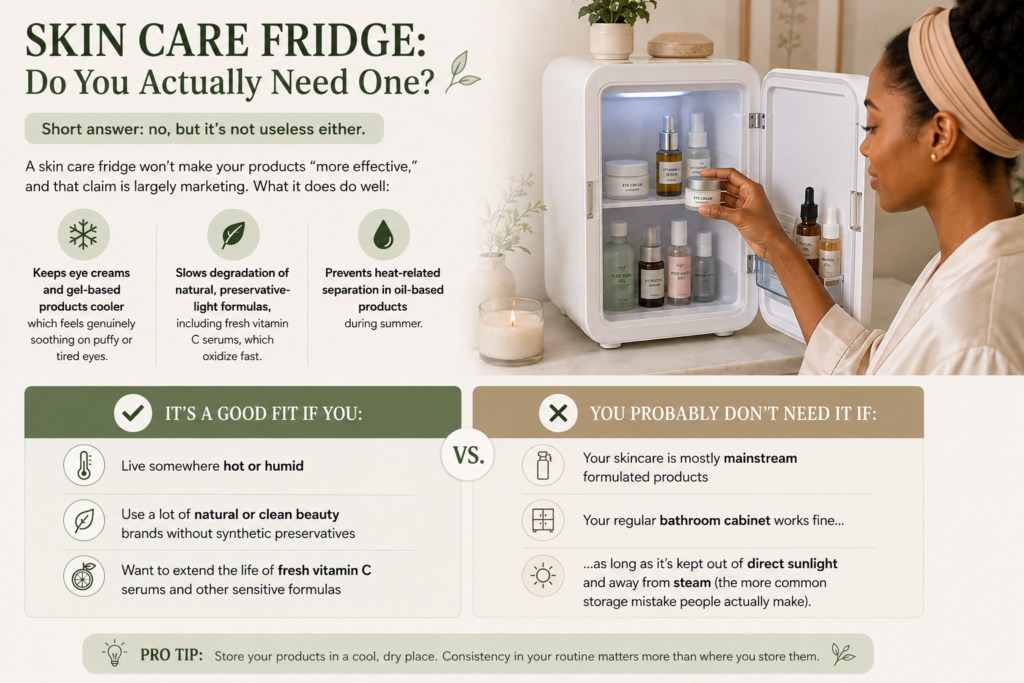
Short answer: no, but it’s not useless either.
A skin care fridge won’t make your products “more effective,” and that claim is largely marketing. What it does do well:
- Keeps eye creams and gel-based products cooler, which feels genuinely soothing on puffy or tired eyes
- Slows degradation of natural, preservative-light formulas, including fresh vitamin C serums, which oxidize fast
- Prevents heat-related separation in oil-based products during summer
If you live somewhere hot or humid, or you use a lot of natural or clean beauty brands without synthetic preservatives, it’s a genuinely useful accessory. If your skincare shelf is mostly mainstream formulated products, your regular bathroom cabinet works fine, as long as it’s kept out of direct sunlight and away from steam, which is the more common storage mistake people actually make.
Building a Skin Care Collection Under Budget
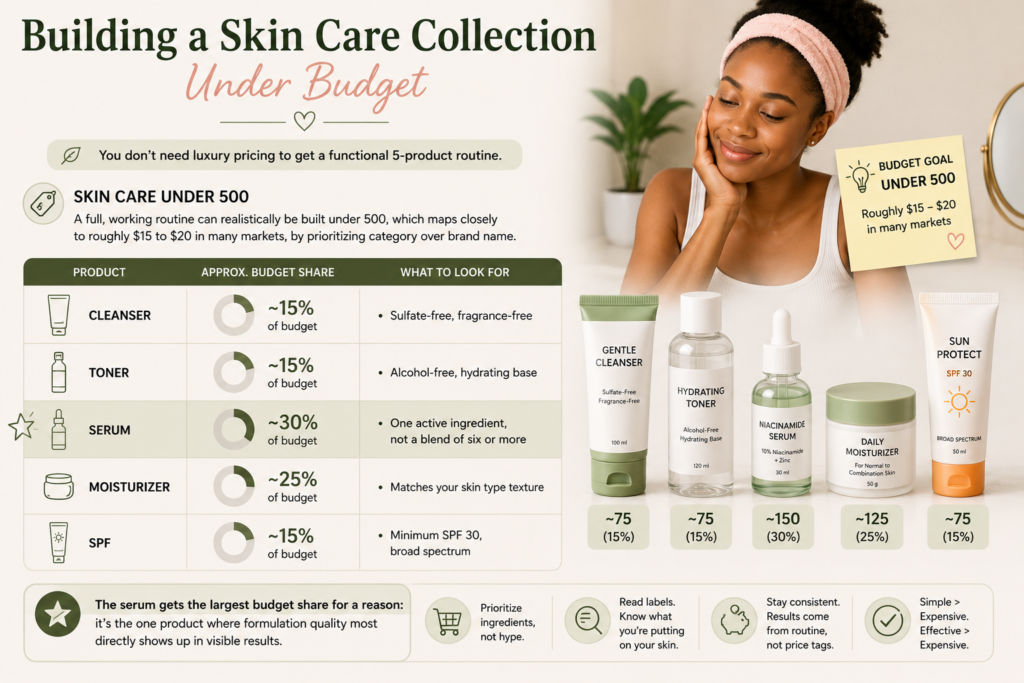
You don’t need luxury pricing to get a functional 5-product routine.
Skin Care Under 500
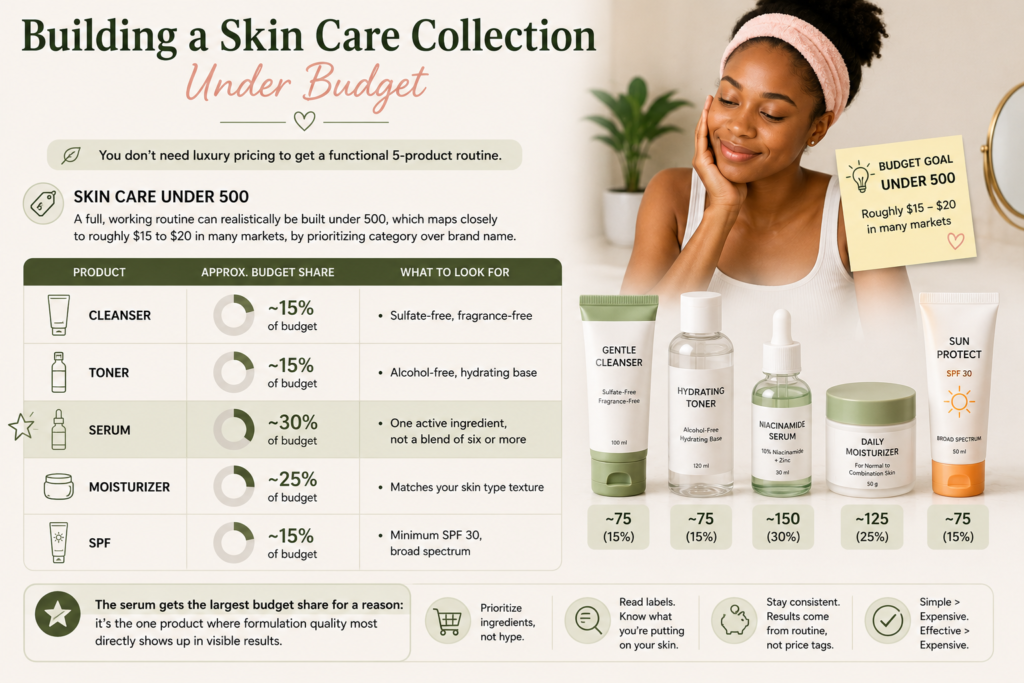
A full, working routine can realistically be built under 500, which maps closely to roughly $15 to $20 in many markets, by prioritizing category over brand name:
| Product | Approx. Budget Share | What to Look For |
|---|---|---|
| Cleanser | ~15% of budget | Sulfate-free, fragrance-free |
| Toner | ~15% of budget | Alcohol-free, hydrating base |
| Serum | ~30% of budget | One active ingredient, not a blend of six or more |
| Moisturizer | ~25% of budget | Matches your skin type texture |
| SPF | ~15% of budget | Minimum SPF 30, broad spectrum |
The serum gets the largest budget share for a reason: it’s the one product where formulation quality most directly shows up in visible results.
Skin Care Under Budget: General Tips

- Spend on the serum and SPF first. These are the two products where formulation quality actually shows up in results. Cleanser and toner have far more forgiving budget alternatives that perform nearly identically to premium versions, because their job, cleaning and rebalancing, is simpler chemistry than active ingredient delivery.
- Buy travel or trial sizes before committing to full size. This avoids the most common budget mistake: a full-price bottle abandoned after two uses because it didn’t suit your skin.
- Watch for single-ingredient budget brands. Plain hyaluronic acid or niacinamide serums from budget-focused lines often perform nearly as well as luxury versions with the same active ingredient at a fraction of the price.
- Don’t confuse expensive with effective. Above a certain price point, you’re often paying for packaging, fragrance, and brand marketing rather than a meaningfully different formula.
Skin Care Combo Sets: Worth Buying or Not?
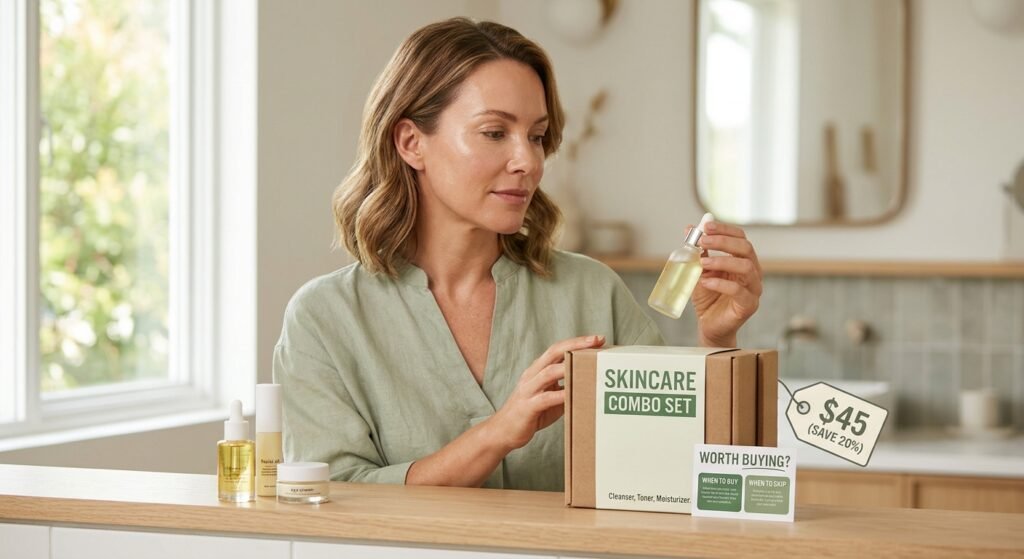
Pre-packaged combo sets, meaning a cleanser-toner-moisturizer bundle sold together, can be a genuinely smart way to build a skin care collection under budget, but only under specific conditions.
Buy a combo set when you’re brand new to a routine and want a tested, matched combination rather than guessing at compatibility, or when the set is from a single-ingredient-focused line where every product shares a simple, compatible formula base.
Skip the combo set when it bundles one strong product, like a good serum, with two weak or filler products just to justify the price, or when any single item in the set doesn’t match your skin type, since a “combo discount” isn’t a discount if a third of it goes unused.
A good rule: price out the set’s best individual item on its own. If the combo price isn’t meaningfully cheaper than that one item alone, you’re not actually saving anything.
Common Mistakes to Avoid When Choosing Skin Care Essentials
- Buying based on packaging aesthetics for Pinterest-worthy shelfies instead of ingredient lists
- Introducing multiple actives at once, such as retinol, vitamin C, and an exfoliating acid in the same week, which is the number one cause of sudden irritation
- Skipping SPF because a moisturizer “has SPF in it,” when most don’t contain enough SPF or reapply-friendly formulas for real protection
- Chasing trends over skin type, since a product going viral doesn’t mean it’s right for your skin
- Over-cleansing, since washing your face more than twice daily strips the barrier and often increases oil production and breakouts
- Storing actives in direct sunlight or a steamy bathroom, since heat and light degrade retinol and vitamin C faster than most people realize, quietly wasting money on a product that’s lost potency long before the bottle is empty
- Applying products in the wrong order, since a serum applied after moisturizer, or SPF applied before other products have absorbed, reduces how well each step actually works
FAQ
Do I need different products for morning and night? Not entirely different, but your serum and finishing product often should differ. Mornings prioritize protection with an antioxidant serum and SPF, while nights prioritize repair with retinol or a richer oil or cream.
How long before a new skincare product actually works? Most active ingredients need four to six weeks of consistent use before you’ll see a real change. Judging a product after a week is one of the most common reasons people over-buy and abandon products too early.
Can I use the same moisturizer year-round? Often not fully. Many people need a lighter formula in summer and a richer one in winter, especially in climates with big seasonal humidity shifts.
Is a skin care fridge a waste of money? Not a waste, but not essential either. It’s most worth it for natural or preservative-light products and hot climates. For standard formulated products, a cool, dark cabinet does the same job.
What’s the single biggest upgrade if I only have three products? Adding SPF to a cleanser-and-moisturizer routine, or swapping a generic moisturizer for one properly matched to your skin type, tends to produce the most noticeable improvement for the least added cost or effort.
Conclusion
A genuinely effective skincare routine isn’t the one with the most products, it’s the one you’ll actually finish, every day, without skipping steps out of exhaustion or cost. Start with the 1-to-5 product framework above, pick based on your skin type and budget rather than what’s trending, layer everything in the correct order, and add accessories like a headband, proper jar storage, or a fridge only once the fundamentals are locked in. Skip the combo sets and trendy tools that don’t pass the clean, treat, or protect test, and put your budget where it actually shows up in results: the serum and the SPF.
If you’re building your first collection, start with the 3-product routine, run it consistently for six weeks, and only then decide what’s actually missing.