Most people have used shampoo and conditioner their entire lives and still get the basics wrong.
Not because they’re careless — but because nobody ever explained why certain products work for certain hair, or what actually happens when you skip a step, use too much product, or wash on the wrong schedule. Shampoo and conditioner feel simple until you’re standing in the haircare aisle facing forty bottles that all claim to “repair,” “hydrate,” and “transform” your hair.
This guide cuts through that. You’ll learn how to match shampoo and conditioner to your specific hair type, avoid the mistakes that quietly sabotage your results, understand what’s actually in the bottle, and build a routine that fits your actual life — not an idealized one where you have time for a 12-step process every night.
How Shampoo and Conditioner Actually Work (and Why They’re Not Interchangeable)
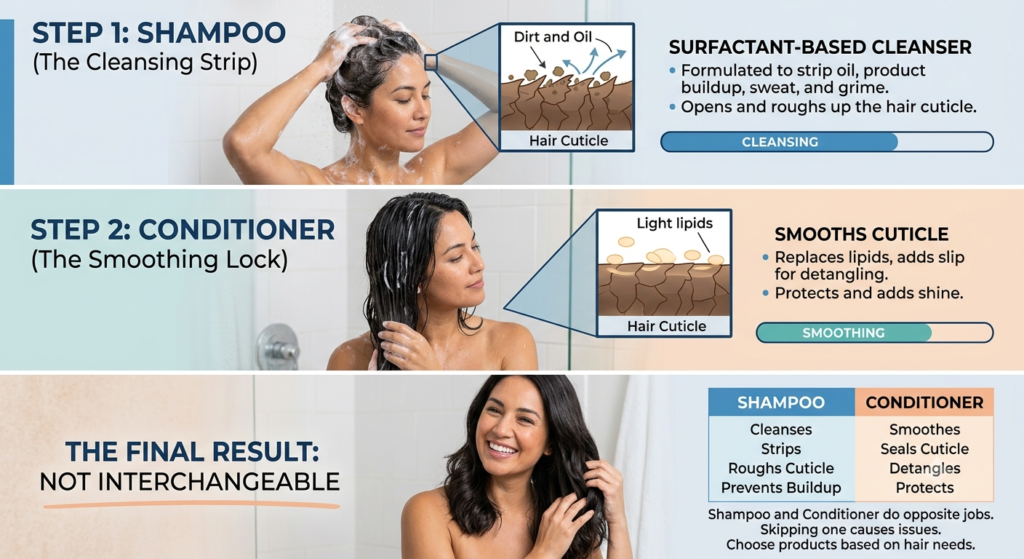
Shampoo and conditioner do opposite jobs, which is why using one without the other creates problems.
Shampoo is a surfactant-based cleanser. It’s formulated to strip oil, product buildup, sweat, and environmental grime from your scalp and hair shaft. That stripping action is necessary, but it also roughs up the hair cuticle — the outer layer of overlapping scales that protects each strand.
Conditioner does the opposite job: it smooths that cuticle back down, replaces some of the lipids shampoo removed, and adds slip so hair detangles without snapping.
Skip conditioner and you’re left with hair that’s clean but rough, static-prone, and harder to style. Skip shampoo and rely only on conditioner (a method called co-washing, which we’ll cover later) and you risk buildup, especially at the scalp, which can lead to flatness or irritation over time.
The mistake most people make isn’t choosing bad products — it’s treating shampoo and conditioner like a matched set of “whatever’s in the two-pack” instead of choosing each one based on what your hair specifically needs.
What’s Actually in the Bottle: Reading Ingredient Labels Without a Chemistry Degree
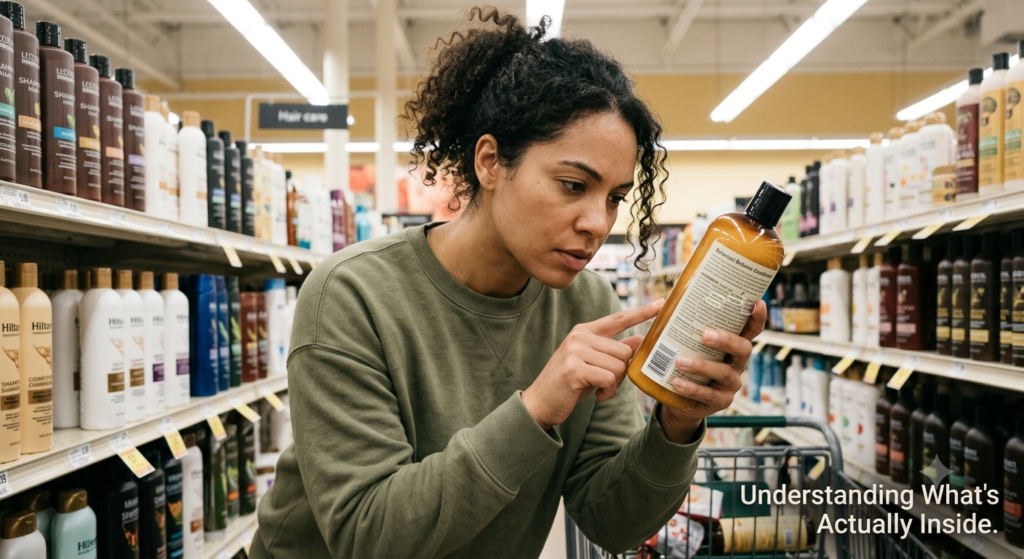
Most people skip the ingredient list entirely and shop by marketing claims instead — “volumizing,” “repair,” “salon quality.” Those words aren’t regulated, so they tell you almost nothing about what the product actually does. A handful of ingredient categories tell you far more.
Surfactants are the cleansing agents in shampoo. Sulfates (like sodium lauryl sulfate) clean aggressively and lather a lot, which feels satisfying but can be too harsh for dry, curly, or color-treated hair. Milder surfactants (like cocamidopyrenamine oxide or decyl glucoside) clean more gently and are usually what “sulfate-free” formulas rely on.
Silicones in conditioner (dimethicone, cyclomethicone) create that instant smoothness and shine by coating the hair shaft. They work well for detangling and frizz control, but non-water-soluble silicones can build up over time if you don’t shampoo regularly enough to remove them — which is one reason people who “co-wash only” sometimes notice their hair getting duller after a few weeks.
Humectants (glycerin, panthenol, hyaluronic acid) pull moisture into the hair and are especially useful for dry or curly types, though in very humid climates they can occasionally contribute to frizz by attracting moisture from the air, not just adding it.
Proteins (hydrolyzed keratin, wheat protein) temporarily reinforce weakened hair, which is genuinely useful for damaged or over-processed strands but can make hair feel stiff or straw-like if overused on hair that isn’t actually damaged. This is a detail that trips up a lot of people who assume “more protein equals healthier hair” — it doesn’t, unless your hair is protein-deficient to begin with.
You don’t need to memorize a chemistry glossary to shop smarter. Just knowing these four categories exist, and roughly what each one does, is usually enough to explain why a product that worked beautifully for a friend does nothing for you — your hair is asking for a different category of ingredient entirely.
Matching Shampoo and Conditioner to Your Hair Type
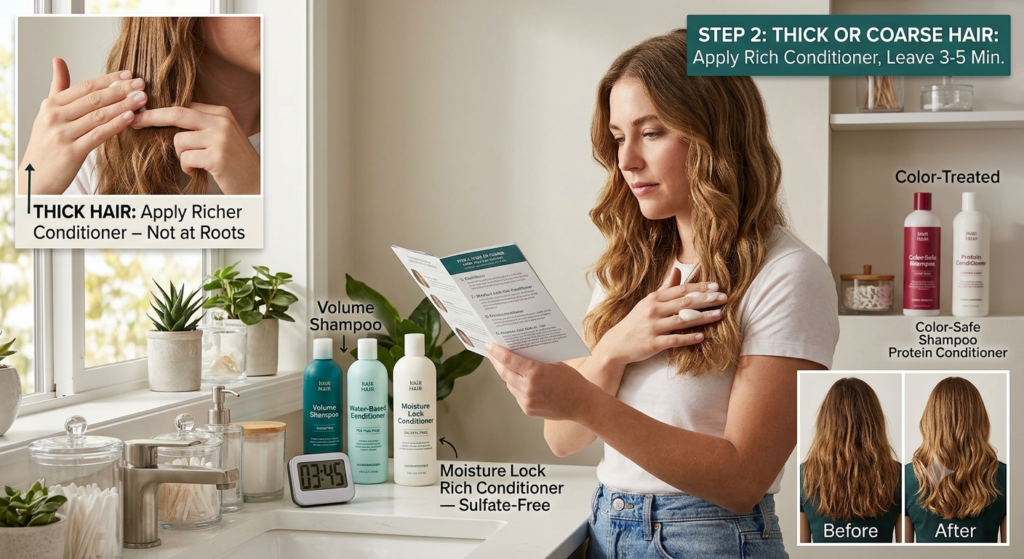
This is the section that changes results the most, and it’s the one most people skip.
Fine or Oily Hair
Fine hair gets weighed down fast, and oily scalps produce sebum faster than other types. The goal here is cleansing power without heavy conditioning agents.
- Shampoo: Look for lightweight, volumizing, or clarifying formulas. Avoid heavy oils like coconut or argan listed near the top of the ingredient list.
- Conditioner: Use a light, water-based conditioner and apply it only from mid-shaft to ends — never at the roots.
- Common mistake: Applying conditioner all over the scalp “for extra moisture.” This is the number one reason fine-haired people say their hair “goes flat by noon.”
- Overlooked detail: Fine hair actually benefits from a monthly clarifying shampoo, even more than other hair types, because thin strands show product buildup faster and more visibly than thick strands do.
Thick or Coarse Hair
Thick and coarse hair typically needs more moisture and slip, since natural oils have a harder time traveling down the length of each strand.
- Shampoo: Moisturizing or hydrating formulas, ideally sulfate-free to avoid over-drying.
- Conditioner: Richer, cream-based conditioners, sometimes left in longer (3–5 minutes) or swapped for a weekly deep conditioner.
- Common mistake: Under-conditioning because “thick hair can handle anything.” Thick hair often needs more conditioner, not less — it just needs it distributed thoroughly, not piled on at the roots.
- Overlooked detail: Coarse hair typically has a wider hair shaft diameter, which means the cuticle takes longer to absorb moisture. Leaving conditioner in slightly longer often outperforms simply using a heavier product.
Curly or Coily Hair
Curl patterns make it physically harder for scalp oil to travel down the hair shaft, which is why curly and coily hair is often drier by nature, regardless of how “oily” the scalp feels.
- Shampoo: Low-poo (mild sulfate-free) or co-wash-friendly formulas used less frequently — often once or twice a week.
- Conditioner: Heavier, slip-focused conditioners are essential, often used as a leave-in or in the “squish to condish” method.
- Common mistake: Washing too often, which strips the limited oil this hair type already struggles to retain.
- Overlooked detail: Applying conditioner to hair that’s still dripping wet, rather than damp, dilutes it too much to be effective. Squeezing out excess water first lets the conditioner actually coat the strand instead of sliding off.
Color-Treated or Chemically Processed Hair
Color, bleach, keratin treatments, and relaxers all compromise the cuticle to some degree, which makes hair more porous and more prone to fading or dryness.
- Shampoo: Sulfate-free, color-safe formulas. Sulfates accelerate color fade, particularly with reds and fantasy colors.
- Conditioner: Bond-building or protein-infused conditioners help reinforce the hair’s internal structure, not just the surface.
- Common mistake: Washing with hot water. Heat opens the cuticle further and accelerates color loss regardless of how gentle the shampoo is.
- Overlooked detail: Chelating shampoos (formulated to remove mineral buildup from hard water) can help color-treated hair hold tone longer, since mineral deposits are a hidden contributor to brassiness that most people blame entirely on the dye fading.
Scalp Conditions (Dandruff, Psoriasis, Sensitivity)
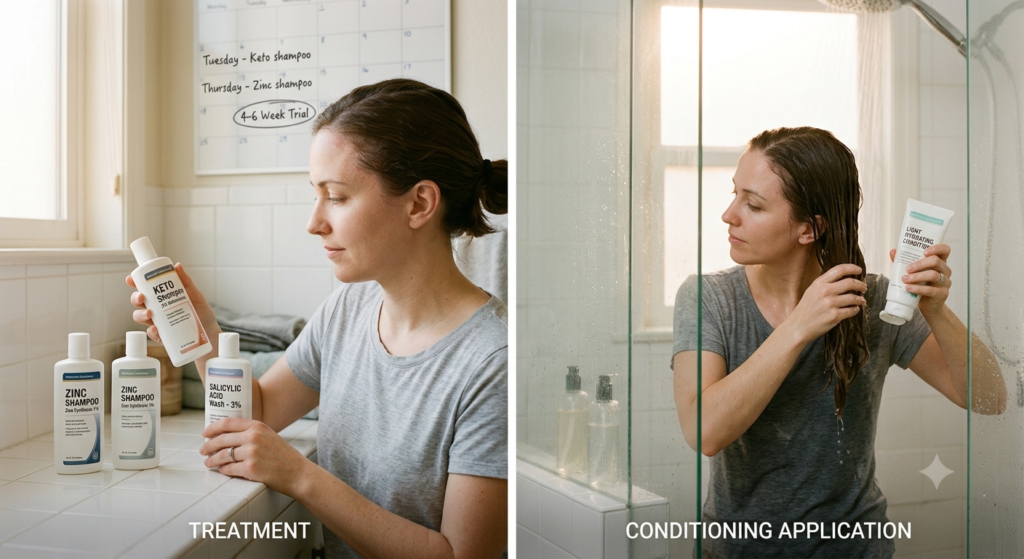
This category gets less attention, but it affects a large percentage of people.
- Shampoo: Medicated options with zinc pyrithione, ketoconazole, or salicylic acid, used as directed (often 2–3x weekly, not daily).
- Conditioner: Apply strictly to the lengths and ends, avoiding the scalp entirely, since conditioner residue can aggravate some scalp conditions.
- Common mistake: Switching shampoos constantly when symptoms don’t improve fast enough. Medicated formulas typically need 4–6 weeks of consistent use before you can judge whether they’re working.
- Overlooked detail: Alternating between two medicated shampoos with different active ingredients (for example, ketoconazole and zinc pyrithione) is a technique some dermatologists recommend, since scalp conditions can build a tolerance to a single active ingredient over time.
How Often You Should Actually Wash Your Hair
There’s no universal answer here, and “wash every other day” advice ignores how different hair types behave.
| Hair Type | Typical Washing Frequency |
|---|---|
| Fine/oily | Every 1–2 days |
| Normal | Every 2–3 days |
| Thick/dry | Every 3–4 days |
| Curly/coily | Every 4–7 days |
| Color-treated | 2–3x per week, cooler water |
Two nuances worth knowing:
- Over-washing can increase oil production. Stripping natural oils daily can prompt the scalp to overcompensate, creating a cycle where hair seems to “need” daily washing even though it didn’t start out that way. Stretching wash days gradually (even by one extra day at a time) can reset this over a few weeks.
- Under-washing has its own consequences. Product buildup can block hair follicles and contribute to a dull, flat appearance that people often mistake for “needing more product” — when what it actually needs is a proper cleanse.
There’s also a seasonal factor most guides skip entirely. Scalp oil production typically increases in summer heat and humidity and decreases in winter dryness, which means the “right” wash frequency for your hair type in July may genuinely be too frequent by January. Rather than locking into one fixed schedule year-round, it’s worth reassessing every few months, especially around seasonal transitions.
Common Mistakes People Make With Shampoo and Conditioner
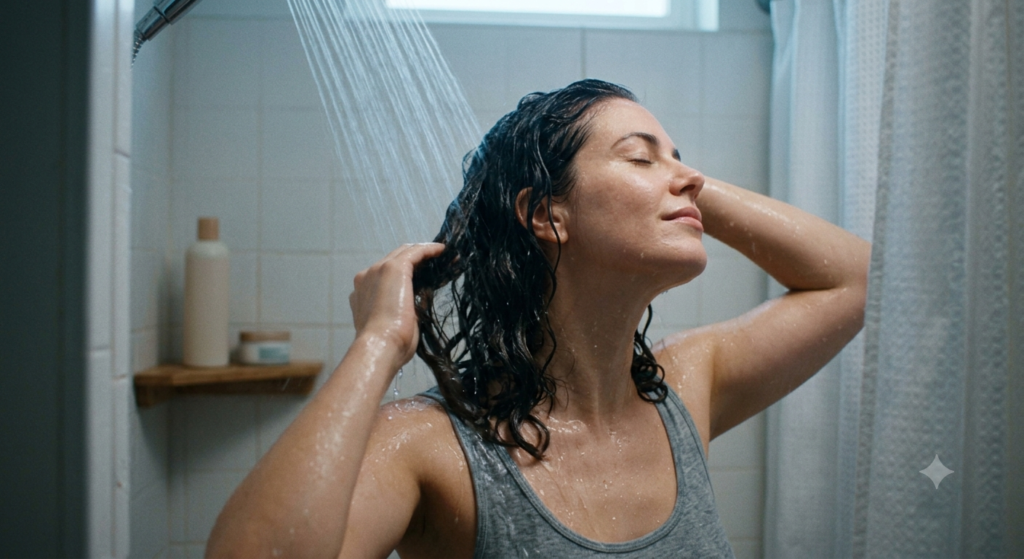
Even people who buy good products often undercut their results with technique errors.
- Applying shampoo to the ends instead of the scalp. Shampoo is meant to clean the scalp; the lather that runs down naturally cleanses the length. Piling shampoo directly onto ends over-strips them.
- Not rinsing thoroughly. Leftover shampoo or conditioner residue is one of the most common causes of “itchy scalp” complaints that people misattribute to product sensitivity.
- Using too much product. A quarter-sized amount of shampoo and a similar amount of conditioner is enough for most hair lengths. More product doesn’t mean cleaner or softer hair — it often just means longer rinse times and residue.
- Conditioning before shampooing (unless intentional). Some curly-hair methods do this deliberately, but for most routines, conditioner needs to go on after the cuticle has been opened by shampoo, not before.
- Ignoring water temperature. Hot water strips more oil and opens the cuticle wider than necessary; a lukewarm-to-cool rinse for the final step helps seal the cuticle and boosts shine.
- Assuming “sulfate-free” means “weaker.” Sulfate-free shampoos clean differently, not necessarily less effectively — they just require slightly more product or a longer massage time to work through oil and buildup.
- Rinsing conditioner out too quickly. Conditioner needs a minute or two of contact time to actually penetrate the cuticle. Applying it and rinsing within a few seconds mostly just coats the surface rather than conditioning the strand.
- Not massaging the scalp during shampoo. A thorough two-minute scalp massage does more than feel nice — it helps loosen dead skin cells and product buildup that a quick rinse-and-go pass leaves behind, and it also supports blood flow to hair follicles.
Co-Washing vs. Traditional Shampoo and Conditioner
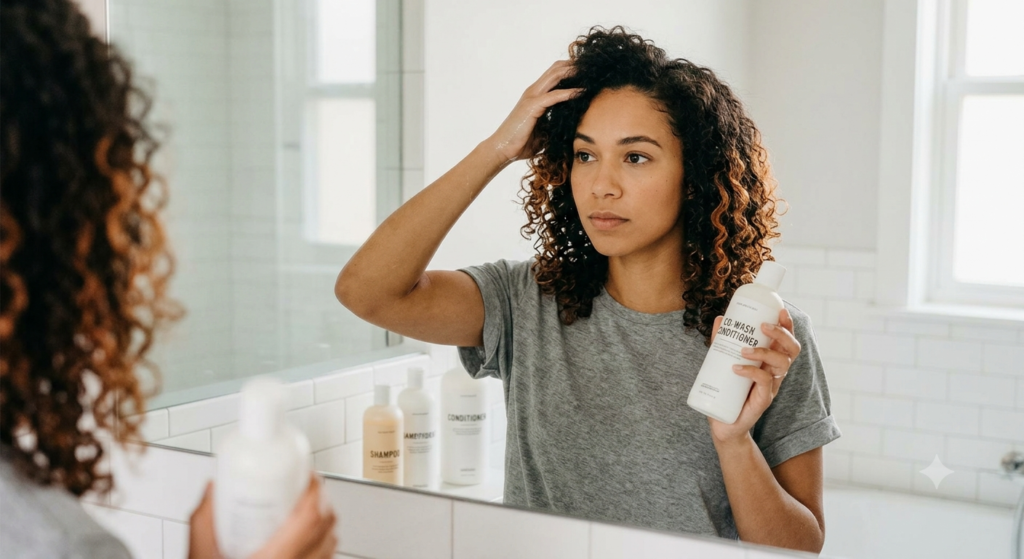
Co-washing (short for “conditioner washing”) means cleansing hair with conditioner instead of shampoo, either exclusively or in rotation with regular washes.
Where co-washing works well:
- Curly, coily, and very dry hair types that don’t produce much natural oil
- People with color-treated hair trying to stretch time between shampoo washes
- Anyone experiencing dryness from over-washing
Where co-washing falls short:
- Fine or oily hair, where it often leads to buildup and flatness within days
- Scalp conditions that need medicated, surfactant-based cleansing
- Anyone using heavy styling products (gels, creams, oils) that need a true surfactant to fully remove
A realistic middle ground many people land on: shampoo once or twice a week to clear buildup, and co-wash on the days in between. This isn’t an all-or-nothing decision, despite how it’s often marketed.
Worth noting: not all conditioners are formulated for co-washing. A true co-wash product usually contains a very mild cleansing agent alongside conditioning ingredients, since a standard conditioner alone isn’t designed to lift buildup or dirt from the scalp effectively. Using a regular conditioner as a full co-wash substitute is one reason some people try co-washing and find it doesn’t work — the product itself wasn’t built for the job.
Building a Weekly Hair Care Routine

Here’s a sample framework you can adjust based on your hair type from the sections above. This isn’t a rigid schedule — it’s a starting structure.
Example: Normal-to-Dry Hair, Washed 3x/Week
- Wash day 1: Shampoo scalp only, conditioner mid-shaft to ends, rinse with cool water.
- Non-wash days: Dry shampoo at the roots if needed; scalp massage with fingertips to redistribute oil.
- Wash day 2: Same as day 1, add a weekly hair mask or deep conditioner instead of regular conditioner.
- Wash day 3: Standard shampoo and conditioner, focus on thorough rinsing.
Example: Curly Hair, Washed 1–2x/Week
- Wash day: Sulfate-free shampoo at the scalp, rich conditioner applied generously through the lengths, detangle while conditioner is still in.
- Co-wash days (2–3x between washes): Conditioner-only cleanse, focusing on the scalp with fingertips.
- Leave-in step: Apply a leave-in conditioner or cream on wet hair before any styling product.
Example: Fine or Oily Hair, Washed Every Other Day
- Wash day: Lightweight or clarifying shampoo, focused entirely on the scalp; light conditioner on the ends only, rinsed thoroughly.
- Non-wash days: Root-focused dry shampoo applied the night before, brushed through in the morning to distribute rather than sprayed fresh right before leaving the house.
- Weekly: One clarifying wash to remove dry shampoo and styling product buildup, since dry shampoo itself contributes to buildup over time if never fully washed out.
The pattern that matters most isn’t the exact schedule — it’s matching cleansing frequency to how fast your specific hair and scalp actually get oily or dry, rather than following a generic “everyone washes twice a week” rule.
When It Might Be Time to Switch Products

Not every hair problem means your shampoo and conditioner are wrong, but a few signs are worth paying attention to.
If your hair feels waxy or coated within a day of washing, that often points to silicone buildup from conditioner rather than a shampoo problem — try a clarifying shampoo every second or third wash before switching your entire routine. If your scalp is consistently itchy or flaky despite thorough rinsing, that’s more likely a scalp-specific issue than a hair-length issue, and a medicated shampoo is worth trying before assuming you need a “gentler” product. If color is fading unusually fast, check your water first; hard water mineral buildup is frequently mistaken for a product failure.
The instinct to buy a completely new set of products at the first sign of an issue often skips the more useful step: identifying which single variable (buildup, water temperature, application technique, or seasonal changes) is actually causing the problem.
Frequently Asked Questions
Do I need to use the same brand for shampoo and conditioner? No. Matching brands is a marketing convenience, not a chemical requirement. What matters is that both products suit your hair type and scalp condition — you can mix a clarifying shampoo from one line with a moisturizing conditioner from another without any issue.
Is it bad to switch shampoo and conditioner often? Switching occasionally isn’t harmful, but constantly rotating products makes it hard to tell what’s actually working. If you’re addressing a specific issue (dandruff, dryness, color fade), give a product at least 3–4 weeks before judging results.
Can conditioner cause hair loss? Conditioner itself doesn’t cause hair loss, but heavy buildup at the scalp can contribute to irritation or blocked follicles over time. This is why conditioner is generally recommended for the lengths and ends rather than the scalp for most hair types.
Should I brush my hair before or after washing? Before. Detangling dry or slightly damp hair before shampooing reduces the amount of pulling and breakage that happens when you try to detangle soaking-wet hair, which is at its weakest state.
Why does my hair feel great right after washing but bad the next day? This usually points to either a conditioner that’s too heavy for your hair type (causing next-day flatness) or one that isn’t rich enough (causing next-day frizz and dryness). If flatness is the issue, apply conditioner only from mid-shaft down. If frizz is the issue, look for a richer formula or add a lightweight leave-in.
Key Takeaways
Shampoo and conditioner aren’t interchangeable, and they’re not one-size-fits-all — they’re two products doing two different jobs, and the right formula for each depends entirely on your specific hair type, scalp condition, and how often you actually wash.
The fastest way to improve your results isn’t necessarily buying more expensive products. It’s applying shampoo where it belongs (the scalp), conditioner where it belongs (mid-shaft to ends), rinsing thoroughly, letting conditioner sit for a minute before rinsing, and adjusting your wash frequency based on how your hair actually behaves rather than a generic schedule.
If you take one thing from this guide, let it be this: pay attention to where you’re applying each product and how long you’re leaving it on, not just which products you’re buying. That single adjustment resolves more haircare complaints than switching brands ever does.