Ask five people to explain the difference between a relaxer and a texturizer, and you’ll usually get five different answers — and at least two of them will be wrong. It’s not because people are careless. It’s because salons, box kits, and even some stylists use these words loosely, which means clients walk in asking for one thing and walk out with another.
That mismatch is where most chemical hair damage actually starts. Not from the chemicals themselves, but from getting the wrong service for your hair’s actual needs. A client who wanted soft, loosened curls ends up bone straight. Another who wanted a manageable texturizer gets talked into a full relaxer because the words got used interchangeably during the consultation.
This guide breaks down perms, relaxers, and texturizers the way a stylist would explain it during a consultation — not a chemistry lecture, but not oversimplified either. By the end, you’ll know which one (if any) fits your hair goals, what happens to your strands during and after each service, how the process actually feels sitting in the chair, and the specific mistakes that turn a good treatment into a bad haircut waiting to happen.
Perms vs. Relaxers vs. Texturizers: What’s Actually Different
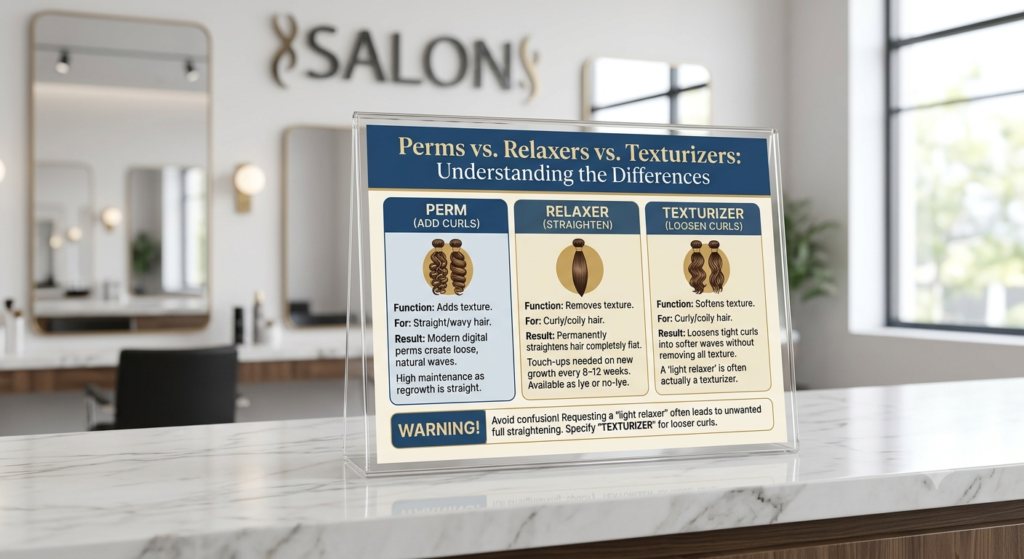
The confusion makes sense once you realize these three services are chemically related but functionally opposite in what they’re trying to accomplish.
Perms add curl or wave to straight or slightly textured hair. The solution breaks down the hair’s internal bonds, wraps it around rods, and reforms those bonds in a curled shape. This is the service most people picture from the 1980s, but modern perms — spiral perms, body waves, digital perms — are far gentler and more customizable than their reputation suggests. A digital perm, for example, uses heated rods and a lower-pH solution, which tends to produce a looser, more natural-looking wave than the tight, uniform curls of a traditional cold perm.
Relaxers do the opposite job: they permanently straighten curly or coily hair by breaking down the natural curl pattern until the hair lies flat. A relaxer is meant to be a complete, long-term straightening — you’re not touching up in six weeks, you’re maintaining new growth every 8–12 weeks while the previously relaxed hair stays straight. There are two main chemical types: lye relaxers (sodium hydroxide), which process faster and tend to be gentler on the hair shaft but harsher on the scalp, and no-lye relaxers (calcium hydroxide), which are milder on the scalp but can leave more calcium buildup on the hair over time if not clarified regularly.
Texturizers are relaxers with the brakes tapped. Same basic chemistry — usually a lye or no-lye formula — but left on for a shorter processing time and often at a lower strength. Instead of fully straightening the hair, a texturizer loosens the curl pattern, taking a tight coil and softening it into a looser wave or curl without eliminating texture completely. Think of it as the difference between fully unwinding a spring and just stretching it out slightly.
Here’s the distinction that actually matters when you’re deciding what to ask for:
| Service | What it changes | Result | Maintenance | | Perm | Straight/wavy hair → curled | Adds texture | Grows out; regrowth is straight | | Relaxer | Curly/coily hair → straight | Removes texture | Touch-ups on new growth every 8–12 weeks | | Texturizer | Curly/coily hair → looser curl | Softens texture | Touch-ups every 3–4 months, less frequent than relaxers |
A lot of women ask for a “light relaxer” when what they actually want is a texturizer. Those aren’t the same request, and a stylist who takes it literally will give you full straightening, not the loose, soft curl pattern you had in mind. This single miscommunication is probably the most common source of “I told them exactly what I wanted and they still got it wrong” complaints in salon reviews.
How to Know Which One (If Any) Is Right for Your Hair
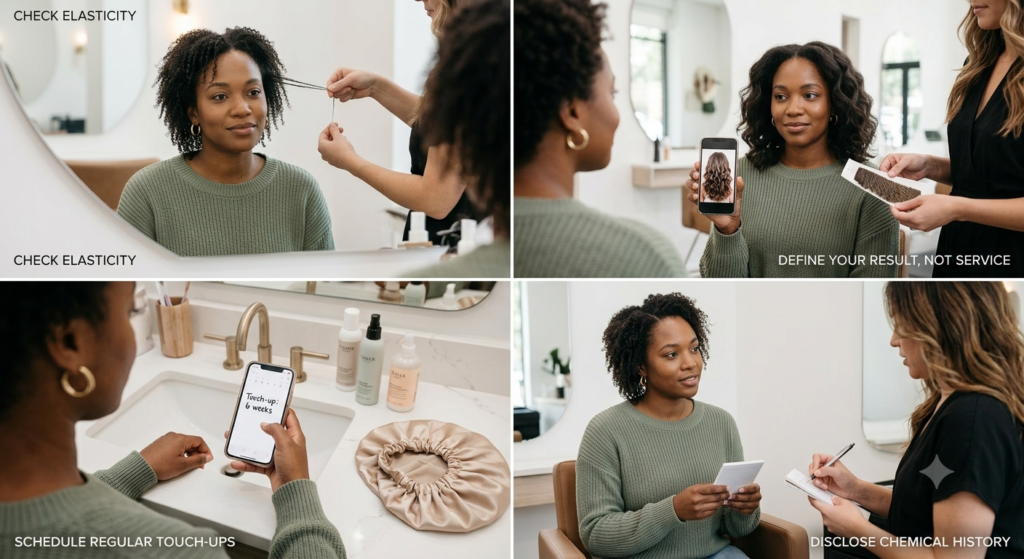
Choosing between these services isn’t just about the look you want — it’s about whether your hair, scalp, and lifestyle can actually support the maintenance involved. Here’s what to weigh before you book anything.
Consider your hair’s current condition first
Chemical services amplify whatever state your hair is already in. If your hair is already dry, over-processed from box color, or breaking at the ends, adding a perm, relaxer, or texturizer on top of that is asking for trouble. Most reputable stylists will refuse or postpone a chemical service on compromised hair — and if yours doesn’t, that’s a red flag, not a green light.
A practical test many stylists use: gently stretch a strand of wet hair. If it snaps immediately with little to no elasticity, the hair is too compromised for another chemical process right now, regardless of how long it’s been since your last treatment.
Think about your realistic maintenance capacity
This is the part people skip during the excitement of a consultation.
- Relaxers commit you to consistent touch-ups. Skip too many appointments and you’ll have two different textures fighting each other at the point of new growth, which is one of the most common causes of breakage.
- Texturizers are more forgiving because the goal isn’t total straightness, so uneven regrowth blends more easily.
- Perms require heat styling or product routines to maintain curl definition between salon visits, plus they grow out visibly since new growth won’t have the same curl pattern.
If you travel often, have a demanding schedule, or simply know yourself well enough to admit you won’t make every touch-up appointment, a texturizer or a temporary styling alternative, like a curling wand routine or keratin treatment, may serve you better long-term than a relaxer.
Match the service to your actual goal, not a photo
A common situation: someone brings in a photo of loose, tousled waves and asks for a “relaxer” because that’s the word they know. A relaxer will straighten hair completely — it won’t produce loose waves. That result usually comes from a light texturizer, a soft perm, or even heat styling alone. Being specific about the end result you want, rather than naming a service, gives your stylist room to recommend the right one.
Factor in your hair history, not just its current state
Two people can have hair that looks identical today and still need completely different treatment plans, because their chemical histories are different. Someone who’s never had a chemical service can usually tolerate a standard strength product. Someone with a history of color, keratin treatments, or previous relaxers is working with hair that’s already had some of its natural protective layer altered, even if it looks healthy now. Always disclose your full chemical history to your stylist, including box treatments you did yourself years ago. It affects processing time and strength recommendations more than people realize.
The Recovery Timeline: What to Expect After Each Treatment
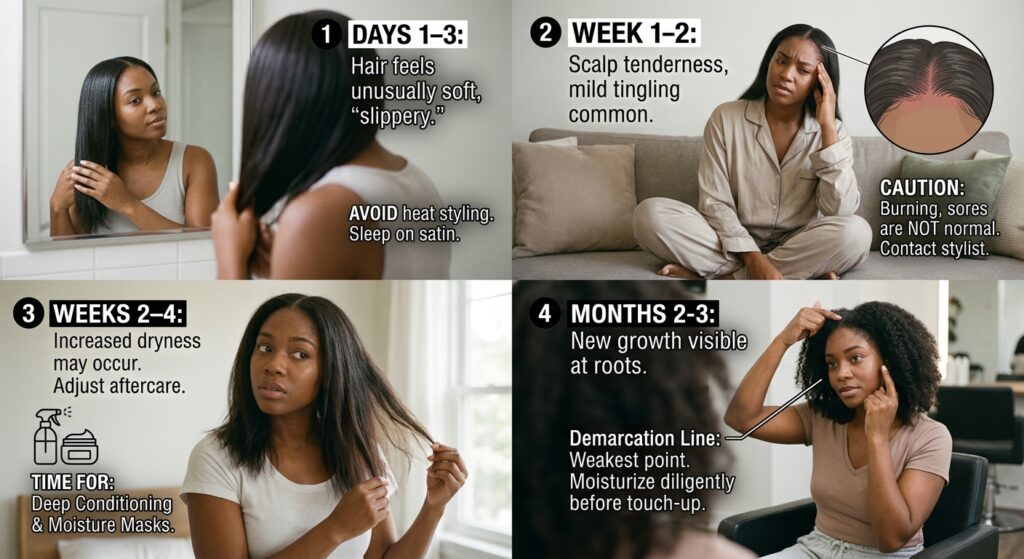
This is the section most articles skip, and it’s exactly why people panic two days after their appointment thinking something went wrong.
Days 1–3 (all three services): Hair may feel unusually soft, almost “slippery,” due to the altered protein structure. Avoid heat styling and manipulation during this window — the hair is at its most vulnerable right after chemical processing. Sleeping on a satin or silk pillowcase during these first few days also reduces unnecessary friction while the hair is settling.
Week 1–2: Scalp sensitivity is common, especially with relaxers, which can cause mild tingling or tenderness even when applied correctly. If you experience burning, open sores, or scabbing, that’s a sign of chemical burns, not a normal reaction, and it should be addressed with your stylist immediately. Mild flaking during this window is usually just a sign the scalp is recovering, but persistent pain is not something to wait out.
Weeks 2–4: This is when moisture balance becomes the real test. Chemically treated hair loses some of its natural ability to retain moisture, so if you notice increased dryness or a “straw-like” texture during this period, it’s not a sign the service failed — it’s a sign your aftercare routine needs adjusting. This is usually the point where a deep conditioning treatment or protein mask, depending on how the hair feels, makes the biggest visible difference.
Month 2–3 for relaxers, Month 3–4 for texturizers: New growth becomes visible at the roots. This is the natural checkpoint for a touch-up, not a sign of damage. Waiting too long past this point is when most breakage at the demarcation line, where treated and untreated hair meet, starts to happen. That line is the weakest point on the entire strand, and it’s where a comb will snag first if the hair isn’t properly moisturized.
Perms specifically: Curl pattern often loosens slightly over the first few weeks as the hair adjusts, and this is normal and doesn’t mean the perm is failing. True loss of curl definition usually shows up closer to the 3–4 month mark, and at that point it’s more about styling technique fatigue than the chemical process wearing off.
Common Mistakes That Wreck Chemically Treated Hair
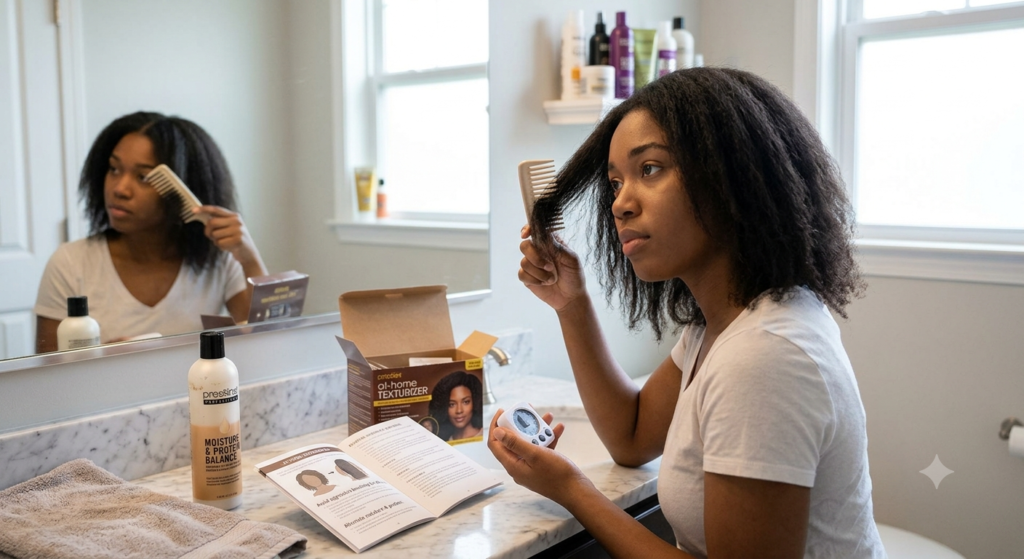
Most chemical hair damage isn’t caused by the treatment itself, it’s caused by what happens in the weeks after.
- Shampooing too soon. Washing within 48 hours of a relaxer or texturizer can disrupt the bonds that are still settling, sometimes reversing part of the straightening or loosening process.
- Skipping the neutralizing step. Whether at a salon or with a box kit, the neutralizer stops the chemical process from continuing to break down hair. Rushing through this step is one of the fastest ways to cause severe breakage.
- Combining chemical services too closely together. Getting a relaxer touch-up and a color treatment in the same week, or even the same month, puts more stress on the hair than most strands can handle. Stylists generally recommend spacing these services at least two weeks apart, and some recommend a full month between a relaxer and any bleach service.
- Over-relaxing new growth. Applying relaxer to hair that’s already been previously straightened, not just the new growth, is called “overlapping,” and it’s one of the top causes of hair snapping off at the mid-shaft. This is especially easy to do accidentally with box kits, since there’s no professional guiding where the product should and shouldn’t go.
- Assuming texturized or relaxed hair needs less product. The opposite is true. Chemically treated hair typically needs more moisture and protein-balancing products, not less, because the altered structure holds onto hydration less efficiently than untouched hair.
- Ignoring protein-moisture balance. Chemically treated hair needs both protein, to reinforce strength, and moisture, to prevent brittleness, and leaning too far into either one causes problems. Over-moisturized hair can feel mushy and limp; over-proteinized hair can feel stiff and prone to snapping. If your hair feels gummy and stretchy when wet, that’s usually a moisture overload sign. If it feels straw-like and breaks with almost no stretch, that’s usually a protein deficiency.
- Brushing or detangling too aggressively right after processing. Freshly relaxed or texturized hair is at its weakest point structurally for the first several days. Wide-tooth combs and finger detangling cause far less breakage than brushes during this window.
- Using heat tools at full strength immediately after a service. Even though the hair may look and feel ready for styling, it’s still adjusting internally. Lower heat settings and heat protectant use for the first few weeks make a measurable difference in preventing brittleness later.
How to Talk to Your Stylist (So You Get What You Actually Want)
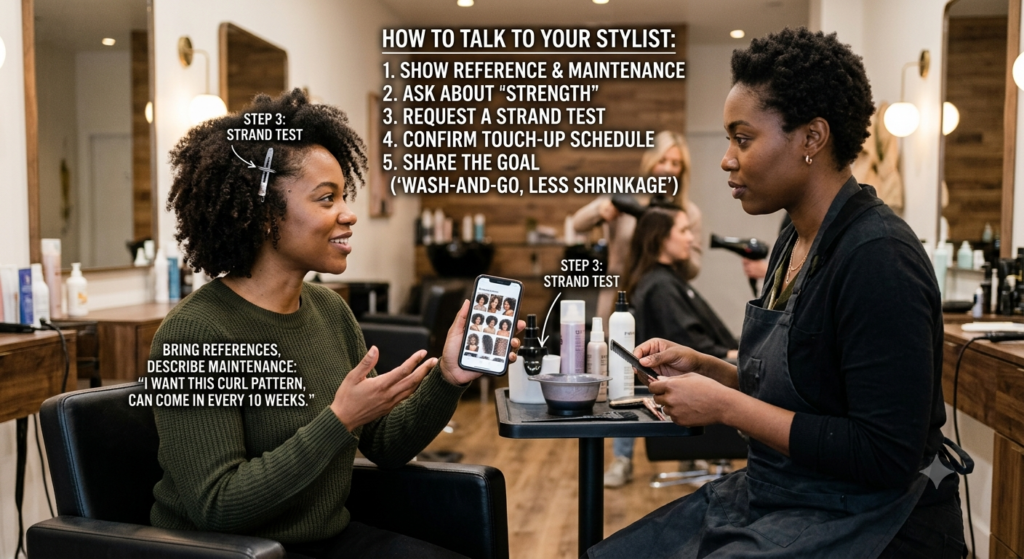
The gap between what clients ask for and what they actually want is the single biggest source of “bad perm” and “over-processed relaxer” stories. Closing that gap comes down to communication, not luck.
Bring reference photos, but describe the maintenance, not just the look. Instead of “I want this,” try “I want this curl pattern, and I’m only realistically able to come in every 10 weeks.” That second sentence gives your stylist the information they actually need to recommend a service.
Ask what “strength” means for your hair type specifically. Relaxer and texturizer strength, mild, regular, super, isn’t standardized the same way across brands, and what counts as “mild” for coarse, dense hair might be too strong for fine or previously colored hair.
Request a strand test if it’s your first time with a stylist or product. A responsible stylist should apply the product to a small section first to check processing time and reaction before committing your whole head. If a stylist skips this step on a first-time client, that’s worth questioning.
Ask directly what the touch-up schedule will look like before you commit. Get a real answer, not a vague “whenever you need it.” Vague answers usually mean vague aftercare guidance too.
Say the word “goal,” not just the word “service.” Telling a stylist your goal is “manageable wash-and-go hair with less shrinkage” gives them far more room to recommend the right chemical strength and type than simply requesting “a texturizer,” which can mean different things depending on the brand and technique they normally use.
What’s In the Bottle: Ingredients Worth Knowing About
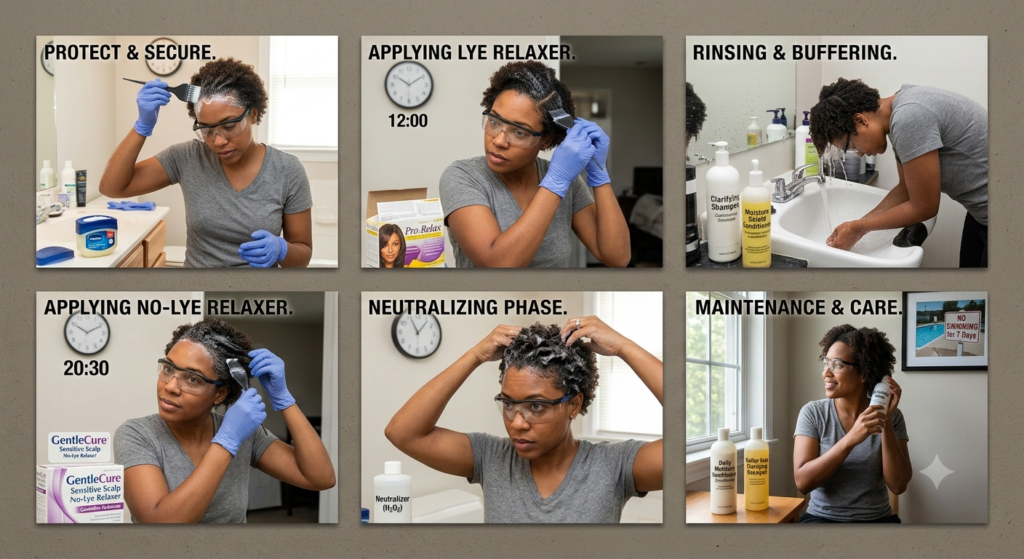
Most people never look past the “lye” or “no-lye” label, but a handful of ingredients on the box matter more than that distinction once you’re deciding between products or trying to repair hair afterward.
Sodium hydroxide is the active ingredient in lye relaxers. It processes quickly, often in under 15 minutes, which limits the window of exposure to the hair shaft itself, but it’s also more likely to irritate or burn the scalp if left too long or applied to already-broken skin. This is why a base or protective cream along the hairline and scalp is a non-negotiable step, not an optional one.
Calcium hydroxide and guanidine hydroxide are the typical actives in no-lye relaxers. They’re gentler on the scalp, which is part of why they’re marketed as “kids’ formulas” or “sensitive scalp” options, but they leave a mineral residue on the hair that builds up over multiple applications. If your relaxed or texturized hair starts feeling coated or resistant to moisture no matter how much conditioner you use, a clarifying or chelating shampoo every few weeks usually resolves it.
Ammonium thioglycolate is the primary active in most perm solutions. It’s the ingredient responsible for breaking the disulfide bonds in the hair so it can be reshaped around the rods, and it’s also why perm processing rooms often have that distinct sulfur-like smell. Hair that’s been permed shouldn’t be exposed to chlorinated pool water for at least a week afterward, since chlorine reacts with the residual thioglycolate and can cause the curl pattern to loosen unevenly or turn brittle.
Neutralizers typically contain hydrogen peroxide or sodium bromate, and their entire job is to stop the chemical process and re-harden the bonds in their new shape. This is the step people rush most often, especially with box kits, because it feels like “the hard part is already done.” It isn’t. Skipping or shortening neutralizing time is one of the single biggest predictors of breakage in the weeks that follow.
Look for, rather than avoid: conditioning agents like cetrimonium chloride or dimethicone built into the relaxer or texturizer base formula itself. These help buffer some of the harshness of the active ingredient and are increasingly common in mid-range and higher-end product lines, though they add cost.
Building an Aftercare Routine That Actually Works
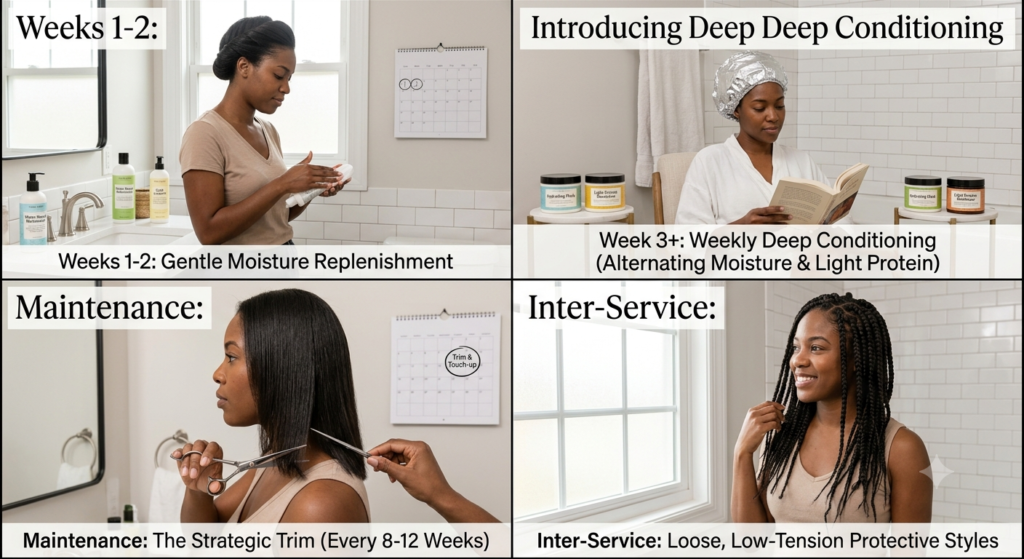
A single good aftercare routine matters more to the long-term health of chemically treated hair than the specific brand or strength you chose in the first place. Most damage attributed to “bad relaxers” is really the result of no structured aftercare plan at all.
In the first two weeks, focus on gentle moisture replenishment rather than deep treatments. A leave-in conditioner and a light, water-based moisturizer applied daily helps offset the initial dryness without overwhelming hair that’s still stabilizing.
From week three onward, introduce a weekly or biweekly deep conditioning treatment, alternating between moisture-focused and protein-focused formulas depending on how the hair responds. This is also the point where a light protein treatment, not a heavy reconstructor, can help reinforce strength without stiffening the hair.
Trims matter more than people expect. Chemically treated ends are more prone to splitting, and split ends travel upward over time, compounding into breakage further up the strand. A trim every 8–12 weeks, timed close to your touch-up schedule, keeps damaged ends from spreading.
Protective styling has real value between services, particularly for relaxed and texturized hair, since it reduces daily manipulation and friction. But protective styles that pull tightly at the edges or nape, especially soon after a chemical service, can cause breakage at exactly the point where the hair is already weakest. Loose, low-tension styles are the safer choice in the weeks immediately following any of these treatments.
Frequently Asked Questions
Can I switch from relaxed hair straight to a texturizer without growing everything out? Not safely in one session. Applying a texturizer over already-relaxed hair essentially reprocesses hair that’s already had its bonds broken once, which significantly raises the risk of breakage. Most stylists recommend transitioning gradually or waiting for new growth before making that switch.
Do texturizers cause less damage than relaxers? They cause less straightening, which often means less overall chemical exposure since processing time tends to be shorter. But “less damage” isn’t automatic. A texturizer left on too long or applied too frequently can still cause the same breakage issues as a relaxer.
Is it true that box relaxer kits are always worse than salon relaxers? Not always, but the risk profile is different. Box kits use standardized processing times regardless of your specific hair density or porosity, while a stylist can adjust timing and strength in real time. If you’re doing it yourself, err toward the mildest strength option and shorter processing time, then check progress frequently.
How do I know if my hair can even handle a perm, relaxer, or texturizer right now? Beyond the strand-stretch test mentioned earlier, look at how your hair has responded to previous chemical or heat treatments. Hair that snaps easily, feels gummy when wet, or has visible thinning at stress points like the crown or edges usually needs a recovery period with protein treatments and trims before adding another chemical process.
Can I color my hair and get a relaxer or texturizer at the same time? It’s generally not recommended to do both in the same appointment or even the same week. Color and chemical straightening both alter the hair’s structure, and doing them too close together compounds the stress on the strand. Most stylists recommend relaxing or texturizing first, waiting at least two weeks, then coloring afterward.
Conclusion
The real difference between perms, relaxers, and texturizers isn’t just chemical, it’s about direction and degree: adding curl, removing it entirely, or softening it partway. Getting the right one for your hair depends less on trends and more on an honest look at your hair’s current condition, your chemical history, your realistic maintenance schedule, and a clear conversation with whoever’s applying the product.
If you’re about to book a service, the most useful next step is a consultation where you describe your desired result and maintenance capacity, not just a service name, so your stylist can match the right chemical process to your actual hair. That single conversation prevents most of the regret stories you’ll find searching this topic in the first place.