Somewhere between the 12-step Korean routine trend and the “just use soap and water” minimalists, most people lost track of a simple question: how many skin care products do you actually need?
The honest answer isn’t one-size-fits-all, and anyone who tells you it is hasn’t looked closely at your skin, your budget, or your 7 a.m. schedule. A 22-year-old with clear, oil-balanced skin needs a completely different shelf than a 40-year-old managing dryness, pigmentation, and the first fine lines.
This guide walks through exactly what belongs in a routine at every stage — from a single product to a full five-piece collection — plus the tools and accessories nobody mentions until you’re already three products in and wondering why your serum “isn’t working.” You’ll also get the layering order that actually determines whether your products work together or fight each other, a realistic look at what a routine costs at different budget levels, and how to introduce something new without setting your skin back a month.
By the end, you’ll know exactly what to buy, what to skip, and how to tell a genuinely good combo deal from a marketing trick.
What Actually Counts as “Skin Care Products” (Beyond the Bottles)
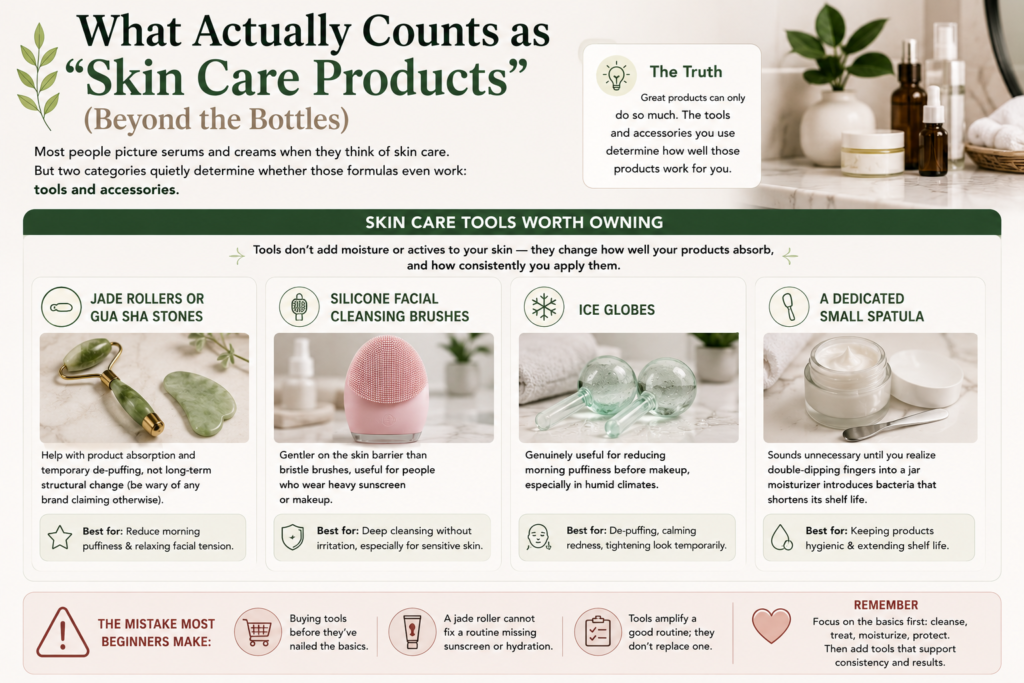
Most people picture serums and creams when they think of skin care. But two categories quietly determine whether those formulas even work: tools and accessories.
Skin Care Tools Worth Owning
Tools don’t add moisture or actives to your skin — they change how well your products absorb, and how consistently you apply them.
- Jade rollers or gua sha stones – help with product absorption and temporary de-puffing, not long-term structural change (be wary of any brand claiming otherwise)
- Silicone facial cleansing brushes – gentler on the skin barrier than bristle brushes, useful for people who wear heavy sunscreen or makeup
- Ice globes – genuinely useful for reducing morning puffiness before makeup, especially in humid climates
- A dedicated small spatula – sounds unnecessary until you realize double-dipping fingers into a jar moisturizer introduces bacteria that shortens its shelf life
The mistake most beginners make: buying tools before they’ve nailed the basics. A jade roller cannot fix a routine missing sunscreen or hydration. Tools amplify a good routine; they don’t replace one.
Skin Care Accessories That Make a Real Difference
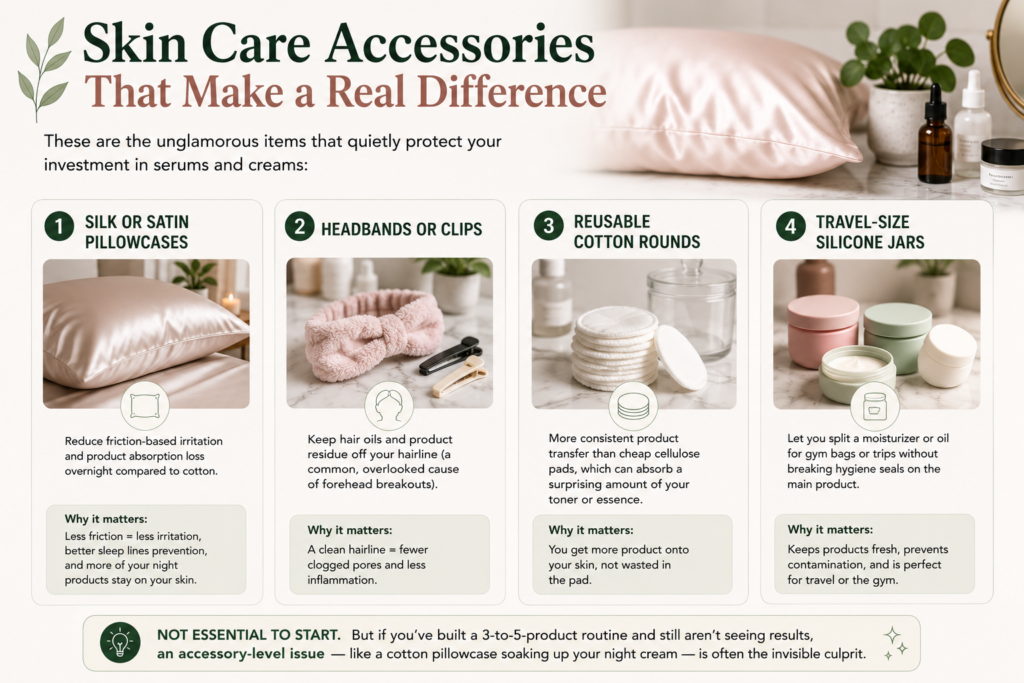
These are the unglamorous items that quietly protect your investment in serums and creams:
- Silk or satin pillowcases – reduce friction-based irritation and product absorption loss overnight compared to cotton
- Headbands or clips – keep hair oils and product residue off your hairline (a common, overlooked cause of forehead breakouts)
- Reusable cotton rounds – more consistent product transfer than cheap cellulose pads, which can absorb a surprising amount of your toner or essence
- Travel-size silicone jars – let you split a moisturizer or oil for gym bags or trips without breaking hygiene seals on the main product
None of these are essential to start. But if you’ve built a 3-to-5-product routine and still aren’t seeing results, an accessory-level issue — like a cotton pillowcase soaking up your night cream — is often the invisible culprit.
The Three Formulas That Do the Real Work
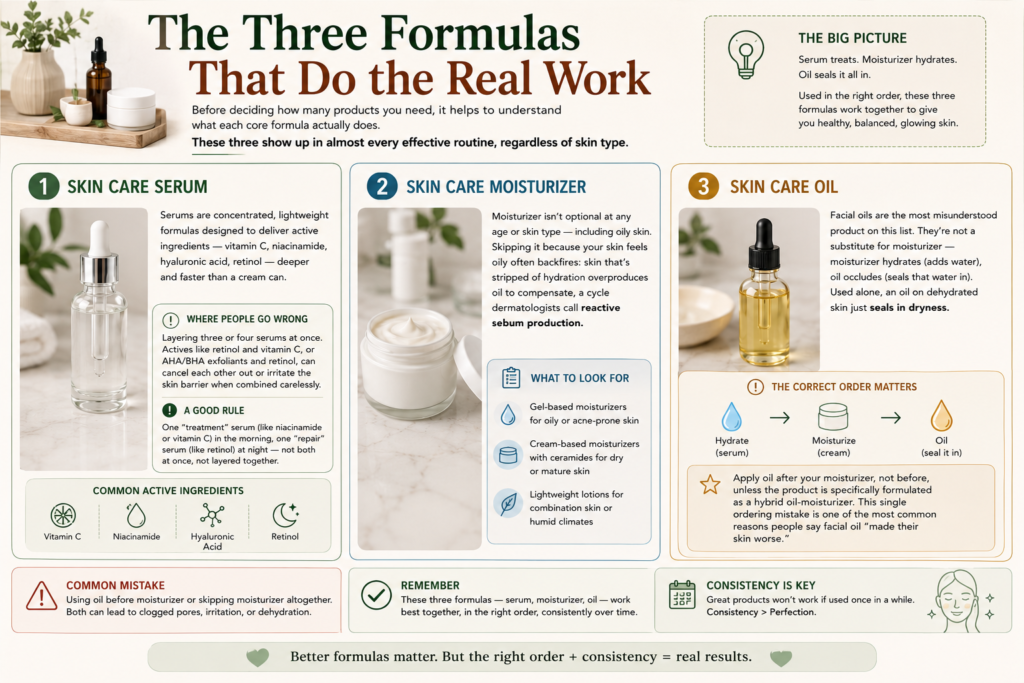
Before deciding how many products you need, it helps to understand what each core formula actually does. These three show up in almost every effective routine, regardless of skin type.
Skin Care Serum
Serums are concentrated, lightweight formulas designed to deliver active ingredients — vitamin C, niacinamide, hyaluronic acid, retinol — deeper and faster than a cream can.
Where people go wrong: layering three or four serums at once. Actives like retinol and vitamin C, or AHA/BHA exfoliants and retinol, can cancel each other out or irritate the skin barrier when combined carelessly. A good rule: one “treatment” serum (like niacinamide or vitamin C) in the morning, one “repair” serum (like retinol) at night — not both at once, not layered together.
Skin Care Moisturizer
Moisturizer isn’t optional at any age or skin type — including oily skin. Skipping it because your skin feels oily often backfires: skin that’s stripped of hydration overproduces oil to compensate, a cycle dermatologists call reactive sebum production.
Look for:
- Gel-based moisturizers for oily or acne-prone skin
- Cream-based moisturizers with ceramides for dry or mature skin
- Lightweight lotions for combination skin or humid climates
Skin Care Oil
Facial oils are the most misunderstood product on this list. They’re not a substitute for moisturizer — moisturizer hydrates (adds water), oil occludes (seals that water in). Used alone, an oil on dehydrated skin just seals in dryness.
The correct order matters: apply oil after your moisturizer, not before, unless the product is specifically formulated as a hybrid oil-moisturizer. This single ordering mistake is one of the most common reasons people say facial oil “made their skin worse.”
How Many Products Do You Really Need? A Routine-by-Routine Breakdown
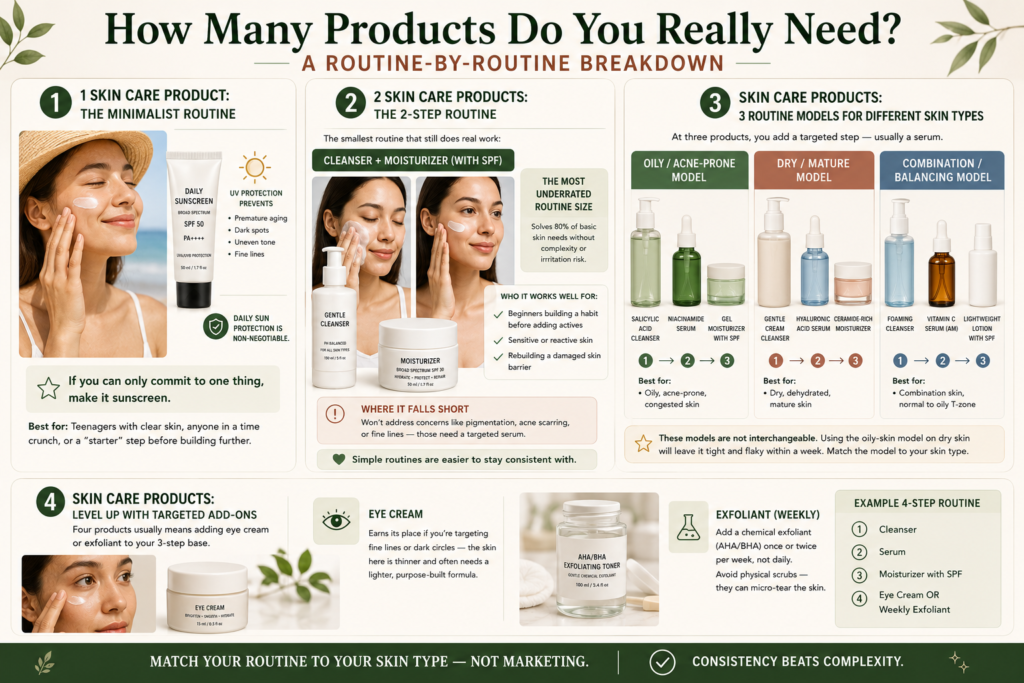
This is the part most guides skip. Here’s a realistic, honest breakdown by routine size.
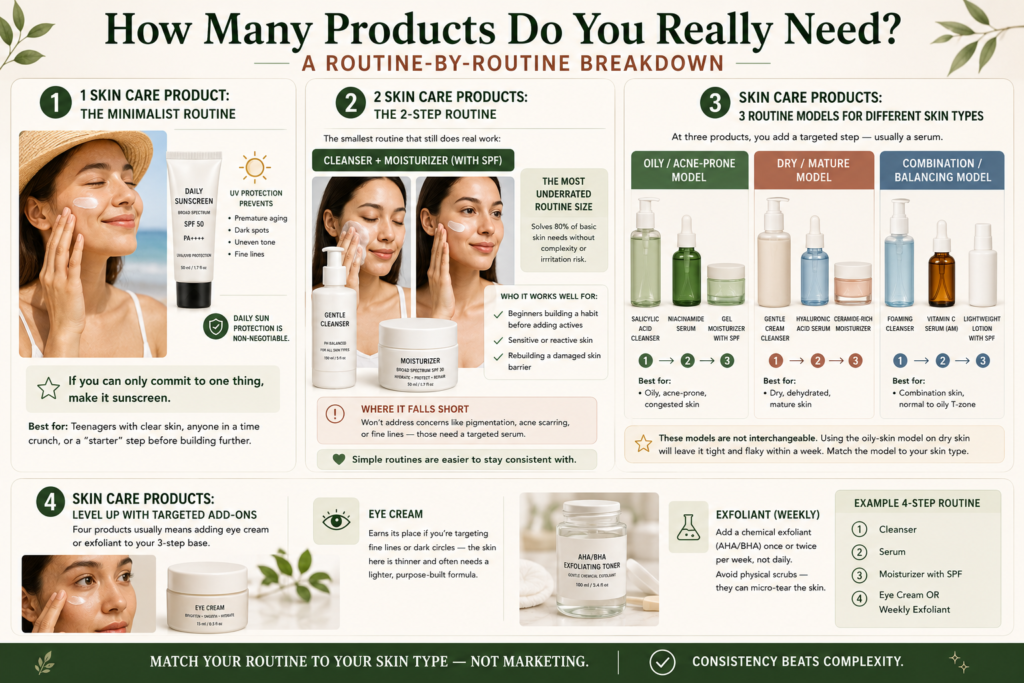
1 Skin Care Product: The Minimalist Routine
If you can only commit to one thing, it should be sunscreen — not a cleanser, not a serum. Unprotected UV exposure is the single largest driver of visible aging and pigmentation, and no serum can undo daily sun damage faster than it accumulates.
Best for: teenagers with clear skin, anyone in a genuine time crunch, or a “starter” step before building further.
Skin Care 2 Products (The Skin Care 2 Steps Routine)
When people search for skin care 2 products or a skin care 2 steps routine, they’re usually looking for the same thing: the smallest routine that still does real work. That’s cleanser + moisturizer with SPF built in (or a separate sunscreen swapped in during the day).
This is the most underrated routine size. It solves 80% of basic skin needs — removing daily grime and pollution, replenishing hydration — without the complexity or irritation risk of actives. It’s also the routine most likely to actually get followed consistently, which matters more than any “optimal” 7-step plan you abandon after two weeks.
Who a 2-product routine works well for:
- Beginners who’ve never used active ingredients and want to build a habit before adding complexity
- People with sensitive or reactive skin, where fewer products means fewer chances of irritation
- Anyone rebuilding a damaged skin barrier — dermatologists often recommend stripping a routine back down to just cleanser and moisturizer for a few weeks to let skin recover
Where a 2-step routine falls short: it won’t address specific concerns like pigmentation, acne scarring, or fine lines — those need a targeted serum, which is why most people eventually move to the 3-product stage below.
3 Skin Care Products (and 3 Skin Care Routine Models)
At three products, you introduce a targeted step — usually a serum. This is where routines start splitting by skin type. Here are three practical routine models:
| Routine Model | Step 1 | Step 2 | Step 3 |
|---|---|---|---|
| Oily/Acne-Prone Model | Salicylic acid cleanser | Niacinamide serum | Gel moisturizer with SPF |
| Dry/Mature Model | Gentle cream cleanser | Hyaluronic acid serum | Ceramide-rich moisturizer |
| Combination/Balancing Model | Foaming cleanser | Vitamin C serum (AM) | Lightweight lotion with SPF |
Notice none of these three models are interchangeable — using the oily-skin model on dry skin will leave it tight and flaky within a week. Matching the model to your actual skin type matters more than following whatever a specific product’s marketing suggests.
4 Skin Care Products
Four products usually means adding eye cream or exfoliant to a 3-step base. Eye cream earns its place if you’re specifically targeting fine lines or dark circles — the skin there is thinner and often needs a lighter, purpose-built formula rather than your regular moisturizer.
A weekly (not daily) exfoliant — chemical (AHA/BHA) rather than physical scrubs, which can micro-tear the skin — is the other common fourth addition.
5 Skin Care Products (Top 5 Skin Care Products for a Complete Routine)
This is generally the ceiling for most people before returns diminish and irritation risk climbs. A well-built top 5 looks like:
- Cleanser – removes dirt, oil, and sunscreen buildup
- Treatment serum – niacinamide, vitamin C, or retinol depending on goal
- Eye cream – optional but common at this tier
- Moisturizer – hydration and barrier support
- Sunscreen (SPF 30+) – non-negotiable, even indoors near windows
Anything beyond five products should be justified by a specific, named skin concern — not habit or marketing. More steps mean more opportunities for ingredients to conflict, and more chances you’ll skip the routine entirely on busy mornings.
The Right Order to Apply Your Products (Why Layering Sequence Matters)
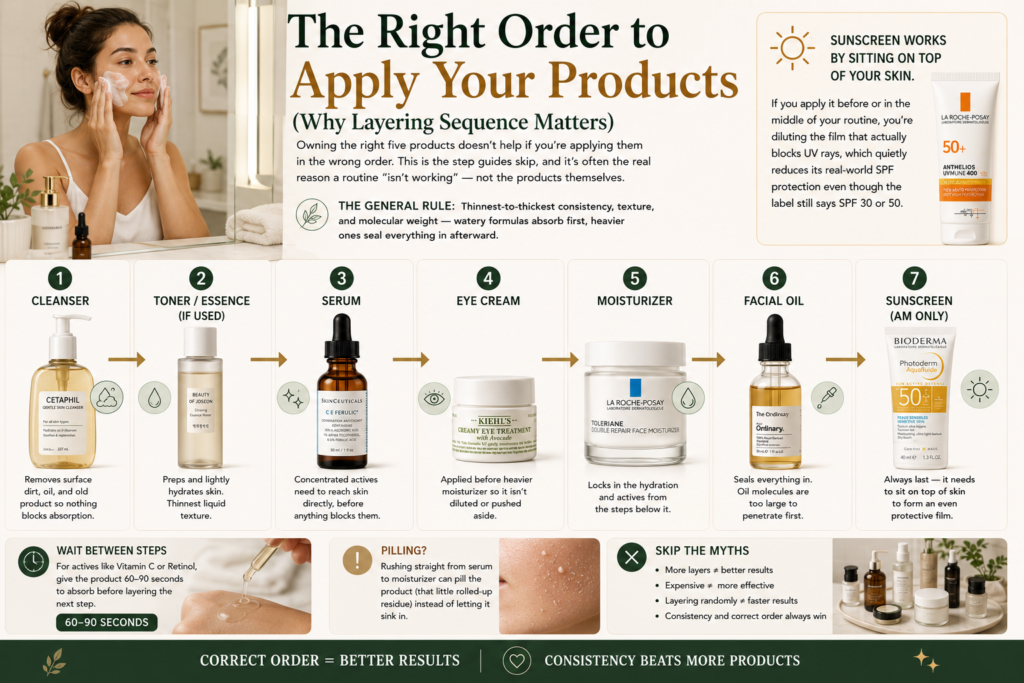
Owning the right five products doesn’t help if you’re applying them in the wrong order. This is the step guides skip, and it’s often the real reason a routine “isn’t working” — not the products themselves.
The general rule is thinnest-to-thickest consistency, texture, and molecular weight — watery formulas absorb first, heavier ones seal everything in afterward:
| Order | Step | Why It Goes Here |
|---|---|---|
| 1 | Cleanser | Removes surface dirt, oil, and old product so nothing blocks absorption |
| 2 | Toner or essence (if used) | Preps and lightly hydrates skin, thinnest liquid texture |
| 3 | Serum | Concentrated actives need to reach skin directly, before anything blocks them |
| 4 | Eye cream | Applied before heavier moisturizer so it isn’t diluted or pushed aside |
| 5 | Moisturizer | Locks in the hydration and actives from the steps below it |
| 6 | Facial oil | Seals everything in; oil molecules are too large to penetrate first |
| 7 | Sunscreen (AM only) | Always last — it needs to sit on top of skin to form an even protective film |
A detail most people miss: sunscreen works by sitting on the skin’s surface, not absorbing into it. If you apply it before or in the middle of your routine, you’re diluting the film that actually blocks UV rays, which quietly reduces its real-world SPF protection even though the label still says SPF 30 or 50.
Waiting between steps: for actives like vitamin C or retinol, give the product 60–90 seconds to absorb before layering the next step. Rushing straight from serum to moisturizer can pill the product (that little rolled-up residue) instead of letting it sink in.
Skin Care Combo vs. Skin Care Collection: What’s the Difference?
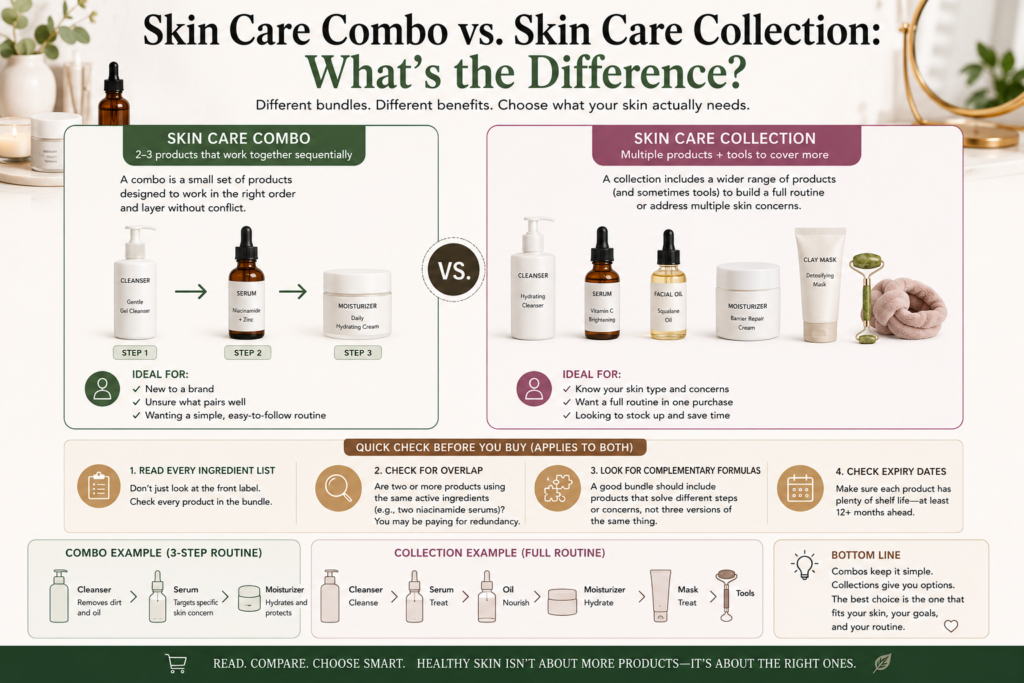
These terms get used interchangeably in marketing, but they solve different problems.
A skin care combo is usually 2–3 products bundled to work together sequentially — think cleanser + serum + moisturizer from one line, formulated to layer without conflict. Combos are ideal if you’re new to a brand or unsure what pairs well.
A skin care collection is broader: often includes tools, accessories, and multiple formula types (serum, oil, moisturizer, sometimes a mask) meant to cover a full routine or address multiple concerns at once. Collections suit people who’ve already identified their skin type and want to stock up efficiently rather than buy piecemeal.
Quick check before buying either: read the ingredient list on every item in the bundle. It’s common for combo pricing to hide the fact that two of the three products contain nearly identical active ingredients — meaning you’re paying combo price for redundant formulas, not complementary ones.
What a Routine Costs at Different Budget Levels
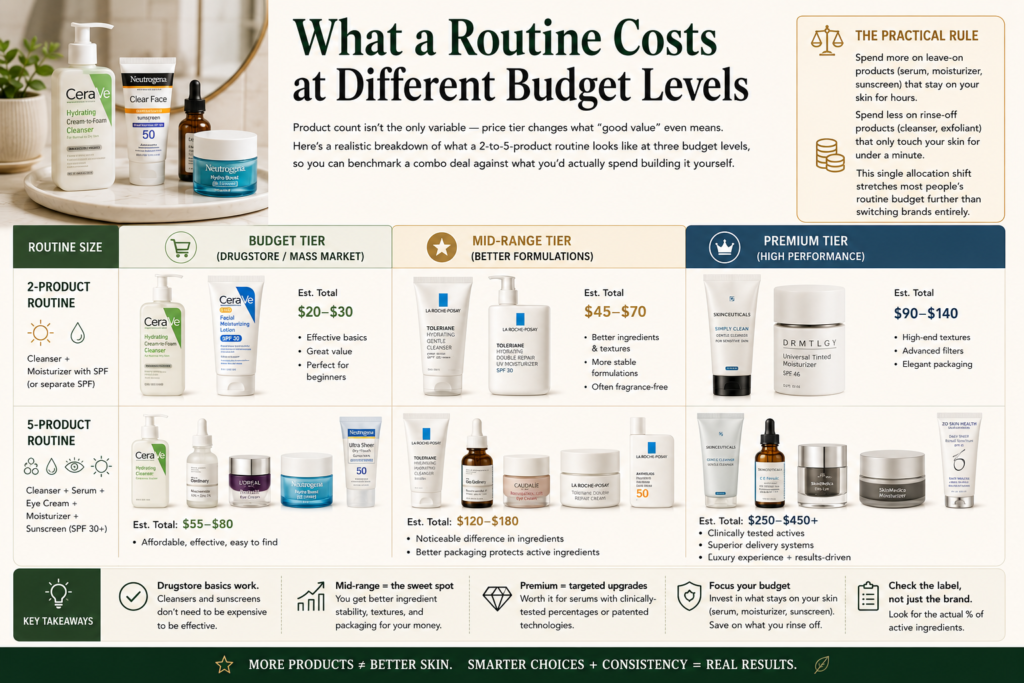
Product count isn’t the only variable — price tier changes what “good value” even means. Here’s a realistic breakdown of what a 2-to-5-product routine looks like at three budget levels, so you can benchmark a combo deal against what you’d actually spend building it yourself.
Budget tier (drugstore/mass market): A 2-step routine (cleanser + moisturizer with SPF) typically runs low, with a 5-product routine still staying affordable if you skip eye cream in favor of a slightly thicker moisturizer around the eye area. This tier is genuinely fine for basics — cleansers and sunscreens rarely need to be expensive to work.
Mid-range tier: This is where targeted serums (niacinamide, vitamin C, retinol) start to show real formulation differences — better stabilization of actives, fewer fillers, and often better packaging (airless pumps instead of jars, which matters for keeping vitamin C and retinol from degrading). Most people land here once they move past a 2-step routine.
Premium tier: Diminishing returns are real above a certain price point for basics like cleanser, but premium pricing can be justified for serums with clinically-tested percentages of active ingredients, or moisturizers with patented delivery systems. The mistake at this tier is assuming price alone signals effectiveness — always check the actual percentage of active ingredient, not just the brand name.
A practical rule: spend more on leave-on products (serum, moisturizer, sunscreen) that stay on your skin for hours, and spend less on rinse-off products (cleanser, exfoliant) that only touch your skin for under a minute. This single allocation shift stretches most people’s routine budget further than switching brands entirely.
How to Introduce a New Product Without Wrecking Your Skin
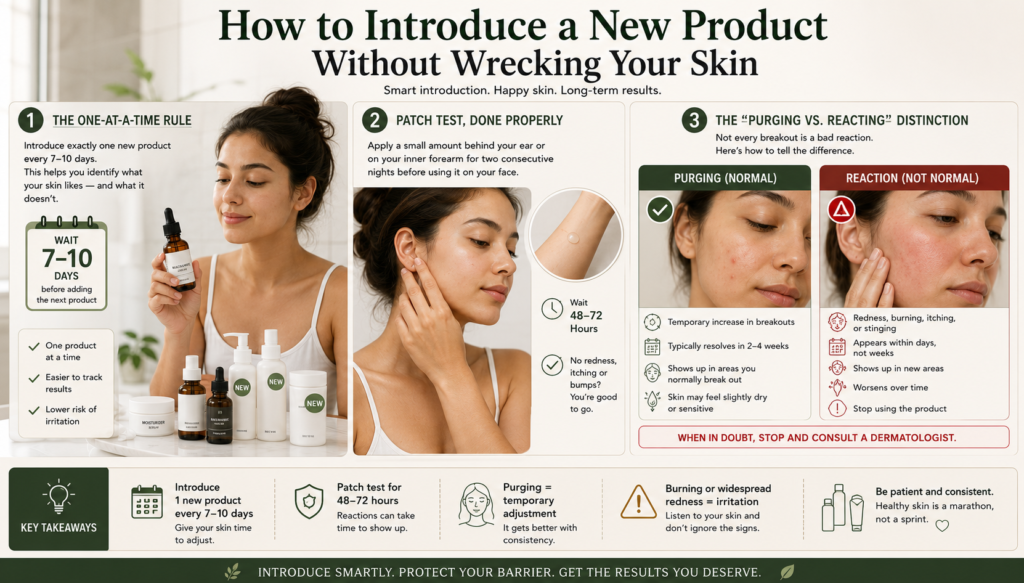
Even a well-chosen product can cause problems if it’s added carelessly. This step gets skipped constantly, especially when a combo deal tempts you to start three new products on the same day.
The one-at-a-time rule: introduce exactly one new product every 7–10 days, not a full new routine at once. If irritation shows up, you’ll know exactly which product caused it. Adding a new cleanser, serum, and moisturizer simultaneously — which is exactly what a 3-piece combo deal encourages — makes it impossible to isolate the culprit if your skin reacts badly.
Patch testing, done properly: apply a small amount behind your ear or on your inner forearm for two consecutive nights before using it on your face. Twenty-four hours isn’t always long enough — some reactions, especially to fragrance or certain preservatives, take 48–72 hours to appear.
The “purging vs. reacting” distinction: a new retinol or exfoliating acid can cause purging — a temporary increase in breakouts as skin cell turnover speeds up — which typically resolves in 2–4 weeks and shows up in areas you normally break out. This is different from an allergic reaction or irritation, which usually appears as redness, burning, or bumps in new areas within days, not weeks. Confusing the two causes people to either quit a genuinely good product too early, or keep using an ingredient that’s actively irritating their skin.
Smart Shopping: Evaluating “Buy 2 Get 1 Free” and “Buy 2 at ₹999” Deals
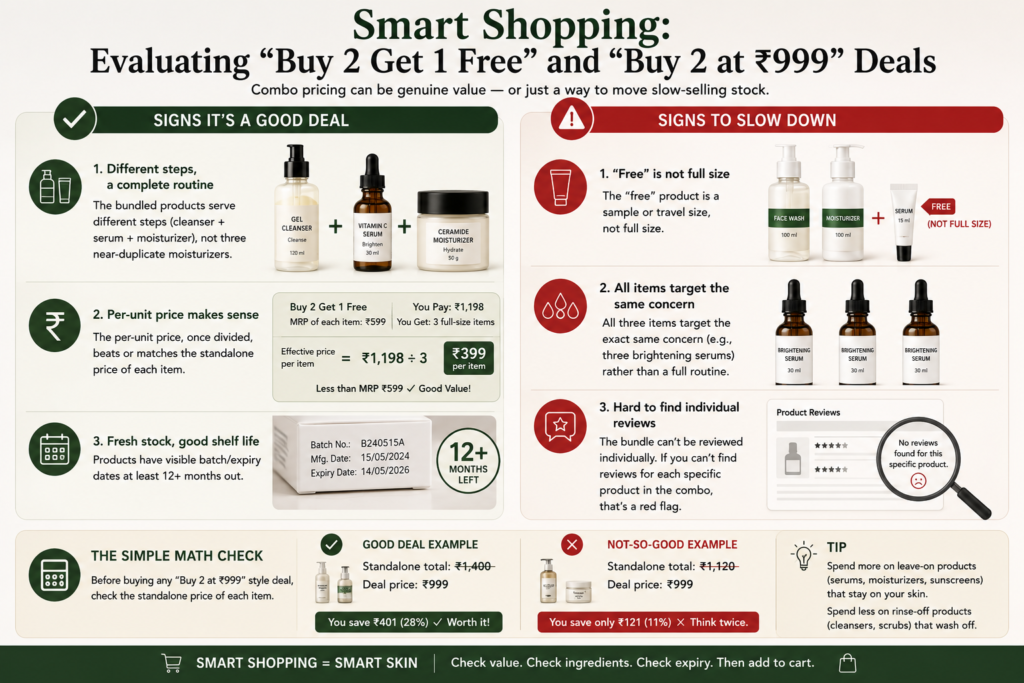
Combo pricing — buy 2 get 1 free, or flat bundle pricing like buy 2 at ₹999 — can be genuinely good value, or it can be a way to move slow-selling stock. Here’s how to tell the difference before adding to cart:
Signs it’s a good deal:
- The bundled products serve different steps (cleanser + serum + moisturizer), not three near-duplicate moisturizers
- The per-unit price, once divided, beats or matches the standalone price of each item
- The products have visible batch/expiry dates at least 12+ months out — bundled deals sometimes clear stock nearing expiry
Signs to slow down:
- The “free” product is a sample size, not full size (check the ml/g listed)
- All three items target the exact same concern (three brightening serums, for example) rather than a full routine
- The bundle can’t be reviewed individually — if you can’t find reviews for each specific product in the combo, that’s a red flag
A simple math check: before buying any “buy 2 at ₹999” style deal, search the standalone price of each item. If two full-size products alone already cost close to ₹999, the deal is solid. If the standalone total is only slightly above ₹999, you’re paying mostly for packaging and marketing, not product value.
Common Mistakes People Make Building a Routine
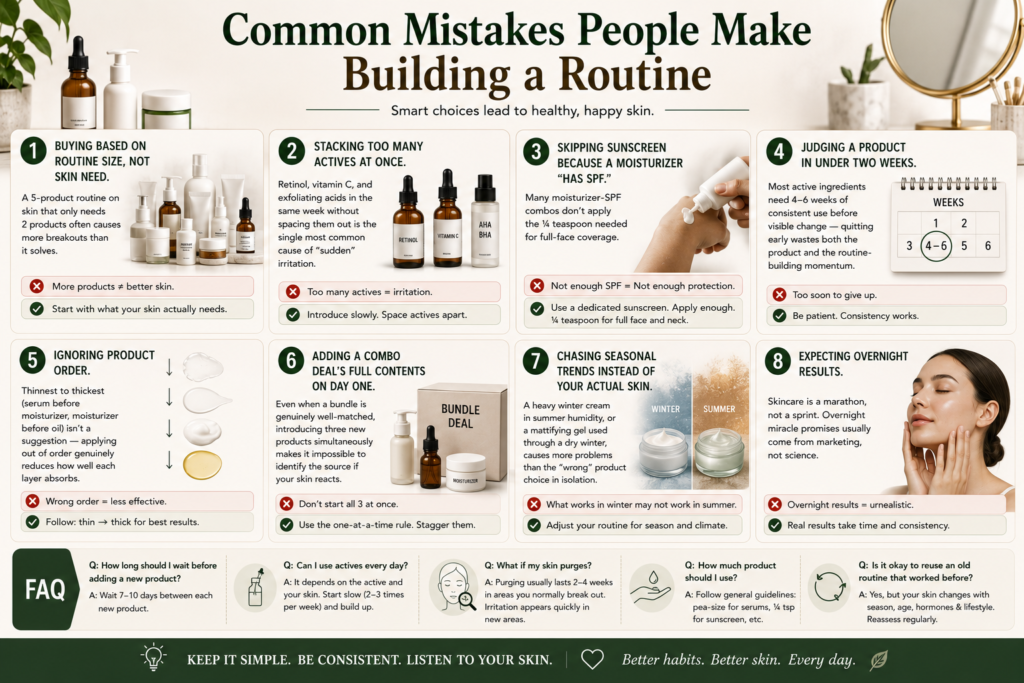
- Buying based on routine size, not skin need. A 5-product routine on skin that only needs 2 products often causes more breakouts than it solves.
- Stacking too many actives at once. Retinol, vitamin C, and exfoliating acids in the same week without spacing them out is the single most common cause of “sudden” irritation.
- Skipping sunscreen because a moisturizer “has SPF.” Many moisturizer-SPF combos don’t apply the ¼ teaspoon needed for full-face coverage, since people apply moisturizer more sparingly than they would a dedicated sunscreen.
- Judging a product in under two weeks. Most active ingredients need 4–6 weeks of consistent use before visible change — quitting early wastes both the product and the routine-building momentum.
- Ignoring product order. Thinnest to thickest (serum before moisturizer, moisturizer before oil) isn’t a suggestion — applying out of order genuinely reduces how well each layer absorbs.
- Adding a combo deal’s full contents on day one. Even when a bundle is genuinely well-matched, introducing three new products simultaneously makes it impossible to identify the source if your skin reacts. Stagger them using the one-at-a-time rule above, even if you bought them as a set.
- Chasing seasonal trends instead of your actual skin. A heavy winter cream applied in summer humidity, or a mattifying gel used through a dry winter, causes more problems than the “wrong” product choice in isolation — the same formula can be right or wrong purely based on season and climate.
FAQ
Do I need different products for morning and night? Not always. Sunscreen is the main AM-specific requirement, since most other products (serum, moisturizer) work fine at either time. Retinol is the main PM-specific product, since it can increase sun sensitivity.
Is a more expensive skin care collection always better than building your own? No. Curated collections save time and guesswork, but a self-built routine matched precisely to your skin type often outperforms a generic bundle, especially once you understand your skin’s specific needs.
Can I skip moisturizer if I use a facial oil? Not recommended. Oil seals in moisture but doesn’t add it. Skipping moisturizer and using oil alone on dehydrated skin usually leaves skin feeling tight underneath, even though it looks glossy on the surface.
How long should I stick with a routine before deciding it’s not working? Give a full routine at least 4–6 weeks, since that’s roughly one full skin cell turnover cycle. Judging results at one or two weeks — a common mistake when a new combo arrives and impatience kicks in — usually means quitting right before visible change would have shown up.
Do I need to change my routine when I switch seasons? Usually yes, at least in degree rather than in full product count. The same 3-to-5 product structure can stay, but formula weight often needs to shift — a gel moisturizer that felt perfect in humid summer can leave skin tight and flaky once heating systems dry out winter air.
Is it bad to mix products from different brands? No — mixing brands is completely normal and often necessary, since no single brand makes every formula type well. What matters is the ingredient list, not the logo on the bottle. Focus on avoiding conflicting actives (see the serum section above) rather than trying to stay loyal to one brand’s full lineup.
Conclusion
The right number of skin care products isn’t a fixed number — it’s the smallest routine that consistently addresses your actual skin concerns. Start with sunscreen if you’re doing just one thing, build to the classic 2-step if you want reliable basics, and only expand to 3, 4, or 5 products once you can name the specific job each one is doing.
Before your next purchase — whether it’s a single serum or a “buy 2 get 1 free” combo — run it through the checks in this guide: does it fill a real gap in your current routine, or does it just duplicate something you already own? That one question will save more money and skin irritation than any product review ever will.