If your foundation looks patchy by noon, or your concealer creases under your eyes no matter what you do, the problem usually isn’t the makeup. It’s the six steps that happened before you picked up a brush.
Most people treat skin care and makeup as two unrelated categories — one for “health,” one for “looks.” But your skin is a single surface reacting to everything you put on it, in the order you put it on. A $60 foundation applied over dehydrated, flaky skin will look worse than a $12 tinted moisturizer applied over well-prepped skin. This is the part beauty counters rarely explain, because it doesn’t sell more product — it sells better habits.
There’s also a timing problem nobody talks about. Skin care brands sell routines. Makeup brands sell routines. Almost nobody sells the handoff between them — the two or three minutes where product actually finishes absorbing, settles into skin, and either sets you up for a smooth application or works against everything you’re about to put on top of it. That handoff is where most routines quietly fail.
This guide walks through the actual mechanics of how skin care and makeup interact: what to do, in what order, why certain combinations fail, how to adjust for your specific skin type, and how to build a look that photographs well without turning your morning into a 20-step production. By the end, you’ll know exactly why your routine has been underperforming and what to change first.
The Foundation Rule: Makeup Reflects Whatever Is Underneath It
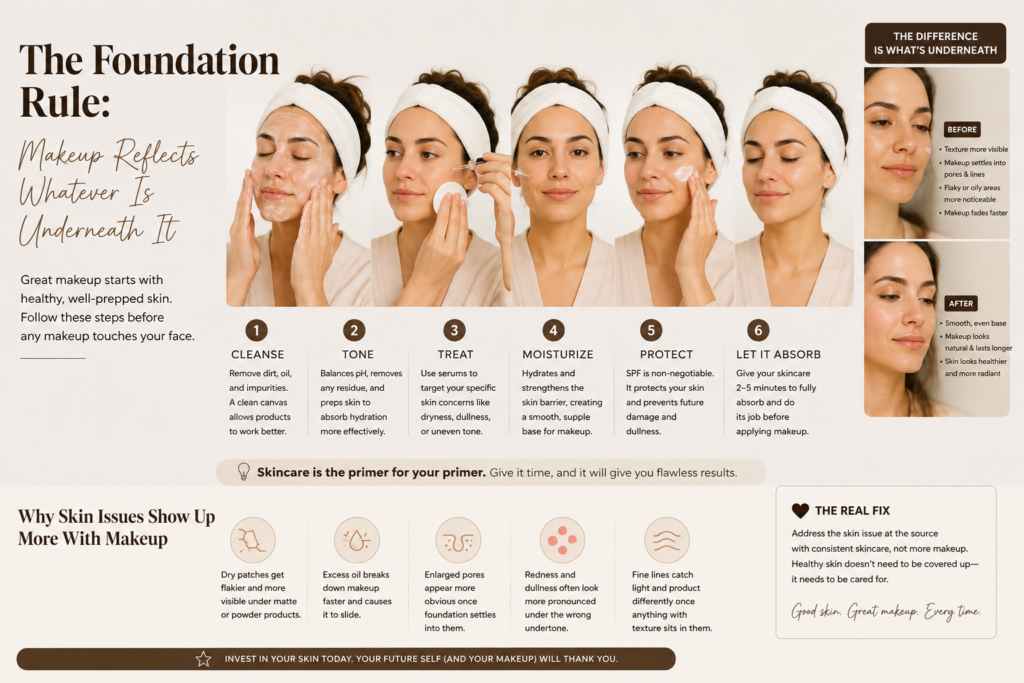
Foundation, concealer, and powder are not corrective tools in the way most people assume. They’re magnifiers. They amplify texture, dryness, oiliness, and unevenness rather than hiding it.
That means:
- Dry patches get flakier and more visible under matte or powder products
- Excess oil breaks down makeup faster and causes it to slide
- Enlarged pores appear more obvious once foundation settles into them
- Redness and dullness often look more pronounced under the wrong undertone of concealer
- Fine lines catch light and product differently once anything with texture sits in them
This is why two people can use the exact same foundation with completely different results. The skin under it isn’t the same, and neither is the prep work that happened five minutes earlier.
The fix isn’t more makeup — it’s addressing the skin issue at the source, which is where skin care comes in before a single product touches your face. Think of skin care as the primer for your primer. If that sounds redundant, it’s because most routines genuinely are doing the same job twice — once with an expensive silicone-based primer, and once with a well-formulated moisturizer that could have done the job for a fraction of the price if it had been given time to work.
The Correct Skin Care to Makeup Order (Step-by-Step)
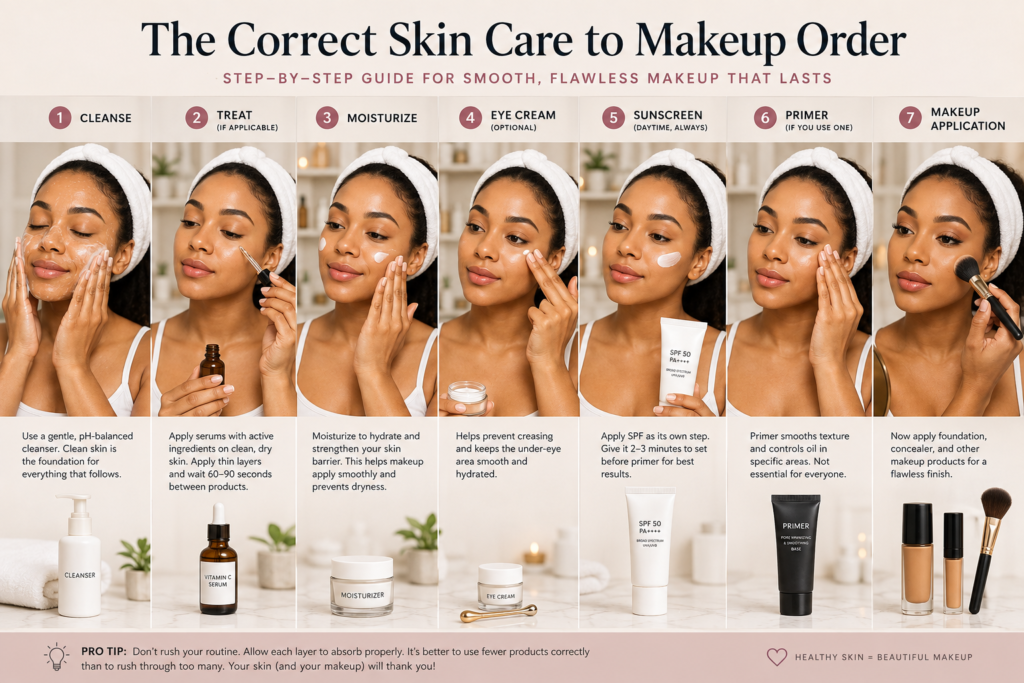
Here’s the sequence that actually holds up under makeup, based on how ingredients absorb and how products layer physically.
1. Cleanse
Use a gentle, pH-balanced cleanser. Skip anything that leaves skin tight or squeaky — that tightness is a sign of stripped moisture, which will show up later as flaking under makeup. If you wear makeup daily, consider whether your cleanser was formulated for makeup removal at night versus a gentler morning formula; using a heavy-duty cleansing oil both morning and night can over-strip skin that doesn’t need that level of cleansing twice a day.
2. Treat (if applicable)
Serums with active ingredients (vitamin C, niacinamide, retinoids) go on clean, dry-ish skin. Apply thin layers and wait 60–90 seconds between products so they don’t pill later. If you’re using more than one active in the morning, apply them thinnest-to-thickest, and give each one a moment to sink in rather than layering them wet-on-wet.
3. Moisturize
This step is non-negotiable, even for oily skin. Skipping moisturizer to “keep makeup matte” backfires — skin overcompensates with more oil, and makeup grabs onto dry patches instead of sitting smoothly. A common but overlooked detail: the amount matters as much as the formula. A pea-sized amount spread too thin leaves patches under-hydrated even if the product itself is right for your skin type.
4. Eye Cream (Optional but High-Impact)
If concealer creases in your under-eye area, this step is often the missing piece, not the concealer formula itself. Apply with your ring finger using a light patting motion rather than dragging, since the skin there is thinner and more prone to irritation and premature creasing.
5. Sunscreen (Daytime, Always)
Apply SPF as its own step, not blended into a tinted moisturizer as an afterthought. Give it 2–3 minutes to set before primer. Mineral sunscreens in particular need this settling time, or they can pill dramatically the moment foundation goes on top.
6. Primer (If You Use One)
Primer’s job is to smooth texture and control oil or dryness in specific zones — it’s not a mandatory step for everyone. If your skin care is doing its job, you may not need primer at all except on the T-zone or around the nose. Using primer as a substitute for proper hydration is one of the more common — and more expensive — workarounds people rely on without realizing there’s a cheaper, more effective fix underneath.
7. Makeup Application
Only now does foundation, concealer, or complexion product go on.
The mistake most people make: skipping straight from cleanser to foundation, or applying makeup within seconds of moisturizer before it’s absorbed. Both lead to pilling, patchiness, or makeup that “slides” by mid-morning. If you’re in a hurry, it’s better to simplify the number of products you use than to rush through applying all of them.
Matching Your Makeup to Your Skin Type (Not Just Your Skin Tone)
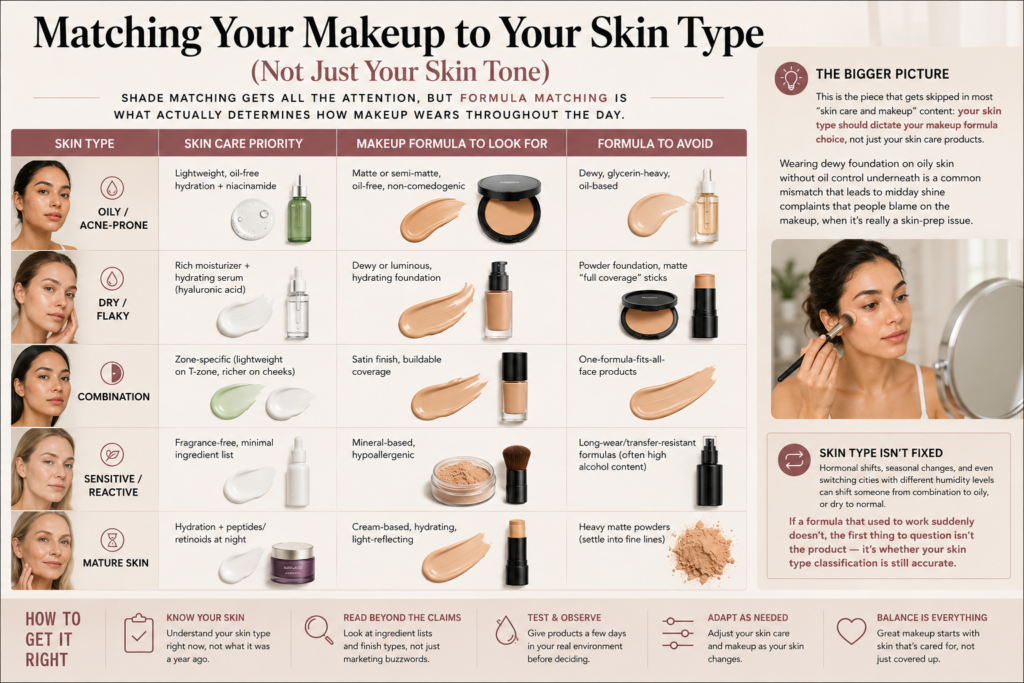
Shade matching gets all the attention, but formula matching is what actually determines how makeup wears throughout the day.
| Skin Type | Skin Care Priority | Makeup Formula to Look For | Formula to Avoid |
|---|---|---|---|
| Oily / Acne-Prone | Lightweight, oil-free hydration + niacinamide | Matte or semi-matte, oil-free, non-comedogenic | Dewy, glycerin-heavy, oil-based |
| Dry / Flaky | Rich moisturizer + hydrating serum (hyaluronic acid) | Dewy or luminous, hydrating foundation | Powder foundation, matte “full coverage” sticks |
| Combination | Zone-specific (lightweight on T-zone, richer on cheeks) | Satin finish, buildable coverage | One-formula-fits-all-face products |
| Sensitive / Reactive | Fragrance-free, minimal ingredient list | Mineral-based, hypoallergenic | Long-wear/transfer-resistant formulas (often high alcohol content) |
| Mature Skin | Hydration + peptides/retinoids at night | Cream-based, hydrating, light-reflecting | Heavy matte powders (settle into fine lines) |
This is the piece that gets skipped in most “skin care and makeup” content: your skin type should dictate your makeup formula choice, not just your skin care products. Wearing dewy foundation on oily skin without oil control underneath is a common mismatch that leads to midday shine complaints that people blame on the makeup, when it’s really a skin-prep issue.
It’s also worth noting that skin type isn’t fixed. Hormonal shifts, seasonal changes, and even switching cities with different humidity levels can shift someone from combination to oily, or dry to normal. If a formula that used to work suddenly doesn’t, the first thing to question isn’t the product — it’s whether your skin type classification is still accurate.
A Quick Self-Check for Skin Type
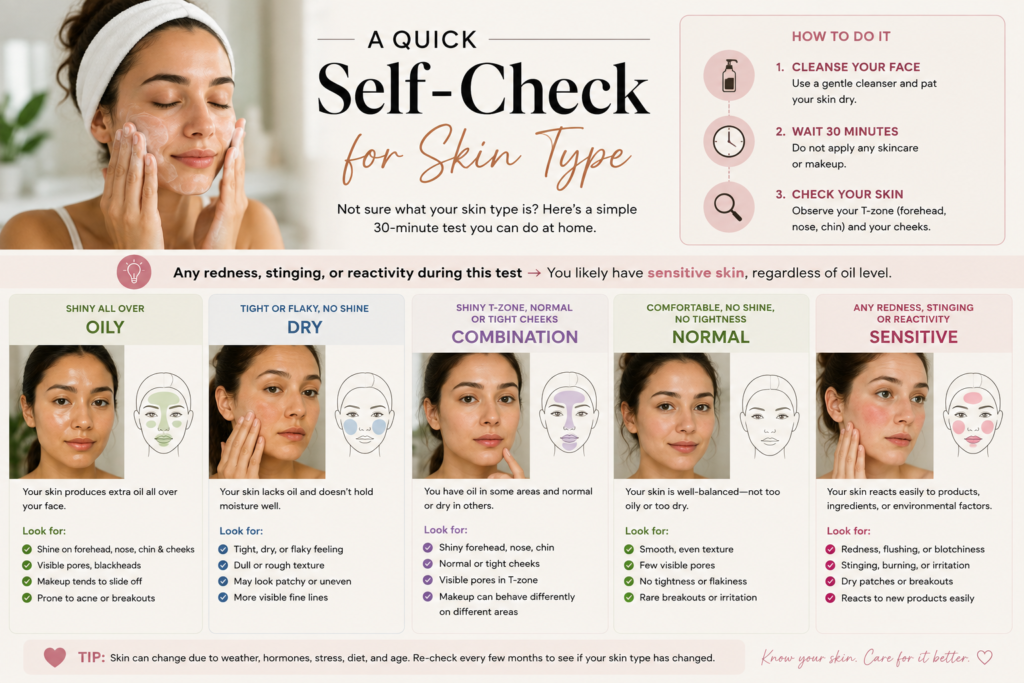
If you’re unsure which category you fall into, try this: cleanse your face and wait 30 minutes without applying anything. Then check your T-zone and cheeks.
- Shiny all over → oily
- Tight or flaky, no shine → dry
- Shiny T-zone, normal or tight cheeks → combination
- Comfortable, no shine, no tightness → normal
- Any redness, stinging, or reactivity during this test → sensitive, regardless of oil level
Skin Care and Makeup Mistakes That Are More Common Than People Realize
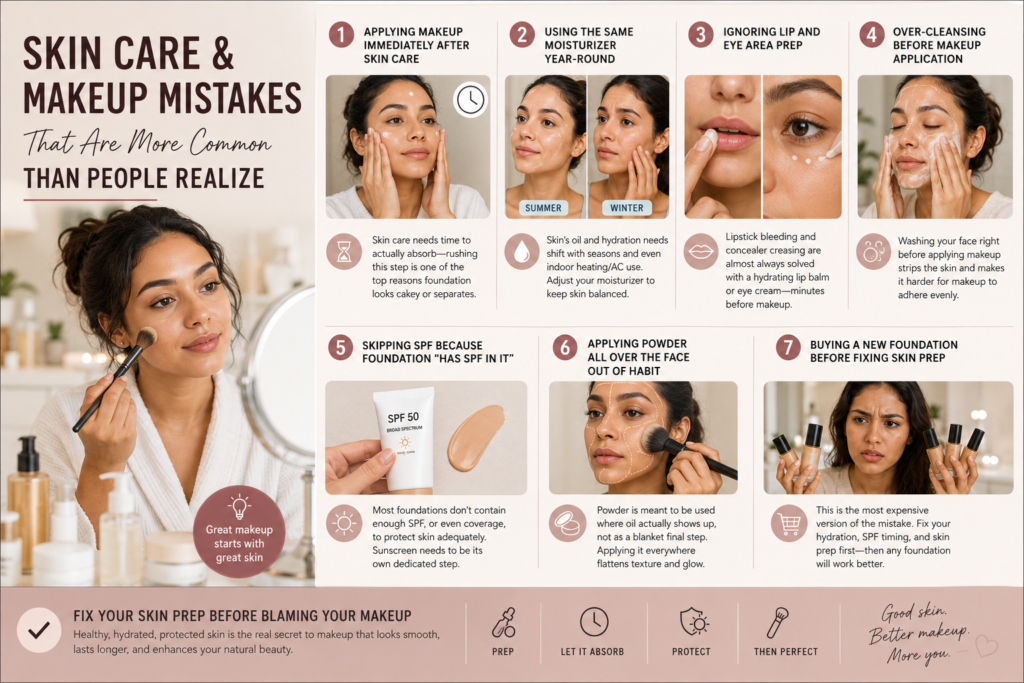
Applying makeup immediately after skin care. Skin care needs time to actually absorb — rushing this step is one of the top reasons foundation looks cakey or separates.
Using the same moisturizer year-round. Skin’s oil and hydration needs shift with seasons and even indoor heating/AC use. A moisturizer that worked perfectly under makeup in summer might leave skin under-hydrated (and makeup patchy) in winter.
Ignoring lip and eye area prep. Lipstick bleeding and concealer creasing are almost always solved with a hydrating lip balm or eye cream applied minutes before makeup — not a different lipstick or concealer formula.
Over-cleansing before makeup application. Washing your face right before applying makeup (rather than in the morning routine, with time to absorb products) strips the skin and makes it harder for makeup to adhere evenly.
Skipping SPF because foundation “has SPF in it.” Most foundations don’t contain enough SPF, or even coverage, to protect skin adequately. Sunscreen needs to be its own dedicated step.
Applying powder all over the face out of habit. Powder is meant to be used where oil actually shows up, not as a blanket final step. Applying it everywhere flattens texture and glow in areas that didn’t need it.
Buying a new foundation before fixing skin prep. This is the most expensive version of the mistake. People will replace a foundation three or four times looking for one that “just works,” when the actual fix was a hydration or SPF timing issue that would have fixed the problem with any foundation.
Skin Care y Maquillaje Aesthetic: Building a Routine That Photographs Well
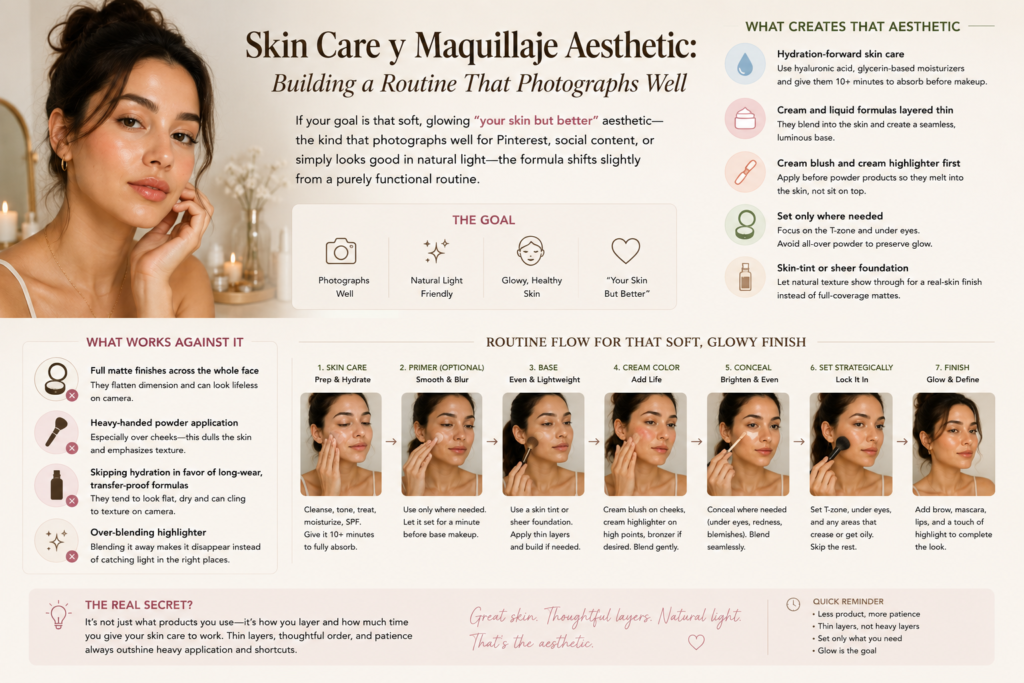
If your goal is that soft, glowing “your skin but better” aesthetic — the kind that photographs well for Pinterest, social content, or simply looks good in natural light — the formula shifts slightly from a purely functional routine.
What creates that aesthetic:
- Hydration-forward skin care (hyaluronic acid, glycerin-based moisturizers) applied 10+ minutes before makeup
- Cream and liquid formulas layered thin, rather than heavy powder layers
- Cream blush and cream highlighter applied before powder products, so they melt into skin rather than sit on top
- Setting only where needed (T-zone, under eyes) instead of all-over powder, which flattens the glow
- Skin-tint or sheer foundation formulas that let some natural texture show through, rather than full-coverage mattes
What works against it:
- Full matte finishes across the whole face
- Heavy-handed powder application, especially over cheeks
- Skipping hydration in favor of long-wear, transfer-proof formulas, which tend to look flat and dry on camera
- Over-blending highlighter to the point it disappears instead of catching light in the right spots (high points of the cheeks, brow bone, cupid’s bow)
This aesthetic is less about specific products and more about finish and layering order — a distinction that matters more than most product recommendations suggest. Two people can use nearly identical products and get very different results purely based on how much time they gave their skin care to absorb and how thin they applied each layer of makeup on top.
Skin Care y Makeup: Why the Order Changes Depending on the Occasion
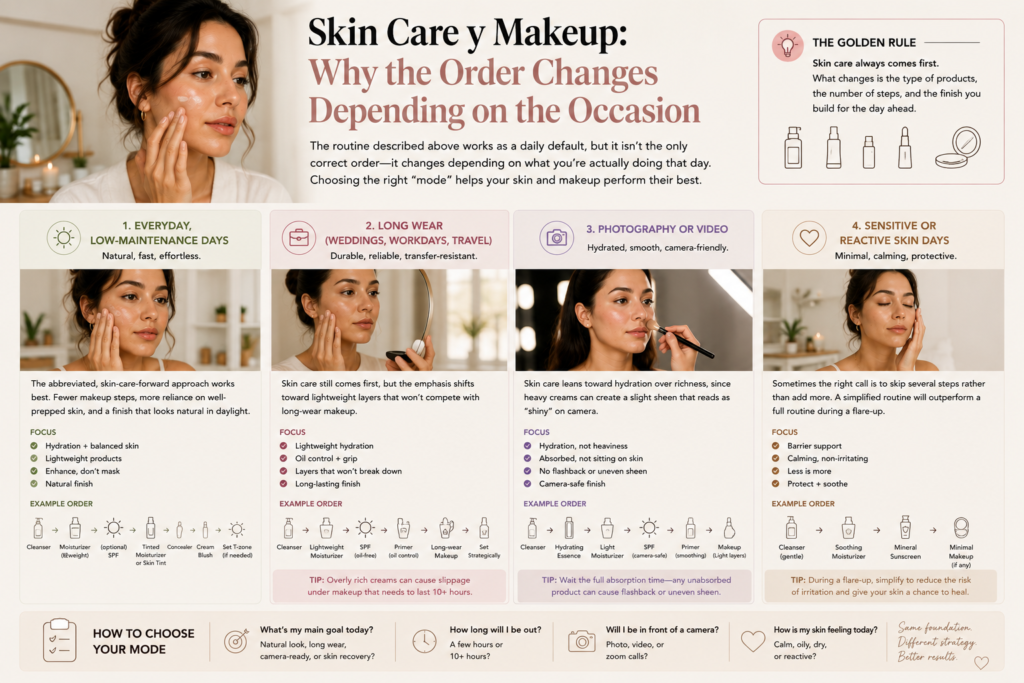
The routine described above works as a daily default, but it isn’t the only correct order — it changes depending on what you’re actually doing that day.
For everyday, low-maintenance days: the abbreviated skin-care-forward approach works best. Fewer makeup steps, more reliance on well-prepped skin, and a finish that looks natural in daylight.
For long wear (weddings, full workdays, travel): skin care still comes first, but the emphasis shifts toward lightweight layers that won’t compete with long-wear makeup. Overly rich creams can cause slippage under makeup that needs to last 10+ hours. In this case, a thinner moisturizer plus a dedicated primer for oil control is usually a better combination than a heavier, more luxurious moisturizer that feels nicer but doesn’t hold up.
For photography or video: skin care leans toward hydration over richness, since heavy creams can create a slight sheen that reads as “shiny” on camera even when it looks fine in person. This is also where waiting the full absorption time matters most — any unabsorbed product will show up as flashback or an uneven sheen under camera lighting.
For sensitive or reactive skin days: sometimes the right call is to skip several steps rather than add more. A simplified skin care and makeup routine — cleanser, one moisturizer, mineral sunscreen, minimal makeup — during a flare-up will outperform a full routine that introduces more potential irritants at the worst possible time.
Recognizing which “mode” you’re in before you start is a habit that experienced makeup artists build over time, but it’s rarely explained to beginners, who tend to use the same routine regardless of occasion and then wonder why results are inconsistent.
Make Up x Skin Care: Building a Simplified 10-Minute Routine
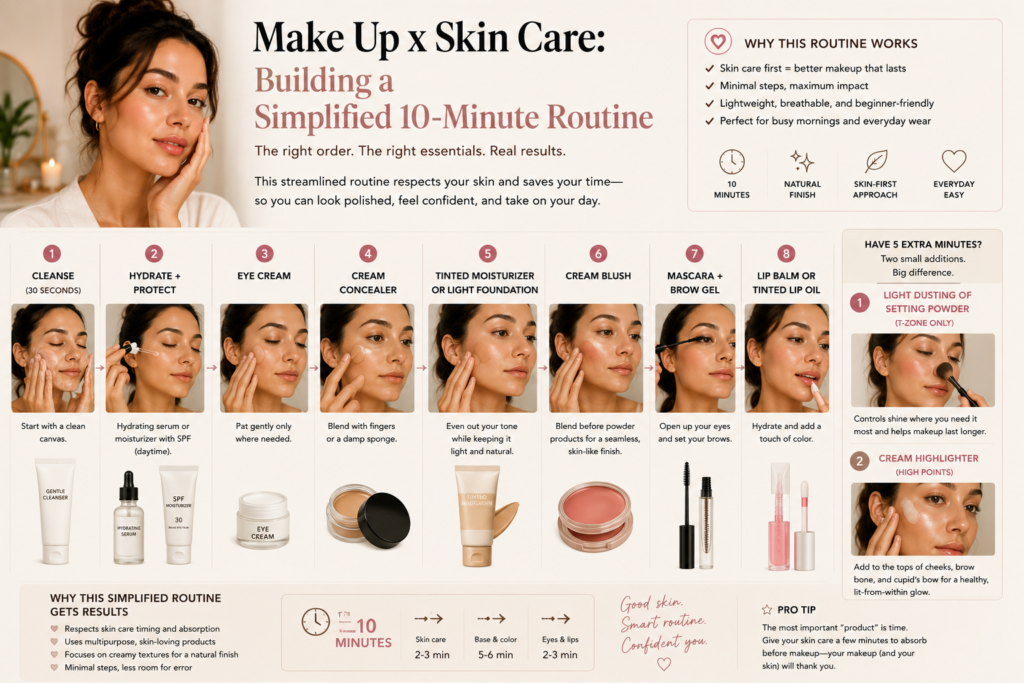
For readers who want the shortest possible version that still works, here’s a streamlined routine that respects the order above without unnecessary steps:
- Cleanse (30 seconds)
- Hydrating serum or moisturizer with SPF built in (if daytime and skin tolerates it well)
- Eye cream, patted only where needed
- Cream concealer, blended with fingers or a damp sponge
- Tinted moisturizer or lightweight foundation
- Cream blush, blended before powder products
- Mascara and brow gel
- Lip balm or tinted lip oil
This version skips traditional primer and heavy powder, relying instead on well-prepped skin to do the work that primer usually compensates for. It’s a practical option for anyone who finds a full 12-step routine unsustainable on weekday mornings.
If you have an extra five minutes, the two additions with the highest impact are a light dusting of setting powder only on the T-zone, and a cream highlighter on the high points of the face. Both take under a minute and noticeably extend how polished the look stays through midday.
Skin Care Makeup: Products That Blur the Line Between the Two Categories
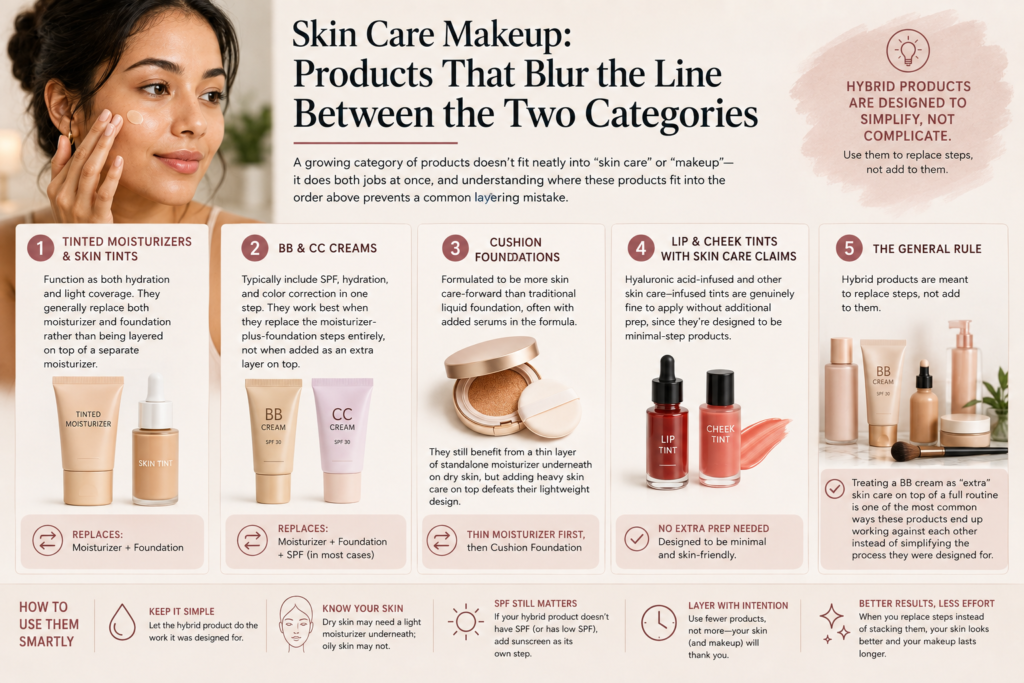
A growing category of products doesn’t fit neatly into “skin care” or “makeup” — it does both jobs at once, and understanding where these products fit into the order above prevents a common layering mistake.
Tinted moisturizers and skin tints function as both hydration and light coverage. They generally replace both moisturizer and foundation rather than being layered on top of a separate moisturizer, which is a common source of product buildup and pilling.
BB and CC creams typically include SPF, hydration, and color correction in one step. They work best when they replace the moisturizer-plus-foundation steps entirely, not when added as an extra layer on top of a full skin care routine.
Cushion foundations are formulated to be more skin care-forward than traditional liquid foundation, often with added serums in the formula. They still benefit from a thin layer of standalone moisturizer underneath on dry skin, but adding heavy skin care on top defeats their lightweight design.
Lip and cheek tints with skin care claims (hyaluronic acid-infused, for example) are genuinely fine to apply without additional prep, since they’re designed to be minimal-step products.
The general rule: hybrid products are meant to replace steps, not add to them. Treating a BB cream as “extra” skin care on top of a full routine is one of the more common ways these product categories end up working against each other instead of simplifying the process the way they were designed to.
Frequently Asked Questions
Does skin care actually change how makeup looks, or is that oversold?
It genuinely changes performance, not just theoretically. Hydrated, balanced skin allows makeup to sit flat and blend evenly; dehydrated or oily-without-control skin causes separation, patchiness, or slide — regardless of how expensive the makeup is.
How long should I wait between skin care and makeup?
A general rule is 2–3 minutes for lightweight products (serums, gel moisturizers) and up to 5 minutes for richer creams or sunscreen, so they fully absorb rather than sitting on the surface where makeup can disturb them.
Can I skip moisturizer if my skin is oily?
No — skipping it typically increases oil production as skin compensates for the lack of hydration. The better approach is switching to a lightweight, oil-free, or gel-based moisturizer rather than skipping the step entirely.
Why does my concealer crease even with “long-wear” formulas?
Creasing is almost always a hydration and application issue, not a formula issue. It typically means the under-eye area is dry, too much product was applied, or it wasn’t set with a very light amount of powder pressed (not swiped) into place.
Is it okay to use hybrid skin care-makeup products and a separate skin care routine on the same day?
Yes, but simplify rather than stack. If you’re using a tinted moisturizer or BB cream, treat it as your moisturizer step rather than adding a full separate moisturizer underneath, unless your skin is on the drier side and genuinely needs the extra layer.
Key Takeaways
Skin care and makeup aren’t two separate categories competing for space in your morning routine — they’re one connected system where each step either sets up or undermines the next. The order matters as much as the products themselves: cleanse, treat, moisturize, protect, then apply makeup formulated for your actual skin type, not just your skin tone.
The occasion matters too. A daily low-maintenance routine, a long-wear event routine, and a camera-ready routine all call for slightly different emphasis, even though the underlying order stays the same. And when in doubt about hybrid skin care-makeup products, simplify the steps around them instead of stacking more on top.
If your makeup routine has felt inconsistent lately, don’t start by replacing your foundation. Start by auditing the five minutes before you apply it — that’s usually where the real answer is.
Next step: Pick one mismatch from this guide that applies to you (wrong formula for your skin type, rushed absorption time, or skipped SPF) and adjust just that one variable for a week before changing anything else.