If you’ve spent any time on Pinterest lately, you’ve seen them — the split-screen glow up photos. Dull, tired skin on the left. Bright, smooth, “lit from within” skin on the right. A little caption underneath says something like “30 days, no filter.”
Some of those are real. Some are lighting and a good moisturizer. Most people can’t tell the difference, and that’s the problem — it makes a genuine glow up feel like a magic trick instead of a process you can actually follow.
This guide breaks down what a skin care glow up really looks like at different timelines (2 days, 1 week, 30 days, 6 months), what changes are realistic versus wishful thinking, and the specific habits that separate someone with visibly better skin in a month from someone who’s still doing the same routine with the same results.
What “Glow Up” Actually Means, Skin-Wise
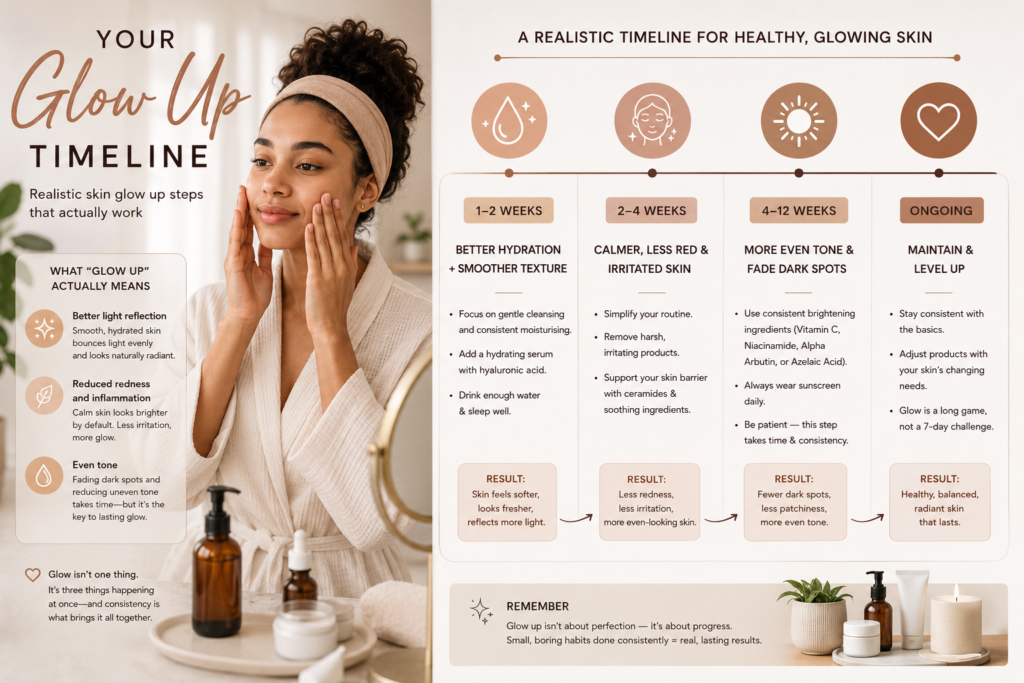
Before the timelines, it helps to know what you’re actually chasing. “Glow” isn’t one thing — it’s usually three things happening at once.
Better light reflection is the first piece. Smooth, hydrated skin bounces light evenly. Flaky or rough texture scatters it, which reads as dull even if your skin tone hasn’t changed at all. This is why two people with identical skin tone can look completely different in photos — one has smooth, hydrated texture catching the light, the other has dry patches breaking it up.
Reduced redness and inflammation is the second. A lot of “glow” is really just the absence of irritation. Calm skin looks brighter by default, which is why people are often shocked at how much better their skin looks the week after they stop using a harsh product, not the week they start a new one.
Even tone is the third. Dark spots, post-acne marks, and patchy redness make skin look tired even when it’s otherwise healthy. This one takes the longest to fix and is the piece most “quick glow up” content quietly skips over, because it can’t be solved in a week no matter what’s promised.
Almost nobody’s glow up is about fixing one giant problem. It’s usually three or four small, boring habits done consistently, which is exactly why it doesn’t get talked about as much as the 12-step product hauls.
Skin Care in 2 Days: What’s Realistic (and What Isn’t)
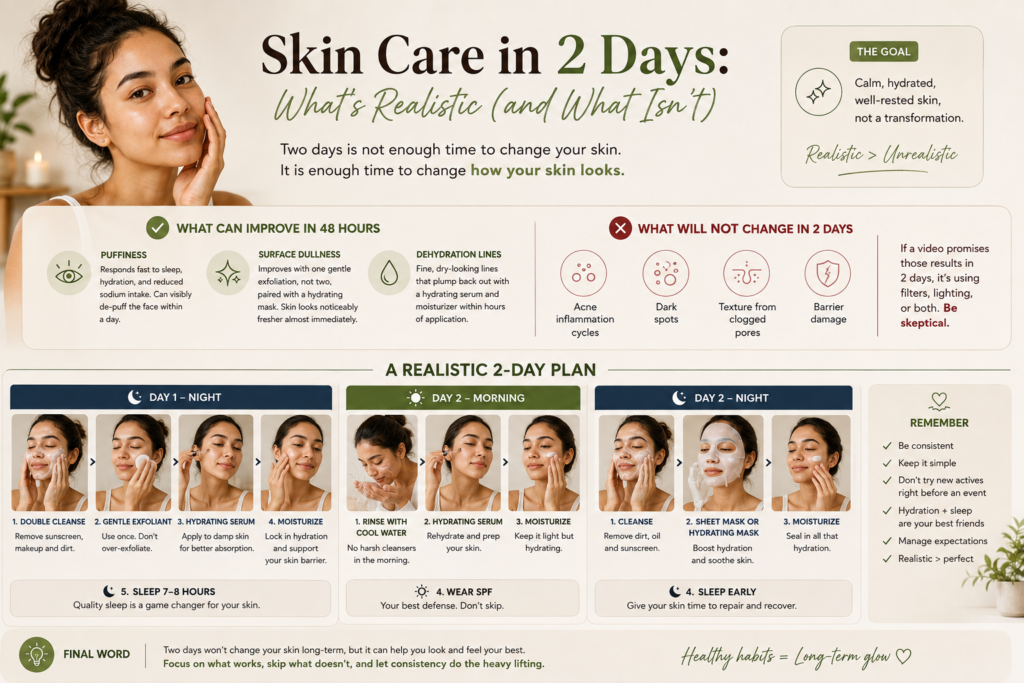
Two days is not enough time to change your skin. It is enough time to change how your skin looks, which matters if you’ve got an event, a photo, or a first date coming up.
What can genuinely improve in 48 hours: puffiness responds fast to sleep, hydration, and reduced sodium intake, and can visibly de-puff the face within a day. Surface dullness improves with one gentle exfoliation, not two, paired with a hydrating mask, which can make skin look noticeably fresher almost immediately. Dehydration lines, which are different from wrinkles, are fine, dry-looking lines that plump back out with a hydrating serum and moisturizer within hours of application.
What will not change in 2 days, no matter what a product claims, includes acne inflammation cycles, dark spots, texture from clogged pores, or barrier damage. If a video promises those results in 2 days, it’s using filters, lighting, or both, and it’s worth being skeptical of anything claiming otherwise.
A realistic 2-day plan looks like this. On day one at night, double cleanse, use a gentle exfoliant once, apply a hydrating serum, moisturize, and sleep 7 to 8 hours. On day two in the morning, rinse with cool water, apply a hydrating serum, moisturize, and wear SPF. On day two at night, cleanse, use a sheet mask or hydrating mask, moisturize, and sleep early.
That’s the entire plan. The goal is calm, hydrated, well-rested skin, not a transformation, and treating it as anything more sets you up to feel disappointed by results that were never possible in that window.
The 1 Week Glow Up Challenge for Skin Care
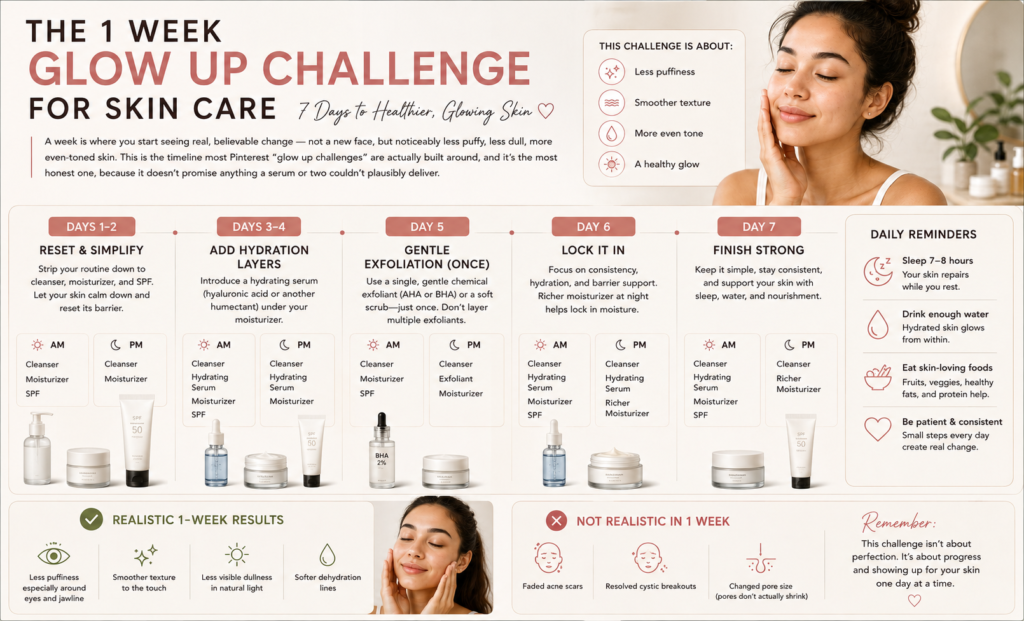
A week is where you start seeing real, believable change — not a new face, but noticeably less puffy, less dull, more even-toned skin. This is the timeline most Pinterest “glow up challenges” are actually built around, and it’s the most honest one, because it doesn’t promise anything a serum or two couldn’t plausibly deliver.
Days one and two are for resetting and simplifying. Strip your routine down to cleanser, moisturizer, and SPF. If your skin has been irritated, this pause lets it calm down before you add anything active. Most people skip this step entirely and wonder why new products “aren’t working” — they’re actually fighting an already-inflamed barrier that never got a chance to settle.
Days three and four are for adding hydration layers. Introduce a hydrating serum, such as one with hyaluronic acid or another humectant, underneath your moisturizer. This is the fastest visible change most people see all week — skin looks plumper almost immediately because dehydrated skin holds onto water quickly once it’s given the chance.
Day five is for gentle exfoliation, done once. A single gentle chemical exfoliant, like a mild AHA or BHA, or a soft physical scrub, used one time, removes the dead skin buildup that’s dulling your tone. Do not layer multiple exfoliants this week — that’s one of the most common self-inflicted setbacks, and it’s covered in more detail further down.
Days six and seven are for locking it in. Consistent sleep, steady water intake, and a richer night moisturizer round out the week. By day seven, most people notice less puffiness, smoother texture under makeup or bare-faced, and a more even tone — not a different face, but a better-rested version of their own.
A realistic one-week result includes less puffiness, especially around the eyes and jawline, smoother texture to the touch, less visible dullness in photos with natural light, and softened dehydration lines. What isn’t realistic in a week is faded acne scars, resolved cystic breakouts, or changed pore size — pores don’t actually shrink, which is explained further in the FAQ section below.
Skin Care 30 Day Challenge: The Timeline That Actually Shows Results
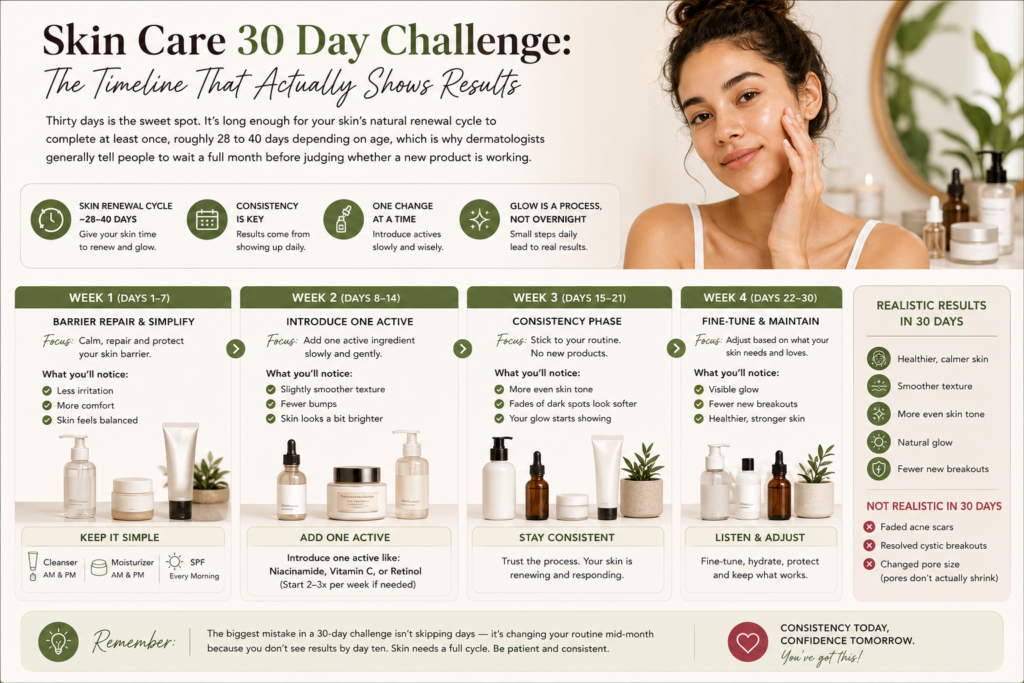
Thirty days is the sweet spot. It’s long enough for your skin’s natural renewal cycle to complete at least once, roughly 28 to 40 days depending on age, which is why dermatologists generally tell people to wait a full month before judging whether a new product is working.
In week one, the focus is barrier repair and simplifying your routine, and what you’ll notice is less irritation and more comfort day to day. In week two, the focus shifts to introducing one active ingredient at a time, which usually brings a slight improvement in texture. Week three is a consistency phase where no new products are added, and this is typically when tone starts visibly evening out. Week four is for fine-tuning based on what’s actually working, and by this point most people see a visible glow along with fewer new breakouts.
The biggest mistake in a 30-day challenge isn’t skipping days — it’s changing your routine mid-month because you don’t see results by day ten. Skin needs a full cycle. Judging a serum on day twelve is like judging a haircut while it’s still growing out; you’re evaluating an unfinished process and drawing conclusions that don’t hold up once it’s actually done.
A Note on “Boys’ Face After 1 Month Skin Care” Content
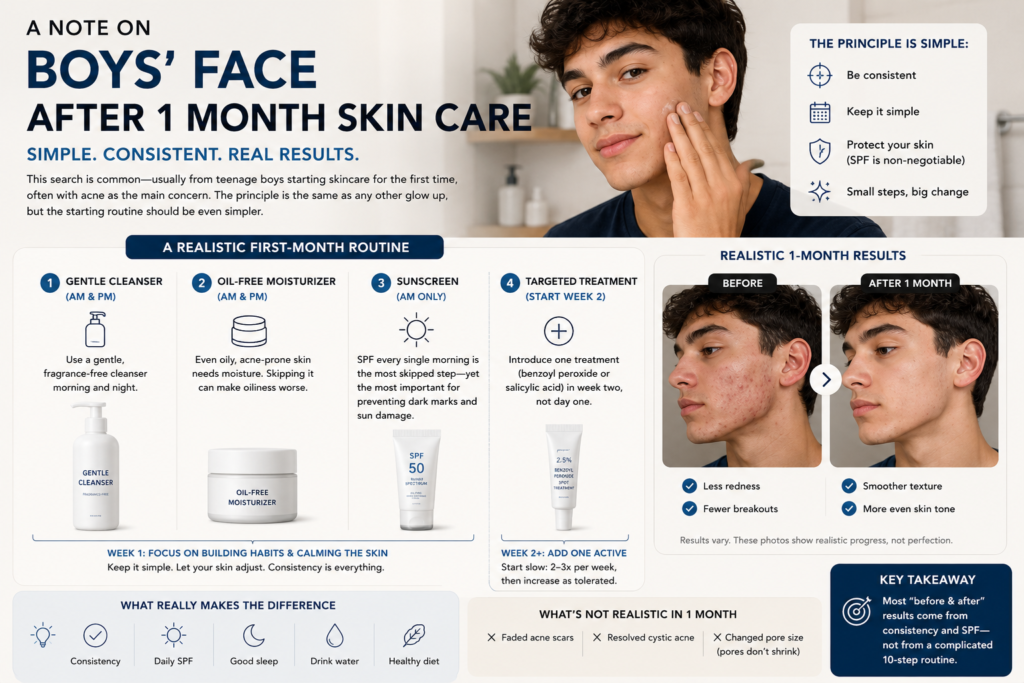
This specific search shows up a lot, usually from teenage boys starting skincare for the first time, often with acne as the main concern. The principle is identical to any other glow up, but the starting routine should be even simpler, because over-treating new acne is the single most common mistake in this group.
A realistic first-month routine for someone new to skincare, regardless of gender but especially relevant here since it’s often a first-ever routine, starts with a gentle, fragrance-free cleanser used morning and night. Next comes an oil-free moisturizer, which matters even for oily and acne-prone skin — skipping it usually makes oiliness worse, not better, because stripped skin overcompensates by producing more oil. SPF every single morning is the most skipped step in this group, and also the one with the biggest long-term payoff for preventing future dark marks and sun damage. One targeted treatment, such as a benzoyl peroxide or salicylic acid spot treatment, should be introduced in week two rather than day one, giving the skin time to adjust before adding an active ingredient.
Most “before and after 1 month” results in this group come from consistency and SPF alone, not from an aggressive product stack, and that’s genuinely good news for anyone intimidated by a 10-step routine they saw online.
6 Month Skin Care: The Timeline for Real, Structural Change
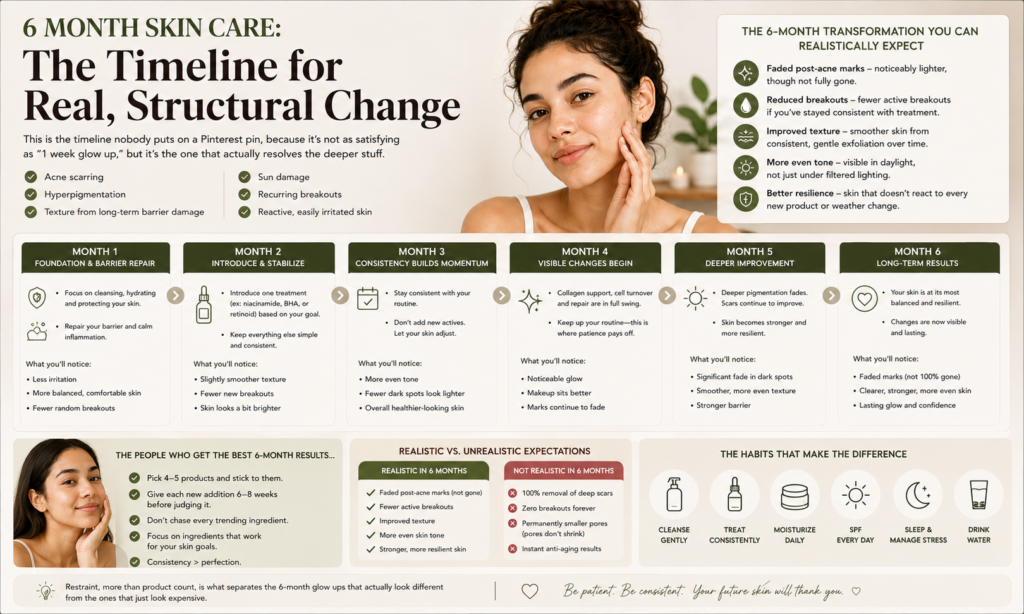
This is the timeline nobody puts on a Pinterest pin, because it’s not as satisfying as “1 week glow up,” but it’s the one that actually resolves the deeper stuff: acne scarring, hyperpigmentation, texture from long-term barrier damage, and sun damage.
At six months, with consistent care, you can realistically expect noticeably faded post-acne marks, though not fully gone, and significantly lighter than where they started. Reduced active breakouts are common if you’ve stuck with a treatment ingredient the whole time. Improved texture comes from consistent, gentle exfoliation applied over time rather than in aggressive bursts. A visibly more even tone shows up in daylight, not just under filtered lighting, which is a meaningful distinction since a lot of “results” only hold up under a ring light. Better resilience is often the most underrated change — skin that doesn’t react to every new product or weather shift anymore.
The people who get the best six-month results aren’t the ones with the most complicated routines. They’re the ones who picked four or five products, gave each new addition at least six to eight weeks before judging it, and didn’t chase every trending ingredient in between. Restraint, more than product count, is what separates the six-month glow ups that actually look different from the ones that just look expensive.
Skin Care Hacks Worth Actually Using
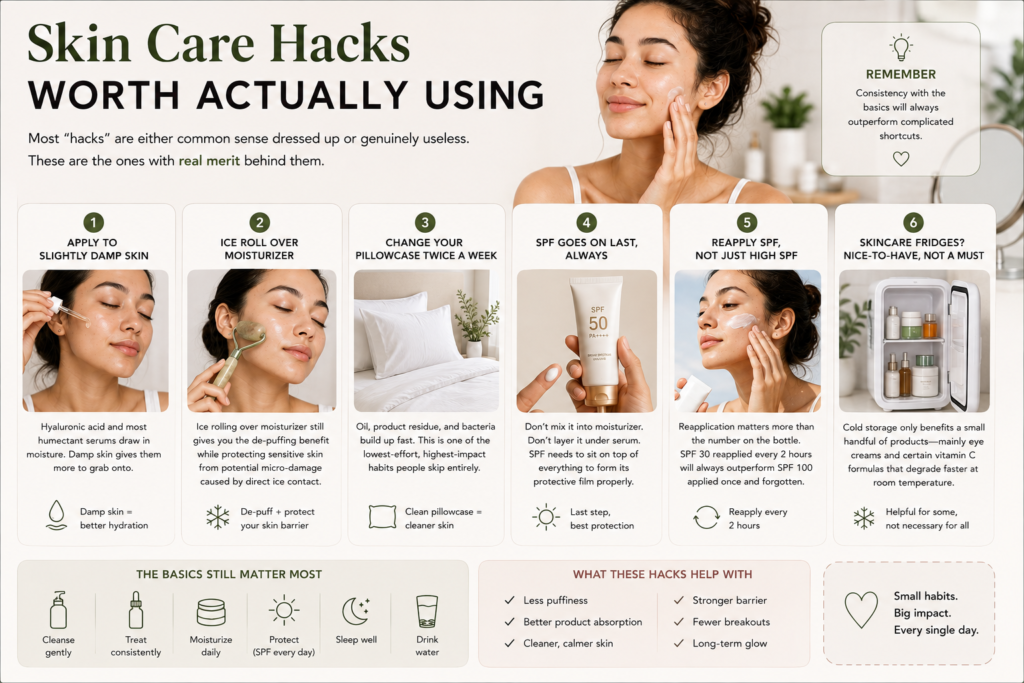
Most “hacks” are either common sense dressed up or genuinely useless. These are the ones with real merit behind them.
Applying products to slightly damp skin helps because hyaluronic acid and most humectant serums work by drawing in moisture, and applying to damp skin gives them more to grab onto than dry skin would. Ice rolling over moisturizer, rather than bare skin, still gives you the de-puffing benefit while protecting sensitive skin from potential micro-damage caused by direct ice contact. Changing your pillowcase twice a week matters more than most people assume, because oil, product residue, and bacteria build up fast, and this is one of the lowest-effort, highest-impact habits people skip entirely. SPF should always go on last, not mixed into moisturizer and not layered under serum, because it needs to sit on top of everything else to form its protective film properly. Reapplication matters more than the number on the bottle — SPF 30 reapplied every two hours will consistently outperform SPF 100 applied once in the morning and forgotten.
A less obvious hack worth mentioning: skincare fridges are trendy, but cold storage only meaningfully benefits a small handful of products, mainly eye creams and certain vitamin C formulas that degrade faster at room temperature. Most moisturizers and cleansers don’t need it, so it’s a nice-to-have rather than a routine game changer.
Common Mistakes That Quietly Stall a Glow Up
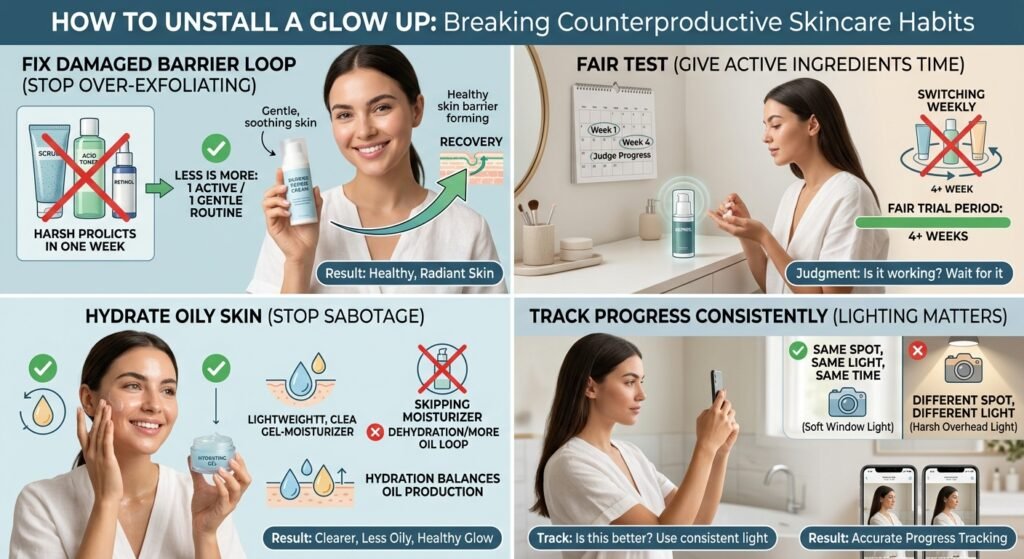
These are the patterns that explain why someone can spend money on skincare for months and see almost nothing change.
Layering multiple exfoliants — a scrub, a toner with acid, and a retinol, all in the same week — doesn’t speed up results. It damages the barrier and causes the exact dullness and irritation the person was trying to fix in the first place, which creates a frustrating loop where more effort produces worse skin.
Switching products every five to seven days because “it’s not working yet” prevents any single product from ever getting a fair test. Most active ingredients need four or more weeks before you can fairly judge them, and constant switching means you never actually find out what would have worked.
Skipping moisturizer on oily skin is one of the most common self-sabotaging habits in skincare, and it often makes oil production worse rather than better, since the skin senses dehydration and compensates by producing more oil to protect itself.
Only fixing skin, never sleep or diet, ignores the fact that skin reflects the rest of the body. No serum fully compensates for chronic dehydration or four hours of sleep a night, no matter how well-formulated it is.
Comparing your skin in different lighting convinces a lot of people they’re not progressing when they actually are. A phone camera in harsh overhead light versus soft window light can make the same skin look completely different, which is why tracking progress in the same light, at the same time of day, matters more than people expect.
Building a Skin Care Tracker That Actually Helps
A tracker only works if it captures the right information. Most people just take photos, which is useful but incomplete, because it doesn’t tell you why something changed.
What’s worth logging daily or weekly includes the specific products used, so you know what to credit or blame later. Skin condition notes matter too — oily, dry, breaking out, or calm — since these shift week to week and are easy to forget without writing them down. Sleep and water intake should be tracked alongside products, because these affect skin more than most product changes ever will. Photos should be taken in the same lighting, same time of day, and same angle every time, since inconsistent photo conditions are the number one reason people think they’re not progressing. Any new product introductions should be dated clearly, so that if a reaction happens two weeks later, you can trace it back to the actual cause instead of guessing.
A simple weekly log works better than a complicated app for most people. Week one might note a gentle cleanser added, with skin feeling slightly irritated as it adjusts, and a photo taken. Week two might note a hydrating serum added, with skin feeling less tight and more comfortable, and another photo taken. Week three, a consistency week with no new products, might show tone starting to even out. Week four, with a spot treatment introduced, might show fewer new breakouts appearing. Writing this down in plain sentences, even without a formal spreadsheet, makes patterns obvious in a way that memory alone never does.
Skin Care Tips That Hold Up Long-Term
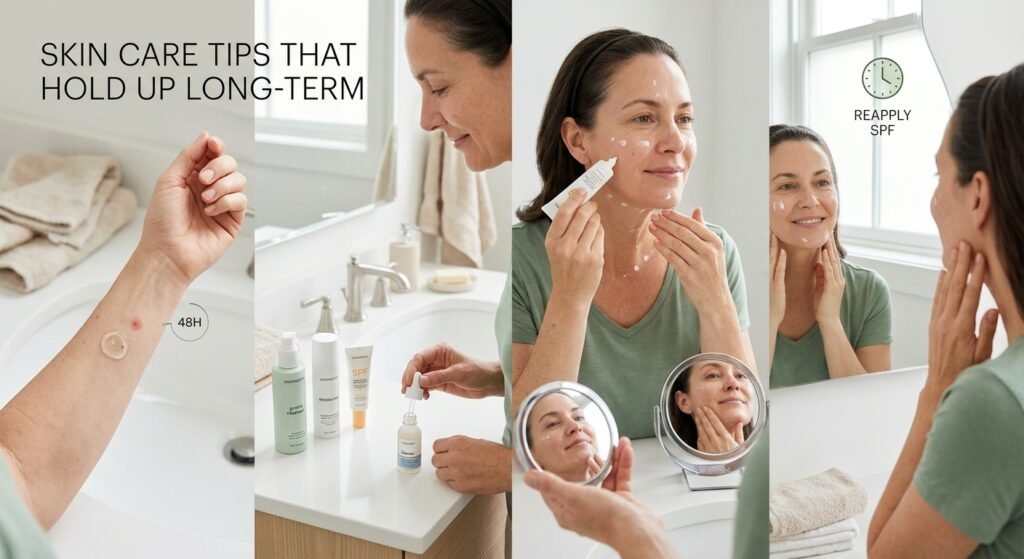
Patch testing every new product for 48 hours before applying it to your whole face prevents a full-face reaction from ever happening in the first place. Introducing one new product at a time, rather than overhauling a full routine at once, makes it possible to actually identify what’s working and what isn’t. Reapplying SPF throughout the day, rather than applying it once in the morning and forgetting about it, is where most of sunscreen’s real protective value comes from. Not picking at breakouts is worth repeating, because it’s the single biggest cause of lasting dark marks — more so than the acne itself in most cases. Extending your routine to your neck and jawline matters too, since most people stop their routine at the chin, creating a visible difference in tone and texture between the face and neck over time.
Skin Care Knowledge Worth Knowing Before You Start
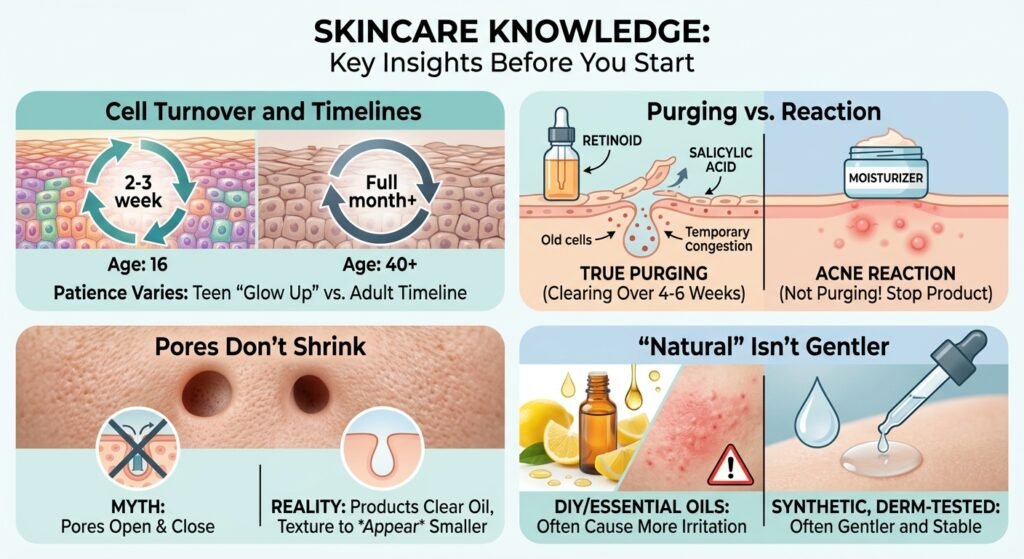
A few pieces of context make everything above make more sense. Skin cell turnover slows with age, so teens might see results in weeks that take adults a full month or more, which is a big part of why timelines vary so much between different “glow up” posts online.
Purging is real, but it’s not an excuse for everything. True purging only happens with ingredients that speed up cell turnover, like retinoids and acids, and should resolve within four to six weeks. Breakouts from a new moisturizer or sunscreen are usually just a reaction, not “purging,” and treating every breakout as purging can lead people to push through with a product that’s genuinely wrong for their skin.
Pores don’t shrink or open and close, despite how often that language gets used. Products can make them appear smaller by reducing what’s inside them, like oil and debris, and by improving the texture around them, but the pore structure itself doesn’t physically change size.
“Natural” doesn’t automatically mean gentler. Essential oils and citrus-based DIY treatments actually cause more irritation complaints than most synthetic, dermatologist-tested ingredients, which runs counter to a lot of what circulates in skincare content online.
How Diet and Lifestyle Fit Into a Glow Up

No skincare guide is complete without acknowledging that topical products only address part of the picture. Sleep quality affects skin more directly than most people realize — during deep sleep, the body increases blood flow to the skin and repairs collagen, which is part of why a bad week of sleep shows up as dullness and puffiness even with a perfect routine.
Hydration matters, but not in the dramatic way it’s often framed. Drinking enough water supports overall skin function, but chugging extra water beyond what your body needs won’t produce a visible glow on its own — it’s a baseline requirement, not a magic fix layered on top of dehydration.
Diet’s role is more nuanced than “cut sugar and your skin will clear up.” High-glycemic diets have been associated with increased breakouts in some studies, but the effect varies significantly between individuals, and dramatic dietary overhauls without addressing topical care rarely produce the results people expect on their own.
Stress deserves more attention than it usually gets in skincare content. Cortisol increases oil production and can worsen inflammatory skin conditions, which is why breakouts often cluster around stressful periods regardless of what routine is being followed at the time.
Adjusting Your Routine by Season
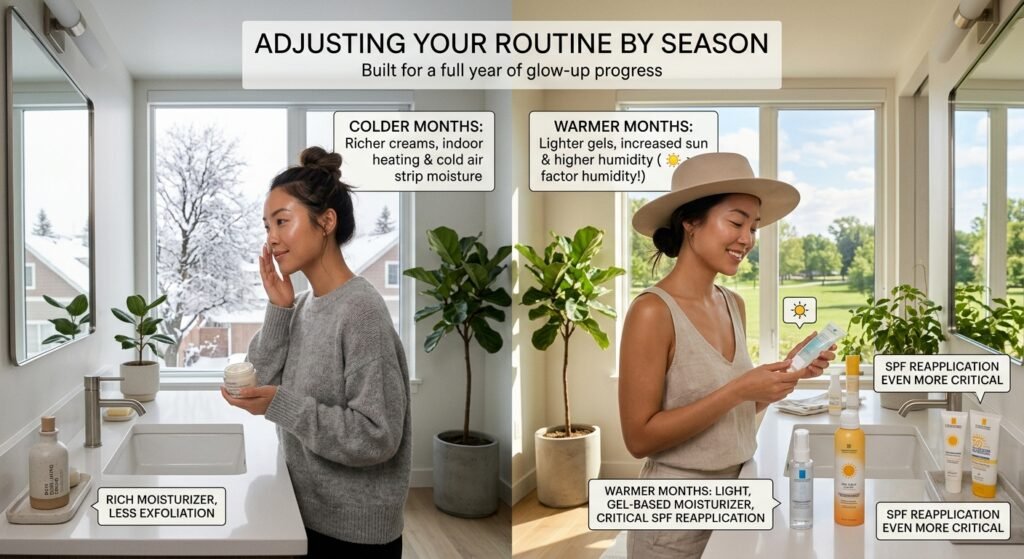
A glow up routine isn’t static, and one of the more overlooked reasons progress seems to stall is that a routine built for one season stops working as the weather shifts. In colder months, skin typically needs richer moisturizers and less frequent exfoliation, since cold air and indoor heating both strip moisture faster than usual. In warmer months, lighter, gel-based moisturizers usually perform better, and SPF reapplication becomes even more critical given increased sun exposure. Humidity levels also affect how products perform — a hydrating serum that feels perfect in a humid climate can feel heavy or even cause breakouts in a dry one, which is worth factoring in before assuming a product itself is the problem.
Frequently Asked Questions
Can I really see a difference in five days of skin care? Yes, but it’s about hydration and calmness, not structural change. Five days is enough time to reduce puffiness, soften dehydration lines, and calm irritation — not enough for scarring, deep texture, or long-term tone changes.
Why does my skin look worse in week two of a new routine? This is usually either purging, if you added an active ingredient, or barrier irritation from adding too much too fast. If it’s not resolving by week four to six, the product likely isn’t right for your skin, rather than something to push through indefinitely.
Do I need expensive products for a real glow up? No. Consistency with gentle, well-formulated basics — cleanser, moisturizer, SPF, and one targeted treatment — outperforms an expensive routine used inconsistently almost every time.
Is it normal for progress to feel inconsistent week to week? Yes, and this trips a lot of people up. Skin doesn’t improve in a straight line — hormonal shifts, weather changes, stress, and sleep all cause natural fluctuation even when the underlying trend is genuinely improving.
The Takeaway
A real skin care glow up isn’t a before-and-after photo trick — it’s a timeline. Two days can de-puff and hydrate. A week can calm and smooth. Thirty days lets your skin complete a full renewal cycle. Six months resolves the deeper stuff like scarring and tone.
The habits that actually move the needle are almost boringly simple: fewer products, introduced slowly, tracked consistently, backed by sleep and SPF. If you take one thing from this guide, let it be this — pick a simple routine, give it a full month before judging it, and track your progress in the same lighting every time. That’s the difference between guessing and actually knowing your glow up is working.