Somewhere between “double cleansing is a myth” and “you need 11 products or your skin will never glow,” the actual Korean 7 step skin care routine got lost.
The version that circulates on Pinterest is often either oversimplified into a checklist or stretched into a 10-step marketing funnel for whatever brand is selling it. The original method — the one Korean dermatologists and skincare counters actually taught — is neither. It’s a logical sequence built around one idea: hydration is layered, not applied once and forgotten.
This article walks through the real 7 steps, why the order matters, and where people go wrong. It also gives dedicated, standalone space to Indian skincare traditions, Japanese skincare philosophy, popular Japanese skincare products, how brown skin should adapt this routine, and what’s currently trending on Xiaohongshu (RedNote). Each of these is treated as its own topic rather than a quick aside, because each deserves more than a passing mention.
What the Korean 7 Step Skin Care Routine Actually Includes
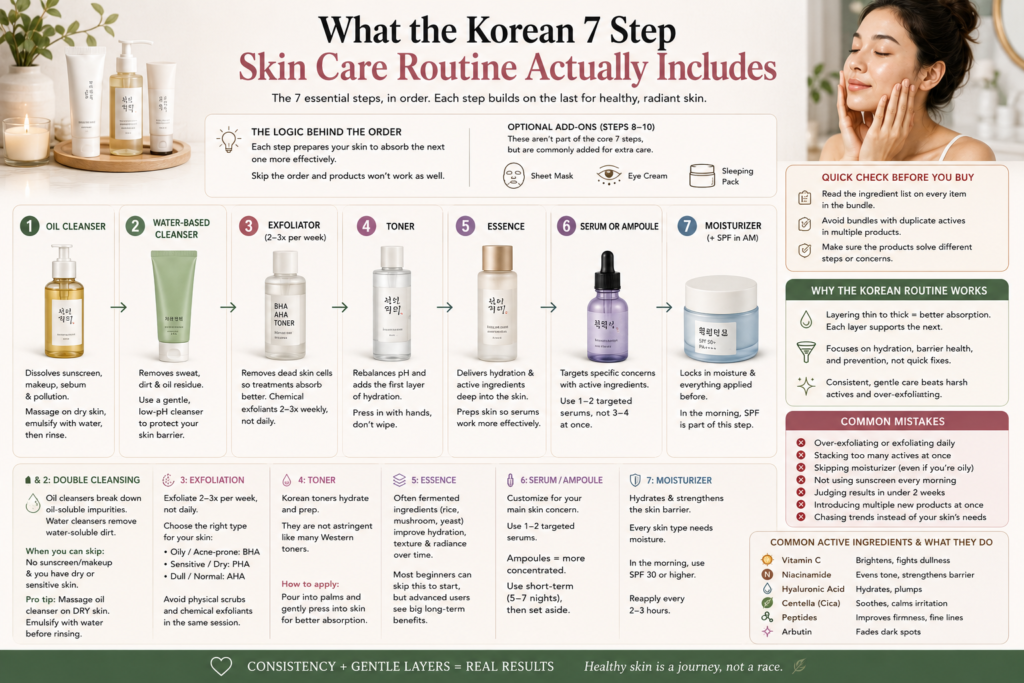
The 7 steps, in order, are:
- Oil cleanser
- Water-based cleanser
- Exfoliator (2–3x per week, not daily)
- Toner
- Essence
- Serum or ampoule
- Moisturizer (with SPF in the AM version)
Sheet masks, eye cream, and sleeping packs are commonly added as optional steps 8–10, which is where the “10 step” version comes from. They’re not core to the original method — they’re layered on top of it.
The logic behind the order is simple once you see it: each step prepares the skin to absorb the next one more effectively. Skipping the order (say, applying serum before toner) doesn’t ruin your skin, but it does reduce how much of each product actually gets used. Think of it less like a checklist and more like a funnel — each layer is thinner and more targeted than the one before it, moving from removing what’s on the skin to delivering what the skin actually needs.
Step 1 & 2: Double Cleansing (Oil Then Water)
Double cleansing is the step people either love or dismiss as unnecessary. Here’s the actual reasoning.
Sunscreen, sebum, and pollution particles are oil-soluble. Water-based cleansers alone don’t fully break them down — they mostly just move them around. An oil cleanser (or cleansing balm) dissolves that layer first. The water-based cleanser that follows then removes sweat, dirt, and any oil residue left behind.
When you can skip it: If you didn’t wear sunscreen or makeup that day and have dry or sensitive skin, a single gentle cleanse at night is fine. Double cleansing every single day regardless of exposure is one of the more common ways people over-strip their skin barrier.
Common mistake: Using a foaming, high-pH cleanser as the water-based step. Korean formulations lean toward low-pH, gel, or cream cleansers specifically to avoid disrupting the skin’s acid mantle. A harsh foaming cleanser after an oil cleanse can undo the benefit of the first step.
A detail most tutorials skip: the order in which you rinse matters too. Oil cleansers are meant to be massaged into dry skin first, then emulsified with a small amount of water before rinsing. Adding water too early turns the oil cleanser into a slip agent instead of letting it actually bind to and lift debris — you end up with a product that feels like it “did nothing” purely because of technique, not formulation.
Step 3: Exfoliation (The Step Most People Overdo)
This is where a lot of routines fall apart, especially ones copied from Pinterest infographics that treat exfoliation as a daily step.
Korean routines typically use chemical exfoliants (AHA/BHA) 2–3 times a week, not daily, and rarely combine physical scrubs with them. The goal is removing dead skin cells so the essence and serum steps that follow can actually penetrate — not achieving a “just scrubbed” feeling.
Situational example: Someone with oily, acne-prone skin might use a BHA toner 3x a week. Someone with dry or sensitized skin might do a gentle PHA once a week instead. Same step, different intensity — this is where a lot of generic advice fails people, because “exfoliate” isn’t a one-size instruction.
A nuance worth knowing: physical exfoliation (scrubs, brushes) and chemical exfoliation are not meant to be used in the same session, and ideally not even in the same week if your skin is sensitive. The combination is one of the most common causes of a compromised skin barrier that people mistake for “purging,” when it’s actually irritation. If your skin has been unusually reactive to everything lately — new redness, stinging from products that never used to sting — this step, not your moisturizer, is usually the first place to look.
Step 4: Toner (Not What Western Toners Usually Are)
This is one of the biggest points of confusion for people new to K-beauty. Western toners are often astringent, alcohol-based, and meant to “remove residue” or shrink pores. Korean toners are hydrating first-layer products — closer to what Western skincare calls an essence-toner hybrid.
Its job is to rebalance the skin’s pH after cleansing and add the first layer of hydration the following steps will build on. If a toner leaves your skin feeling tight or dry, it’s not doing its job in the Korean method — that’s a sign it’s formulated more like a Western clarifying toner.
How to apply it correctly: Korean toners are typically pressed into the skin with hands rather than swiped with a cotton pad. Cotton pads absorb a portion of the product before it ever reaches your skin, which matters more with these lighter-weight formulas than it does with a rinse-off cleanser. Palm-pressing also slightly warms the product, which some estheticians argue improves absorption, though this part is more technique preference than proven science.
Step 5: Essence (The Step Most Non-Korean Routines Skip Entirely)
Essence is the step that confuses people the most because it doesn’t have a clean Western equivalent. It’s thinner than a serum, more concentrated than a toner, and its main function is delivering hydration and active ingredients (often fermented extracts) deep into the skin before the heavier serum step.
Why it’s often skipped by beginners: It feels redundant — “isn’t this just a lighter serum?” But the difference is texture and delivery, not marketing. An essence is designed to be layered, patted in, and absorbed quickly, prepping skin so serums work more efficiently rather than sitting on the surface.
If you’re building a routine on a budget, this is the step most safe to skip initially — but it’s also the one that experienced K-beauty users say makes the biggest visible difference over time, especially for dullness and uneven texture. Fermented essences in particular (rice, mushroom, or yeast-derived) are often cited as the single product K-beauty users say they’d never cut from their routine, even when trimming everything else down.
A common misconception: that essence and serum are interchangeable if you’re short on time or budget. They actually treat the skin at different depths and different concentrations, so replacing one with the other doesn’t just skip a step — it changes what the rest of the routine is able to absorb.
Step 6: Serum or Ampoule (Where You Target Specific Concerns)
This is the customization step. Ampoules are more concentrated, more expensive versions of serums, typically used short-term to address a specific issue (a breakout, hyperpigmentation, dehydration) rather than daily long-term.
| Concern | Common Active Ingredient |
|---|---|
| Dullness / uneven tone | Vitamin C, niacinamide |
| Dehydration | Hyaluronic acid, glycerin |
| Breakouts | Centella asiatica (cica), tea tree |
| Fine lines | Peptides, bakuchiol |
| Hyperpigmentation | Niacinamide, arbutin |
Common mistake: Layering 3–4 active serums at once. Korean routines are built around sequencing over time (a brightening serum for a few weeks, then switching focus), not stacking every active simultaneously. This is especially important advice for melanin-rich skin, covered in more depth further below.
Ampoule vs. serum, practically speaking: if you’ve had a bad breakout or a few nights of poor sleep showing up on your skin, an ampoule used for 5–7 nights and then set aside is the more traditional approach — not a daily-use product added permanently to your shelf. Treating every ampoule like a serum is one of the fastest ways to overspend on a routine without seeing proportional results.
Step 7: Moisturizer (and Why It’s Never Optional, Even for Oily Skin)
The final step locks in everything applied before it. Skipping moisturizer because you have oily skin is one of the most persistent myths in skincare — under-moisturized oily skin often overproduces sebum to compensate, making the problem worse.
Korean moisturizers range from lightweight gel-creams (oily/combination skin) to richer cream formulas (dry skin), but the step itself is never skipped, only adjusted in texture. In the daytime routine, this step also includes SPF — Korean skincare culture treats sun protection as a hydration and anti-aging step, not an afterthought.
A distinction worth understanding: Korean sunscreens are formulated primarily as skincare-cosmetic hybrids, often with a lighter, more cosmetically elegant finish than many Western SPFs. This is part of why sunscreen compliance tends to be higher in routines built around Korean products — people are more likely to use a product daily if it doesn’t leave a white cast or greasy finish, which is a compliance issue as much as a formulation one.
Morning vs. Night: How the Routine Actually Changes
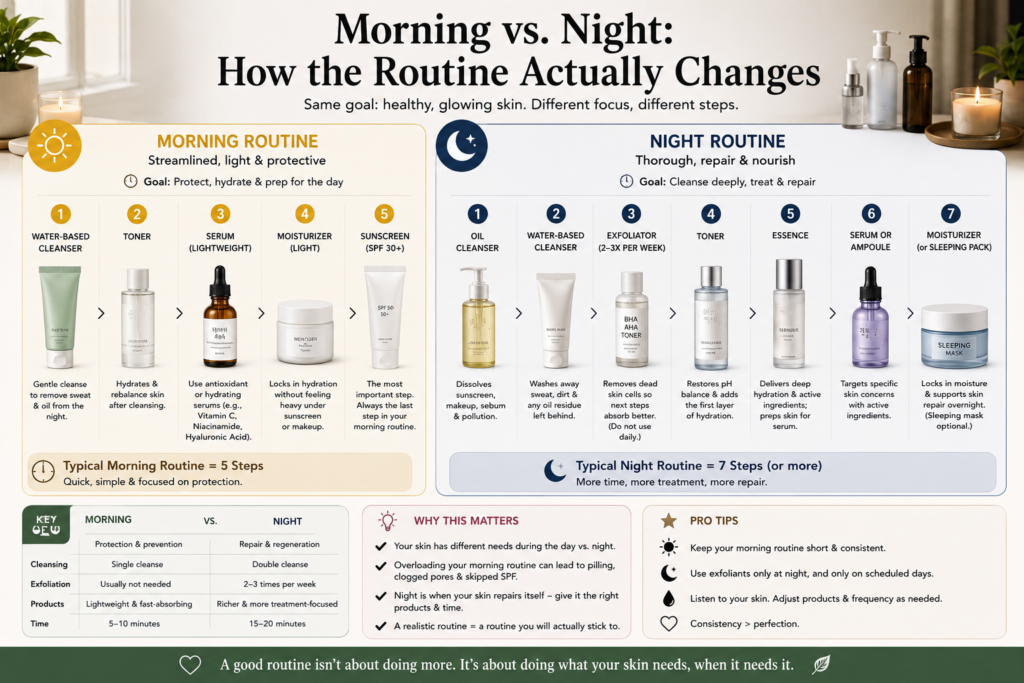
One detail that gets lost when the 7 steps are presented as a single list is that they’re rarely all performed twice a day, identically.
Typical morning routine: water-based cleanser (often skipping the oil cleanser, since there’s nothing from the day to remove), toner, a lighter serum, moisturizer, SPF. Five steps, streamlined for speed and protection.
Typical night routine: the full sequence, including double cleansing and exfoliation on scheduled nights. This is where richer serums, ampoules, and sleeping masks come in, since the skin does more of its repair work overnight and isn’t competing with makeup or sun exposure.
Treating both routines as identical is one of the more common reasons people find the 7-step method exhausting and quit after a few weeks — the morning version is meant to be quick.
Building the Routine on a Budget: What to Prioritize First
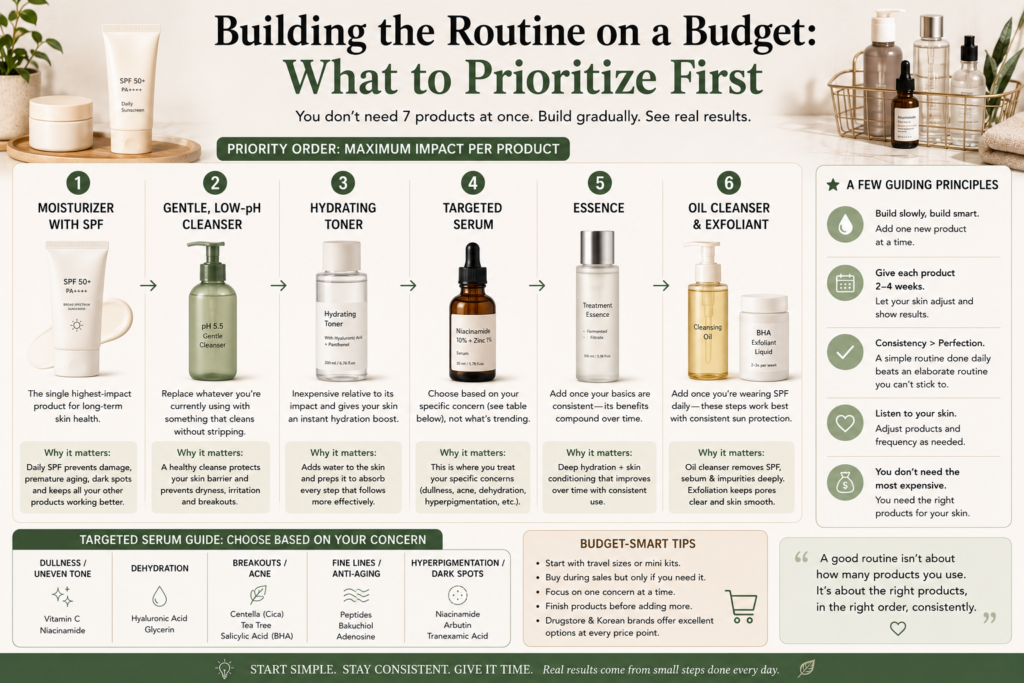
Not everyone wants to buy seven products at once, and you don’t need to. If you’re building the routine gradually, the general order of priority — based on which steps have the most noticeable impact per product — tends to look like this:
- Moisturizer with SPF — the single highest-impact product for long-term skin health.
- A gentle, low-pH cleanser — replaces whatever you’re currently using with something formulated not to strip the barrier.
- A hydrating toner — inexpensive relative to its impact, and doubles as a light hydration boost on its own.
- A targeted serum — chosen based on your specific concern from the table above, not the most popular product online.
- Essence — added once the basics are consistent, since its benefit compounds with regular use.
- Oil cleanser and scheduled exfoliant — added once you’re using SPF daily, since these have the most benefit alongside consistent sun protection.
This order isn’t the “correct” way to build the routine — it’s a practical way to get real results before you own all seven products.
Common Mistakes People Make With the 7 Step Routine
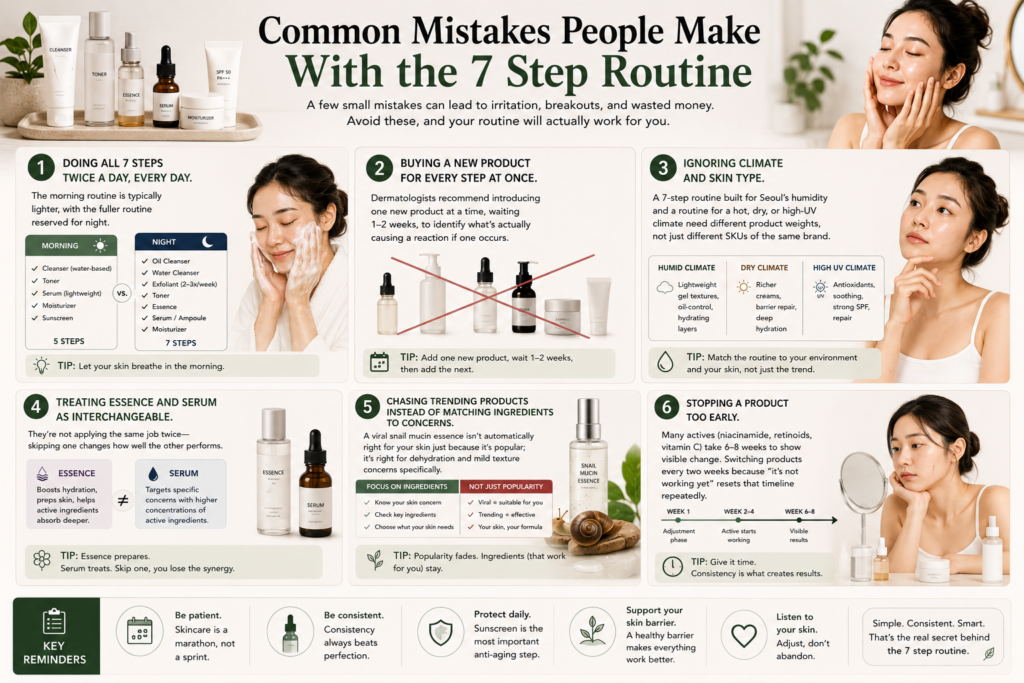
- Doing all 7 steps twice a day, every day. The morning routine is typically lighter, with the fuller routine reserved for night.
- Buying a new product for every step at once. Dermatologists recommend introducing one new product at a time, waiting 1–2 weeks, to identify what’s actually causing a reaction if one occurs.
- Ignoring climate and skin type. A 7-step routine built for Seoul’s humidity and a routine for a hot, dry, or high-UV climate need different product weights, not just different SKUs of the same brand.
- Treating essence and serum as interchangeable. They’re not applying the same job twice — skipping one changes how well the other performs.
- Chasing trending products instead of matching ingredients to concerns. A viral snail mucin essence isn’t automatically right for your skin just because it’s popular; it’s right for dehydration and mild texture concerns specifically.
- Stopping a product too early. Many actives (niacinamide, retinoids, vitamin C) take 6–8 weeks to show visible change. Switching products every two weeks because “it’s not working yet” resets that timeline repeatedly.
Skin Care Indian: How Ayurvedic Traditions Compare and Combine With the Korean Method
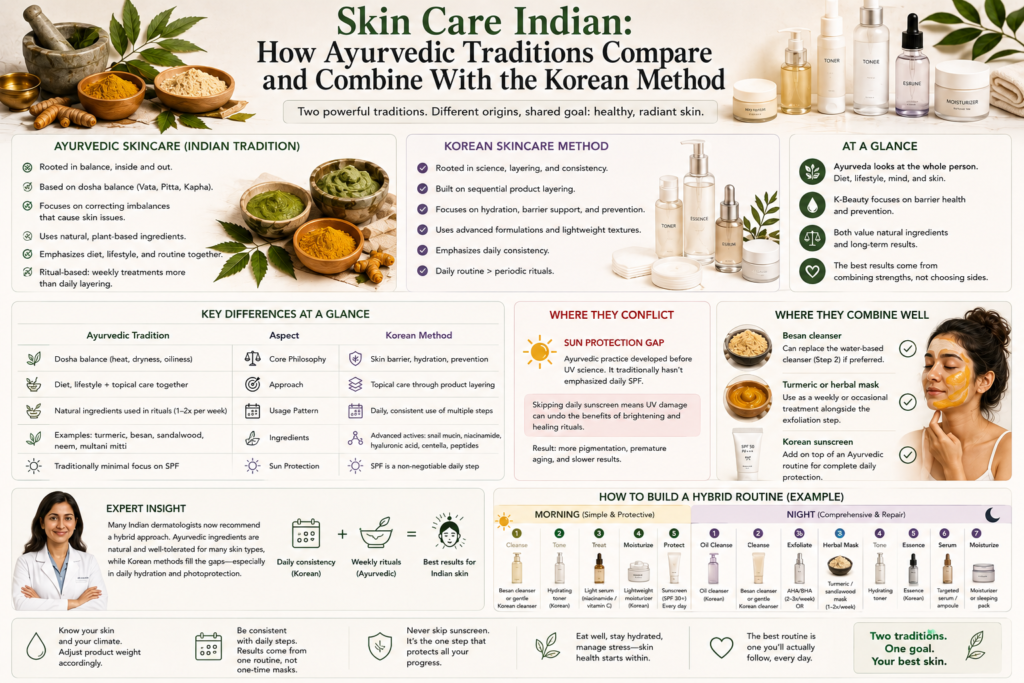
Indian skincare is not a single tradition — it’s a set of regional, largely Ayurvedic practices that predate modern skincare marketing by centuries, and it operates on a completely different logic than the Korean method.
Where the Korean routine is built around sequential product layering, Ayurvedic skincare is built around dosha balance — the idea that skin issues stem from an imbalance (excess heat, dryness, or oiliness) that needs to be corrected from both inside and outside the body. This is why traditional Indian skincare routines often include dietary components (turmeric consumed internally, not just applied) alongside topical ones, something the Korean method doesn’t really address at all.
The most common traditional ingredients — turmeric, besan (gram flour), sandalwood, multani mitti (Fuller’s earth), and neem — are used less like “products” and more like weekly rituals: a besan-and-turmeric face pack once or twice a week, rather than a daily-use serum. This is a meaningful structural difference from the Korean routine, which is designed around daily consistency rather than periodic ritual.
Where the two systems genuinely conflict: Ayurvedic practice traditionally hasn’t emphasized daily SPF the way Korean skincare does, largely because it developed before UV science was well understood. This is the single biggest gap for anyone with Indian skin adopting Ayurvedic ingredients without also adopting the Korean sunscreen habit — you can get all the brightening benefit of a turmeric mask and lose most of it to unprotected sun exposure between uses.
Where they combine well: a besan-based cleanser can reasonably replace the water-based cleanser step (Step 2) for someone who prefers it, a turmeric-and-honey mask can slot in as an occasional treatment alongside the exfoliation step, and a Korean-style lightweight sunscreen can be added on top of an otherwise fully Ayurvedic routine without disrupting anything. The hybrid works best when the Korean structure provides the daily consistency and the Ayurvedic ingredients provide the weekly, deeper-treatment layer.
One frequently overlooked point: many Indian dermatologists now recommend exactly this kind of hybrid rather than choosing one system exclusively, since Ayurvedic ingredients are well-tolerated for many skin tones but the Korean emphasis on daily hydration and photoprotection addresses gaps that traditional practice alone doesn’t cover.
Skin Care Japan: The Philosophy Behind Japanese Beauty Culture
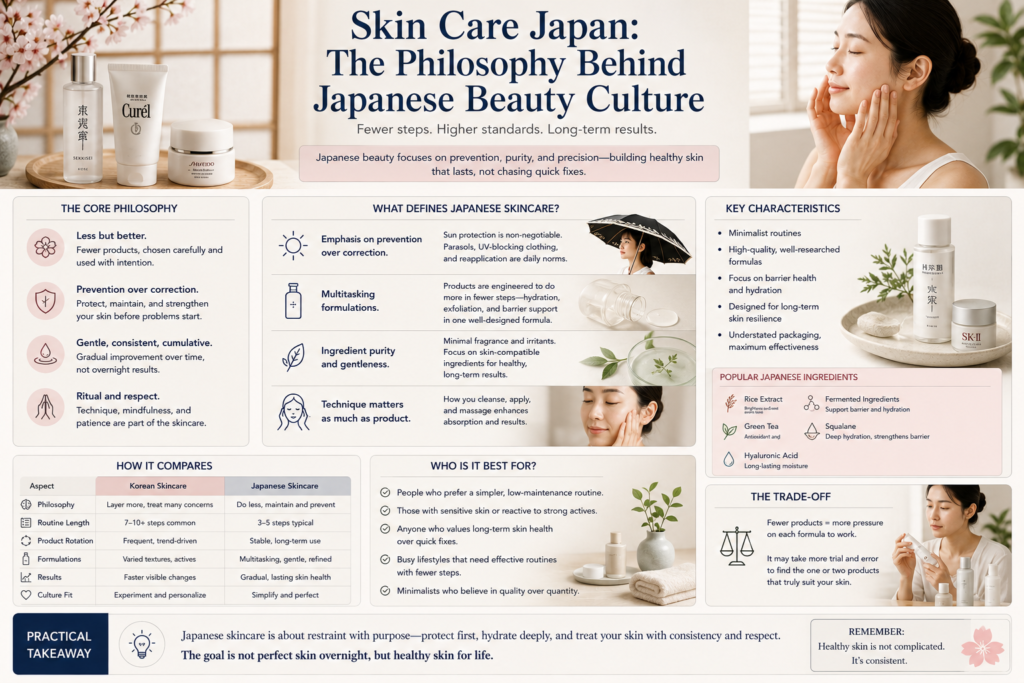
Japanese skincare culture is often grouped with K-beauty online, but the philosophy underneath it is closer to the opposite of the Korean approach in a few important ways.
Where Korean skincare culture is comfortable with visible, multi-step routines and a wide product rotation, Japanese skincare culture is built around “less but better” — fewer products, chosen with more scrutiny, used with more precision. This isn’t a marketing angle; it reflects a broader cultural preference for restraint and quality over quantity that shows up in Japanese design and food culture as well.
A few specific traits define Japanese skincare philosophy:
- Emphasis on prevention over correction. Sun protection, in particular, is treated as a near-mandatory daily habit — parasols, UV-blocking clothing, and reapplication are culturally normalized in a way that’s less common even in other skincare-focused cultures.
- Multitasking formulations. A single Japanese “lotion” (a liquid, closer to a Korean toner-essence hybrid) is often engineered to handle hydration, mild exfoliation, and light barrier support in one step, rather than splitting those functions across three separate products.
- Ingredient purity and gentleness. Japanese formulations tend to avoid heavy fragrance and aggressive actives, favoring gradual, cumulative results over fast, visible change — a contrast to K-beauty’s occasional embrace of trend-driven, high-concentration actives.
- Ritual and technique matter as much as product. Facial massage, specific washing techniques, and unhurried application are treated as part of the routine’s effectiveness, not an optional add-on.
Practically, for someone building a routine: Japanese skincare philosophy is the better fit if the 7-step Korean method feels like too much upkeep, but you still want a structured, effective approach rather than an unstructured one. The trade-off is that Japanese routines rely more heavily on getting a smaller number of formulations right, which sometimes means more trial and error finding the one or two products that work for your skin, rather than being able to swap individual steps freely the way you can in the Korean method.
Skin Care Japanese Products: What’s Actually Worth Knowing Before You Buy
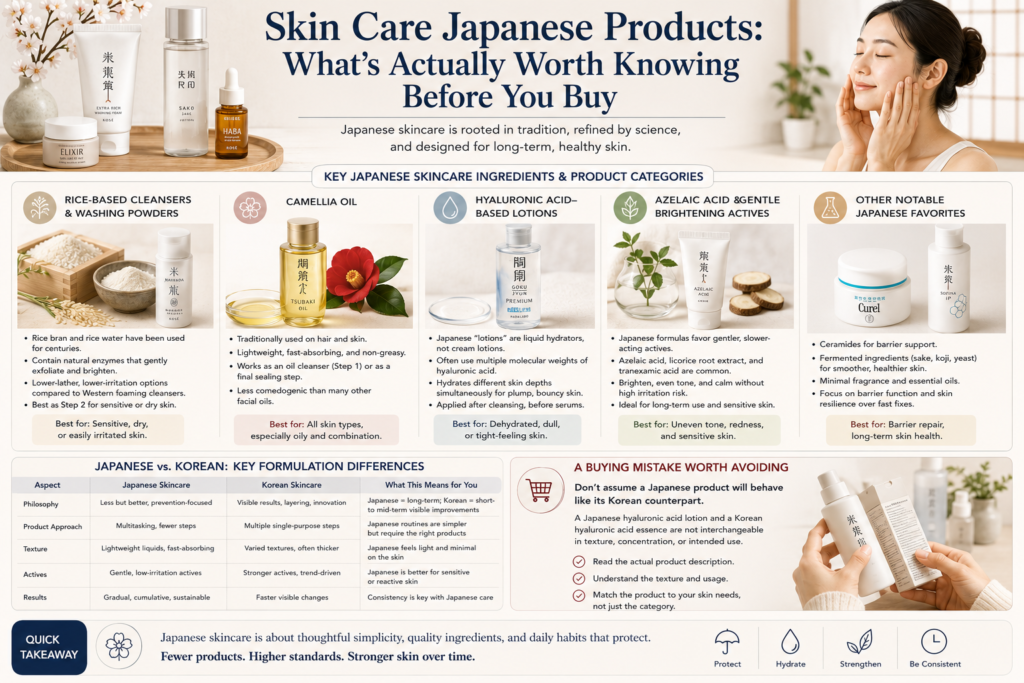
Beyond the philosophy, it helps to know what specific categories of Japanese skincare products are doing differently at a formulation level, since this is where most of their reputation comes from.
Rice-based cleansers and washing powders. Rice bran and rice water have been used in Japanese skincare for centuries, valued for mild exfoliating enzymes and a gentle brightening effect. These tend to be lower-lather, lower-irritation options compared to Western foaming cleansers, and work well as a Step 2 substitute for sensitive or drier skin types.
Camellia oil. Traditionally used on hair as well as skin, camellia oil is a lightweight, fast-absorbing oil that works well as an oil-cleansing option (Step 1) or as a final sealing step over moisturizer for very dry skin. It’s notably less comedogenic than many other facial oils, which is part of why it’s persisted as a staple rather than being replaced by newer trend ingredients.
Hyaluronic acid-based lotions. Japanese “lotions” (again, a liquid step rather than a Western cream lotion) are frequently built around multiple molecular weights of hyaluronic acid to hydrate at different skin depths simultaneously — a more technical approach to a single ingredient than most Western products bother with.
Azelaic acid and gentle brightening actives. Where Korean products often reach for niacinamide or vitamin C for brightening, Japanese formulations lean toward gentler, slower-acting actives like azelaic acid or licorice root extract, aimed at people who want results without the irritation risk that comes with higher-concentration actives.
A buying mistake worth avoiding: assuming a Japanese product will behave like its Korean counterpart because they’re grouped together as “Asian skincare” online. A Japanese hyaluronic acid lotion and a Korean hyaluronic acid essence are not interchangeable in texture, concentration, or intended use — read the actual product description rather than the category it’s filed under.
Brown Skin Care: Adjusting the Korean Routine for Melanin-Rich Skin
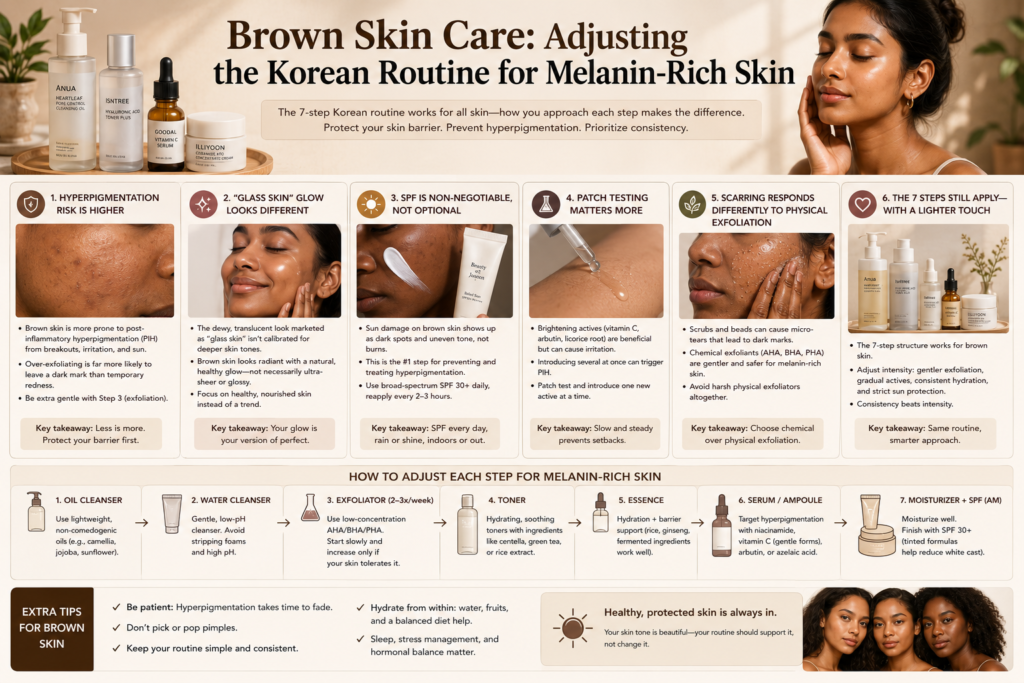
Most K-beauty content is developed and photographed on lighter Korean skin tones, in a specific climate, which means a few things get lost in translation for brown and melanin-rich skin specifically.
Hyperpigmentation risk is higher, not lower. Brown skin is more prone to post-inflammatory hyperpigmentation from breakouts, over-exfoliation, or sun exposure than lighter skin tones. This makes the exfoliation step (Step 3) one to approach more conservatively — over-exfoliating is far more likely to leave a visible dark mark on brown skin than on fair skin, where the same irritation might just cause temporary redness that fades on its own.
“Glass skin” glow looks different on brown skin. The dewy, translucent look marketed as the end goal of K-beauty isn’t calibrated for deeper skin tones. Brown skin more often photographs and appears radiant with a slightly different finish — glowy rather than glassy — and chasing the exact visual reference from Korean marketing can lead to unnecessary over-layering of products in pursuit of a look that was never designed with that skin tone in mind.
SPF needs to be non-negotiable, not optional. This is the step most often skipped by people with deeper skin tones, largely because sun damage on brown skin shows up as hyperpigmentation and uneven tone rather than visible burning — making the damage easy to underestimate until it’s already there. It’s also the single step most directly tied to correcting the hyperpigmentation concern that brown-skin skincare routines are usually built around in the first place.
Patch testing matters more. Brightening actives — vitamin C, arbutin, licorice root — are common in K-beauty serums and generally beneficial for brown skin, but introducing several at once raises irritation risk, and irritation itself is what triggers the hyperpigmentation these products are meant to treat. One new active at a time, with a proper patch test, is the more reliable approach.
Scarring responds differently to physical exfoliation. Any product with visible grit or beads carries more risk of the kind of micro-tearing that leads to dark marks on brown skin than it does on lighter skin. This is part of why the Korean preference for chemical over physical exfoliation tends to translate especially well for brown skin specifically, even though that preference wasn’t originally developed with this skin tone in mind.
None of this means brown skin needs a different routine structure — the 7 steps still apply as written. It means the exfoliation and active-ingredient steps need a lighter, more gradual hand than most Pinterest tutorials suggest, and that sunscreen deserves considerably more attention than it typically gets in routines built for or marketed toward this skin tone.
Xiaohongshu Skin Care: What’s Trending on the Platform Right Now
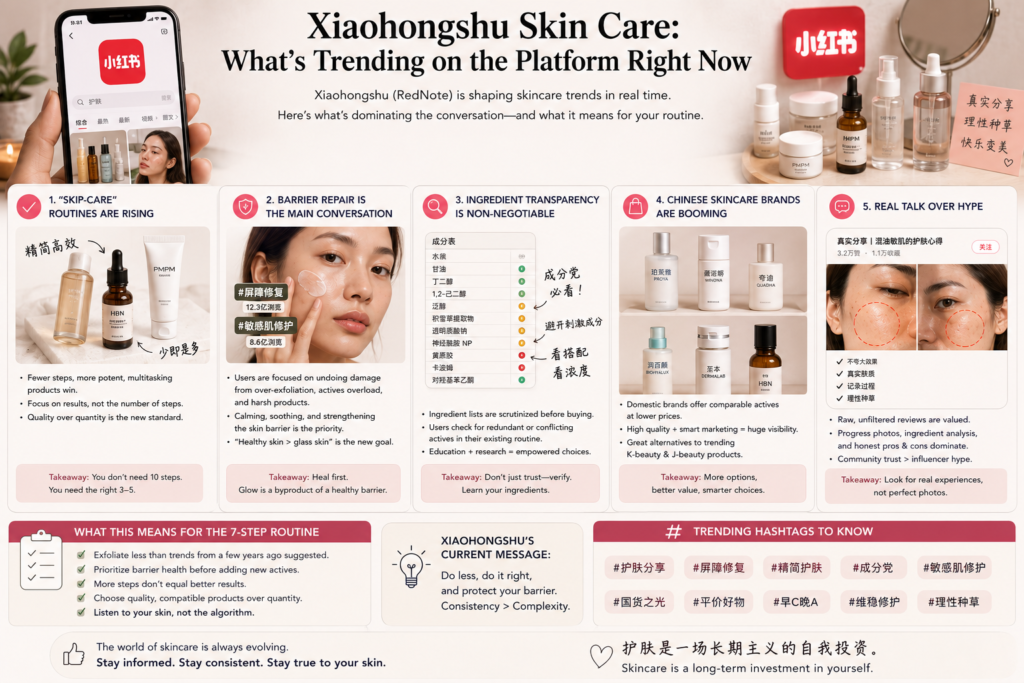
Xiaohongshu (also called RedNote) has become one of the most influential platforms for skincare trends outside of Korea, and its current direction is worth understanding on its own terms — not just as a footnote to K-beauty.
“Skip-care” routines are gaining ground. This is a direct pushback against 7-to-10-step routines, favoring fewer, more potent, multitasking products instead — echoing the Japanese minimalism philosophy discussed earlier, though it developed somewhat independently on the platform.
Barrier repair has replaced “glass skin” as the dominant topic. A large share of current Xiaohongshu skincare content is focused on undoing damage from years of aggressive routines — over-exfoliation, over-layering of actives, and fragrance-heavy products that built up sensitivity over time. Search interest and content volume around barrier repair has grown substantially as a direct response to the over-optimized routines the same platform helped popularize a few years earlier.
Ingredient transparency is now a core part of the culture. Users regularly screenshot and cross-reference ingredient lists before purchasing, checking for redundant or conflicting actives across their existing routine, rather than relying purely on an influencer’s word that a product works.
Domestic Chinese skincare brands are gaining significant visibility. These brands often compete directly with Korean and Japanese imports at lower price points, using similar or identical key actives, and much of the platform’s current product discovery content centers on finding these more affordable domestic alternatives to trending Korean and Japanese products.
The practical takeaway for the 7-step routine specifically: the platform’s current direction reinforces the exact caution given earlier in the exfoliation section of this article — exfoliate less than the trend cycles of a few years ago suggested, prioritize barrier health before adding new actives, and don’t assume that more steps or more potent formulations automatically mean better results. It’s a useful, real-time correction from the same online skincare culture that helped popularize the more-is-more approach in the first place.
How to Tell If the Routine Is Actually Working
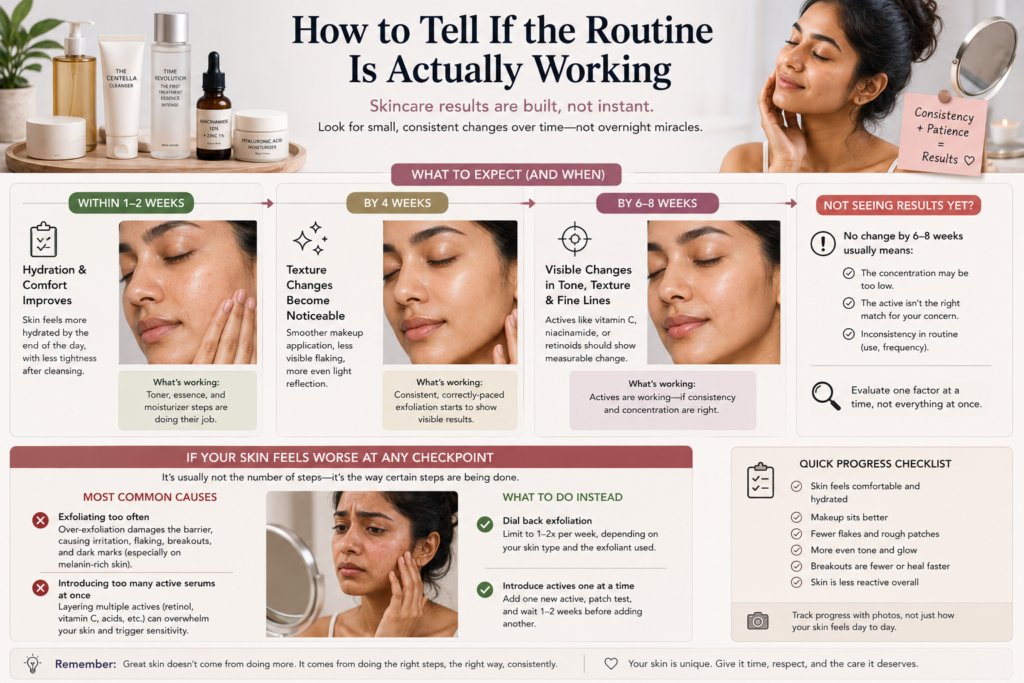
Because results from a layered routine build gradually, it helps to know what to check for at each stage rather than waiting for a dramatic before-and-after.
Within 1–2 weeks: skin should feel more hydrated by the end of the day, with less tightness after cleansing. This is mostly the toner, essence, and moisturizer steps doing their job.
By 4 weeks: texture changes become noticeable — smoother makeup application, less visible flaking, more even light reflection. This is where consistent, correctly-paced exfoliation starts to show.
By 6–8 weeks: active ingredients like vitamin C, niacinamide, or retinoids should show measurable change in tone, texture, or fine lines. If there’s no change by this point, the issue is usually concentration or consistency, not the routine structure itself.
If skin feels worse at any of these checkpoints — more reactive, more textured, more broken out — the most common cause isn’t “too many steps,” it’s usually exfoliation frequency or too many active serums introduced simultaneously, both covered earlier in this article.
Frequently Asked Questions
Do I need all 7 steps every single day? No. The full 7 steps (plus optional extras) are typically a nighttime routine. Mornings usually use a shortened version: cleanser, toner, serum, moisturizer, SPF.
Can I use Korean, Japanese, and Indian products together in one routine? Yes, and many people already do. The steps are a structure, not a brand requirement — you can put a Japanese lotion in the toner/essence step and an Indian-formulated SPF at the end without breaking the method.
How long before I see results from a 7-step routine? Hydration-focused improvements (texture, dullness) are often visible within 2–3 weeks. Changes tied to active ingredients like vitamin C or exfoliants typically take 6–8 weeks of consistent use to show clearly.
Is the 7 step routine too much for oily or acne-prone skin? Not inherently — the step count stays the same, but the formulations change. Oily and acne-prone skin generally uses lighter, gel-based essences and serums, and may skip the oil cleanser on non-makeup days.
Do I need to buy Korean-branded products specifically to follow this method? No. The routine is a sequence and a philosophy, not a brand requirement. Japanese, Indian, or Western products can be used at any step as long as the texture and function match what that step is meant to do.
Conclusion
The Korean 7 step skin care routine isn’t a rigid product list — it’s a sequencing logic built around layering hydration and letting each step improve the absorption of the next. The steps that get skipped most often (essence, SPF, and correctly paced exfoliation) also tend to be the ones with the biggest long-term impact, which is worth remembering next time a routine feels like it’s not “doing enough.”
If you’re building your own version, start with the core 7 steps using whatever products fit your budget and skin type — Korean, Japanese, Indian, or a mix — and adjust texture, actives, and exfoliation frequency based on your specific skin and climate rather than copying a routine built for someone else’s. That’s the actual method behind the trend, and it’s more adaptable than most Pinterest graphics give it credit for.