Somewhere between the last box of crayons and the first request for a “real” face wash, kids start noticing their skin. It usually isn’t dramatic. A shiny forehead before gym class. A friend’s older sister with a five-step routine. A TikTok video that makes retinol look like a school supply.
Parents are often caught in between two extremes: doing nothing until acne shows up, or accidentally handing a 10-year-old an adult skin care routine built for 30-year-old concerns. Neither works well.
This guide breaks down what kids’ skin actually needs at each age and grade, what’s genuinely useful, and what’s marketing dressed up as skin care. If you’ve searched anything like “skin care routine for kids,” “skin care for 9-10 years,” or “8th grade skin care routine,” this is meant to answer it in one read.
It also matters to say what this guide isn’t. It isn’t a list of trending products or a “10-step glow-up” adapted down for a smaller face. Most of what circulates online under “kids’ skin care” is really adult skin care with the marketing softened — pastel packaging around the same actives that were never meant for a developing skin barrier. The routine below is built from what dermatologists actually recommend for pre-teen and early-teen skin, not what performs well in a Pinterest feed.
Why Kids’ Skin Care Needs Are Different From Adults’
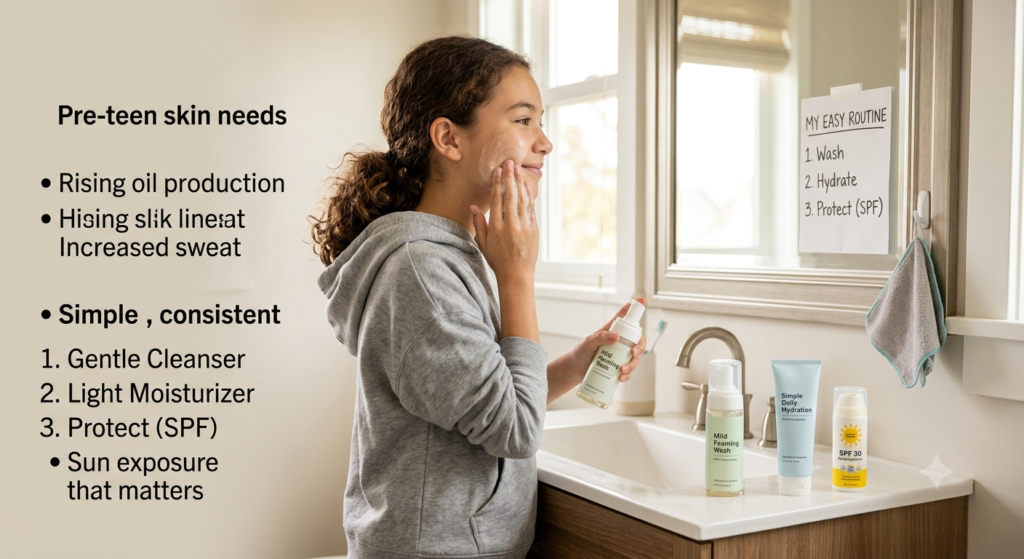
Adult skin care is built around problems adult skin actually has: sun damage accumulated over decades, slowing cell turnover, hormonal fluctuations tied to cycles or menopause, and fine lines. Almost none of that applies to a 9- to 13-year-old.
What kids’ skin actually deals with:
- Rising oil production as hormones begin shifting, sometimes years before any other visible sign of puberty
- Increased sweat and friction from sports, PE class, and being outside more
- Sun exposure that matters more long-term than most parents realize, since a large share of lifetime UV damage happens before age 18
- New sensitivities to fragrance, harsh cleansers, or products borrowed from an older sibling or parent
The goal at this age isn’t correction — it’s protection and habit-building. A kid who learns a simple, consistent three-step routine at 10 is in a far better position at 16 than a kid who never touched their face until acne showed up and panic-bought six products at once.
The Core Routine Every Kid Needs (Before Anything Else)
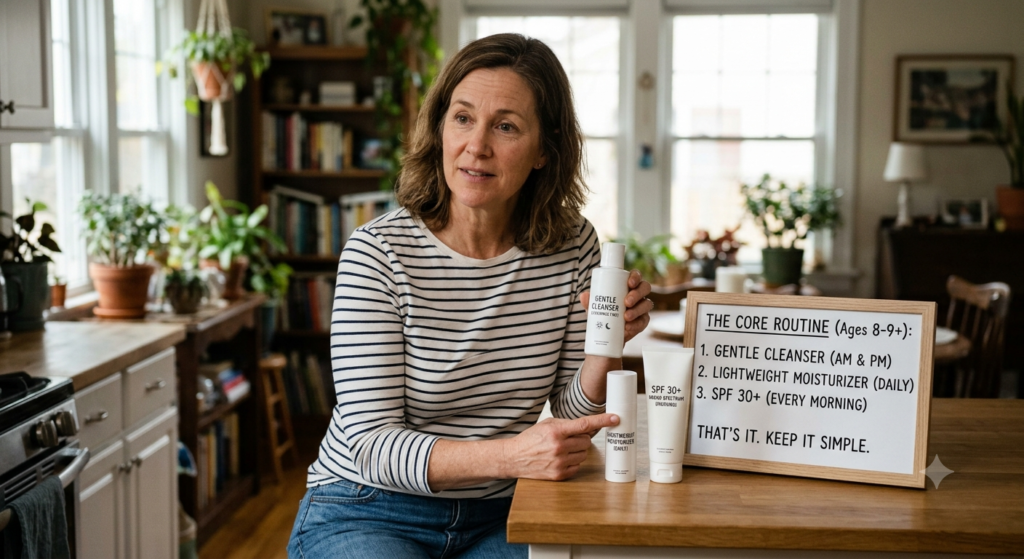
Before getting into ages and grades, here’s the routine that applies to essentially every kid past age 8 or 9, regardless of skin type:
- Gentle cleanser, twice a day. Morning and night. Not a scrub, not an acne wash unless a dermatologist has recommended one — just a basic, fragrance-free or lightly-scented cleanser.
- Lightweight moisturizer, daily. Even oily skin needs this. Skipping moisturizer often makes oily skin produce more oil to compensate.
- SPF 30+ every morning, rain or shine, applied to face, ears, and neck.
That’s it. That’s the whole non-negotiable routine. Everything else — spot treatments, toners, exfoliants, serums — is optional, situational, or better left for later. A common mistake is treating “skin care routine” as synonymous with “as many products as possible.” For kids, fewer products used consistently beats a long routine used inconsistently, every time.
What the Morning and Night Routine Actually Looks Like
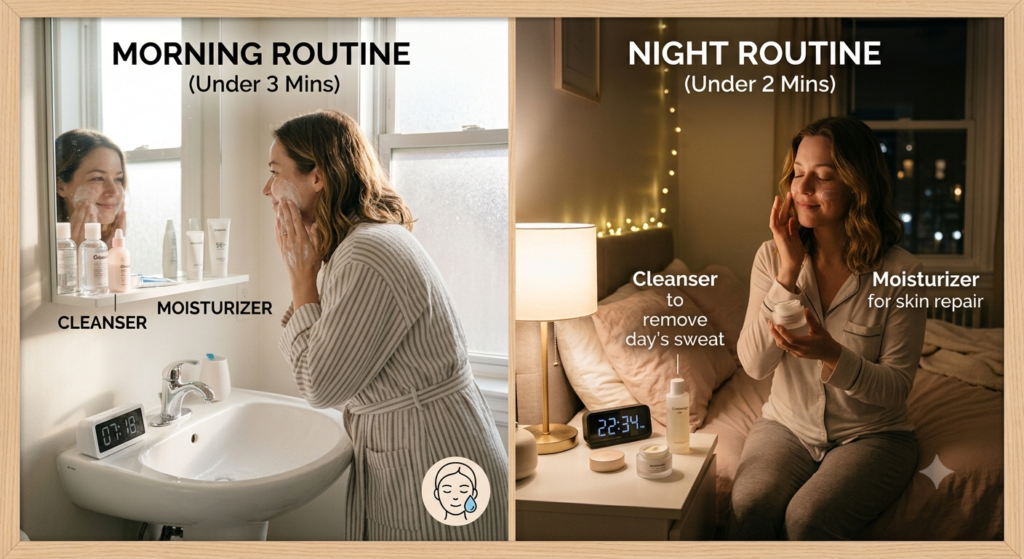
Parents often ask what this looks like in practice, minute by minute, rather than as a bulleted list. Here’s a realistic version:
Morning (under 3 minutes):
- Splash face with lukewarm water — not hot, which strips natural oils faster than needed
- Cleanser, gently massaged in for about 20–30 seconds, then rinsed
- Moisturizer while skin is still slightly damp, which helps it absorb better
- SPF as the last step, applied generously — most kids (and adults) use less than half the amount needed for real protection
Night (under 2 minutes):
- Cleanser to remove the day’s sweat, sunscreen, and any surface dirt
- Moisturizer again, since nighttime is when skin does most of its repair work
Notice what’s missing: no toner, no exfoliant, no serum. Those aren’t banned outright, but they’re add-ons for a specific concern later — not defaults every kid needs from day one.
Choosing Between Product Types: A Quick Comparison
Walking down a drugstore aisle with a kid who suddenly cares about skin care can be overwhelming. Here’s how the main cleanser and moisturizer formats compare for this age group specifically:
| Format | Pros | Cons | Best for |
|---|---|---|---|
| Foaming cleanser | Feels “clean,” rinses easily, satisfying for kids who like a routine that feels active | Can be drying if used more than twice daily | Oilier skin, active kids |
| Cream/lotion cleanser | Gentle, less stripping, good for sensitive skin | Can feel less “effective” to a kid used to foaming products | Dry or sensitive skin |
| Gel moisturizer | Lightweight, absorbs fast, doesn’t feel heavy under sunscreen | Less hydrating for very dry skin | Oily or combination skin |
| Cream moisturizer | More hydrating, better barrier support | Can feel greasy under makeup or SPF for some kids | Dry skin, colder climates |
| Mineral SPF (zinc oxide/titanium dioxide) | Gentler on sensitive skin, less irritation risk | Can leave a slight white cast | Sensitive or reactive skin |
| Chemical SPF | Blends in more easily, lighter feel | Slightly higher irritation risk for reactive skin | Kids without sensitivity issues |
There’s no universally “best” option here — the right choice depends on the individual kid’s skin type and tolerance, which is often discovered through a bit of trial and error rather than guessed correctly on the first try.
Skin Care by Age and Grade: What Actually Changes
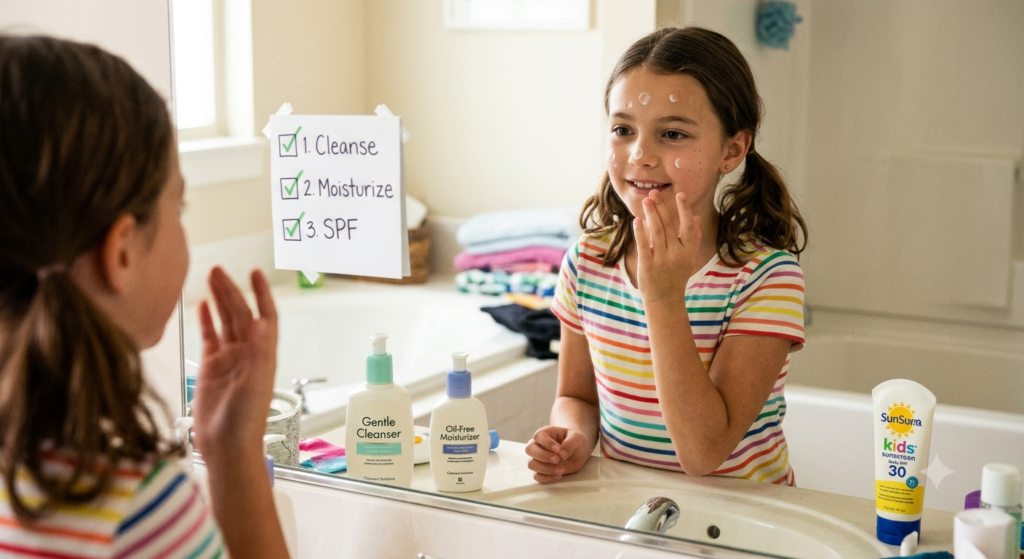
Skin care needs don’t jump overnight at a birthday — they shift gradually, often tracking more closely with a specific kid’s hormone timeline than their exact age. Still, there are patterns worth knowing at each stage.
Skin Care for Ages 8–10
At this stage, most kids don’t need “skin care” so much as they need good hygiene habits. The priority is teaching the cleanser-moisturizer-SPF sequence as a routine, not a chore assigned by a parent every single day.
A practical approach: let the child pick their own bottle (within a short, parent-approved list). Ownership over the choice makes the habit stick far better than a routine that feels imposed. This is also the age to start explaining why SPF matters — not with a lecture, but by connecting it to something they care about, like preventing sunburn before a pool day.
A situational example: a family with an 8-year-old who spends summers at swim practice will have very different priorities than a family with a 10-year-old who’s mostly indoors. For the swimmer, a water-resistant, reef-safe SPF matters more than anything else on this list, and reapplication every two hours becomes part of the routine, not an afterthought. For the mostly-indoor kid, consistency of the basic three steps matters more than product strength.
Skin Care for 9-Year-Olds
Nine is often the age where the first genuine oil changes start showing up, especially on the forehead and nose — well before any other puberty signs. Parents sometimes mistake this for “dirty” skin and reach for stronger cleansers, which usually backfires by stripping the skin and triggering even more oil production.
The better move: keep the cleanser gentle, and if shine is a real concern, use an oil-free, non-comedogenic moisturizer instead of skipping moisturizer altogether.
Skin Care for Ages 9–10
For kids in this window specifically transitioning from “little kid” hygiene (a bath and nothing else) to a real daily habit, consistency matters more than product choice. A short, visual checklist taped inside a bathroom cabinet works better than verbal reminders, since it removes the “I forgot” excuse without turning it into a nagging match.
Skin Care at 10 Years
Ten is a common age for the first noticeable shift many parents describe as “suddenly needing to wash their face.” It’s frequently the earliest visible sign of approaching puberty, sometimes arriving a full year or two before anything else changes. This is a reasonable point to introduce a proper cleanser (rather than just splashing water) if the routine hasn’t started yet.
It’s also worth having a short, low-pressure conversation here about why skin is changing, so it doesn’t feel confusing or embarrassing later.
Skin Care for 11-Year-Olds
By 11, body odor and localized breakouts (chin, hairline, sometimes the back) become more common. This is often when kids start asking for deodorant on their own — a good sign, not something to brush off. Pair the skin routine with basic body hygiene guidance at the same time, since kids at this age tend to lump both together mentally anyway.
A frequently overlooked detail: bath towels and pillowcases. Reusing the same towel for a week or sleeping on the same pillowcase for two weeks can undo a decent skin routine by reintroducing oil and bacteria nightly.
Skin Care Routine for 6th Grade
Sixth grade brings a very specific, practical pressure most articles skip: locker rooms, shared gym equipment, and communal showers or changing spaces. This is the age to introduce:
- A small gym bag with a travel-size cleanser and deodorant
- A quick post-PE face wipe (fragrance-free) for days when a full wash isn’t possible
- A conversation about not sharing towels, razors, or skin products with classmates
This is less about products and more about giving a kid the tools to manage a new social environment without embarrassment.
Skin Care at Age 12
Twelve is frequently the age where actual acne — not just oiliness — starts to appear for a meaningful share of kids. If breakouts are occasional and mild, the core three-step routine plus a gentle salicylic acid spot treatment (used only on active spots, not the whole face) is usually enough.
If breakouts are widespread, painful, or leaving marks, that’s a signal to loop in a pediatrician or dermatologist rather than escalating the at-home routine on your own. More products is not automatically the right response to more acne.
Skin Care for 7th Graders
Seventh grade often overlaps with the age when kids start paying attention to skin care content — social media tutorials, multi-step routines built for adult skin, and products with actives (retinol, strong acids, high-percentage exfoliants) that aren’t appropriate yet. This is one of the most common mistakes families run into: a 12- or 13-year-old asking for a 10-step “glow” routine copied from an adult influencer.
The nuance worth understanding: many of those routines target concerns — fine lines, dullness from decades of sun damage, hormonal adult acne — that simply don’t exist yet in a 12-year-old’s skin. Using them anyway can cause irritation, sensitivity, or a compromised skin barrier that shows up as worse skin, not better.
8th Grade Skin Care Routine
By 8th grade, many kids want more independence in choosing and managing their own products — and that’s reasonable. The useful parenting move here isn’t control, it’s guardrails: agree on a short list of appropriate ingredients and product types together, then let them pick within it.
This is also a sensible age to introduce a very basic double-duty item, like a tinted moisturizer with SPF, if a child is self-conscious about redness or unevenness. It solves a real concern without introducing a full makeup routine.
Common Mistakes Parents Make
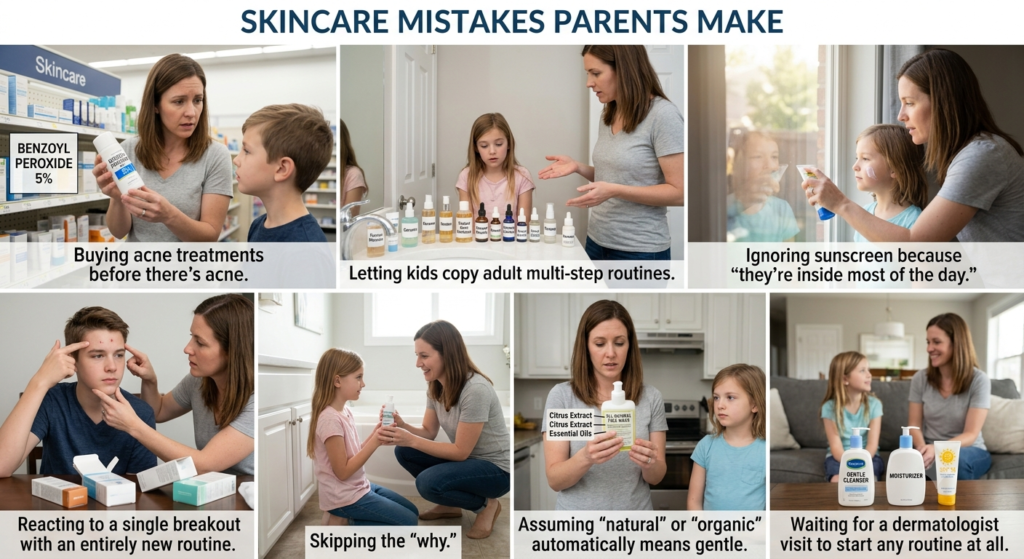
- Buying acne treatments before there’s acne. Prevention here means gentle cleansing and SPF — not benzoyl peroxide “just in case.” Using active acne ingredients on skin that doesn’t need them tends to cause dryness and irritation without any upside.
- Letting kids copy adult multi-step routines. More steps almost always means more irritation risk for kids’ skin, not better results. A 12-step routine designed for an adult managing wrinkles and hyperpigmentation has almost nothing useful to offer a 12-year-old.
- Ignoring sunscreen because “they’re inside most of the day.” Car rides, recess, PE, and walks to and from school add up to meaningful daily UV exposure, and car windows only block a portion of UV rays.
- Reacting to a single breakout with an entirely new routine. One pimple doesn’t require a product overhaul; a pattern over several weeks might.
- Skipping the “why.” Kids who understand why they’re washing their face stick with it. Kids who are just told to do it tend to stop the moment no one’s checking.
- Assuming “natural” or “organic” automatically means gentle. Some natural ingredients, like citrus extracts or certain essential oils, are actually more irritating to young skin than a well-formulated synthetic alternative.
- Waiting for a dermatologist visit to start any routine at all. Basic cleansing, moisturizing, and SPF don’t require a prescription or a professional recommendation — they’re appropriate as a starting point for nearly every kid, with or without a specific skin concern.
Ingredients to Avoid in Kids’ Skin Care
Not every “gentle” or “kids” label on a bottle actually means gentle. Worth checking for and avoiding at this age:
| Ingredient | Why to avoid it in kids’ products |
|---|---|
| High-percentage retinol or retinoids | Made for cell turnover concerns kids’ skin doesn’t have; can cause irritation and sun sensitivity |
| Strong AHAs/BHAs at high concentrations | Can compromise a still-developing skin barrier |
| Added fragrance in leave-on products | A common source of sensitivity and irritation in kids’ skin specifically |
| Alcohol-based toners | Frequently strip natural oils, triggering a rebound oily reaction |
| Physical exfoliating beads/scrubs used daily | Can create micro-tears in delicate skin with regular use |
A Simple Checklist for Building the Habit
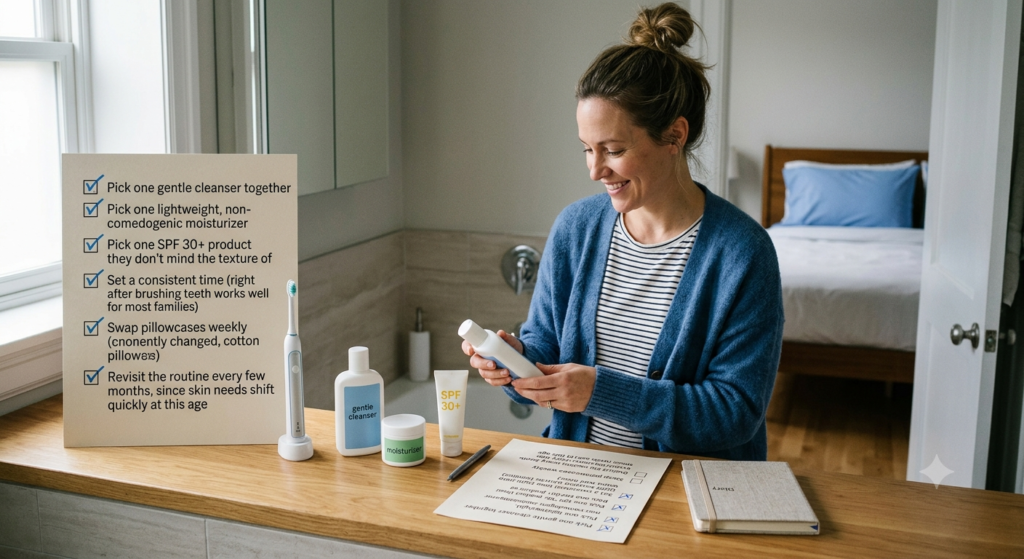
- [ ] Pick one gentle cleanser together
- [ ] Pick one lightweight, non-comedogenic moisturizer
- [ ] Pick one SPF 30+ product they don’t mind the texture of
- [ ] Set a consistent time (right after brushing teeth works well for most families)
- [ ] Swap pillowcases weekly
- [ ] Revisit the routine every few months, since skin needs shift quickly at this age
When to See a Dermatologist

Most kids don’t need a dermatologist for standard oiliness or the occasional pimple. It’s worth booking an appointment if:
- Breakouts are painful, deep (cystic), or leaving dark marks or scars
- Over-the-counter spot treatments haven’t helped after 6–8 consistent weeks
- Skin issues are affecting a child’s confidence or willingness to go to school
- There’s a family history of severe acne, since early intervention tends to produce better long-term results
FAQ
Is skin care necessary for kids, or is it just marketing? The basics — gentle cleansing, moisturizer, and daily SPF — are genuinely useful and grounded in real skin biology, not just marketing. Multi-step “glow” routines built for adult skin concerns are where the marketing outpaces the need.
What age should a kid start using sunscreen daily? As early as possible, ideally as a daily habit well before puberty. Sun damage is cumulative, and habits formed young tend to carry into adulthood.
Can kids use the same products as their parents? Not usually. Adult products often contain actives (retinol, strong acids, higher fragrance loads) formulated for concerns kids’ skin doesn’t have yet, and can cause irritation.
My child has acne at 11 — is that normal? It can be. Hormonal shifts sometimes start well before other visible puberty signs. Mild, occasional breakouts are common and manageable at home; widespread or painful breakouts are worth a doctor’s opinion.
Should boys and girls follow different skin care routines at this age? No. Before puberty is fully underway, oil production, sweat, and sun exposure affect boys’ and girls’ skin in essentially the same way. The core three-step routine works regardless of gender — differences tend to show up later, once hormonal patterns diverge more clearly.
How do I get a reluctant kid to actually stick with a routine? Keep it short enough that skipping it feels harder than doing it — under three minutes total is a realistic target. Letting them choose their own products within a short approved list, and pairing the routine with an existing habit like brushing teeth, tends to work far better than reminders alone.
Key Takeaways
A skin care routine for kids doesn’t need to be complicated to be effective. The three non-negotiables — gentle cleanser, lightweight moisturizer, and daily SPF — cover almost everything that matters from age 9 through 8th grade. What changes isn’t the core routine; it’s the context around it: locker rooms in 6th grade, early breakouts in 7th, more independence by 8th, and a steadily rising need for sun protection the whole way through.
The most useful thing a parent can do isn’t finding the “perfect” product — it’s helping a kid build a simple, consistent habit early, and stepping in with a professional’s help if skin concerns go beyond what a basic routine can handle.