Most people don’t have a bad skin care night routine. They have a disorganized one.They own the right serum. They just apply it before their moisturizer instead of after. They double-cleanse religiously but skip sunscreen the next morning, undoing half the work. They buy retinol, use it every night for a week, and quit when their face starts flaking — not realizing that’s a dosing problem, not a product problem.
A night routine isn’t about owning more products. It’s about understanding what your skin is actually doing while you sleep, and giving it the right ingredients in the right order to support that. That’s what this guide walks through — not a generic 10-step list, but the reasoning behind each step, so you can build a routine that fits your actual skin instead of someone else’s Instagram shelfie.
Why Your Skin Care Night Routine Matters More Than Your Morning One
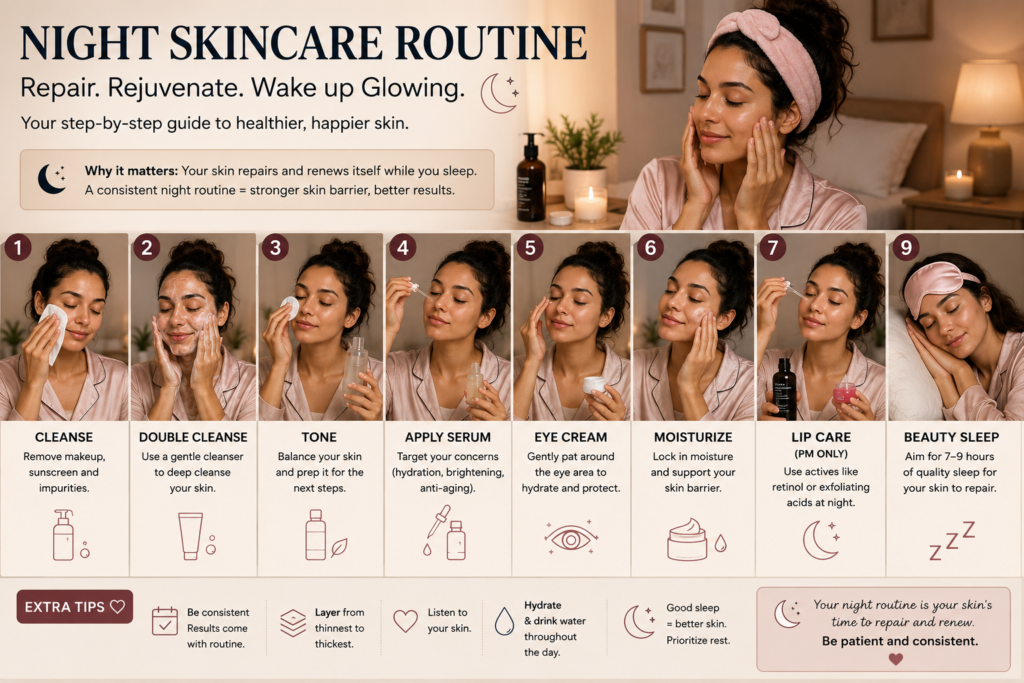
Skin repairs itself at night. Cell turnover — the process where your skin sheds old cells and produces new ones — peaks overnight, roughly between 11 p.m. and 4 a.m. Blood flow to the skin increases, cortisol (which breaks down collagen) drops, and there’s no UV exposure or pollution to defend against.
This means nighttime is when your skin is most receptive to active ingredients like retinoids, peptides, and exfoliating acids. It’s also when transepidermal water loss (moisture escaping through the skin) is highest, which is why a heavier moisturizer or sleeping mask at night makes more sense than it would at noon.
In practical terms: your morning routine is about protection. Your night routine is about repair. Mixing up which ingredients belong where is one of the most common — and most avoidable — skincare mistakes.
There’s also a hormonal piece that rarely gets mentioned. Cortisol naturally declines through the evening, and melatonin — yes, the same hormone that regulates sleep — has documented antioxidant properties in skin tissue. This is part of why sleep quality itself shows up on your face: chronically poor sleep is associated with a weaker skin barrier and slower recovery from environmental stress, independent of what products you’re using. A great night routine layered on top of five hours of sleep will only get you partway there.
The Skin Care Night Routine, Step by Step
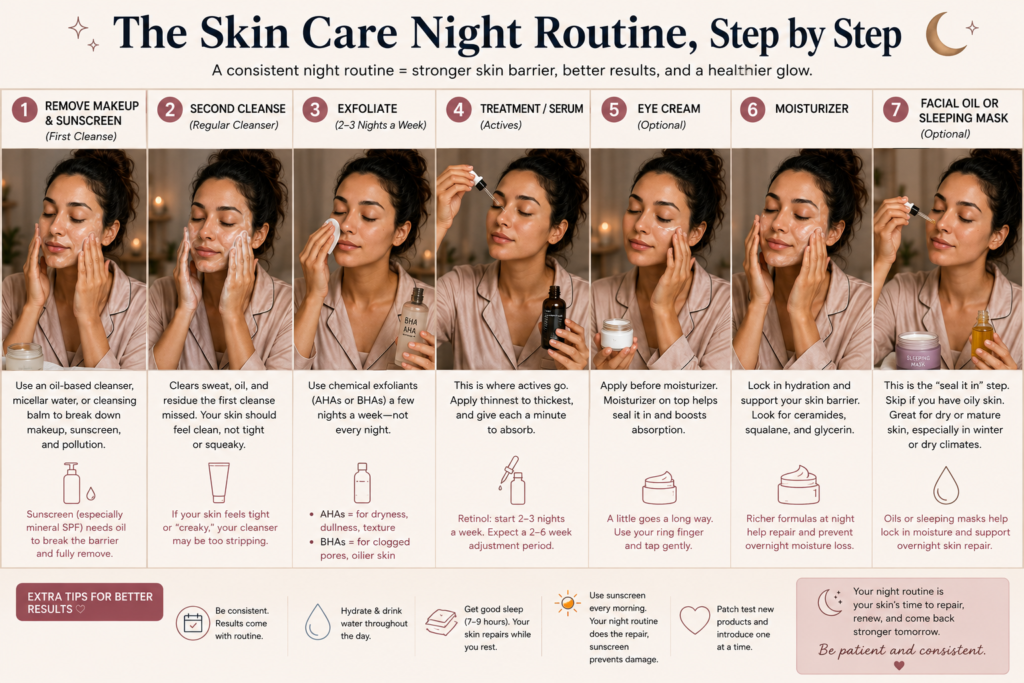
Here’s the order that actually matters, and why each step exists.
1. Remove Makeup and Sunscreen First (Not With Your Regular Cleanser)
If you wore sunscreen, makeup, or spent the day in a city with heavy pollution, your regular water-based cleanser won’t fully break that down. Use an oil-based cleanser, micellar water, or cleansing balm first. This is the “first cleanse” in a double cleanse.
Real-world example: if you’ve ever noticed your foundation is still faintly visible on a cotton pad after your normal face wash, that’s a sign you need this step — not a sign your cleanser is bad.
This step is also where sunscreen matters most. Mineral sunscreens especially (zinc oxide, titanium dioxide) sit on top of skin and need an oil-based product to break the physical barrier they create. If you’ve ever finished your usual cleanse and still seen a faint white cast around your hairline or jaw the next morning, that’s residual mineral SPF that never fully came off — a common and often overlooked reason for stubborn breakouts along the hairline.
2. Second Cleanse With Your Regular Face Wash
This clears sweat, oil, and anything the first cleanse missed. If your skin feels tight or squeaky afterward, your cleanser is too stripping — that’s not a sign of “clean” skin, it’s a sign of a damaged moisture barrier.
A useful gut check: run your fingertip across your cheek right after rinsing. It should feel smooth, not tight or “creaky.” If it creaks, the surfactants in your cleanser are stripping natural lipids along with the dirt, which over time can make oily skin produce even more oil to compensate — one of the more counterintuitive feedback loops in skincare, and one reason switching to a gentler cleanser sometimes reduces shine rather than increasing it.
3. Exfoliate (2–3 Nights a Week, Not Every Night)
This is where a lot of routines go wrong. Chemical exfoliants — AHAs like glycolic or lactic acid, or BHAs like salicylic acid — should be used a few nights a week, not nightly, unless a product is specifically formulated for daily low-strength use.
- AHAs work well for dryness, dullness, and surface texture.
- BHAs are better for clogged pores and oilier skin because they’re oil-soluble.
Never layer a strong exfoliant on the same night as retinol when you’re starting out — that combination is the single most common cause of “my skin is red and peeling” complaints in skincare forums.
4. Treatment / Serum (This Is Where Actives Go)
Vitamin C is a daytime ingredient (antioxidant protection against UV and pollution). Retinoids, peptides, and niacinamide are night ingredients. Apply serums thinnest-to-thickest, and give each one a minute to absorb before layering the next.
If you’re using retinol: start at 2–3 nights a week, buffer it with moisturizer if your skin is sensitive, and expect a mild adjustment period (retinization) of 2–6 weeks before your skin builds tolerance. That flaking isn’t always “purging” — sometimes it’s simply irritation, and backing off frequency is the right response, not pushing through it.
5. Eye Cream (Optional, But Timing Matters)
If you use one, apply it before your moisturizer, not after — moisturizer on top can seal it in better, but layering it on top of a heavy cream mostly just wastes product on top of a barrier it can’t penetrate.
6. Moisturizer
At night, richer formulas make sense because you’re not worried about makeup sitting on top or shine under office lighting. Ceramides, squalane, and glycerin are worth looking for on the label regardless of price point — these are the ingredients doing the actual barrier-repair work, not the marketing claims on the front of the bottle.
7. Facial Oil or Sleeping Mask (Optional, Skin-Type Dependent)
This is the “seal it in” step. Oilier skin types can often skip this. Dry or mature skin tends to benefit from it, especially in winter or in air-conditioned climates.
Skin Care Night Routine Tips That Actually Make a Difference
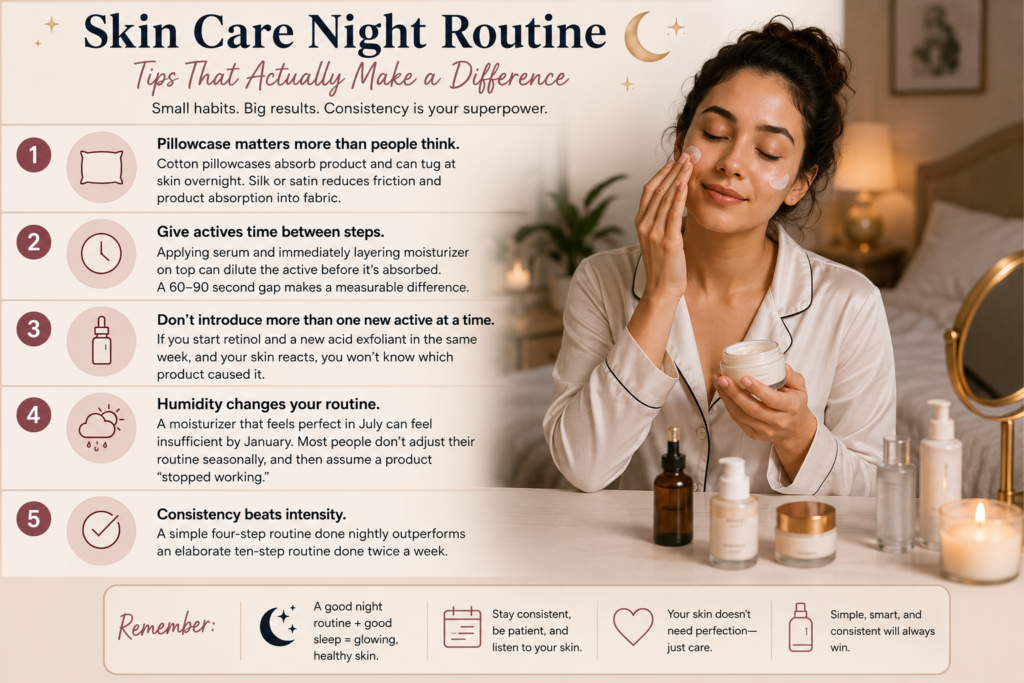
These are the details that separate a routine that works from one that just looks complete.
- Pillowcase matters more than people think. Cotton pillowcases absorb product and can tug at skin overnight. Silk or satin isn’t a luxury gimmick here — it reduces friction and product absorption into fabric.
- Give actives time between steps. Applying serum and immediately layering moisturizer on top can dilute the active before it’s absorbed. A 60–90 second gap makes a measurable difference.
- Don’t introduce more than one new active at a time. If you start retinol and a new acid exfoliant in the same week, and your skin reacts, you won’t know which product caused it.
- Humidity changes your routine. A moisturizer that feels perfect in July can feel insufficient by January. Most people don’t adjust their routine seasonally, and then assume a product “stopped working.”
- Consistency beats intensity. A simple four-step routine done nightly outperforms an elaborate ten-step routine done twice a week.
Skin Care Night Routine Products: What to Actually Look For
Rather than recommending specific brands (which change constantly and vary by skin type), here’s what to evaluate a product against — this works whether you’re shopping at a drugstore or a specialty skincare shop.
| Step | Look For | Skip If You Have |
|---|---|---|
| Cleanser | Non-foaming, pH-balanced | Sensitive/rosacea-prone skin + sulfates |
| Exfoliant | Glycolic (dry/dull) or salicylic (oily/acne-prone) | Active eczema or a compromised barrier |
| Retinoid | Encapsulated retinol for beginners, tretinoin for advanced users (prescription) | Currently pregnant or breastfeeding |
| Moisturizer | Ceramides, squalane, glycerin | Fragrance, if reactive skin |
| Facial oil | Squalane, rosehip, non-comedogenic oils | Active breakouts, oily/acne-prone skin |
A genuinely useful habit: check the ingredient list, not just the front-of-bottle claims. “Brightening” or “anti-aging” on packaging is marketing language; niacinamide, vitamin C, or retinoids in the first half of the ingredient list are what actually do that work.
Adapting the Routine: By Skin Type, and for Real Schedules (Skin Care Noche)
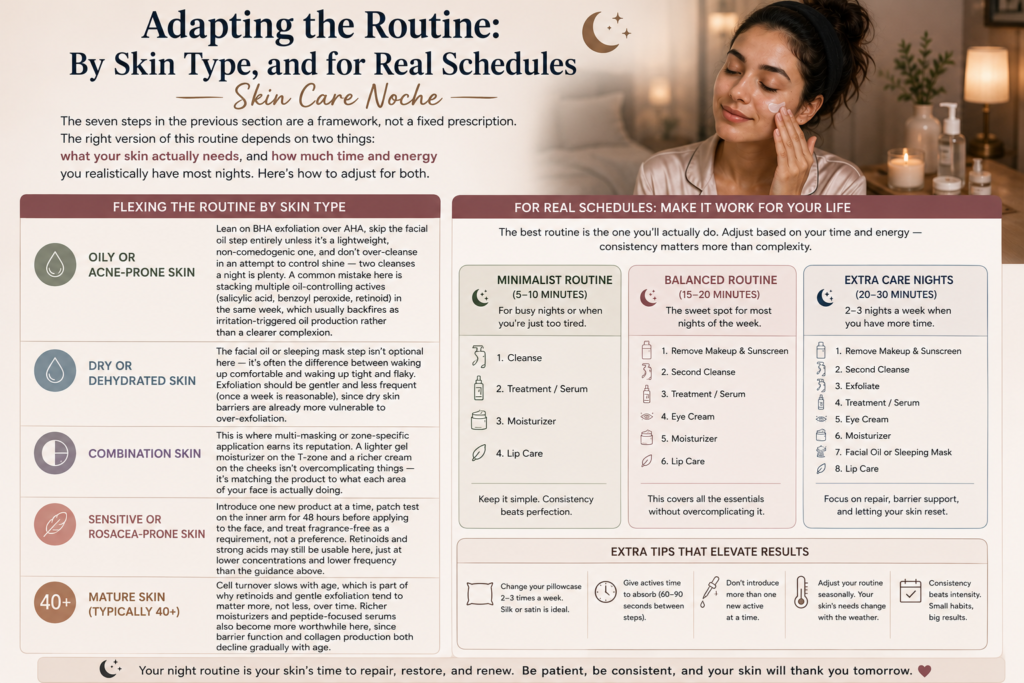
The seven steps in the previous section are a framework, not a fixed prescription. The right version of this routine depends on two things: what your skin actually needs, and how much time and energy you realistically have most nights. Here’s how to adjust for both.
Flexing the Routine by Skin Type
Oily or acne-prone skin: Lean on BHA exfoliation over AHA, skip the facial oil step entirely unless it’s a lightweight, non-comedogenic one, and don’t over-cleanse in an attempt to control shine — two cleanses a night is plenty. A common mistake here is stacking multiple oil-controlling actives (salicylic acid, benzoyl peroxide, retinoid) in the same week, which usually backfires as irritation-triggered oil production rather than a clearer complexion.
Dry or dehydrated skin: The facial oil or sleeping mask step isn’t optional here — it’s often the difference between waking up comfortable and waking up tight and flaky. Exfoliation should be gentler and less frequent (once a week is reasonable), since dry skin barriers are already more vulnerable to over-exfoliation.
Combination skin: This is where multi-masking or zone-specific application earns its reputation. A lighter gel moisturizer on the T-zone and a richer cream on the cheeks isn’t overcomplicating things — it’s matching the product to what each area of your face is actually doing.
Sensitive or rosacea-prone skin: Introduce one new product at a time, patch test on the inner arm for 48 hours before applying to the face, and treat fragrance-free as a requirement, not a preference. Retinoids and strong acids may still be usable here, just at lower concentrations and lower frequency than the guidance above.
Mature skin (typically 40+): Cell turnover slows with age, which is part of why retinoids and gentle exfoliation tend to matter more, not less, over time. Richer moisturizers and peptide-focused serums also become more worthwhile here, since barrier function and collagen production both decline gradually with age.
Skin Care Noche: Adapting the Routine for Real Schedules
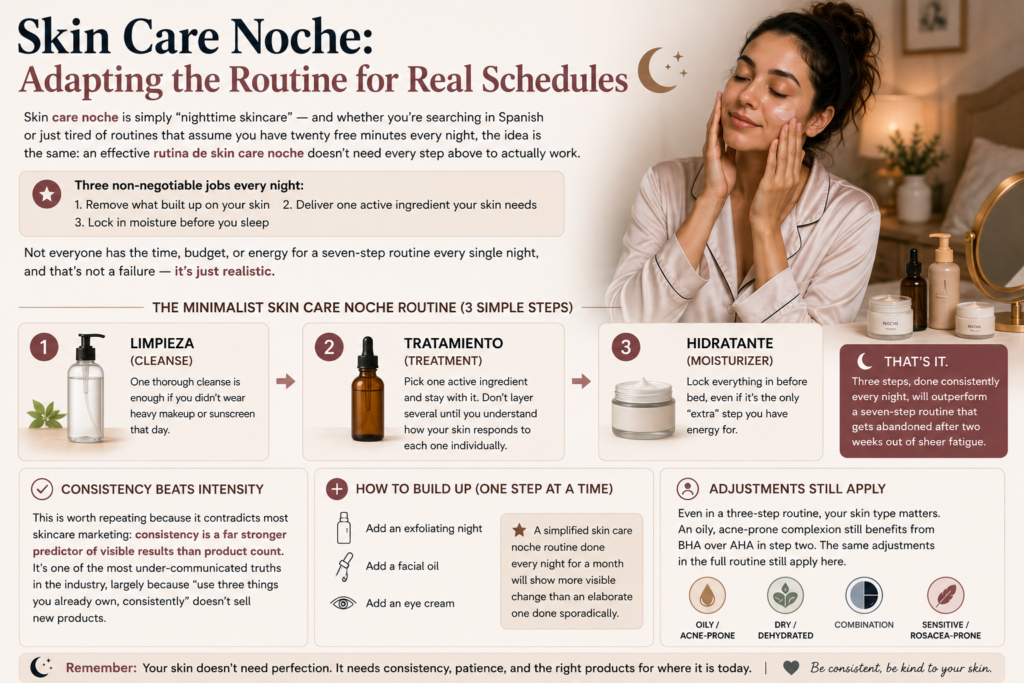
Skin care noche is simply “nighttime skincare” — and whether you’re searching in Spanish or just tired of routines that assume you have twenty free minutes every night, the idea is the same: an effective rutina de skin care noche doesn’t need every step above to actually work.
Not everyone has the time, budget, or energy for a seven-step routine every single night, and that’s not a failure — it’s just realistic. A shortened skin care noche routine still needs to hit three non-negotiable jobs: remove what accumulated on your skin during the day, deliver one active ingredient your skin actually needs, and lock in moisture before you sleep. Everything else is optional depth, not a requirement.
If you’re short on time, new to skincare, or simply want a lower-maintenance rutina nocturna, this minimalist version still gets the important work done:
- Limpieza (Cleanse) — one thorough cleanse is enough if you didn’t wear heavy makeup or sunscreen that day.
- Tratamiento (Treatment) — pick one active ingredient and stay with it. Don’t layer several until you understand how your skin responds to each one individually.
- Hidratante (Moisturizer) — lock everything in before bed, even if it’s the only “extra” step you have energy for.
That’s it. Three steps, done consistently every night, will outperform a seven-step routine that gets abandoned after two weeks out of sheer fatigue. This is worth repeating because it contradicts most skincare marketing: consistency is a far stronger predictor of visible results than product count. It’s one of the most under-communicated truths in the industry, largely because “use three things you already own, consistently” doesn’t sell new products.
If you later want to build back up toward the fuller seven-step routine, add one new step at a time — an exfoliating night, then a facial oil, then an eye cream — rather than trying to adopt the entire routine at once. A simplified skin care noche routine done every night for a month will show more visible change than an elaborate one done sporadically. And if your skin type falls into one of the categories above, the same adjustments still apply even in the simplified version — an oily, acne-prone complexion still benefits from BHA over AHA in step two, even when the routine is down to three steps.
Skin Care Night Aesthetic: Making the Routine Feel Like a Ritual

There’s a reason “get ready with me” nighttime skincare videos are so popular on Pinterest and TikTok — the aesthetic of a routine affects whether people actually stick with it. Function and atmosphere aren’t in competition here; a routine you enjoy doing is a routine you’ll repeat.
A few low-effort ways to make your night routine feel intentional rather than like a chore:
- Warm, dim lighting in the bathroom instead of harsh overhead lights — it also makes it easier to see how your skin actually looks (bright white light exaggerates redness and texture, which can make you overcorrect with product).
- A dedicated tray or shelf for your nighttime products, separate from morning ones, so the routine feels like a distinct transition into rest rather than an extension of the day.
- A short buffer step — even two minutes of a jade roller, gua sha, or simply massaging in your moisturizer — signals to your nervous system that the day is ending, which matters for sleep quality as much as skin.
This isn’t fluff. Adherence research across skincare and other health routines consistently shows that people stick with habits that feel good in the moment, not just habits that are “correct” on paper.
There’s a Pinterest-specific version of this worth naming directly: the “shelfie” aesthetic — bottles lined up by height, a marble tray, a single flickering candle — isn’t just decoration for a photo. Visually organizing your products by step (cleansers on the left, treatments in the middle, moisturizers on the right, for example) genuinely reduces the friction of “which one goes first,” especially on nights when you’re tired and not thinking clearly. The aesthetic and the function reinforce each other rather than competing for your effort.
How Your Skin Care Morning Routine Should Complement Your Night Routine

Your morning and night routines aren’t separate systems — they’re two halves of the same job.
- Morning = protect. Antioxidants (vitamin C), SPF (non-negotiable, even indoors near windows or on cloudy days), and a lighter moisturizer.
- Night = repair. Exfoliants, retinoids, peptides, and richer occlusives.
A common mistake is applying retinol in the morning “for convenience,” which increases sun sensitivity and reduces its effectiveness — retinoids are also unstable in UV light, meaning some of the product’s benefit degrades on contact with sunlight. Similarly, applying vitamin C at night provides antioxidant benefits, but you lose its main daytime purpose: neutralizing UV-induced free radical damage before it happens.
If you only fix one habit from this section, make it this: wear SPF every single morning, even if your night routine is otherwise perfect. Retinol and acids increase photosensitivity, meaning an excellent night routine paired with a sunscreen-free morning routine can actually leave skin more vulnerable to sun damage, not less.
Common Night Routine Mistakes to Avoid
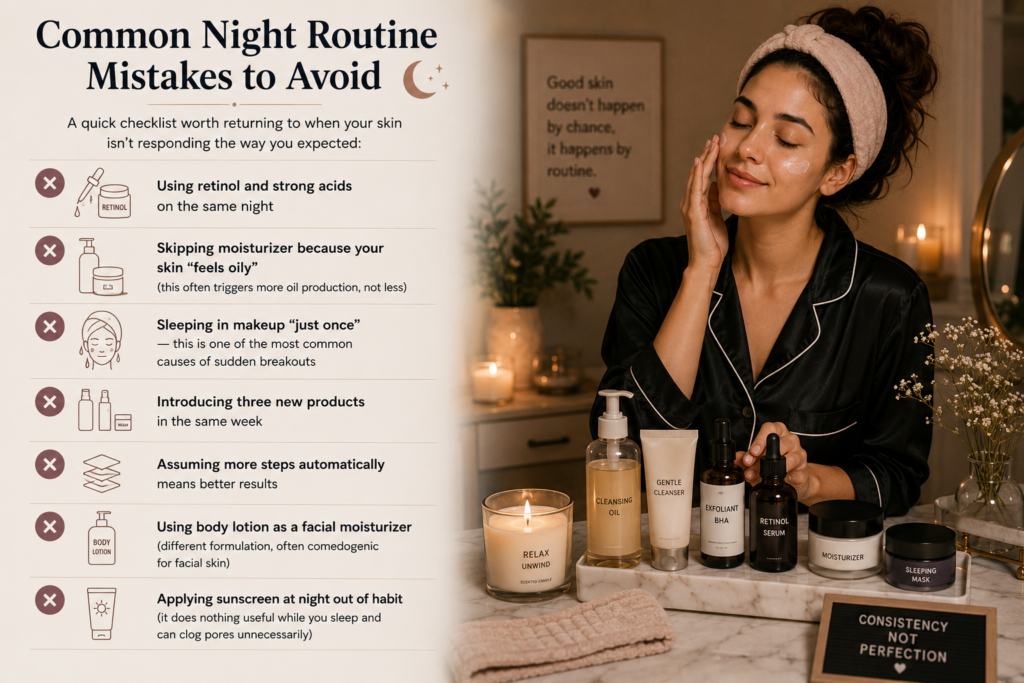
A quick checklist worth returning to when your skin isn’t responding the way you expected:
- ❌ Using retinol and strong acids on the same night
- ❌ Skipping moisturizer because your skin “feels oily” (this often triggers more oil production, not less)
- ❌ Sleeping in makeup “just once” — this is one of the most common causes of sudden breakouts
- ❌ Introducing three new products in the same week
- ❌ Assuming more steps automatically means better results
- ❌ Using body lotion as a facial moisturizer (different formulation, often comedogenic for facial skin)
- ❌ Applying sunscreen at night out of habit (it does nothing useful while you sleep and can clog pores unnecessarily)
FAQ
How long does it take to see results from a night routine? Cell turnover takes roughly 28 days in your 20s, slowing to 45–60+ days as you age. Most people should evaluate a new routine after 6–8 weeks, not 6–8 days.
Can I use the same moisturizer morning and night? Yes, if it doesn’t contain SPF (SPF degrades and isn’t necessary at night) and it suits your skin’s needs in both contexts.
Do I need a separate night cream, or is my regular moisturizer enough? If your regular moisturizer already contains barrier-supporting ingredients (ceramides, squalane, glycerin), a separate “night cream” is often the same formula with different marketing. The exception is if your skin is notably drier at night or in winter and needs something richer.
Is it bad to skip steps some nights? No. Cleansing and moisturizing are the two steps worth protecting on tired nights. Actives can wait a day without consequence.
Should I change my night routine seasonally? Yes, more often than most people do. Winter typically calls for a richer moisturizer and a scaled-back exfoliation schedule, since indoor heating dries out both the air and your skin barrier. Summer often allows for a lighter moisturizer and can tolerate exfoliation slightly more often, since higher humidity supports barrier recovery.
Can I layer a retinoid and a moisturizer with retinol both in one routine? Generally, no — this is a case of well-meaning product stacking causing irritation rather than better results. Pick one retinoid source per night and let your moisturizer do its job without a second, redundant active layered on top.
Key Takeaways
A skin care night routine works best when it’s built around why each step exists, not just what products are trendy. Cleanse thoroughly, exfoliate a few nights a week rather than daily, let actives absorb before layering moisturizer, and don’t be afraid to keep the routine simple if that’s what actually gets done consistently.
The version of this routine that changes your skin isn’t the most expensive one or the longest one — it’s the one you’ll still be doing in three months. Start with the three non-negotiable steps (cleanse, treat, moisturize), add complexity only as your skin tolerates it, and remember that your morning SPF is doing just as much work as anything you apply at night.
If you’re building this routine from scratch, start tonight with just cleanser and moisturizer, and add one active per week from there.