You’re standing in the beauty aisle (or scrolling through fifteen browser tabs) trying to decide between a $25 lotion trio and a $90 “ultimate spa experience” box, and neither one feels quite right.
Here’s the problem with most gift set shopping advice: it tells you what to buy without telling you why certain sets work and others end up regifted or forgotten in a bathroom cabinet by February.
This guide is different. It’s built around one question: what actually makes a beauty or self-care gift set feel thoughtful instead of generic? By the end, you’ll know how to evaluate any set or kit in about 30 seconds, which categories consistently deliver, which red flags mean a “luxury” box is really just dollar-store products in nicer packaging, and how to dress up an already-great set so it feels personal even when you bought it off a shelf twenty minutes ago.
Why Sets and Kits Make Better Gifts Than Single Items
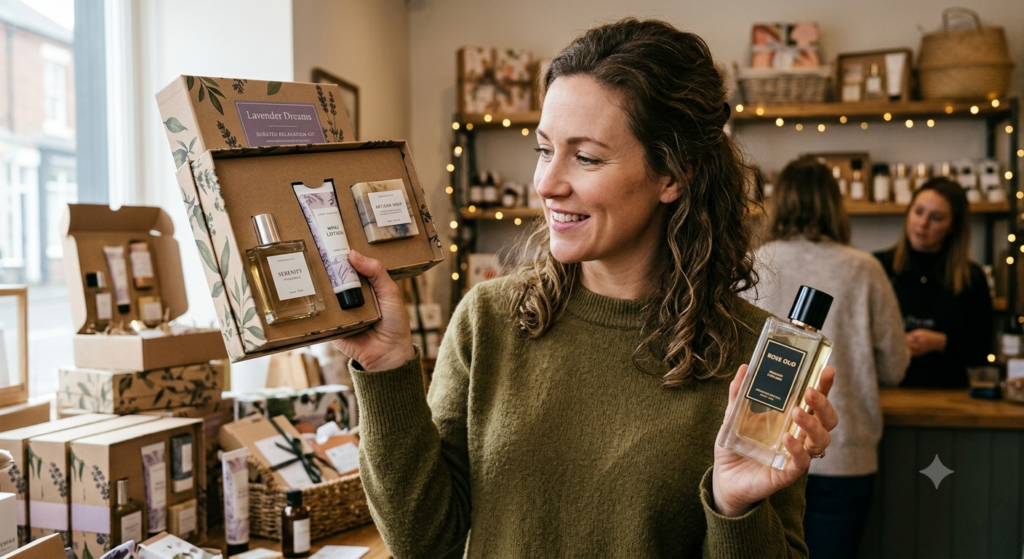
A single product is a guess. A well-curated set is a strategy.
When you give someone a single bottle of perfume, you’re betting everything on one scent, one preference, one guess about their taste. A gift set spreads that risk across multiple smaller items — a mini fragrance, a matching body lotion, a shower gel — so even if one piece misses, the whole gift doesn’t fall flat.
Sets also solve a real gifting problem: they let the recipient try before they commit. Full-size skincare products are expensive to buy blind. A kit with trial sizes of a cleanser, serum, and moisturizer gives someone permission to test a new routine without the guilt of an unused $60 jar sitting on their counter.
There’s also a psychological effect worth knowing: research on gift-giving consistently shows that recipients value gifts that feel personalized and effortful over gifts that are simply expensive. A thoughtfully assembled set signals more effort than a single pricier item, even when the total cost is similar.
There’s a practical side to this too. Sets are easier to shop for under time pressure. If you have twenty minutes before a party starts, choosing “the lavender bath set” is a faster decision than standing in front of forty individual bottles trying to guess which serum won’t irritate someone’s skin. The curation has already been done for you — your job is just matching it to the right person.
How to Choose the Right Set for Each Type of Recipient
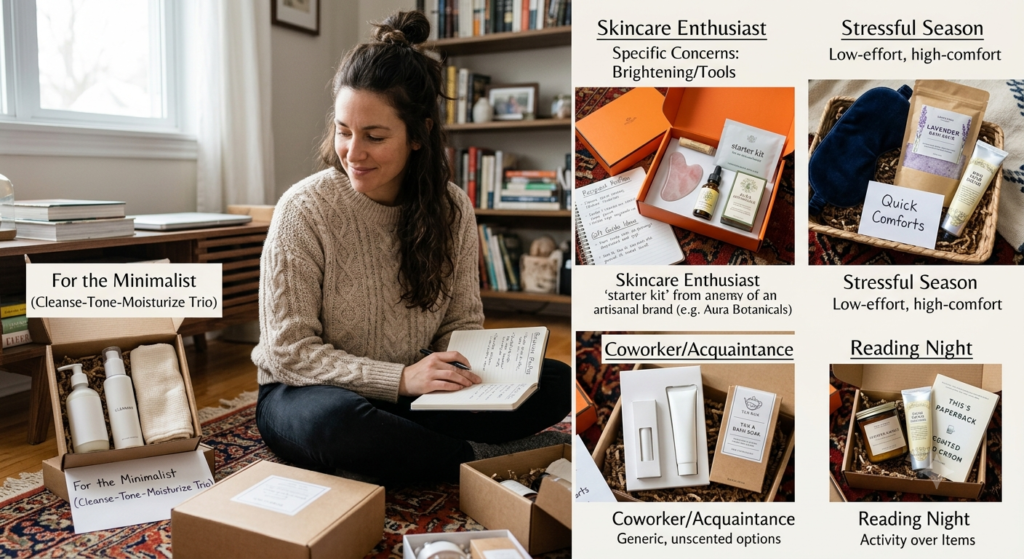
Not every self-care kit suits every person. Matching the set to the recipient’s actual habits — not just their general “vibe” — is where most gift shopping goes wrong.
For the Minimalist Who Owns Three Skincare Products, Total
Skip anything with more than 4–5 items. Look for streamlined sets built around one routine (like a cleanse-tone-moisturize trio) rather than sprawling 10-piece kits. Fragrance-free and unscented lines tend to land better here, since minimalists often already have a “no-frills” bathroom shelf and don’t want clutter. If you’re unsure, a single elevated item — one really good moisturizer plus one complementary product — often beats a full kit for this person.
For the Self-Proclaimed Skincare Enthusiast
This person already owns a 12-step routine, so a generic drugstore set will feel like a step backward. Instead, look for:
- Sets from brands they haven’t tried yet (a “starter” version of a cult-favorite brand)
- Kits built around a specific concern (brightening, barrier repair, retinol introduction)
- Tools or gadgets bundled with product — gua sha sets, LED masks, jade rollers paired with facial oil
- Sets tied to a technique they may not have tried, like double cleansing or facial oiling, rather than another version of a step they already do well
For Someone Going Through a Stressful Season
New parents, caregivers, people mid-move, or anyone visibly burned out benefit less from “indulgent” luxury sets and more from low-effort, high-comfort kits: weighted eye masks, bath soaks, hand creams, and anything they can use in under five minutes without a full routine. Avoid sets that require a quiet, uninterrupted 45 minutes to enjoy — that’s exactly the resource this person doesn’t have right now.
For a Coworker, Acquaintance, or “Obligation Gift” Situation
This is where scent-neutral, universally likable sets matter most. Unscented or lightly scented lip balm and hand cream duos, or tea-and-bath-soak combos, are safe without feeling like an afterthought. Avoid anything with a strong, specific fragrance — it’s the single most common reason gift sets go unused.
For the Person Who Says “I Don’t Need Anything”
This recipient is often the hardest to shop for precisely because they’ve opted out of wanting things. The move here isn’t a bigger set — it’s a smaller, more specific one tied to an activity rather than a product category: a “reading night” kit with a scented candle and hand cream, or a “commute reset” kit sized for a bag rather than a bathroom shelf. Framing the set around an experience, not a routine, sidesteps the “I don’t need more stuff” objection entirely.
Reading a Gift Set Like an Expert: What’s Actually Inside Matters
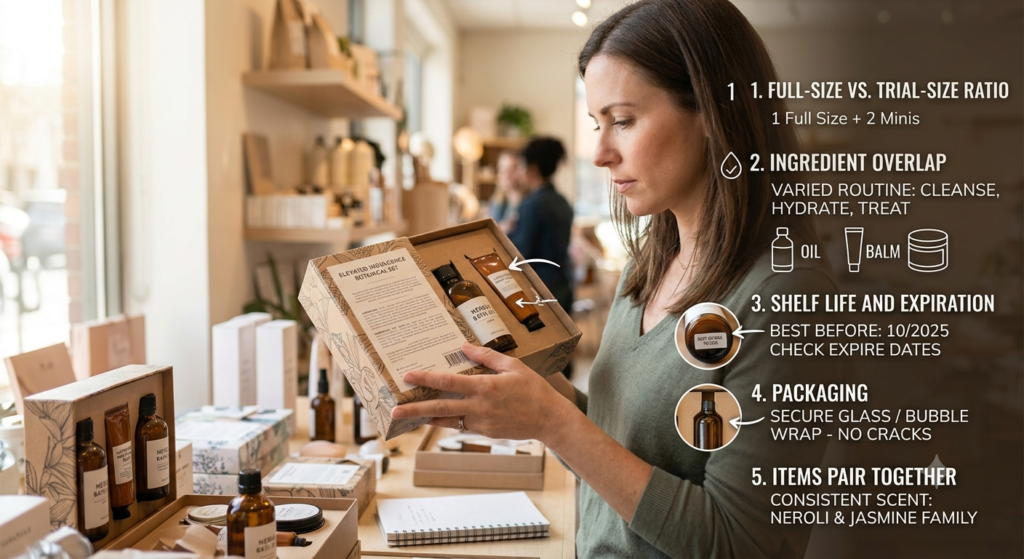
Packaging sells the gift; contents determine whether it gets used. Before buying, check these five things.
1. Full-size vs. trial-size ratio. A box that’s mostly 5ml deluxe samples dressed up as a “collection” is a marketing move, not a value. Good sets include at least one or two full-size items alongside minis.
2. Ingredient overlap and redundancy. Watch for sets that include three products doing the same job (three different body lotions, for instance) instead of a genuinely varied routine. Variety across categories — cleanse, hydrate, treat, relax — makes a set feel complete rather than padded.
3. Shelf life and expiration windows. Bath and body sets, especially ones with natural or preservative-light formulas, can have shorter shelf lives than standalone products. If you’re buying seasonally (say, a holiday set in November for use “eventually”), check that the recipient will realistically use it before it expires.
4. Packaging that survives shipping. Glass bottles, ceramic diffusers, and multi-tier boxes look beautiful in product photos and arrive cracked more often than plain plastic. If buying online, check reviews specifically for damage-in-transit complaints before trusting the presentation.
5. Whether the items actually pair together. Some sets are assembled by category rather than by compatibility — a citrus-scented scrub next to a lavender-scented lotion, for example. A set with a consistent scent family or product line across all items usually signals more intentional curation than one that grouped “bath stuff” together loosely.
Common Mistakes People Make When Buying Beauty Gift Sets
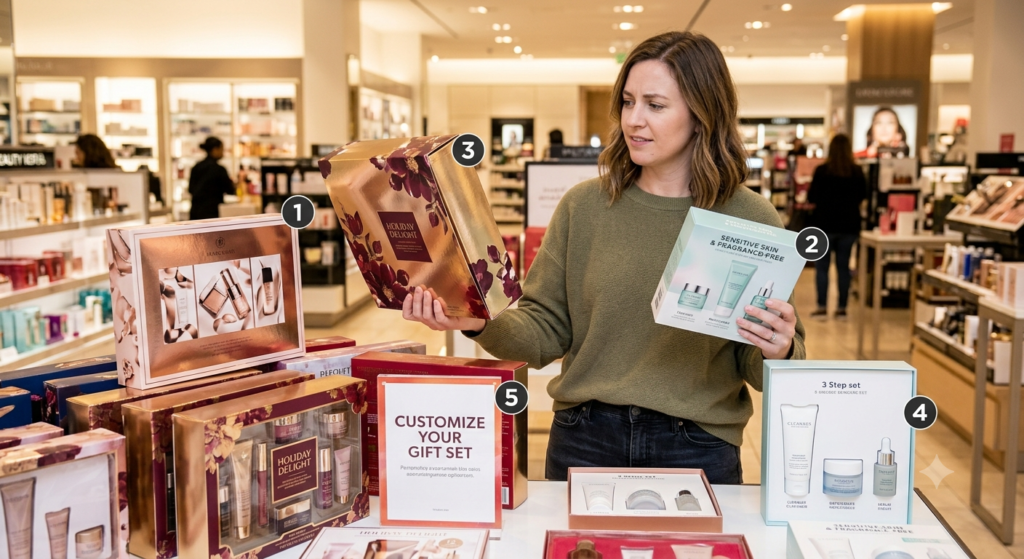
Buying based on box aesthetics alone. A beautifully photographed box with rose gold foil can still contain mediocre, low-concentration products. Aesthetic packaging is a marketing layer, not a quality signal — check the actual product list, not just the presentation shots.
Ignoring skin type and sensitivities entirely. A bath bomb and body scrub set is a poor gift for someone with eczema or fragrance sensitivities, no matter how popular the brand is. If you don’t know the recipient’s skin type, default to fragrance-free or “sensitive skin” labeled sets.
Assuming bigger sets are always better gifts. A 12-piece kit isn’t automatically more thoughtful than a 3-piece one. Oversized sets often include filler items the recipient will never open, and they can feel impersonal — like a gift chosen for its size rather than its contents.
Forgetting the “who actually uses this” test. Elaborate multi-step routines (double cleanse, essence, serum, sheet mask, night cream) are wasted on someone who currently uses bar soap and calls it a night. Match the complexity of the set to the recipient’s existing habits, not to what looks impressive.
Waiting until the last minute for personalized or curated sets. Build-your-own or customizable kits are some of the most thoughtful gift set options available, but they usually require lead time for assembly and shipping. If personalization matters to you, start at least 1–2 weeks out.
Buying the same set you’d want for yourself. It’s an easy trap: you love a warm vanilla scent, so you assume everyone will. Shopping your own preferences instead of the recipient’s is one of the quieter reasons gift sets underwhelm — the giver is happy with the choice, but the recipient never was the target audience for it.
Gift Set Comparison by Budget
| Budget | What to Expect | Best For |
|---|---|---|
| Under $25 | Single-category sets (lip + hand cream duo, one bath soak trio) | Coworkers, teacher gifts, stocking stuffers |
| $25–$50 | Multi-step mini routines, 3–5 item bath/body sets | Friends, extended family, “nice but not overboard” gifts |
| $50–$100 | Full-size hero products bundled with minis, tool + product combos | Close friends, partners, milestone birthdays |
| $100+ | Curated luxury collections, multi-brand boxes, personalized kits | Anniversaries, significant holidays, “big” gift occasions |
A quick gut check: if a set’s price feels high relative to its total content weight or item count, it’s often paying for brand name and packaging rather than product value. That’s not always a bad trade — but it’s worth knowing what you’re actually buying.
Occasion-Based Gift Set Ideas

- Holiday/Christmas: Layered advent-style beauty calendars, festive-scented bath sets, cozy self-care bundles with candles and hand cream
- Birthdays: Concern-specific skincare sets (anti-aging, hydration, acne-focused) tailored to the recipient’s stage of life
- New job/promotion: Polished, professional-feeling sets — fragrance sample sets, elegant hand cream and lip balm duos
- Postpartum/new parent: Low-scent, quick-use self-care kits; nothing requiring a long routine
- Bridal party/bridesmaid gifts: Matching mini sets across the group, often personalized with names or initials
- “Just because”: Smaller, single-category sets that don’t require a big occasion to justify the price
- Sympathy or comfort gifts: Understated, unscented or very lightly scented sets — this is not the moment for a bold, energetic fragrance, even if the set is beautifully made
Small Ways to Make a Store-Bought Set Feel Personal

You don’t have to build a set from scratch to make it feel custom. A few low-effort additions change how a pre-made gift reads:
- Add one small item the recipient specifically mentioned wanting, even if it’s unrelated to the set’s theme — it signals you were listening, not just shopping a category.
- Repackage the set in a container they’ll actually reuse, like a small basket or tray, instead of gifting it in the original cardboard box.
- Include a note that names why you picked this particular set for them, rather than a generic “hope you enjoy” line. Specificity is what separates a thoughtful gift from an efficient one.
- If the set includes a scent you know they love (or already wear), mention that you noticed — it reinforces that the choice wasn’t random.
Frequently Asked Questions
Are gift sets actually cheaper than buying items individually? Sometimes, but not always. Bundled sets often carry a slight premium for packaging and curation. The value comes less from discount pricing and more from convenience and the “try multiple things” factor — you’re paying for the curation, not necessarily saving money.
What if the recipient has allergies or sensitive skin? Default to fragrance-free, dermatologist-tested, or “sensitive skin” labeled sets. When in doubt, a set with fewer, simpler ingredients is a safer bet than a heavily fragranced luxury box.
Is it better to buy a pre-made set or build a custom one? Pre-made sets are faster and usually well-tested for balance (they’re curated by people who know the product line). Custom sets take more effort but let you tailor everything to the recipient’s specific taste — worth it for closer relationships or bigger occasions.
How far in advance should I order a gift set? For standard pre-made sets, a few days is usually fine. For personalized, engraved, or build-your-own kits, order at least 1–2 weeks ahead to account for assembly and potential shipping delays.
Should I worry about a set feeling “impersonal” because it’s mass-produced? Not inherently. Most gift sets are mass-produced by definition — what makes a gift feel personal is whether it matches the recipient’s actual preferences and habits, not whether it was hand-assembled. A well-matched mass-market set will always read as more thoughtful than a mismatched custom one.
What’s the biggest red flag when shopping for a set online? Reviews mentioning that products arrived expired, broken, or noticeably smaller than expected. Since you often can’t inspect a set in person, scan recent reviews specifically for these three complaints before purchasing, especially around high-volume gifting seasons when inventory turns over quickly.
Conclusion
The best beauty and self-care gift sets aren’t the ones with the fanciest packaging or the highest price tag — they’re the ones matched to how the recipient actually lives. A minimalist doesn’t need ten products, a burned-out new parent doesn’t need a twelve-step routine, and a coworker doesn’t need a strongly scented luxury box that might trigger a sensitivity you didn’t know about.
Before you buy, run through the quick checklist this guide covered: check the full-size-to-sample ratio, watch for redundant products dressed up as variety, match the set’s complexity to the recipient’s existing habits, and resist judging a box purely by its photos.
If you’re shopping right now, start with the recipient type sections above to narrow your search, then use the budget table to set realistic expectations for what that price point actually delivers. A well-matched $30 set will always outperform a mismatched $100 one — and a few minutes spent personalizing even a store-bought box will do more for how the gift is received than upgrading to a pricier one.