Most hair advice starts in the wrong place. It starts with the ends, the length, the shine — and treats the scalp like an afterthought, something you rinse and move past on the way to shampooing your actual hair.
That’s backwards. Your scalp is skin. It has oil glands, it can get inflamed, it can build up product residue, and it directly determines how your hair grows in the first place. If you’ve been buying serums and masks for your strands while ignoring what’s happening at the root, you’ve been treating a symptom instead of the source.
This guide walks through how to actually identify what your scalp needs, how to choose a treatment that matches it (instead of whatever’s trending), and how to build a routine you’ll realistically keep up with — plus the mistakes that quietly undo good products.
It’s worth saying upfront: there is no single “best” scalp treatment. The product that clears up a friend’s flaking might do nothing for yours, or make it worse, because two scalp issues can look nearly identical on the surface while having completely different causes. This guide is built around diagnosing your specific situation first, then matching a solution to it — not handing you a generic list of trending products and hoping one sticks.
Signs Your Scalp Needs a Treatment (Not Just a New Shampoo)
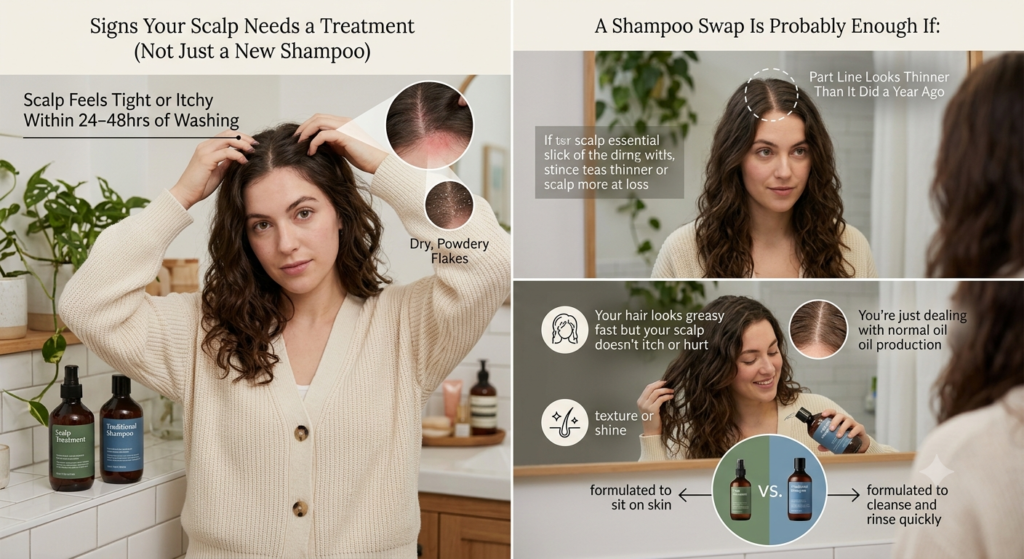
A lot of people cycle through shampoos for months trying to fix a scalp problem, when the shampoo was never the issue. Here’s how to tell the difference.
You probably need a targeted scalp treatment if:
- Your scalp feels tight or itchy within 24–48 hours of washing, not just on day 3 or 4
- You see flaking that’s dry and powdery (different from oily, yellowish dandruff flakes)
- Your part line looks thinner than it did a year ago, even without major shedding
- Your scalp feels sore or tender to the touch, especially after wearing tight styles
- Product seems to “sit” on your scalp instead of absorbing, even hours after application
- You notice a sour or musty smell by day 2, which usually points to bacterial or fungal buildup rather than just oil
A shampoo swap is probably enough if:
- Your hair looks greasy fast but your scalp itself doesn’t itch or hurt
- You’re just dealing with normal oil production and want to extend time between washes
- Your only complaint is texture or shine, not scalp comfort
The distinction matters because scalp treatments are formulated to sit on skin and work over minutes, while shampoos are formulated to cleanse and rinse quickly. Using a treatment-strength product as a daily shampoo, or a gentle shampoo to try to fix inflammation, is why so many people feel stuck.
A Quick Way to Track What’s Actually Happening
Before buying anything, spend one week just observing instead of treating. Note three things each day: how your scalp feels the morning after washing, how it feels by day two or three, and whether flaking (if present) looks dry and fine or thicker and yellowish. This sounds tedious, but it’s the difference between guessing and knowing. A lot of people buy a dandruff shampoo for what’s actually eczema, or a growth serum for what’s actually just seasonal shedding tied to stress — and a week of honest observation would have pointed them toward the right category from the start.
How to Choose a Scalp Treatment Based on Your Actual Scalp Type
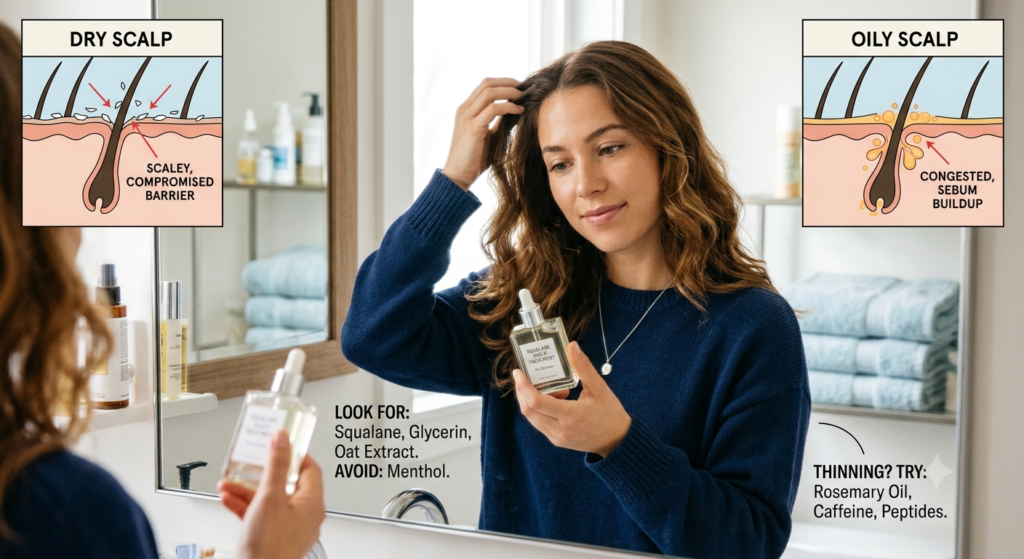
Not every scalp treatment is interchangeable, and this is where most people waste money — buying a product built for oily, congested scalps when they actually have a dry, barrier-damaged one (or the reverse).
Dry, Flaky Scalp
This usually means the skin barrier is compromised — often from over-washing, hot water, or heavy sulfate shampoos stripping natural oils.
Look for: Squalane, glycerin, oat extract, ceramides, hyaluronic acid. Avoid: Peppermint or menthol-heavy formulas that give a “clean” tingle but can worsen dryness over time.
Oily, Congested Scalp
Excess sebum plus product buildup creates a film that can clog follicles and contribute to flat, greasy-looking roots by day two.
Look for: Salicylic acid, tea tree oil, niacinamide, clarifying clay. Avoid: Heavy oils (coconut, castor) applied directly to the scalp, which can compound the buildup rather than clear it.
Itchy, Irritated, or Sensitive Scalp
This can stem from product sensitivity, mild dermatitis, or a disrupted scalp microbiome. It’s the trickiest category because “itchy” can mean opposite root causes.
Look for: Fragrance-free formulas, colloidal oatmeal, zinc pyrithione (for fungal-related itch specifically). Avoid: Layering multiple active ingredients (like tea tree and salicylic acid and a scalp scrub) in the same week — this is one of the most common causes of scalp irritation that people mistake for “needing a stronger product.”
Thinning or Shedding-Prone Scalp
This is about circulation and follicle environment, not just moisture or oil control.
Look for: Peptides, caffeine, rosemary oil, minoxidil (if you want a clinically-backed option — this one requires consistent, long-term use to see results). Avoid: Expecting visible change in under 3 months. Hair growth cycles are slow, and most thinning treatments need 12+ weeks of consistent use before you can honestly judge whether they’re working.
DIY vs. Store-Bought Scalp Treatments: What Actually Works

Pinterest is full of DIY scalp treatment recipes, and some genuinely help — but a lot of the popular ones are more folklore than formulation. Here’s an honest breakdown.
| Treatment Type | What It’s Good For | What It’s Not Good For | Worth Trying? |
|---|---|---|---|
| Apple cider vinegar rinse | Clarifying mild buildup, restoring pH after clarifying shampoo | Active dandruff, sensitive/broken skin (it will sting) | Yes, diluted, occasionally |
| Coconut oil scalp massage | Temporary softness on very dry scalps | Oily or acne-prone scalps — it’s comedogenic for many people | Situational, patch test first |
| Aloe vera gel | Soothing mild irritation, lightweight hydration | Deep-seated fungal or bacterial issues | Yes, especially post-sun exposure |
| Store-bought exfoliating scalp scrub | Removing product buildup and dead skin cells | Daily use — most are meant for 1x/week max | Yes, if formulated for scalp (not body scrubs repurposed) |
| Essential oil blends (rosemary, peppermint) | Sensory experience, mild circulation boost | Standalone treatment for real hair loss — evidence is limited, not absent, but modest | Yes, as a supplement, not a solution |
The honest takeaway: DIY treatments are best for maintenance and mild issues. If you’re dealing with a diagnosed condition — seborrheic dermatitis, psoriasis, active hair loss — a formulated product (or dermatologist visit) will outperform kitchen-cabinet ingredients almost every time. DIY isn’t “better because it’s natural”; it’s just less concentrated and less tested.
The Weekly Scalp Care Routine That Doesn’t Take Over Your Life
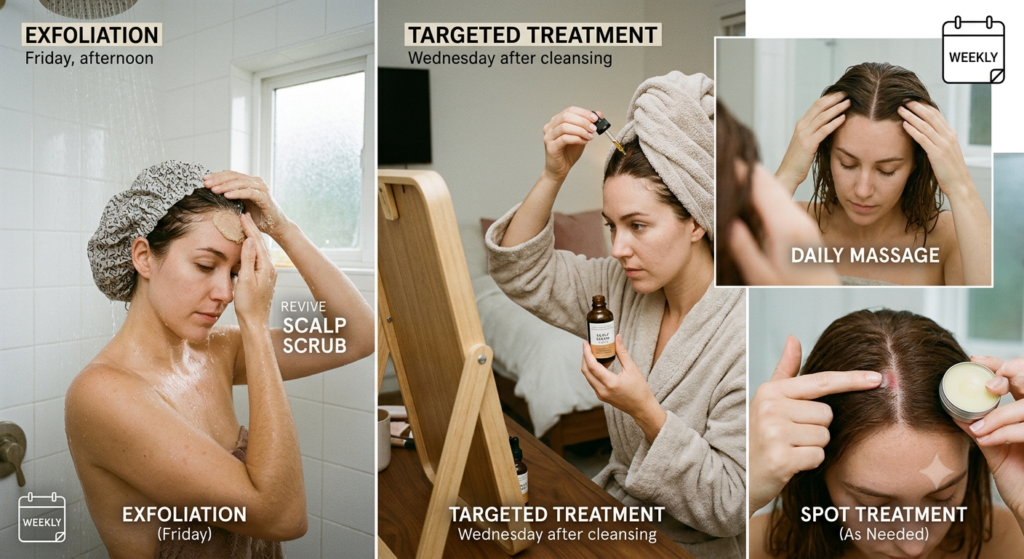
A routine only works if you’ll actually do it. Here’s a realistic weekly structure that takes under 10 extra minutes total per week, built around whichever scalp type you identified above.
Once a week — Exfoliation or clarifying step Use a scalp scrub or clarifying shampoo to remove buildup from styling products, dry shampoo, and natural oil. Skip this step if your scalp is actively irritated; exfoliating inflamed skin makes it worse.
2–3x a week — Targeted treatment application Apply your chosen treatment (serum, oil blend, or medicated formula) directly to the scalp, focusing on the part line and areas of concern. Leave it on for the time specified on the product — most active treatments need at least 5–10 minutes of contact time to actually penetrate, not just sit and rinse immediately.
Daily (optional) — Gentle massage A 2-minute scalp massage with your fingertips (not nails) during washing can support circulation. This isn’t a treatment on its own, but it’s a free habit that compounds well with everything else here.
As needed — Spot treatment If a specific area flares up (an itchy patch, a sore spot from a tight hairstyle), treat that area directly rather than reapplying product to your entire scalp. This prevents over-treating healthy areas while under-treating the actual problem spot.
A realistic weekly snapshot:
- Monday: Wash + scalp massage
- Wednesday: Targeted treatment application
- Friday: Exfoliation or clarifying wash
- Sunday: Targeted treatment application
This isn’t the only way to structure it — some people do better washing less often and adjusting treatment days around that. The principle that matters is spacing exfoliation and active treatment apart, rather than doing everything on wash day and overwhelming the scalp at once.
Common Scalp Treatment Mistakes That Undo Your Results
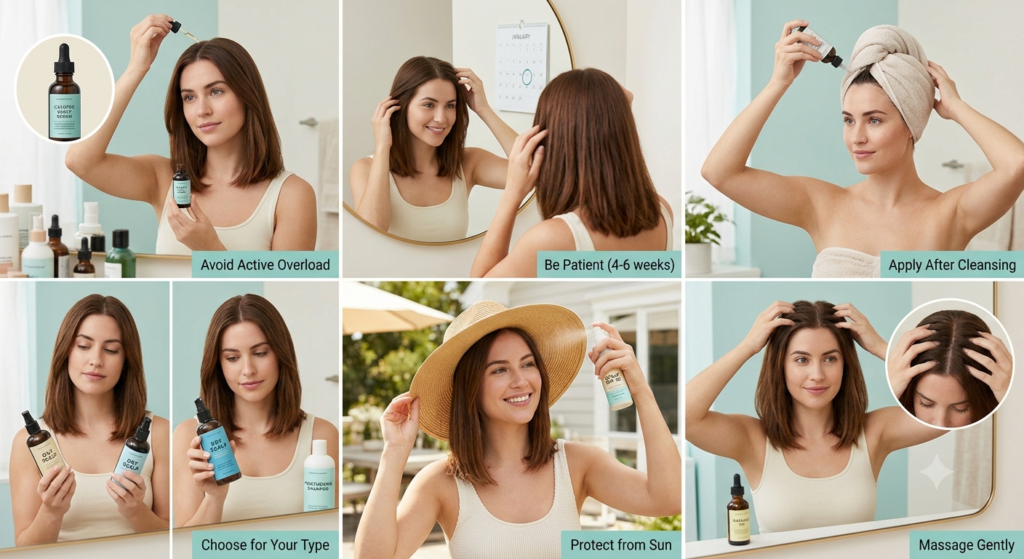
Even good products fail when they’re used the wrong way. These are the mistakes that come up most often.
Mistake 1: Layering too many actives at once. Salicylic acid scrub, tea tree serum, and a “growth” tonic in the same week is a fast track to irritation, not faster results. Introduce one new active at a time and give it two weeks before adding another.
Mistake 2: Judging results too soon. Scalp cell turnover and hair growth cycles are slow. Four days of a new serum won’t show change. Give any consistent treatment at least 4–6 weeks before deciding it isn’t working — and 12+ weeks for anything related to hair thinning specifically.
Mistake 3: Applying treatment to dirty, product-laden hair. If your scalp is coated in dry shampoo or styling residue, a serum applied on top is treating the residue, not your skin. Apply treatments after cleansing, when the scalp is actually accessible.
Mistake 4: Using scalp treatments meant for oily scalps on a dry, sensitive one (or vice versa). This is the single biggest reason people say “nothing works for my scalp.” The product isn’t ineffective — it’s mismatched. Revisit the scalp type section above before switching products again.
Mistake 5: Skipping sun protection on the scalp. Part lines and thinning areas are frequently the most sun-exposed skin on your body, and sunburn there compounds irritation and can worsen shedding. A hat or scalp-safe SPF spray during long outdoor days is a genuinely overlooked step.
Mistake 6: Massaging with nails instead of fingertip pads. This one seems minor but causes real damage — nail pressure can create micro-abrasions that get irritated by whatever product you apply next, making a treatment feel like it’s “burning” when it’s actually a skin injury reacting to the ingredients.
Frequently Asked Questions
How long does a scalp treatment take to work? Mild issues like buildup or minor dryness can improve within 1–2 weeks. Anything related to inflammation, dandruff, or hair thinning typically needs 4–12 weeks of consistent use before you can fairly judge results.
Can I use a scalp treatment every day? It depends on the formula. Lightweight leave-on serums (like lightweight peptide or caffeine tonics) are often fine daily. Exfoliating scrubs and stronger actives (salicylic acid, medicated formulas) are usually meant for 1–3x per week — daily use of these can damage the scalp barrier rather than help it.
Do scalp treatments actually help hair growth, or is that mostly marketing? Some ingredients have real clinical support — minoxidil is the most studied, and caffeine and peptides have modest supporting evidence. Others (many “natural growth oils”) are more anecdotal. A scalp treatment can improve the environment hair grows in, but it won’t reverse genetic or hormonal hair loss on its own — that usually needs a dermatologist’s input.
Is it bad to switch scalp treatments often? Yes, more than people expect. Constant switching means you never give a formula the 4+ weeks it needs to show whether it’s working, and it increases the odds of irritation from ingredient overlap. Pick one, commit to a defined trial period, then reassess.
Conclusion
The scalp is where hair health actually starts, and treating it well means matching the product to the specific problem — dryness, oil, irritation, or thinning — rather than chasing whatever’s trending. A realistic routine beats an aggressive one: one clarifying step, a couple of targeted treatment days, and patience measured in weeks, not days.
If you take one thing from this guide, let it be this: stop switching products every two weeks. Pick a treatment that matches your actual scalp type, give it a fair trial, and let your scalp — not your Pinterest feed — tell you what’s working.