Somewhere between the shower drain full of hair and the third ad promising a “miracle serum,” most people give up trying to understand hair loss products and just start buying things. That’s usually where the money gets wasted.
Hair loss products aren’t interchangeable. A shampoo that blocks DHT works on a completely different mechanism than a topical that stimulates blood flow, and neither of those does what a scalp-microneedling routine does. Using the wrong one for your specific type of thinning is the single biggest reason people say “nothing works for me” — when really, they just never tried something matched to their actual problem.
This guide walks through how to identify what’s actually causing your shedding, which ingredients have real clinical backing versus marketing spin, specific product categories worth your money, and the small mistakes that quietly undo people’s progress in month one. By the end, you’ll be able to walk into a pharmacy aisle (or scroll a website) and know exactly what you’re looking at.
How to Know Which Type of Hair Loss You’re Dealing With

Before buying anything, it helps to know what pattern you’re fighting. Hair loss products are built to solve specific problems, and using the wrong tool for your situation is why so many people feel like “nothing works.”
Pattern (androgenetic) hair loss shows up as a receding hairline in men or widening part in women. It’s gradual, genetic, and driven by DHT (a byproduct of testosterone) shrinking hair follicles over time. This is the most common type and the one most hair loss products are designed around.
Telogen effluvium is diffuse shedding — hair coming out all over, not in one spot — usually triggered by stress, illness, crash dieting, childbirth, or a medication change. It typically shows up two to three months after the triggering event and often resolves on its own once the underlying cause is addressed.
Traction alopecia comes from tight hairstyles (tight ponytails, braids, extensions) pulling on the follicle repeatedly. It shows up along the hairline or wherever the tension is concentrated.
Scalp-related thinning stems from conditions like seborrheic dermatitis, psoriasis, or fungal infections that damage the follicle environment. If you notice flaking, itching, or redness along with the hair loss, this is worth ruling out before buying regrowth products, since treating the scalp condition often resolves the shedding.
A simple gut check: if the loss is patterned and slow, you’re likely dealing with androgenetic hair loss. If it’s sudden and widespread, look backward three months for a stressor. If your scalp is uncomfortable, start there instead of the hair.
The Ingredients That Actually Have Science Behind Them
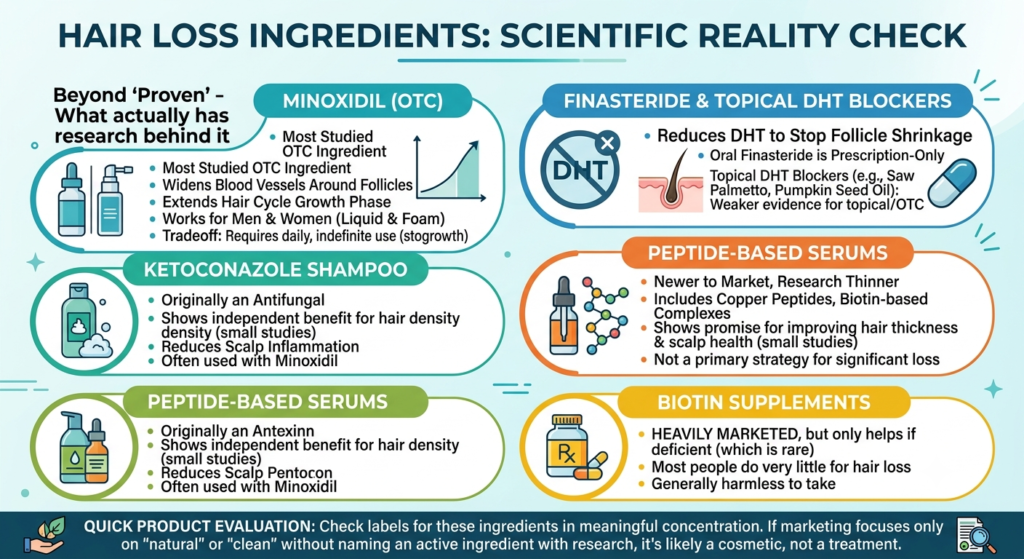
Hair loss product marketing loves vague words like “clinically proven” and “dermatologist recommended” without saying proven to do what, exactly. Here’s what actually has research behind it.
Minoxidil is the most studied over-the-counter ingredient for hair regrowth. It widens blood vessels around the follicle, which is believed to extend the growth phase of the hair cycle. It works on both men and women, comes in liquid and foam versions, and is the active ingredient in most FDA-approved OTC hair regrowth treatments. The tradeoff: it requires daily, indefinite use — stopping typically means losing the regrowth within months.
Finasteride and topical DHT blockers work differently. Rather than stimulating growth directly, they reduce the DHT that shrinks follicles in the first place. Oral finasteride is prescription-only, but topical formulations and DHT-blocking shampoos containing ingredients like saw palmetto or pumpkin seed oil extract are available without a prescription, though the evidence for the topical/OTC versions is weaker than for the oral form.
Ketoconazole shampoo, originally an antifungal, has shown some independent benefit for hair density in small studies, likely by reducing scalp inflammation. It’s often used alongside minoxidil rather than as a standalone treatment.
Peptide-based serums (copper peptides, biotin-based complexes) are newer to the market and the research is thinner. Some show promise in small studies for improving hair thickness and scalp health, but they shouldn’t be your only strategy if you’re dealing with significant pattern loss.
Biotin supplements, despite heavy marketing, only help if you’re actually deficient in biotin — which is rare in people eating a normal diet. For most people, oral biotin does very little for hair loss, though it’s harmless to take.
A quick way to evaluate any product: check the label for one of the ingredients above in a meaningful concentration. If a product’s marketing focuses entirely on “natural” or “clean” without naming an active ingredient with research behind it, it’s likely a cosmetic product, not a treatment.
The Newer Ingredients Worth Watching
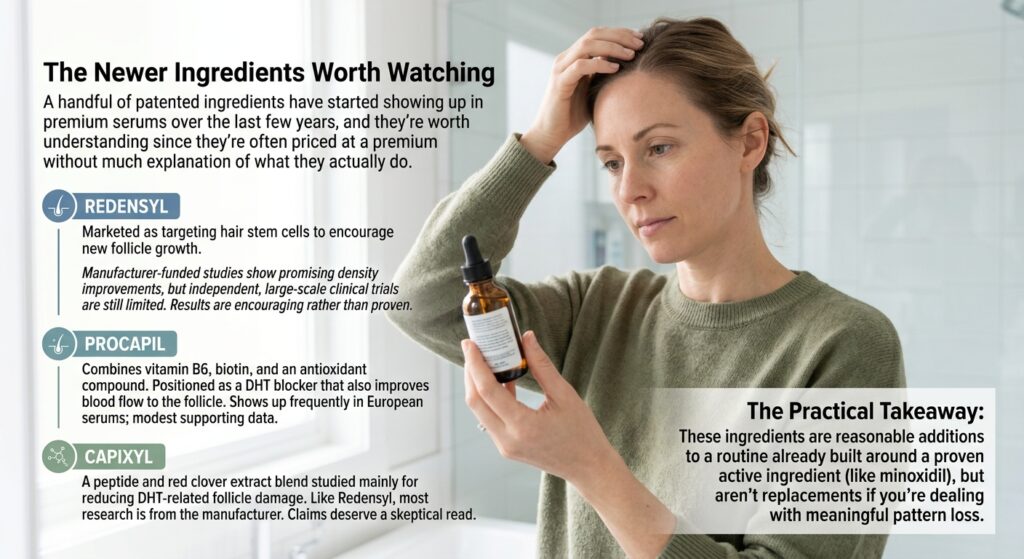
A handful of patented ingredients have started showing up in premium serums over the last few years, and they’re worth understanding since they’re often priced at a premium without much explanation of what they actually do.
Redensyl is marketed as targeting hair stem cells to encourage new follicle growth. The manufacturer-funded studies show promising density improvements, but independent, large-scale clinical trials are still limited, so it’s reasonable to treat the results as encouraging rather than proven.
Procapil combines vitamin B6, biotin, and an antioxidant compound, and is positioned as a DHT blocker that also improves blood flow to the follicle. It shows up frequently in European hair serums and has modest supporting data.
Capixyl is a peptide and red clover extract blend studied mainly for reducing DHT-related follicle damage. Like Redensyl, most available research comes from the ingredient manufacturer rather than an independent university, which doesn’t mean it’s ineffective, but it does mean the claims deserve a more skeptical read than something with decades of independent research behind it, like minoxidil.
The practical takeaway: these ingredients aren’t scams, but they also aren’t replacements for minoxidil if you’re dealing with meaningful pattern loss. Think of them as reasonable additions to a routine already built around a proven active ingredient, not a first-line treatment on their own.
Best Hair Loss Products by Category
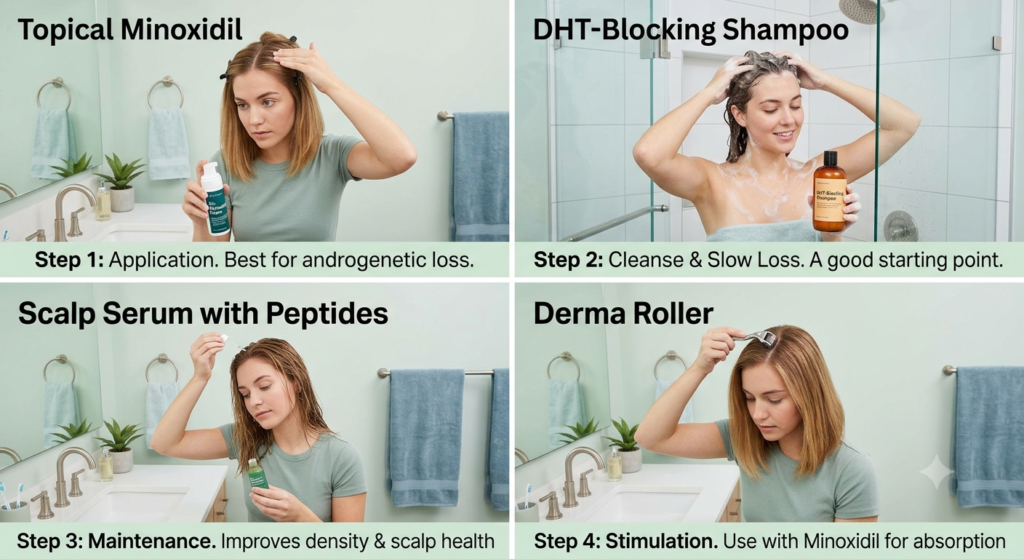
Rather than recommend specific brands (formulations change constantly), here’s how to shop by category and what each is actually good for.
Topical Minoxidil Treatments
Best for: androgenetic (pattern) hair loss in early-to-moderate stages. Look for 5% concentration for men, 2–5% for women (5% can cause more facial hair growth in some women, so start lower if that’s a concern). Foam formulations tend to be less greasy than liquid and absorb faster.
DHT-Blocking Shampoos and Serums
Best for: people who want a lower-commitment entry point before trying minoxidil, or as a supplement alongside it. These won’t regrow significant hair on their own for most people, but they can help slow further loss and are a reasonable starting point for early thinning.
Scalp Serums with Peptides or Growth Ingredients
Best for: people focused on hair density and scalp health rather than reversing significant loss. These work well as a maintenance layer once you’re already using minoxidil, not as a replacement for it.
Derma Rollers / Microneedling Devices
Best for: pairing with minoxidil to potentially improve absorption and stimulate blood flow. Some research suggests microneedling combined with minoxidil outperforms minoxidil alone, though it needs to be done carefully (0.25mm–0.5mm needles, sanitized, not overused) to avoid scalp irritation.
Hair Growth Vitamins

Best for: people with an actual nutrient deficiency (iron, vitamin D, zinc) contributing to shedding. Worth getting bloodwork done before relying on these — supplementing something you’re not deficient in won’t move the needle.
Quick comparison:
| Product Type | Best For | Time to See Results | Commitment Level |
|---|---|---|---|
| Topical Minoxidil | Pattern hair loss | 4–6 months | High (daily, ongoing) |
| DHT-Blocking Shampoo | Early thinning, prevention | 2–4 months | Medium |
| Peptide Serums | Density, scalp health | 3–6 months | Medium |
| Microneedling + Minoxidil | Boosting absorption | 4–6 months | High (technique matters) |
| Nutrient Supplements | Deficiency-driven shedding | Varies | Low (if deficient) |
OTC Products vs. Prescription Options: Knowing When to Level Up
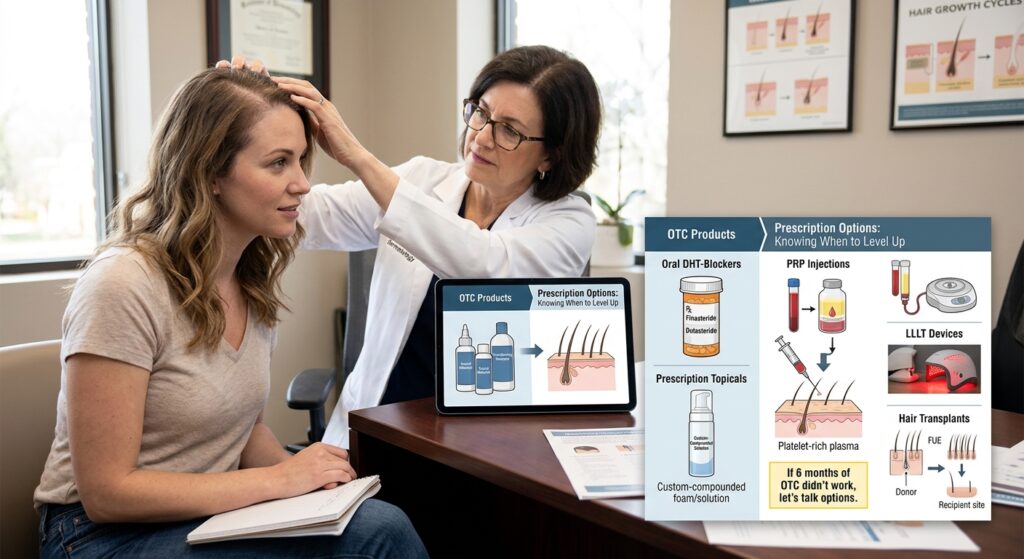
Most people start with over-the-counter products, and for early-to-moderate thinning, that’s usually the right call. But it helps to know what’s waiting on the other side if OTC options plateau.
Oral finasteride and dutasteride are prescription DHT-blockers taken as a daily pill. They tend to be more effective than topical DHT blockers because they lower DHT systemically rather than just at the scalp. They also carry a small but real risk of sexual side effects in some men, which is worth discussing with a doctor rather than sourcing through unregulated online sellers.
Prescription-strength topical finasteride compounds (often combined with minoxidil in a single solution) are increasingly common through telehealth dermatology services. These reduce the systemic absorption compared to the oral version while still targeting DHT at the follicle.
Platelet-rich plasma (PRP) injections use your own blood, spun down to isolate growth-factor-rich plasma, injected into the scalp. Research suggests it can meaningfully boost density, especially combined with minoxidil, but it requires repeat in-office sessions and isn’t cheap.
Low-level laser therapy (LLLT) devices — caps, combs, or helmets that use red light to stimulate follicles — have modest but real evidence behind them and sit in an interesting middle ground: not prescription, but a bigger investment than a bottle of shampoo. They’re a reasonable next step for someone who’s plateaued on minoxidil and isn’t ready for oral prescriptions.
Hair transplants are the most definitive option, moving follicles from a donor area (usually the back of the head, less prone to DHT sensitivity) to thinning areas. They’re a serious financial and time investment but are the only category on this list that can address already-miniaturized or dormant follicles that topical products can’t reach.
A reasonable rule of thumb: if you’ve used a proven OTC product consistently for six months with no meaningful change, that’s the point to talk to a dermatologist rather than continuing to cycle through OTC options indefinitely.
Common Mistakes People Make When Starting a New Product
Expecting results in a few weeks. Hair grows in cycles, and a follicle that’s currently in its resting phase won’t respond to anything until it re-enters the growth phase. This alone explains most of the “it didn’t work for me” reviews — people stopped at week six when the realistic window is closer to month four.
Switching products every few weeks. Every time you switch, you reset the clock on seeing whether the previous product was actually working. Pick one approach and give it a real trial period before judging it.
Applying too much product. More minoxidil doesn’t mean faster results — it just increases the odds of scalp irritation, which can itself trigger shedding. Stick to the labeled dose.
Ignoring the “shedding phase.” Many people experience increased shedding in the first few weeks of starting minoxidil as the hair cycle resets. This is often mistaken for the product failing, when it’s frequently a sign it’s working.
Skipping the scalp check. If you have underlying dandruff, psoriasis, or dermatitis, layering hair growth products on top of an irritated scalp reduces absorption and can make things worse. Treat the scalp condition first or alongside the hair treatment.
Not tracking progress. Because hair growth is gradual, it’s easy to miss real change. A monthly photo from the same angle and lighting makes a far more honest judge than memory.
Buying based on packaging instead of ingredients. A sleek bottle with words like “botanical complex” or “restorative formula” can sit right next to a plain pharmacy-brand minoxidil that costs a third of the price and does more. Flip the bottle over before deciding.
Stopping right when it starts working. Because minoxidil and similar treatments maintain rather than permanently fix the underlying hormonal or genetic cause, discontinuing use typically means losing the gains within three to six months. If budget is a concern long-term, factor that into which product you commit to from the start, since generic minoxidil is far cheaper to maintain indefinitely than premium serums.
How Long Before You See Real Results
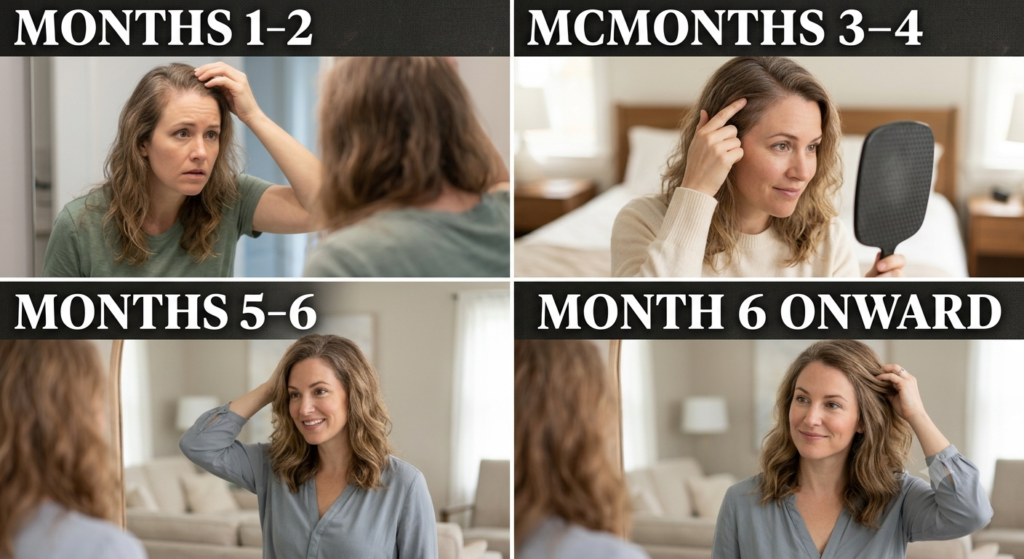
This is the question everyone actually wants answered, and it’s also where most products are marketed dishonestly.
Months 1–2: Little visible change, and possibly increased shedding as the hair cycle resets. This is the phase where most people quit — don’t.
Months 3–4: Fine, “baby” hairs may start appearing along the hairline or thinning areas. This is early but genuine progress.
Months 5–6: Noticeable thickening and density improvement, assuming consistent use. This is typically when most clinical trials measure results, and it’s a realistic benchmark for your own expectations.
Month 6 onward: Results tend to plateau at whatever level the product/routine can achieve, and maintaining it requires continuing the treatment indefinitely (particularly with minoxidil).
If you’re three months in with zero change and no increased shedding at all, it may be worth reconsidering whether the product matches your type of hair loss, rather than assuming you just need to wait longer.
FAQ
Can I use more than one hair loss product at once? Yes, and combining a topical treatment (like minoxidil) with a supportive product (like a DHT-blocking shampoo) is common and often more effective than either alone. Avoid layering multiple active ingredients meant to do the same job, though — that mostly increases irritation risk without adding benefit.
Do hair loss products work for women the same way they work for men? The underlying biology can differ. Women’s pattern hair loss often presents as diffuse thinning rather than a receding hairline, and hormonal factors (perimenopause, PCOS, postpartum) play a larger role. Minoxidil is approved and effective for both, but concentration and formulation matter more for women avoiding unwanted facial hair growth.
Is it too late to use hair loss products if I’ve already lost a lot of hair? Existing products work on follicles that are miniaturized but still alive — they generally can’t regrow hair from follicles that have fully scarred over. If loss has been severe and long-standing, a dermatologist consultation makes more sense than trying OTC products indefinitely.
How much should I expect to spend on a hair loss routine? A basic, effective routine (generic minoxidil plus a DHT-blocking shampoo) typically runs $20–40 a month. Adding microneedling, premium peptide serums, or LLLT devices can push that considerably higher, but the added cost doesn’t always translate to proportionally better results — the foundational, well-studied ingredients still do most of the work.
Can I combine a hair loss routine with regular hair dye or styling products? Generally yes, but timing matters. Apply topical treatments like minoxidil after washing and styling, not before, since product buildup can interfere with absorption. If you color your hair, let chemical treatments fully process and rinse before applying minoxidil the same day to avoid scalp irritation from the combination.
Conclusion
The hair loss product market is full of noise, but the underlying facts aren’t complicated: identify what type of hair loss you’re actually dealing with, choose a product built around an ingredient with real evidence behind it, apply it consistently for at least four to six months, and track your progress honestly instead of by memory.
If you’re just getting started, the lowest-risk entry point is usually a topical minoxidil treatment at the appropriate concentration for your gender, paired with a gentle DHT-blocking shampoo. Give that combination a full six-month trial before judging it or switching to something else — and if you’re still seeing no change at all by month three, that’s your signal to loop in a dermatologist rather than keep guessing.