If you have 4C hair, you already know the drill: you section your hair, reach for a detangler, and twenty minutes later you’re sitting in a pile of shed hair wondering if you did something wrong.
You didn’t. 4C hair has the tightest curl pattern of all curl types, which means the strands naturally wrap around each other and lock into knots that a regular conditioner just can’t handle. The right detangler doesn’t just “make hair slippery” — it changes how your fingers and comb interact with the hair shaft, which is the actual difference between a smooth wash day and a breakage-filled one.
This guide covers the best detanglers for 4C hair by specific hair need, the detangling method that stylists actually use, and the mistakes that are quietly causing more breakage than your detangler is preventing.
Why 4C Hair Tangles So Easily (The Science Bit)

4C hair has the smallest curl diameter and the most bends per inch of any curl pattern. Each of those bends is a point where hair can catch on itself, on other strands, or on the cuticle of a neighboring hair. That’s why 4C hair mats and tangles faster than looser curl patterns, even with similar length.
There are three compounding factors most people don’t realize are working against them:
- Low natural moisture retention. The zig-zag shape of 4C hair means natural oils from the scalp travel more slowly down the hair shaft, so strands are drier and rougher by default — and rough, dry strands catch on each other more.
- Shrinkage disguising tangles. Because 4C hair shrinks significantly, tangles can hide in the compressed curl and only reveal themselves once you start stretching or combing.
- Single-strand knots. Unlike a typical tangle between two hairs, 4C hair frequently knots with itself — the strand curls back and loops through its own coil. This is why detangling 4C hair often means addressing knots you can’t even see yet.
Understanding this matters because it explains why “just add more conditioner” isn’t always the fix. You need a product with the right slip (lubrication) and the right technique to work with the curl pattern instead of against it.
The Detangling Method That Actually Works (Step-by-Step)
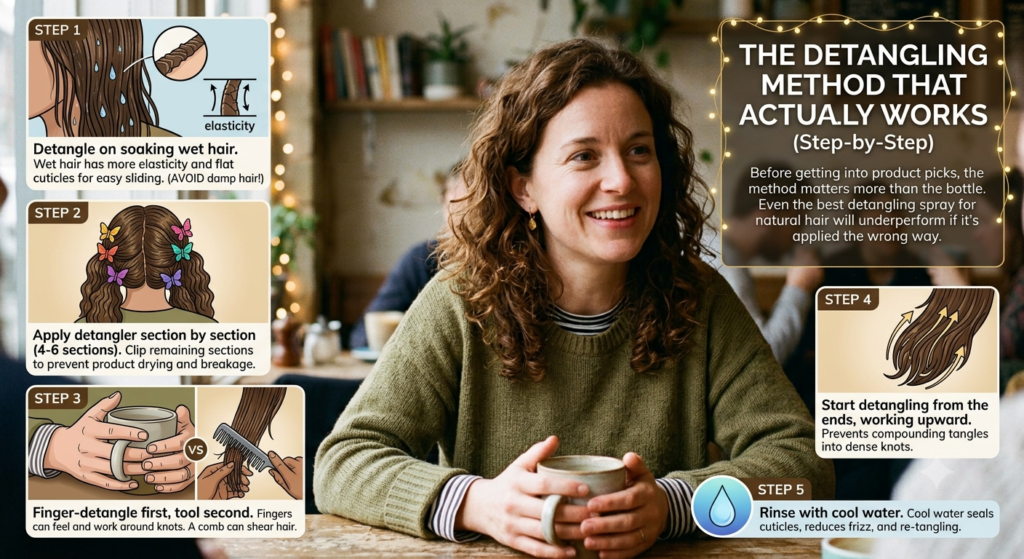
Before getting into product picks, the method matters more than the bottle. Even the best detangling spray for natural hair will underperform if it’s applied the wrong way.
Step 1: Detangle on soaking wet hair, not damp hair. Wet hair has more elasticity and the cuticle lies flatter, so knots slide apart more easily. Damp hair is actually one of the worst times to detangle — it has less slip than fully saturated hair but less structure than dry hair.
Step 2: Apply detangler section by section, not all at once. Divide hair into 4–6 sections and clip them. Working on the whole head at once means product dries out on some sections before you get to them, and dry sections are where breakage happens.
Step 3: Finger-detangle first, tool second. Run your fingers through each section before introducing a comb or brush. Fingers can feel a knot and work around it; a comb just pushes through and can shear the hair at the knot point.
Step 4: Start detangling from the ends, working upward. This is the step most people skip. Starting at the root and combing down pushes every tangle below into one dense knot at the ends. Starting at the ends and slowly working toward the root breaks up small tangles before they compound.
Step 5: Rinse detangler out with cool water if using a rinse-out formula. Cool water helps seal the cuticle after detangling, which reduces frizz and re-tangling before your next step (co-wash, deep condition, or styling).
Best Detangling Products for 4C Hair, By Hair Need

Not every 4C head has the same problem. Some people struggle with dryness, some with buildup, some with fine strands that mat easily. Here’s how to match the product to the actual issue.
If Your Hair Is Dry and Brittle
Look for detanglers with slip-focused ingredients like cetrimonium chloride, behentrimonium methosulfate, or a high concentration of natural oils (avocado, marula, or castor). Cream-based detanglers tend to outperform sprays here because they coat the strand more thoroughly.
Product types to look for: rich detangling conditioners like Camille Rose Curl Love Detangling Conditioner or Mielle Organics Babassu Oil Detangling Milk. Both prioritize slip over foam or fragrance, which is what dry 4C hair actually needs.
If Your Hair Mats Easily Even When Moisturized
This usually means the issue is single-strand knots rather than overall dryness. A leave-in detangler with slip plus hold, like Bounce Curl Whipped Cream Coconut Curl Definer used as a pre-detangler, or As I Am Coconut Cowash, can help separate strands without over-softening them into a mat again.
If Your Hair Is Fine or Low-Density 4C
Fine 4C strands can get weighed down by heavy creams, which paradoxically makes them tangle more because they clump together wet. A lightweight leave-in spray with slip agents but less oil density — something like a diluted leave-in in a spray bottle — often detangles more effectively than a thick cream.
If You’re Detangling a Twist-Out or Wash-and-Go the Next Morning
Overnight styles compress curls and reintroduce shrinkage-related knots. A water-based refresher spray with a small amount of slip agent (not a full detangling cream) is usually enough, since you’re not starting from fully matted hair.
| Hair Concern | Best Product Format | What to Look For |
|---|---|---|
| Dry, brittle | Cream detangler | Cetrimonium chloride, oils |
| Mats even when moisturized | Leave-in with hold | Slip + light protein |
| Fine/low-density | Lightweight spray | Diluted, low-oil formula |
| Refreshing next-day styles | Water-based spray | Minimal buildup |
Detangling Mistakes That Cause Breakage
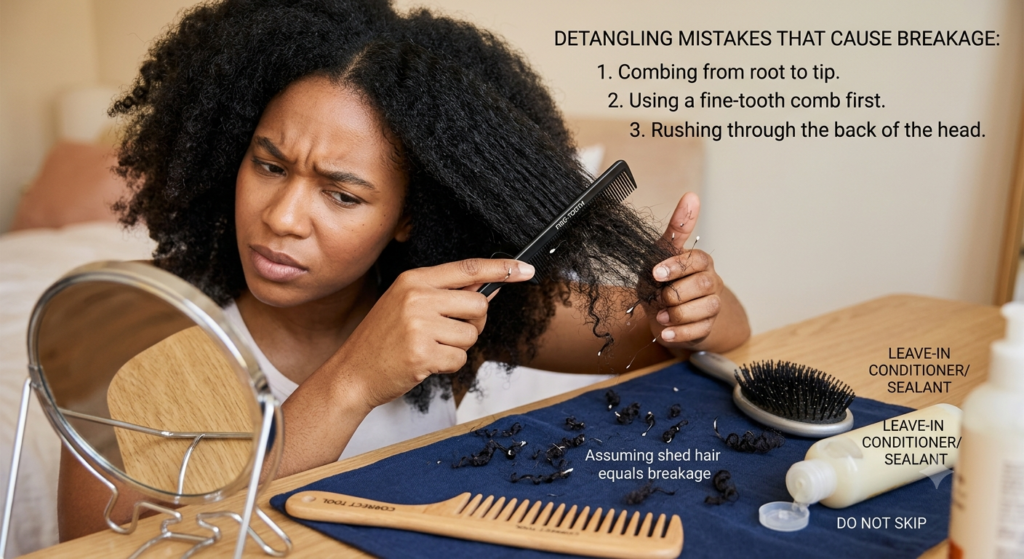
Most breakage during detangling isn’t caused by a bad product — it’s caused by one of these habits.
- Detangling dry hair “to save time.” Dry 4C hair has almost no give, so knots that would slide apart wet instead snap the strand.
- Combing from root to tip. As mentioned above, this compounds tangles instead of releasing them.
- Using a fine-tooth comb first. Fine-tooth combs should be the last tool used, if at all — starting with one on tangled 4C hair is one of the fastest ways to cause single-strand breakage.
- Rushing through the back of the head. The nape and crown are usually the most tangle-prone areas because they’re hardest to see and reach, so people rush them. Slow down specifically in these two zones.
- Skipping the “seal and smooth” step. Detangling without following up with a leave-in or oil to seal the cuticle leaves hair vulnerable to re-tangling within hours, undoing the work you just did.
- Assuming shed hair equals breakage. Some hair loss during detangling is completely normal — the average person sheds 50–100 hairs a day, and much of it collects during detangling sessions rather than throughout the day unnoticed. The concern is breakage (short pieces with no root, or a “fuzzy” texture at the ends), not shed hairs with a visible white bulb at the root.
How Often You Should Detangle 4C Hair
There’s no single universal answer, but the pattern that works for most 4C hair is:
- Full detangling session: Once per wash day, typically every 1–2 weeks depending on your routine.
- Light finger-detangling: Before bed with a satin bonnet or scarf, to prevent overnight tangling from friction.
- Avoid daily heavy detangling. Detangling too frequently, especially with tools, causes cumulative stress on the cuticle even if each session seems gentle.
If you’re protective styling (braids, twists, buns), you’ll detangle less often but should still finger-detangle at takedown before shampooing, rather than shampooing first and detangling a fully matted head afterward.
Frequently Asked Questions
Can I use regular conditioner as a detangler for 4C hair? Regular rinse-out conditioner can work in a pinch, but it typically doesn’t have enough slip agents to fully address single-strand knots. A dedicated detangling conditioner or leave-in will usually get through a full head faster with less breakage.
Should I detangle before or after deep conditioning? Detangle first, then deep condition. Deep conditioner works best on hair that’s already smooth and separated — applying it to matted hair means the product can’t reach the strands evenly.
Is finger detangling enough, or do I need a comb? Finger detangling alone is enough for many low-manipulation routines, especially for twist-outs or braid-outs. A wide-tooth comb is useful for length checks or preparing hair for blow-drying, but it should always come after fingers have already worked through the bulk of the tangles.
Key Takeaways
The best detangler for 4C hair depends less on the brand name and more on matching the formula to your specific hair need — dryness, single-strand knots, fine density, or next-day refreshing. But even the right product won’t prevent breakage if the technique is off. Detangle wet, work section by section, start from the ends, and always seal afterward.
If you only change one thing from this article, make it starting your detangling from the ends instead of the roots — it’s the single habit that prevents the most breakage, and it costs nothing.