If you’ve ever finished a wash day only to find a golf-ball-sized clump of hair in the shower drain, you already know that the wrong detangler doesn’t just fail to work — it actively costs you length. Natural hair coils and curls around itself in a way straight hair simply doesn’t, which means every knot you rip through is a strand you probably won’t get back.
The good news: detangling doesn’t have to be a fight. Once you understand what a detangler is actually supposed to do — and match the right formula to your hair’s texture and porosity — wash day stops being the most dreaded part of your routine.
This guide breaks down the best types of detanglers for natural hair, how to use them correctly, and the mistakes that quietly undo even the best products.
What Makes a Detangler Actually Work (Not Just Marketing Claims)
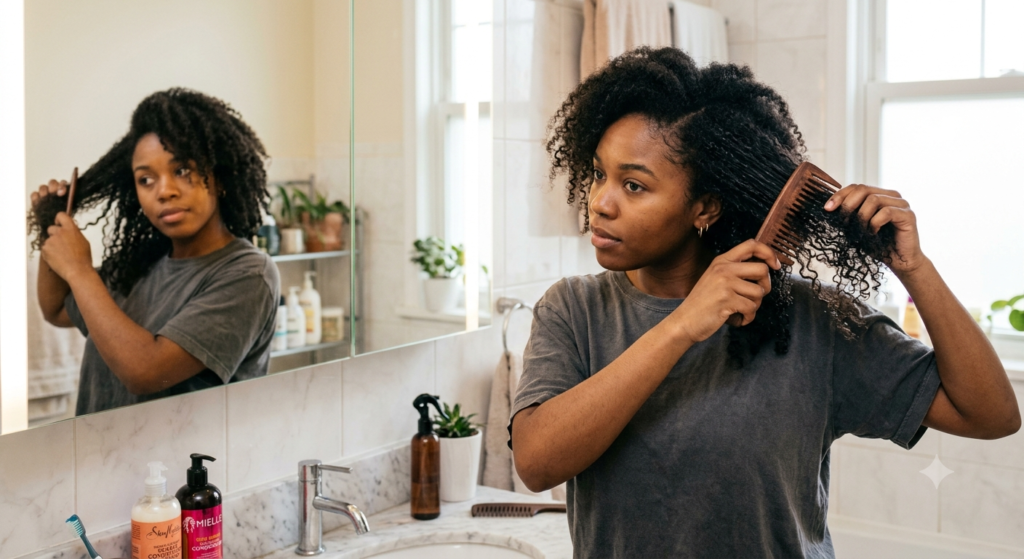
Almost every detangler on the shelf claims to give “instant slip,” but slip isn’t a marketing word — it’s a measurable property. Slip refers to how easily a product allows your fingers or a comb to glide through hair without catching on the cuticle. Products that lack real slip will feel moisturizing in the bottle but still snag the second you start working through a knot.
Three ingredient categories consistently deliver genuine slip:
- Cationic conditioning agents (like behentrimonium methosulfate or cetrimonium chloride) — these carry a positive charge that binds to the negatively charged, damaged spots on your hair shaft, smoothing the cuticle so strands stop grabbing onto each other.
- Humectants (glycerin, aloe vera juice, honey) — these pull moisture into the hair shaft, and hydrated hair is inherently more elastic and less prone to snapping during detangling.
- Emollients and oils (argan, marshmallow root extract, shea butter) — these coat the strand and reduce friction between hairs, which is especially useful for high-porosity or damaged ends where the cuticle is already lifted.
A product that’s mostly water and fragrance with one of these buried at the bottom of the ingredient list will smell nice and do very little. This is the single biggest reason people feel like they’ve “tried everything” and nothing works — they’ve tried a dozen versions of the same underperforming formula.
The 3 Types of Detanglers for Natural Hair (And When to Use Each)
Not every detangler suits every wash-day step. Here’s how the three main categories actually function:
| Type | Best For | How It Works | Watch Out For |
|---|---|---|---|
| Leave-in conditioner detanglers (creams/lotions, e.g. Mielle Organics Pomegranate & Honey, Camille Rose Guava Slip) | Daily detangling, low-to-normal porosity hair | Coats strands with conditioning agents for lasting slip through styling | Can feel heavy on fine, low-density hair if overapplied |
| Detangling sprays/mists (e.g. Garnier Fructis Curl Knot Melter, Pacifica Coconut Milk Detangler) | Quick refreshes, second-day hair, kids’ hair | Lightweight, water-based, easy to distribute evenly | Slip fades faster, so it works best on hair that isn’t severely matted |
| Oil-based or “knot sauce” style detanglers (e.g. Soultanicals Knot Sauce, argan-based primers) | High-porosity or very coily/coarse hair, deep detangling sessions | Heavier coating reduces friction on rough, raised cuticles | Too rich for fine or low-porosity hair; can cause buildup if not clarified regularly |
A practical way to think about it: creams for your everyday detangling routine, sprays for maintenance between wash days, and oil-rich formulas for the toughest sections at the nape or crown where tangles are worst.
How to Detangle Natural Hair Without Breakage (Step-by-Step)
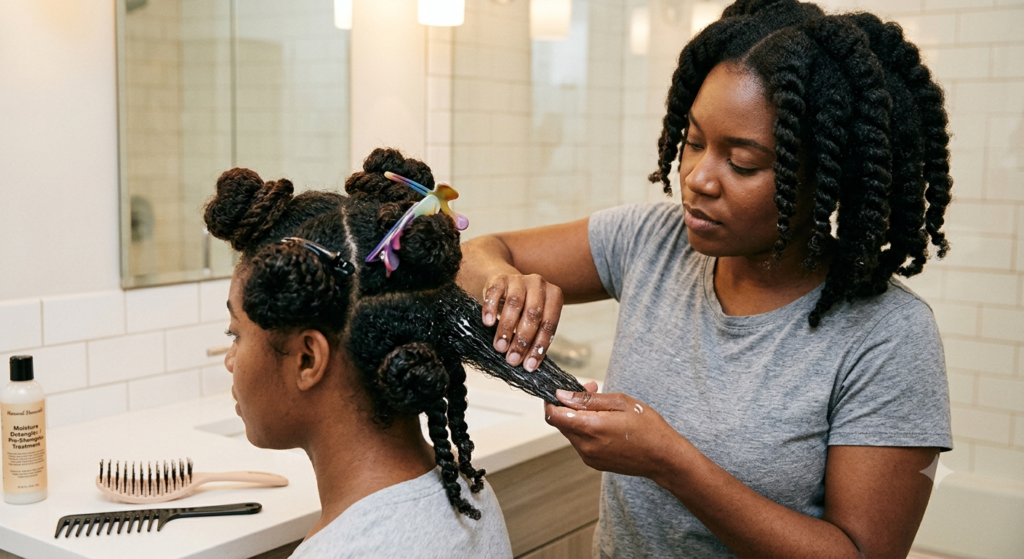
The product matters, but technique determines whether you keep your length. This is the method that consistently produces the least breakage, regardless of which detangler you choose:
- Detangle before you shampoo, not after. Shed hair tangles with new growth the longer it sits, so removing knots pre-wash prevents them from felting together under water.
- Section your hair into 4–6 parts and clip each away. Trying to detangle your whole head at once is the number one reason people give up halfway through.
- Apply detangler generously to one section at a time, saturating from mid-shaft to ends first — this is where the oldest, most fragile hair lives.
- Finger-detangle before reaching for a comb. Your fingers can feel where a knot actually is and work around it; a comb forces through blindly.
- Work from ends to roots, never the reverse. Starting at the root pushes tangles into a tighter knot instead of loosening them.
- Use a wide-tooth comb or a detangling brush with flexible bristles only after fingers have broken up the bulk of the knot.
- Rinse detangler out with cool water if it’s a pre-shampoo step — cool water helps the cuticle lie flat before you introduce shampoo, which can re-roughen it.
If a knot won’t budge after 30 seconds of gentle work, stop. Add more product and let it sit for a minute rather than forcing it — this single pause prevents more breakage than any product swap ever will.
Best Detanglers for Natural Hair by Porosity and Texture
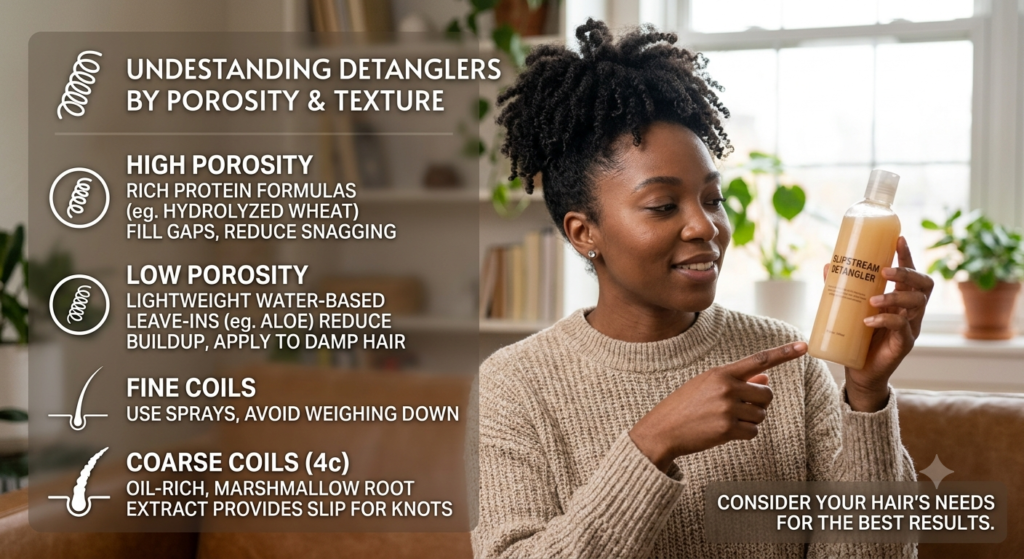
Porosity — how easily your hair absorbs and holds moisture — matters more than curl pattern when choosing a detangler.
Low porosity hair (cuticle lies flat, products tend to sit on top and cause buildup): Choose lightweight, water-based leave-ins with humectants like glycerin and aloe, applied to damp (not soaking) hair. Heavy oil-based detanglers will feel greasy and won’t absorb, leaving strands slick on the surface but still hard to comb through underneath.
High porosity hair (cuticle is lifted or damaged, loses moisture quickly): Richer, protein-containing formulas work best here — look for hydrolyzed wheat or silk protein in the ingredient list, since this temporarily fills in gaps along the damaged shaft and reduces the rough texture that causes snagging.
Fine, low-density coils: A little product goes a long way. Overloading fine strands with a heavy detangler leads to limp, weighed-down curls that look flat by midday. Sprays or diluted creams tend to outperform thick butters here.
Coarse, high-density coils (typically 4a–4c textures): These textures usually need the most slip and the most product, full stop. Oil-rich, “knot sauce” style detanglers or leave-ins with marshmallow root or slippery elm extract are worth the higher price point because they hold up through longer detangling sessions without needing constant reapplication.
Common Detangling Mistakes That Cause More Damage Than the Tangles Themselves
Even with a good product, technique errors undo the benefit fast:
- Detangling on fully dry hair. Dry, unstretched coils have almost no give, so a comb catches instead of gliding. Always detangle on damp or product-saturated hair.
- Using too little product and stretching it to “save money.” A thin layer of detangler on thick, dry coils just means your comb is doing the work the product should be doing.
- Detangling in a rush. Sessions that take 10 minutes on 4c hair usually mean corners were cut. Budget 20–40 minutes depending on length and density.
- Skipping sections closest to the nape and crown. These areas tangle the worst because they get the least airflow and attention, yet they’re often rushed through last when patience is already gone.
- Switching detanglers constantly looking for a “miracle” fix. Buildup from layering incompatible products (heavy silicones under protein-based creams, for example) can actually make hair feel more tangled over time. Give one product 3–4 wash cycles before deciding it isn’t working.
DIY Detangler vs. Store-Bought: Which Actually Works Better?
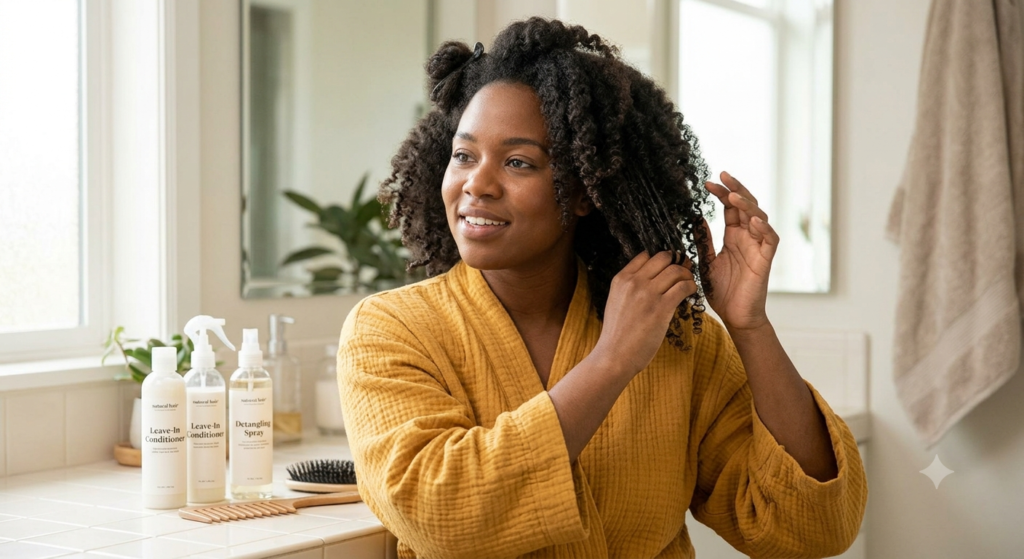
DIY detanglers — typically a mix of water, a few drops of conditioner, glycerin, and an oil — have a real place, especially for daily refresh sprays between full wash days. They’re inexpensive and let you control exactly what touches your scalp.
Where DIY tends to fall short is in concentration and stability. Store-bought formulas are engineered so the cationic conditioning agents, oils, and humectants stay evenly suspended and at an effective percentage — something hard to replicate by eye at home. A DIY mix heavy on water and light on actual conditioning agents will feel fine going on but won’t hold up through a real detangling session on coarse, matted sections.
A practical middle ground many experienced naturals land on: use store-bought, protein- or oil-rich detanglers for wash day (where the heavy lifting happens), and reserve homemade water-based mixes for quick between-wash refreshes.
How Often Should You Detangle Natural Hair?
This depends more on your styling routine than a fixed schedule. As a general guide:
- Daily-manipulation styles (twist-outs worn loose, wash-and-gos): light detangling every 1–2 days to prevent shed hair from felting.
- Protective styles (braids, twists, buns): full detangling only at takedown, though a light finger-detangle at the scalp during refresh days prevents matting at the roots.
- Post-workout or high-humidity climates: more frequent light detangling, since sweat and humidity accelerate tangling regardless of style.
The goal isn’t detangling as often as possible — it’s detangling before tangles compound into mats, which is a much gentler and faster process either way.
Frequently Asked Questions
Do I need a separate detangler if I already use a leave-in conditioner? Not necessarily. Many leave-in conditioners double as detanglers if they contain real slip agents (check for cationic conditioners or oils in the first half of the ingredient list). If your leave-in doesn’t cut through knots on its own, that’s a sign to look for a dedicated detangler rather than assuming your hair “just tangles a lot.”
Can a detangler replace conditioner entirely? For daily maintenance, sometimes. But a rinse-out or deep conditioner still plays a different role — replenishing moisture and protein at a deeper level than a leave-in detangler is designed to do. Think of detanglers as maintaining slip, and conditioners as maintaining hair health.
Why does my hair tangle more after switching detanglers? This is usually a buildup or compatibility issue rather than the new product being “worse.” Silicone-heavy products can leave a coating that clashes with protein-based formulas, creating a rougher texture than either product alone. Clarifying between switches solves this most of the time.
Key Takeaways
The best detangler for natural hair isn’t the one with the prettiest packaging — it’s the one whose ingredients match your hair’s actual porosity and texture, used with a technique that works with your curl pattern instead of against it. Start by identifying whether your hair is low or high porosity, choose a formula built around real slip agents rather than fragrance and filler, and commit to detangling in sections on damp hair rather than rushing through it dry.
If you’re not sure where to start, a lightweight leave-in for daily use plus a richer, protein-based detangler for full wash days covers almost every natural hair texture — and gives your length the best shot at actually growing instead of ending up in the shower drain.