Every doll owner hits this moment eventually. You pick up a beloved American Girl doll, a hand-me-down Barbie, or a thrifted find, and the hair looks like it survived a windstorm. Matted, frizzy, sometimes fused into a solid clump near the scalp. Regular shampoo doesn’t touch it. A regular brush just breaks strands and makes it worse.
Doll hair behaves nothing like human hair, which is exactly why the usual detangling advice fails. This guide walks through what actually works, based on how different doll hair fibers respond to moisture, heat, and friction — plus the mistakes that quietly ruin more doll hair than the tangles ever did.
What Makes Doll Hair Different From Human Hair
Before reaching for any product, it helps to know what you’re actually working with. Not all “doll hair” is the same material, and treating them identically is the number one reason detangling attempts backfire.
Synthetic (Saran) Hair vs. Rooted Human Hair vs. Mohair
Most mass-market dolls — Barbie, My Life As, Disney dolls — use saran fiber, a type of synthetic vinyl-based hair. Saran is heat-sensitive (it melts, it doesn’t singe), holds static easily, and tangles because the fibers are smoother and slipperier than human hair, so they slide against each other and knot at the ends rather than the roots.
American Girl dolls use a nylon or acrylic blend that’s coarser and more textured, which is why their hair holds curls well but also tangles into denser knots.
Some higher-end or reborn dolls use rooted human hair or mohair (goat hair). These behave much closer to real hair — they can tolerate light heat styling and respond well to actual hair conditioner, but they’re also more prone to breakage if brushed dry.
Why this matters: a product marketed as a “doll hair detangler” for saran-haired Barbies can leave human-hair-wigged dolls looking greasy and flat, because the formulas are usually silicone-heavy to smooth synthetic fiber, not to nourish natural fiber. Always match the product to the fiber type, not just the doll brand.
Store-Bought Doll Hair Detanglers Worth Trying
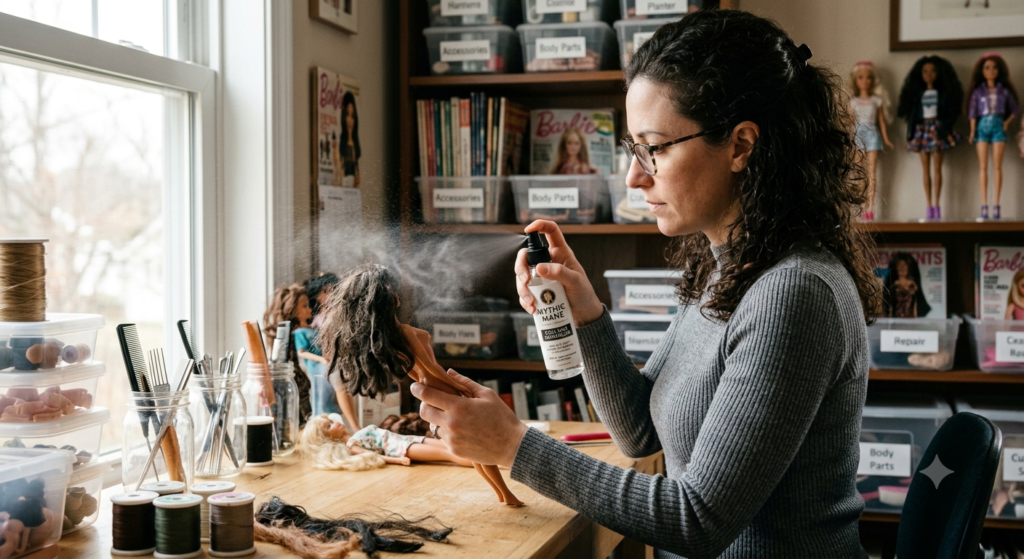
If you’d rather not mix anything yourself, dedicated doll hair detangler sprays exist and are worth the small investment, especially if you’re restoring several dolls (a common situation for collectors, resellers, or parents with multiple kids).
Look for these features when comparing products:
- Leave-in formula — rinse-out conditioners don’t work on doll hair since most doll heads can’t get fully wet without water pooling inside the head.
- No heavy oils — oil-based sprays can leave a residue that attracts dust and makes hair look perpetually damp.
- Fine-mist nozzle — a fine mist distributes product evenly without soaking the roots, where most doll hair is glued or plugged in and can loosen with too much moisture.
- Anti-static ingredients — since saran hair’s biggest tangle trigger is static, not just knots.
A good rule of thumb: if a detangler is marketed for “fashion doll hair” or “synthetic hair extensions,” it will usually work well on Barbie-type dolls too, since the fiber type is nearly identical.
DIY Doll Hair Detangler Recipes You Can Make at Home
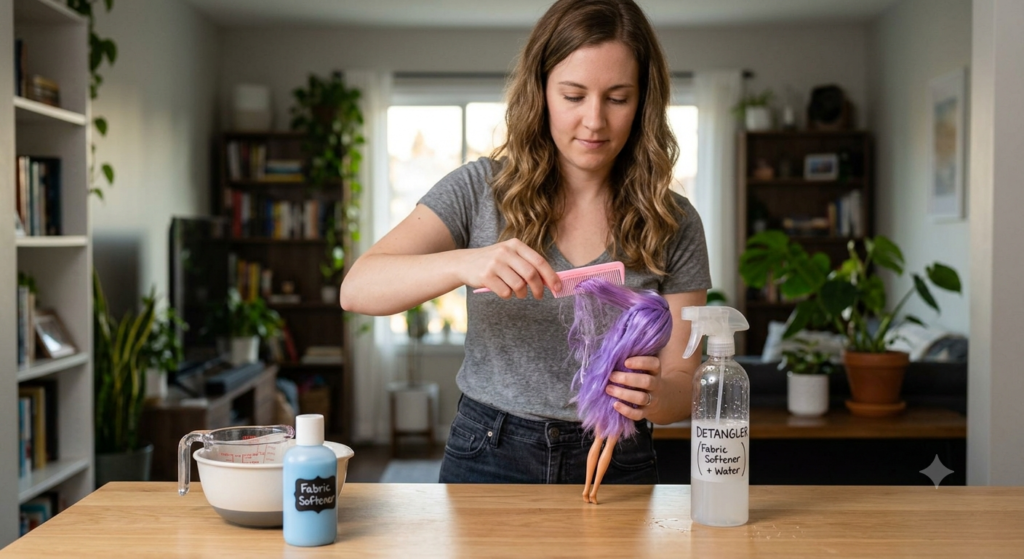
You don’t need a specialty product to get real results. These three recipes cover different tangle severities, from routine maintenance to genuinely stubborn mats.
Fabric Softener Method (Best for Light-to-Moderate Tangles)
Mix one part liquid fabric softener with three parts warm water in a spray bottle. Fabric softener works because it’s designed to coat fibers and reduce friction between them, which is exactly the problem with saran hair.
- Spray lightly, focusing on the ends where knots form.
- Let it sit for 2–3 minutes.
- Comb from the ends upward in small sections, never starting at the scalp.
This is the closest DIY equivalent to a commercial doll hair detangler spray and is safe for regular saran-haired dolls.
Conditioner and Water Spray (Best for Human Hair or Mohair Dolls)
Mix a small amount of regular hair conditioner (avoid anything with heavy oils or heat-protectant chemicals) with warm water, roughly one tablespoon of conditioner per cup of water.
This method mimics how you’d detangle real hair, which makes sense since it’s designed for actual hair fiber. It’s gentler than fabric softener and better suited to dolls with rooted human hair, where preserving natural texture matters more than taming static.
Baby Oil Method (Best for Severely Matted, “Fried,” or Heat-Damaged Hair)
For hair that’s been through heat exposure (a doll left near a sunny window, a curling iron accident, or hair that’s simply decades old and brittle), a small amount of baby oil rubbed between fingers and worked through the ends can soften fiber enough to separate mats that water-based sprays can’t touch.
Use sparingly — a little goes a long way, and too much will leave hair looking oily rather than smooth. This method works on saran hair specifically because the oil temporarily reduces the friction causing fibers to grip each other, but it should be a last resort rather than routine maintenance, since repeated oil application can dull the hair’s shine over time.
Step-by-Step: How to Detangle Doll Hair Without Damaging It
Regardless of which detangler you use, the technique matters more than the product. This is the order that consistently prevents breakage:
- Section the hair. Divide it into 3–4 sections and clip the ones you’re not working on out of the way.
- Apply detangler to one section at a time. Don’t soak the whole head at once — it dries out before you finish and you lose the slip effect.
- Start at the very ends. Hold the hair firmly an inch above where you’re combing so you’re not pulling directly on the root.
- Comb in small strokes, working your way up toward the scalp only once the lower section is fully smooth.
- Use a wide-tooth comb or doll-specific brush, never a fine-tooth comb or a human hairbrush, which are too aggressive for synthetic fiber.
- Re-wet stubborn knots rather than forcing the comb through — this is the step most people skip, and it’s the difference between a smooth detangle and a bald patch.
- Let the hair air dry fully before styling, braiding, or putting the doll back in its original packaging.
Common Mistakes That Make Doll Hair Worse
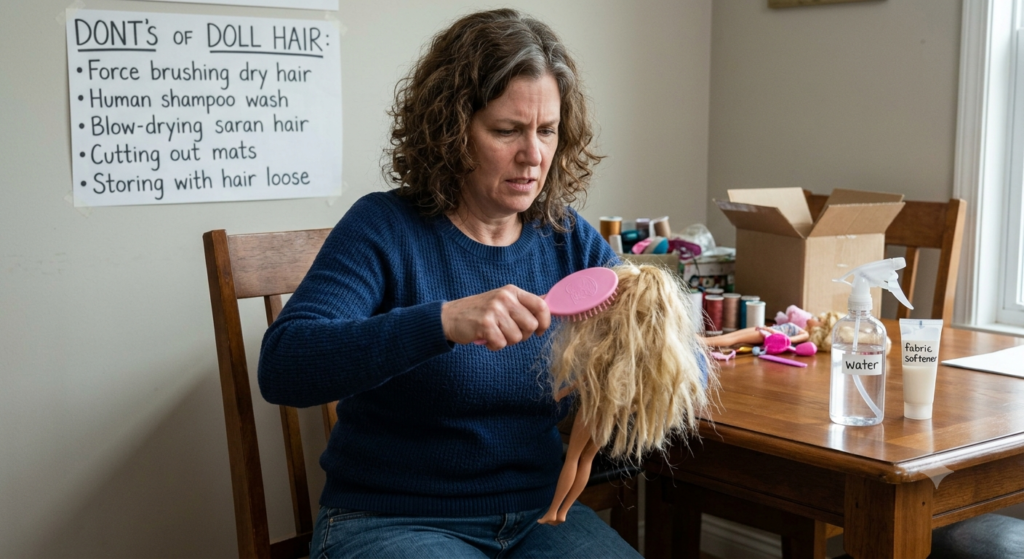
Most damaged doll hair isn’t caused by tangles themselves — it’s caused by how people try to fix them. Watch for these:
- Brushing dry, matted hair with force. This is the single most common cause of doll hair going from “tangled” to “missing.” Always add moisture first.
- Using human shampoo and conditioner as a full wash. Rooted doll hair often isn’t sealed the way human hair follicles are, so a full wash can loosen the glue or knots holding hair in the scalp, leading to shedding.
- Blow-drying saran hair. Even low heat settings can cause slight melting or a “cooked” texture that’s frizzy permanently, not temporarily.
- Cutting mats out. Tempting, but it creates uneven hair that can’t be blended back in, and it doesn’t teach you the underlying detangling skill for next time.
- Storing detangled dolls with hair loose and unbrushed. Hair that’s freshly detangled but not braided or tied will simply re-tangle in storage.
How to Detangle Severely Matted or “Fried” Doll Hair
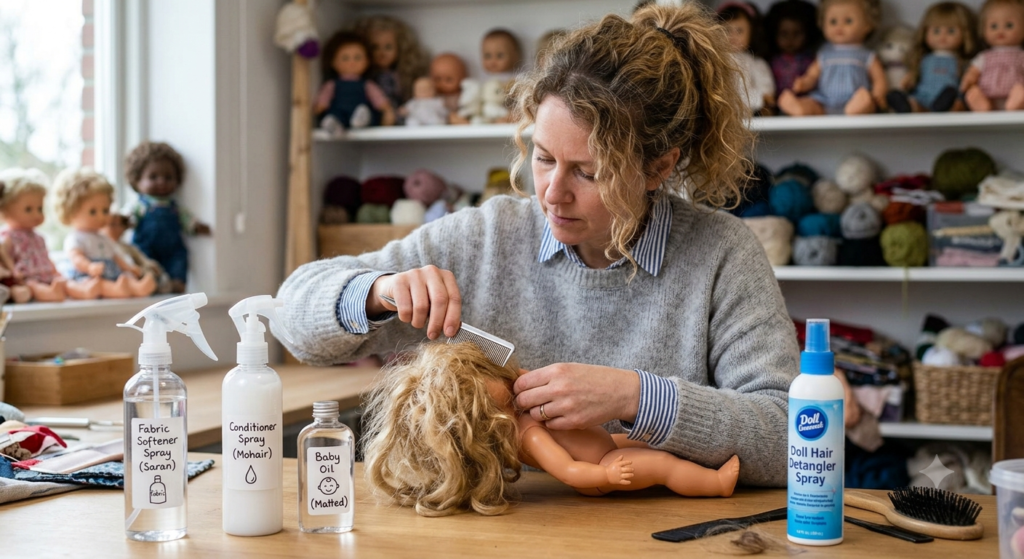
Some dolls arrive in rough shape — a garage sale find with hair that’s essentially one solid clump, or heat-damaged hair with split, frizzy ends that won’t lie flat no matter what you do.
For clumped mats, work in tiny sections (think strand by strand near the worst spot) rather than trying to detangle the whole clump at once. Apply your detangler, wait a full 5 minutes rather than 2–3, and use a needle or fine pick to gently separate fibers before combing.
For fried or heat-damaged ends, detangling alone won’t restore the texture — the fiber itself is altered. In these cases, a small trim of just the damaged tips (not a full haircut) combined with regular detangler use will get the healthiest-looking result. This is different from cutting out a mat; you’re removing genuinely damaged fiber, not avoiding the detangling process.
How to Prevent Tangles Before They Start
Detangling is far easier as prevention than as repair. A few habits make a real difference:
- Brush weekly, even if the doll isn’t being played with. Undisturbed hair still shifts and tangles in storage.
- Braid or loosely tie hair before packing a doll away for any length of time.
- Keep dolls out of direct sunlight and away from heating vents, both of which dry out synthetic fiber over time.
- Apply a light detangler spray after every wash, not just when tangles appear.
Doll Hair Detangler Comparison: DIY vs. Store-Bought
| Method | Best For | Pros | Cons |
|---|---|---|---|
| Fabric softener spray | Saran/synthetic hair, routine tangles | Cheap, effective, easy to make | Not ideal for human-hair wigs |
| Conditioner spray | Mohair or rooted human hair | Gentle, mimics real hair care | Less effective on severe synthetic tangles |
| Baby oil | Severely matted or heat-damaged hair | Strong slip for stubborn mats | Can leave residue if overused |
| Commercial doll detangler spray | Multiple dolls, convenience | Formulated specifically for doll fiber | Costs more than DIY options |
Frequently Asked Questions
Can I use regular human hair detangler on doll hair? You can, in small amounts, but most human detanglers are formulated with heat-protectant and shine ingredients that doll hair doesn’t need and that can leave synthetic fiber looking greasy. A diluted version, or a doll-specific product, gives better results.
Is it safe to wash doll hair fully in the sink? It depends on the doll. Solid-body dolls with sealed heads are usually fine; soft-body dolls with stuffing can develop mold if water seeps in. Check the doll’s care instructions or test with a barely damp cloth first if you’re unsure.
Why does my doll’s hair keep frizzing even after detangling? This usually means the fiber itself is heat- or age-damaged rather than simply tangled. Detangler will smooth it temporarily, but the frizz will return until damaged ends are trimmed.
Key Takeaways
Doll hair detangling comes down to two things: matching the method to the hair fiber, and never forcing a comb through dry, matted hair. Saran hair responds best to fabric softener sprays, human-hair wigs do better with diluted conditioner, and truly stubborn mats need patience, moisture, and a strand-by-strand approach rather than brute force.
Start with the gentlest method for your doll’s hair type, work in small sections, and build a quick weekly brushing habit afterward. That last step is what actually keeps you from doing this whole process again in a month.