Search “Asian foundation looks” and you’ll find three very different finishes under one label. One is dewy and almost wet-looking. One is soft and powdery, like skin with a gentle blur filter. One is polished, bright, and sculpted for a camera.
These looks come from different beauty cultures with different ideas about what “good skin” means. K-beauty prizes hydration and a lit-from-within glow. J-beauty prizes softness, evenness, and a refined, understated finish. Douyin, named for the Chinese short-video platform, prizes a flawless, dimensional base that holds up on camera.
If you buy a matte powder foundation and expect glass skin, you’ll be disappointed, and the mismatch usually gets blamed on blending skill rather than on the product category. This guide explains what defines each look, how to build it step by step, which mistakes to avoid, and which product types fit different skin types and budgets. The technique advice works with makeup you already own, so you can use it without buying anything.
The Three Looks at a Glance
| Look | Finish | Core Idea | Typical Vibe |
|---|---|---|---|
| K-Beauty (glass or “chok-chok” skin) | Dewy, luminous, plump | Skin looks healthy and hydrated from within | Fresh, youthful, natural |
| J-Beauty (mochi or “tamago hada” skin) | Soft, velvety, semi-matte | Skin looks smooth, even, and refined | Soft, understated, polished |
| Douyin | Bright, flawless, sculpted | Skin looks camera-ready and dimensional | Glamorous, high-contrast |
Treat these as tendencies rather than rules. Plenty of Korean brands make matte bases, plenty of Japanese brands make dewy ones, and many people blend elements of all three. The categories are useful because they give you a clear target finish before you start shopping.
Which Finish Do You Actually Want?
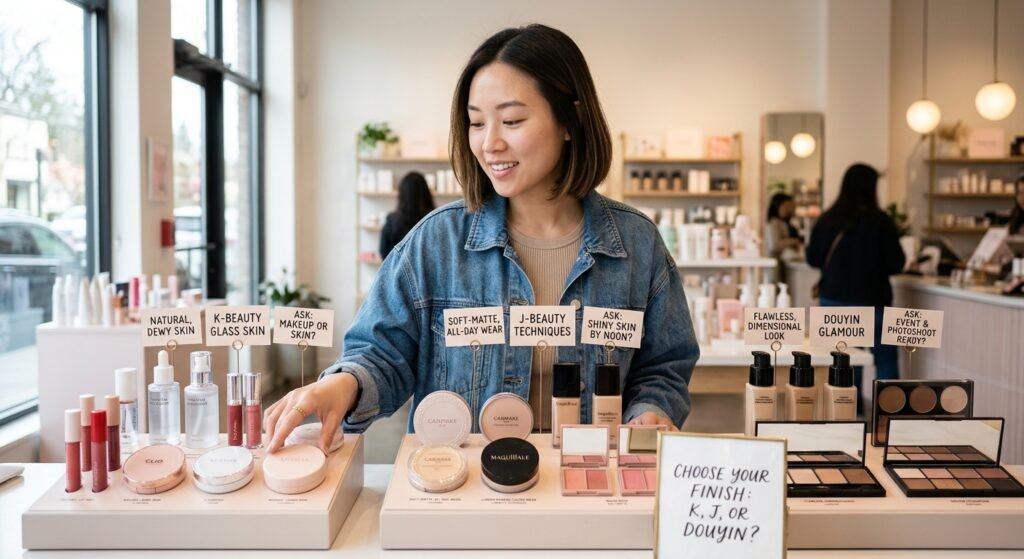
Before choosing products, decide what you want your skin to look like at the end of the day. Most frustration with base makeup comes from picking a product for how it looks in a promo photo rather than how it behaves on your skin.
Ask yourself three questions:
- Do I want to look like I’m wearing makeup? If the answer is no, K-beauty or J-beauty will suit you better. If you want a deliberate, finished look, Douyin is the better fit.
- How does my skin behave by afternoon? Skin that turns shiny by noon usually does better with soft-matte J-beauty techniques. Skin that turns tight or flaky by noon usually does better with hydrating K-beauty layers.
- Where will I be wearing it? Office days, selfies, videos, events, and photos each reward a different finish. Strong overhead lighting and cameras tend to flatter more coverage and some dimension. Natural daylight and close conversation tend to flatter lighter, skin-like bases.
Start With the Skin, Not the Foundation
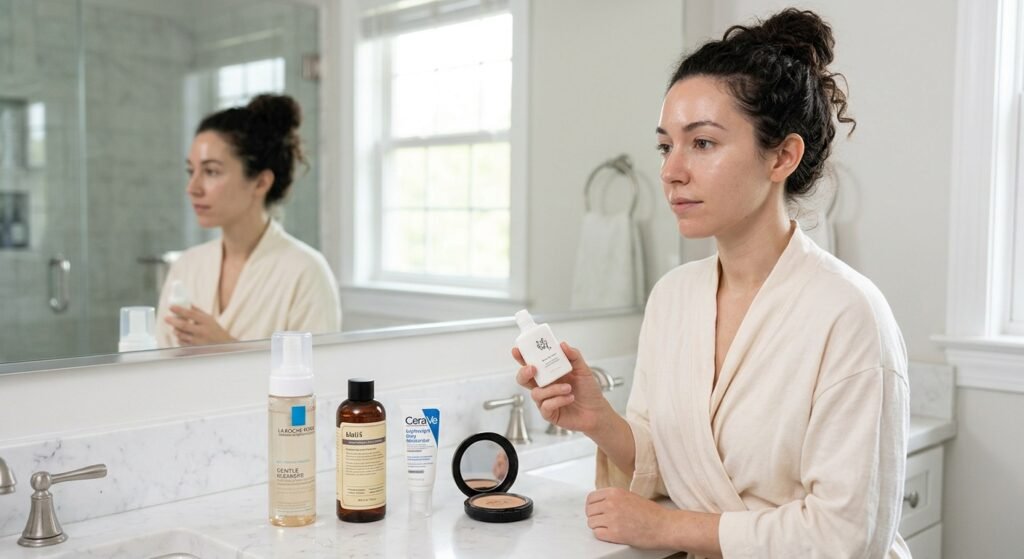
All three looks depend on skin prep more than most tutorials admit. Foundation sits on top of whatever texture and dryness is underneath, and it magnifies both.
A simple prep sequence:
- Cleanse gently. Stripped skin gets tight, then flaky under makeup.
- Hydrate. A lightweight toner, essence, or serum helps most skin types, including oily skin.
- Moisturize lightly. Use less than you think. Too much cream makes base slide around.
- Apply sunscreen. Let it set for a few minutes before makeup.
- Add primer only if you need it. Hydrating primer suits dry patches, pore-blurring primer suits visible texture, and nothing at all suits skin that is already cooperating.
Common mistake: layering foundation over skin that still feels damp or tacky. Wait a couple of minutes between steps so products settle instead of pilling or balling up.
Prep by skin type:
- Dry skin: Add an extra hydrating layer and consider a richer moisturizer. Press products in rather than rubbing.
- Oily skin: Choose lightweight gel textures and apply moisturizer only where you need it. Blot excess before foundation.
- Combination skin: Treat zones separately. Hydrate the cheeks and use lighter products on the forehead and nose.
- Sensitive skin: Keep the routine short, check ingredient lists, and patch test new products on the jawline or behind the ear before using them on your whole face.
A note on sunscreen under makeup
Many K-beauty and J-beauty routines treat sunscreen as the most important skincare step, and the base layer is built around it. Lightweight essence-style and gel-style sunscreens from Korean and Japanese brands are popular for this reason because they tend to feel thin enough to wear under foundation. Biore UV Aqua Rich Watery Essence and Beauty of Joseon Relief Sun are two widely known examples. Formulas, SPF levels, and available versions can differ by region and seller, so read the current listing and the label before buying. Sunscreen is a skincare product, so check the ingredients if you have sensitive skin.
K-Beauty Foundation Look: Glass Skin and Cushion Bases
What defines it
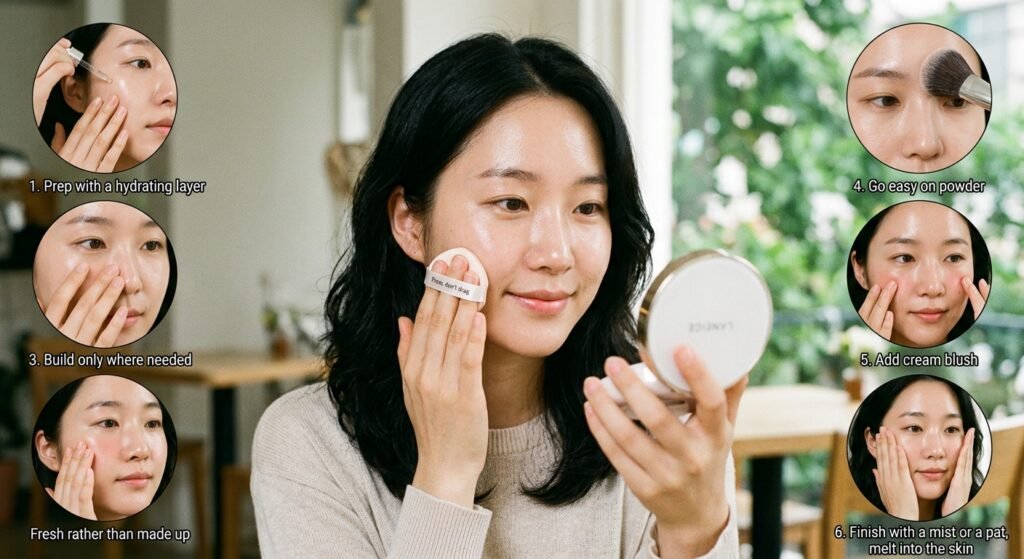
K-beauty bases aim for a healthy, hydrated glow. Coverage is usually light to medium and built in thin layers. The skin should look like skin, with a slight sheen across the cheeks, nose bridge, and forehead. Texture isn’t erased so much as softened, and the overall effect is fresh rather than made up.
The key product: the cushion compact
Cushion foundations hold liquid foundation in a sponge-soaked compact and are applied with a puff. The format delivers thin, even coverage and makes layering easy. Many cushions also include SPF, but check the packaging, because the SPF level is often modest and most people apply less foundation than is needed to reach the labeled protection. Don’t count on a cushion as your only sun protection.
How to recreate it
- Prep with a hydrating layer. Dewy bases look best on skin that is already moisturized.
- Press, don’t drag. Pat the cushion onto the center of the face, then press outward toward the hairline.
- Build only where needed. Add a second thin layer around the nose, on redness, and over blemishes.
- Go easy on powder. If you need to set, dust lightly across the T-zone only.
- Add cream blush. A little cream blush on the apples of the cheeks creates the “flushed from within” effect that defines the look.
- Finish with a mist or a pat. Lightly pressing a clean hand over the face helps the base melt into the skin.
Realistic use case
You’re heading to a casual lunch and want your skin to look healthy without looking made up. A hydrating cushion, a cream blush, and a tinted lip balm is enough. The base takes about five minutes and travels easily if you need a touch-up.
Product options to consider
Cushion foundation (Clio Kill Cover Founwear Cushion, Laneige Neo Cushion, or similar)
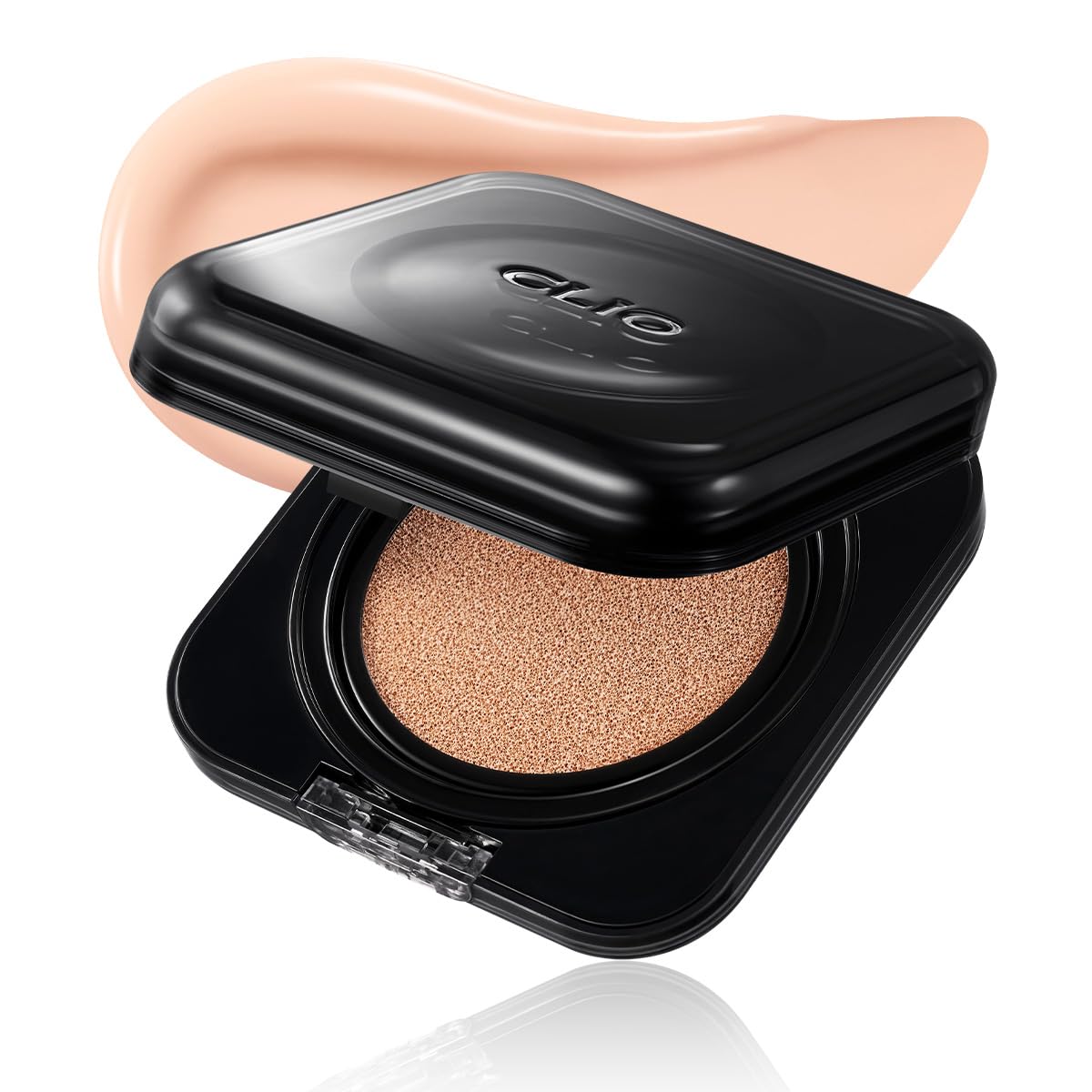
Best For: People who want a natural-looking K-beauty base with simple application.
Why Consider It: The format is beginner-friendly and travel-friendly, and thin layers can look skin-like. These brands are widely known in K-beauty, though Amazon listings, sellers, and shade availability can vary, so check the current listing.
Pros:
- Quick, low-mess application
- Easy to build lightly or heavily
- Portable for touch-ups
Cons:
- Shade ranges can be narrower than some Western brands, so check the shade chart carefully
- Puffs need regular washing, and refills add to the long-term cost
- Dewy formulas may not hold up on very oily skin without setting
What to Consider Before Buying: Compare the shade range to your undertone, and check whether the cushion is a hydrating or a matte formula, since different lines within one brand can finish very differently. Confirm that the listing comes from the brand or an authorized seller, because cushions are a common target for imitations.
Verdict for This Specific Use: A good starting point if you want glass skin without a complicated routine. If you need full-coverage matte wear, a different base type may suit you better.
[Check the current Amazon listing → affiliate link]
Makeup sponge or extra cushion puffs (generic category)

Best For: Anyone who wears cushions regularly or wants a smoother finish than the included puff gives.
Why Consider It: Applicator choice affects the finish as much as the foundation does. A damp sponge can make a medium-coverage base look more skin-like, and spare puffs let you rotate clean ones.
Pros:
- Improves blending
- Easy to keep hygienic when you have spares
- Inexpensive compared to most foundations
Cons:
- Sponges absorb product, so they use more foundation
- Need regular washing and replacement
What to Consider Before Buying: Check that replacement puffs match your cushion’s size and shape, since not every puff fits every compact. If you’re sensitive to latex, check the material before buying.
Verdict for This Specific Use: Worth buying if you already like the look but struggle with patchiness or want to cut down on product waste.
[Check the current Amazon listing → affiliate link]
J-Beauty Foundation Look: Soft, Even, and Refined

What defines it
J-beauty bases lean toward skin that looks smooth, soft, and uniform. Rather than glow, the goal is clarity: gentle redness correction, blurred texture, and a velvety finish. The effect is less “I’m glowing” and more “my skin looks calm and well cared for.” Sun protection is often built into the base layer, because many Japanese skincare and makeup brands put heavy emphasis on UV care.
The key products: UV foundation and finishing powder
A liquid or cream UV foundation provides light, comfortable coverage. A translucent finishing powder sets it and creates the soft-focus finish the look is known for.
How to recreate it
- Apply a thin layer of foundation with a sponge or fingers, working from the center outward.
- Conceal selectively. Use concealer only where you need it, such as under the eyes and around the nose.
- Set the T-zone and any areas that tend to crease, using a soft brush.
- Leave the cheekbones lightly set. Keeping a bit of skin visible stops the face from looking flat.
- Add soft color. A pink or peach blush and a subtle highlight finish the look without overpowering it.
- Keep the brows and lips soft. The J-beauty look is balanced, so heavy brows or lips can pull focus from the base.
Realistic use case
Your skin runs shiny by early afternoon and you want a work-friendly base that doesn’t look heavy. A thin UV foundation, light concealer, and powder on only the T-zone gives you a calm, even finish that survives a desk day.
Product options to consider
Finishing powder (Canmake Marshmallow Finish Powder or similar)

Best For: Oily and combination skin, or anyone who wants a soft blur without heavy coverage.
Why Consider It: It’s a well-known J-beauty drugstore product and a low-cost way to get the soft-matte finish.
Pros:
- Affordable category
- Softens shine without a thick makeup look
- Pairs well with thin foundations
Cons:
- Powder can emphasize dry patches on dry or mature skin
- Does not replace foundation coverage
- Details like scent and finish can vary by version, so check the listing
What to Consider Before Buying: If you’re sensitive to fragrance, check the ingredient list. Apply sparingly, since too much powder is the fastest way to a heavy-looking base.
Verdict for This Specific Use: Suits readers who already have a base they like but want the J-beauty soft finish. Dry-skin readers may do better with a light dusting, or none.
[Check the current Amazon listing → affiliate link]
UV foundation (Cezanne UV Foundation or similar)
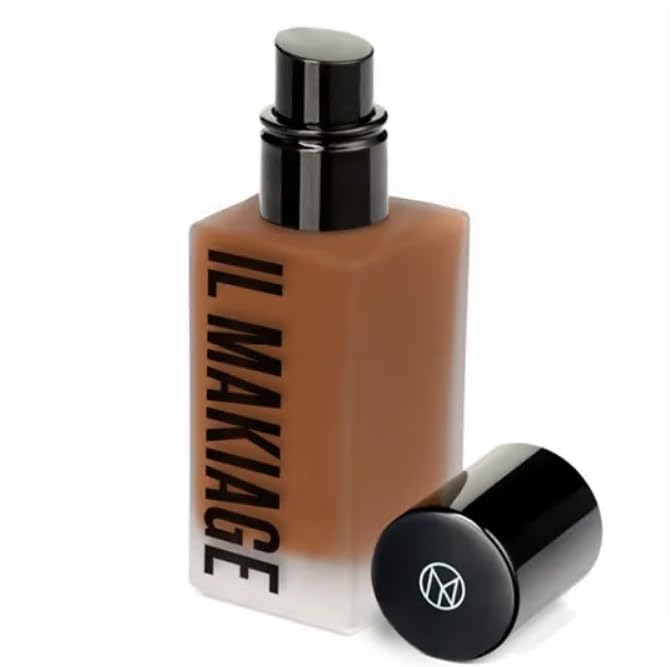
Best For: Everyday wear and people who like a light, practical base.
Why Consider It: The brand is known for budget-friendly Japanese makeup, and this style of foundation is built for daily wear.
Pros:
- Light coverage that looks natural
- Easy for beginners
- Often comes in simple, easy-to-choose shade ranges
Cons:
- Shade selection may be limited, especially for deeper skin tones
- Lighter coverage may not hide dark spots or acne scarring
- Don’t rely on the listed SPF alone for full sun protection
What to Consider Before Buying: Check the SPF label and shade information on the current listing, and reapply sunscreen separately if you’ll be outdoors for long periods.
Verdict for This Specific Use: A practical choice for a natural everyday base. If you need more coverage, consider pairing it with a concealer.
[Check the current Amazon listing → affiliate link]
Oil-blotting papers (category)

Best For: Oily or combination skin that gets shiny midday.
Why Consider It: Blotting lifts surface oil without disturbing the base the way reapplying powder can. This matters for J-beauty looks, where too many powder layers throughout the day can build up and look cakey.
Pros:
- Inexpensive and portable
- No added product on the skin
- Helps a soft-matte base last longer
Cons:
- Only manages shine, not texture or coverage
- Pressing too hard can shift the makeup underneath
What to Consider Before Buying: Check whether the papers are scented or contain added ingredients if you have sensitive skin. Press gently rather than wiping.
Verdict for This Specific Use: A low-cost add-on for oily-skin readers who want the soft finish to last all day.
[Check the current Amazon listing → affiliate link]
Douyin Foundation Look: Bright, Sculpted, Camera-Ready
What defines it
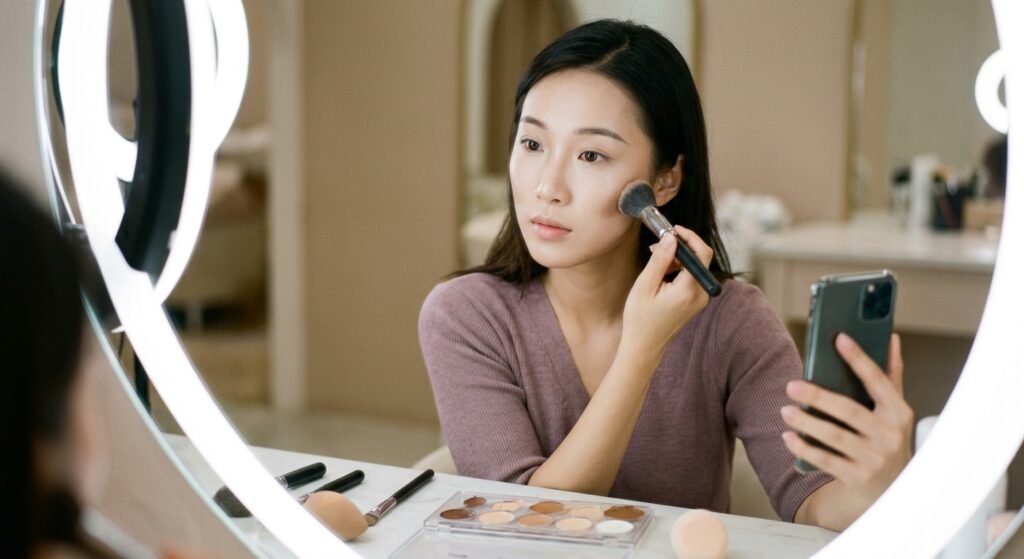
Douyin makeup, inspired by Chinese short-video beauty trends, is typically more glamorous and polished than K-beauty or J-beauty. The base is bright and even, with strategic highlight and contour. Skin often looks airbrushed, a bit luminous, and more deliberately finished. Because the style is designed for video and filters, it tends to use more defined placement of light and shadow than the other two looks.
Techniques that define it
- Thin, even base with medium coverage
- Brightening concealer under the eyes and on the center of the face
- Soft contour and highlight to create dimension
- Layered setting: powder in some areas, glow in others
- Coordinated color: blush, contour, and eye makeup that tie into the same soft palette
How to recreate it
- Apply a medium-coverage foundation in thin layers. Two thin layers look better than one thick one.
- Add concealer one shade lighter than your skin, but not drastically lighter, to avoid a gray or ashy cast.
- Contour with a soft, cool-toned shade along the hollows of the cheeks and the sides of the nose. Blend until no edge is visible.
- Highlight the high points (cheekbones, nose bridge, cupid’s bow) with a subtle liquid or cream highlighter.
- Set selectively. A bit of powder under the eyes and around the nose, glow on the cheekbones.
- Check in different light. Douyin looks are designed for camera lighting, so a base that looks flawless indoors may look heavy in daylight. Take a quick look by a window before leaving.
Realistic use case
You’re filming a video, going to an evening event, or taking photos where you want your face to hold up under strong lighting. The extra coverage and defined placement of highlight and contour read well on camera, though the same look may feel heavy for a casual daytime outing.
Product options to consider
Higher-coverage cushion or long-wear foundation (Hera Black Cushion, Missha Magic Cushion, or similar)

Best For: People who want fuller coverage with a polished finish.
Why Consider It: Higher-coverage cushions suit the Douyin look better than ultra-sheer bases, because they even out tone without needing a thick layer of liquid foundation.
Pros:
- More coverage, helpful for redness or uneven tone
- Longer wear than sheer formulas in many cases
- Built-in puff for easy application
Cons:
- Can look heavy if layered too thickly
- Higher-coverage formulas may feel less comfortable on dry skin
- Premium options may cost more than drugstore alternatives
What to Consider Before Buying: Pay attention to undertone and oxidation, since foundation can look darker after a few hours on some skin types. Patch test, especially if you have sensitive or acne-prone skin.
Verdict for This Specific Use: Good for readers who prefer a polished, glam finish. If you favor a barely-there look, a lighter K-beauty or J-beauty base will suit you better.
[Check the current Amazon listing → affiliate link]
Contour and highlight (cream or liquid, category)

Best For: Readers who want the sculpted dimension that separates Douyin from the other two looks.
Why Consider It: Cream and liquid formulas blend into a base more naturally than heavy powders, which suits the airbrushed finish.
Pros:
- Blends easily into foundation
- Adjustable intensity
- Often available in compact, travel-friendly formats
Cons:
- Can look streaky if applied over too much powder
- Shade matching matters, because a contour that’s too warm or too dark looks muddy
What to Consider Before Buying: Choose a contour shade slightly cooler than your skin tone, and check swatches in reviews for people with a similar skin tone.
Verdict for This Specific Use: Worth adding once you’re comfortable with the base, because the sculpting is what completes the look.
[Check the current Amazon listing → affiliate link]
Product Comparison Table
| Product Type | Best For | Key Feature | Main Advantage | Potential Drawback |
|---|---|---|---|---|
| Hydrating cushion (K-beauty) | Natural, glowy looks | Thin, dewy layers | Beginner-friendly and portable | Shade range may be limited; may need setting on oily skin |
| Makeup sponge or spare puffs | Smoother blending | Improved finish and hygiene | Low cost and easy upgrade | Absorbs product; needs washing |
| Finishing powder (J-beauty) | Oily or combination skin | Soft-focus finish | Affordable and blurs shine | Can emphasize dryness |
| UV foundation (J-beauty) | Everyday wear | Light, natural coverage | Practical and simple | May not cover dark spots |
| Oil-blotting papers | Midday shine control | Removes oil without adding product | Keeps soft-matte base fresh | Only manages shine |
| Higher-coverage cushion (Douyin) | Polished, glam looks | Medium-to-full coverage | Evens tone and lasts longer | Can feel heavier |
| Cream contour and highlight | Sculpted dimension | Blendable placement of light and shadow | Natural-looking definition | Needs careful shade matching |
Check each current Amazon listing for shade options, ingredients, and size before buying.
Finding Your Shade and Undertone
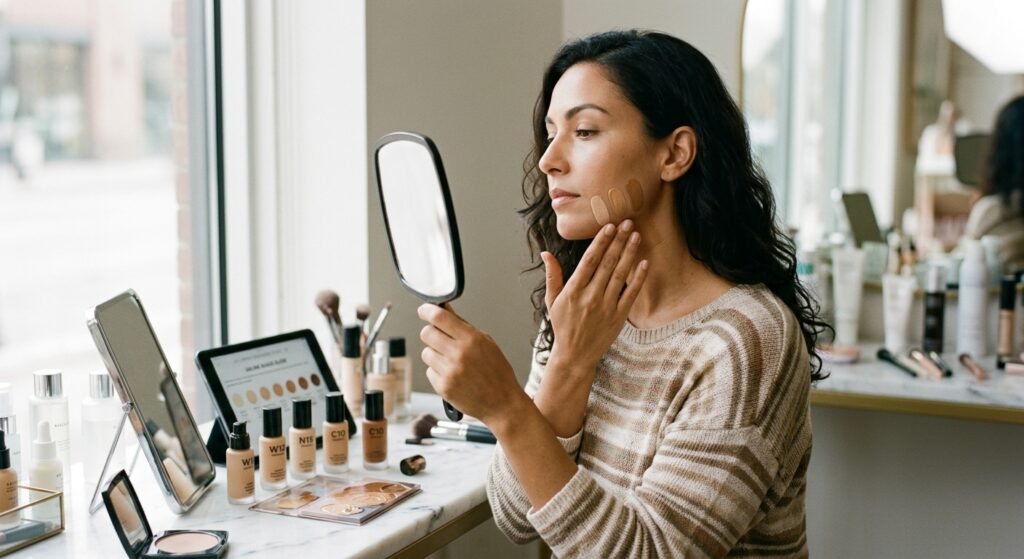
Shade matching deserves its own section because it’s the biggest reason people feel disappointed after buying imported base makeup. Many Korean and Japanese brands develop shades primarily for their home markets, and the range of options can be narrower than what you’d find in some Western brands.
How to choose more carefully:
- Test along the jawline in natural light, not on the back of your hand. Check it again in a different light if possible.
- Identify your undertone. Warm undertones lean yellow or golden, cool undertones lean pink or red, and neutral undertones sit between them. Brands label these differently (numbers, letters, or words), so read the brand’s own shade guide.
- Read shade-specific reviews from people with a similar skin tone, and look for photos in natural light.
- Expect some shade drift. Foundation can oxidize and look slightly deeper after a few hours, so if you’re between two shades, consider the lighter one and adjust with bronzer or contour.
- Consider mixing. A lighter and a deeper shade can be blended for a custom match, and this works especially well with cream and liquid formulas.
For deeper skin tones: Shade availability is a real limitation with many K-beauty and J-beauty brands, though some have expanded their ranges. Check every listing for the specific shades offered, and consider brands that explicitly list deeper shades. If a cushion line doesn’t have a match, you can still recreate these looks with any foundation that has the right finish and shade. The techniques matter more than the brand.
Which Look Should You Choose?
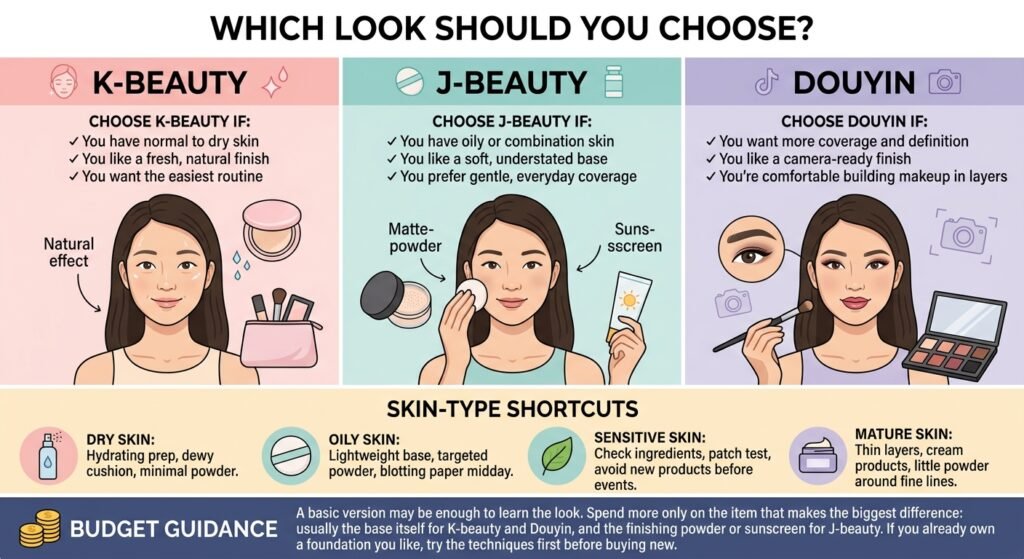
Choose K-beauty if:
- You have normal to dry skin
- You like a fresh, natural finish
- You want the easiest routine
Choose J-beauty if:
- You have oily or combination skin
- You like a soft, understated base
- You prefer gentle, everyday coverage
Choose Douyin if:
- You want more coverage and definition
- You like a camera-ready finish
- You’re comfortable building makeup in layers
Skin-type shortcuts:
- Dry skin: Hydrating prep, a dewy cushion, minimal powder.
- Oily skin: Lightweight base, targeted powder, blotting paper midday.
- Sensitive skin: Check ingredients, patch test, and avoid trying new products before an important event.
- Mature skin: Thin layers, cream products, and little powder around fine lines.
Budget guidance: A basic version of each product category may be enough to learn the look. Spend more only on the item that makes the biggest difference to your finish: usually the base itself for K-beauty and Douyin, and the finishing powder or sunscreen for J-beauty. If you already own a foundation you like, try the techniques first before buying a new one.
Common Mistakes With Asian Foundation Looks
- Matching the shade to your face instead of your neck. Test along the jawline in natural light.
- Ignoring undertone. Many brands have limited shade ranges, so compare swatches and check whether the brand offers neutral, warm, and cool options.
- Using too much product. All three looks work because the base is thin.
- Wearing a dewy base on very oily skin without setting. Target powder where you need it.
- Powdering everywhere. Over-powdering flattens the face and settles into texture.
- Skipping puff and sponge hygiene. Dirty applicators can contribute to breakouts and uneven application.
- Buying from unverified sellers. Cushions and imported makeup are often counterfeited, so buy from the brand or an authorized seller when possible.
- Skipping skin prep. Even an excellent foundation will look patchy over dry flakes or leftover product.
- Choosing a look that doesn’t match your day. A heavily sculpted Douyin base can feel out of place in daylight, while a sheer glass-skin base may not hold up on camera.
Quick Checklist: Before You Buy
- Does the shade range include your undertone?
- Is the finish dewy, soft matte, or full glam?
- Does the product suit your skin type?
- Is the seller authorized?
- Have you checked the ingredients for fragrance or other irritants?
- Do you already own a similar product?
- Have you planned how to clean the puff or sponge?
FAQ
Can I do these looks on deeper skin tones?
Yes, but product selection is harder. Many Korean and Japanese brands offer limited shade ranges, so check each brand’s shade chart carefully. Some brands have expanded their ranges, but availability varies, so verify before buying. You can also recreate the finishes with any foundation that suits your skin tone, since the technique is what shapes the look.
Is cushion foundation good for acne-prone skin?
It can work, but the puff may carry bacteria if it isn’t cleaned regularly. Look at the ingredients, patch test, and wash applicators often. If your acne is persistent, a dermatologist can give advice suited to your skin.
Do I still need sunscreen if my cushion has SPF?
Most people apply too little foundation to reach the labeled SPF, so a separate sunscreen is generally the safer approach.
How do I stop a dewy base from looking greasy?
Use less moisturizer, place a light powder only on the T-zone, and use blotting paper instead of reapplying powder.
Which look is the most beginner-friendly?
The K-beauty cushion approach is usually the easiest to learn because the format is forgiving and the coverage is light.
Can I mix elements of the three looks?
Yes. Many people use a K-beauty hydrating base, J-beauty powder on the T-zone, and a touch of Douyin-style highlight. Treat the three styles as a toolbox rather than a rulebook.
Conclusion
K-beauty, J-beauty, and Douyin foundation looks differ in more than finish. They reflect different ideas of what polished skin looks like, and each calls for a different product type and technique. Glass skin rewards hydration and thin layers. Soft-matte J-beauty rewards restraint and careful setting. Douyin rewards placement, dimension, and a bit more coverage.
The key takeaways:
- Prep matters more than any single product.
- Thin layers are the common thread across all three looks.
- Match the finish to your skin type and your day, not just the trend.
- Check shade range, ingredients, and seller before buying.
- Keep your puffs and sponges clean.
Your next step: Pick the one look that fits your skin and lifestyle, then try it with a single product rather than buying a whole routine. Once you know what you like, you can add a powder, a contour, or a better sunscreen and build from there.